UCSB Computer Science Department

960 posts

UCSB Computer Science Department banner
UCSB Computer Science Department

UCSB Computer Science Department

@ucsbcs

Official account of UC Santa Barbara's Computer Science Department.

Santa Barbara, CA Katılım Nisan 2010
957 Takip Edilen2.3K Takipçiler
UCSB Computer Science Department retweetledi
Nina Miolane 🦋 @ninamiolane.bsky.social
🤩 Personalized ML is the engine of data-driven digital twins... ...but how does personalizing a model impact its accuracy and explainability, especially in low-data regimes?🧐 Find our paper w/ @louisacornelis @gbg1441 @HaewonJeong00 at #ICLR2026🇧🇷! @UCSBengineering @ucsbcs
Louisa Cornelis@louisacornelis

Super excited to announce that our paper, “When Machine Learning Gets Personal”, has been accepted to #ICLR2026! 🇧🇷 We propose a unified framework to reliably quantify how personalizing a model influences both prediction accuracy and explanation quality. arxiv.org/abs/2502.02786

English
0
3
10
1.1K
UCSB Computer Science Department
Reminder that today(March 9th) is our next CS Colloquium event in HFH 1132. The talk will also be streamed live via Zoom. Scan the QR code below to join! We hope you can attend!
UCSB Computer Science Department@ucsbcs

🚨 CS Colloquium this Monday! 📅 March 9 | ⏰ 3:30 PM | 📍 HFH 1132 🎙️ Speaker: Vasia Kalavri from @BU_Tweets 🖥️Title: Rethinking Streaming Dataflow Systems—exploring the future of disaggregated, adaptive, and resource-aware streaming engines. Scan QR below for live stream!

English
0
0
0
94
UCSB Computer Science Department
🚨 CS Colloquium this Monday! 📅 March 9 | ⏰ 3:30 PM | 📍 HFH 1132 🎙️ Speaker: Vasia Kalavri from @BU_Tweets 🖥️Title: Rethinking Streaming Dataflow Systems—exploring the future of disaggregated, adaptive, and resource-aware streaming engines. Scan QR below for live stream!
UCSB Computer Science Department tweet media
English
0
0
1
231
UCSB Computer Science Department retweetledi
Xin Eric Wang
Xin Eric Wang@xwang_lk·
Introducing 𝐆𝐫𝐨𝐮𝐩-𝐄𝐯𝐨𝐥𝐯𝐢𝐧𝐠 𝐀𝐠𝐞𝐧𝐭𝐬 (𝐆𝐄𝐀), a new paradigm for open-ended self-improvement in AI agents. The core shift is simple but radical: 👉 𝐭𝐡𝐞 𝐮𝐧𝐢𝐭 𝐨𝐟 𝐞𝐯𝐨𝐥𝐮𝐭𝐢𝐨𝐧 𝐢𝐬 𝐧𝐨 𝐥𝐨𝐧𝐠𝐞𝐫 𝐚 𝐬𝐢𝐧𝐠𝐥𝐞 𝐚𝐠𝐞𝐧𝐭, 𝐛𝐮𝐭 𝐚 𝐠𝐫𝐨𝐮𝐩 𝐨𝐟 𝐚𝐠𝐞𝐧𝐭𝐬. Why does this matter? To answer that, we need to rewind. Scientific breakthroughs share two core traits: open-endedness and cumulative progress. Exploration never truly ends, and crucially, discoveries don’t vanish: they accumulate, compound, and unlock future advances. AI progress should work the same way. But today, it mostly doesn’t. Most AI systems are built on fixed, human-designed architectures. They can train. They can optimize. They can accumulate experience. But they rarely escape the structural limits imposed at design time. They cannot meaningfully reconfigure themselves, so progress remains bottlenecked by continuous human intervention. To fix this, researchers turned to open-ended self-improving systems, often inspired by biological evolution. The dominant pattern looks like this: - select one parent agent - refine it - produce offspring - repeat Evolution unfolds as a chain or tree. This sounds powerful, and it is good at generating diversity. But there’s a hidden flaw. Those evolutionary branches are isolated. Agents explore independently, discoveries stay local, and most variants are short-lived. They add novelty, but rarely become stepping stones for long-term progress. Exploration happens. Accumulation doesn’t. This leads to an uncomfortable question: Why are we forcing AI agents to evolve like biological individuals? AI agents aren’t constrained by reproduction, lineage, or genetics. They can directly share: - trajectories - tools - workflows - learned artifacts They can aggregate complementary skills instantly. So why not design evolution around that? This is where Group-Evolving Agents (GEA) comes in. GEA rethinks evolution from the ground up by treating a group of agents as the fundamental evolving entity. Not a single parent. Not isolated branches. A collaborative, experience-sharing group. Here’s how GEA works at a high level: 1️⃣ Parent Group Selection At each iteration, GEA selects a parent group using a Performance–Novelty criterion — balancing strong performance with exploratory diversity. 2️⃣ Experience Aggregation Instead of isolating agents, all members contribute their experiences into a shared pool. 3️⃣ Group Reproduction Using this pooled experience, the parent group jointly produces a child group. Exploration is no longer wasted — it’s consolidated. This one change fixes a core failure mode of prior systems. In classic tree-structured evolution: - diversity explodes - but useful discoveries die on isolated branches In GEA: - diversity is explicitly reused - progress becomes cumulative - improvements persist across generations When evaluated on challenging coding benchmarks, the impact is clear: - 71.0% success on SWE-bench Verified - 88.3% on Polyglot - This significantly outperforms prior SOTA self-evolving methods (56.7% and 68.3%). But the more interesting part is why. Analysis shows GEA: - consolidates exploratory diversity instead of losing it - achieves stronger performance with the same number of agents - is more robust to framework-level perturbations - improves workflows and tools rather than overfitting to a specific model These gains transfer consistently across GPT- and Claude-series models. GEA performs meta-learning-based self-improvement with no human intervention. And yet it: - matches human-designed SOTA on SWE-bench Verified (years of efforts from our top AI researchers) - vastly surpasses it on Polyglot All through open-ended, group-level evolution. The takeaway: Open-ended progress doesn’t fail because exploration is hard. It fails because discoveries don’t accumulate. By evolving groups instead of individuals, and enabling explicit experience sharing, GEA turns exploration into something that finally compounds. That’s the promise of Group-Evolving Agents.
Xin Eric Wang tweet media
English
28
105
466
42.8K
UCSB Computer Science Department
We are spotlighting Greta Carl-Halle, Business Officer for UCSB Computer Science, who was recently recognized by, Influential Women! ✨ Congratulations, Greta—thank you for your nearly 33 years of dedication to UCSB and the UC community! 👏 Read more: influentialwomen.com/connect/greta-…
UCSB Computer Science Department tweet media
English
0
0
0
122
UCSB Computer Science Department retweetledi
Nina Miolane 🦋 @ninamiolane.bsky.social
🏆Massive news: #UCSB ranks #1 in scientific impact among public universities (#3 overall)! @ucsantabarbara @UCSBengineering @ucsbcs @ucsbece
Nina Miolane 🦋 @ninamiolane.bsky.social tweet media
UCSB ECE@ucsbece

🏆UCSB ranked #1 public university in the US for scientific impact, and 3rd in universities overall!🎓 Congratulations to all of our researchers who are leading the global conversation.🌐🧵 @ucsantabarbara @UCSBengineering @UofCalifornia

English
1
4
25
2.4K
UCSB Computer Science Department
Congratulations to Associate Professor Prabhanjan Ananth on receiving a grant from the National Science Foundation for his research in quantum cryptography! We’re proud to see our faculty advancing the future of secure computing. Read More: cs.ucsb.edu/happenings/ann…
UCSB Computer Science Department tweet media
English
0
0
2
138
UCSB Computer Science Department
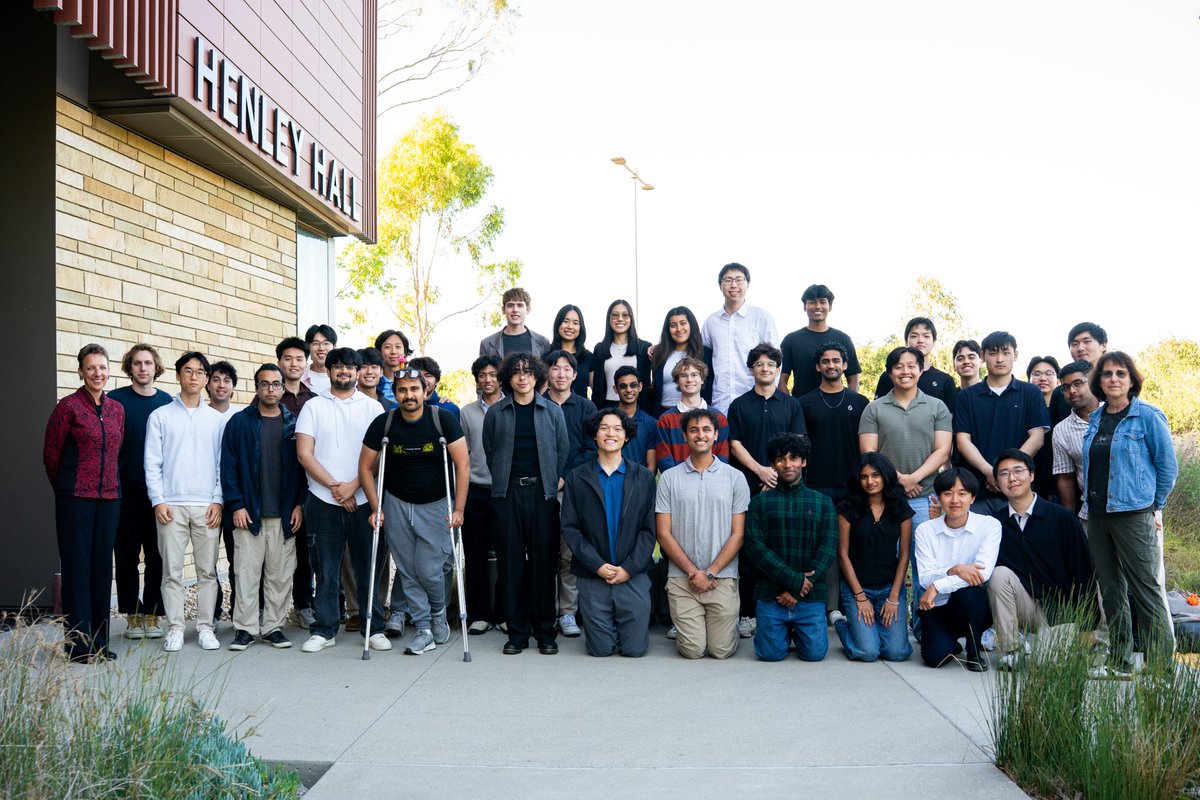
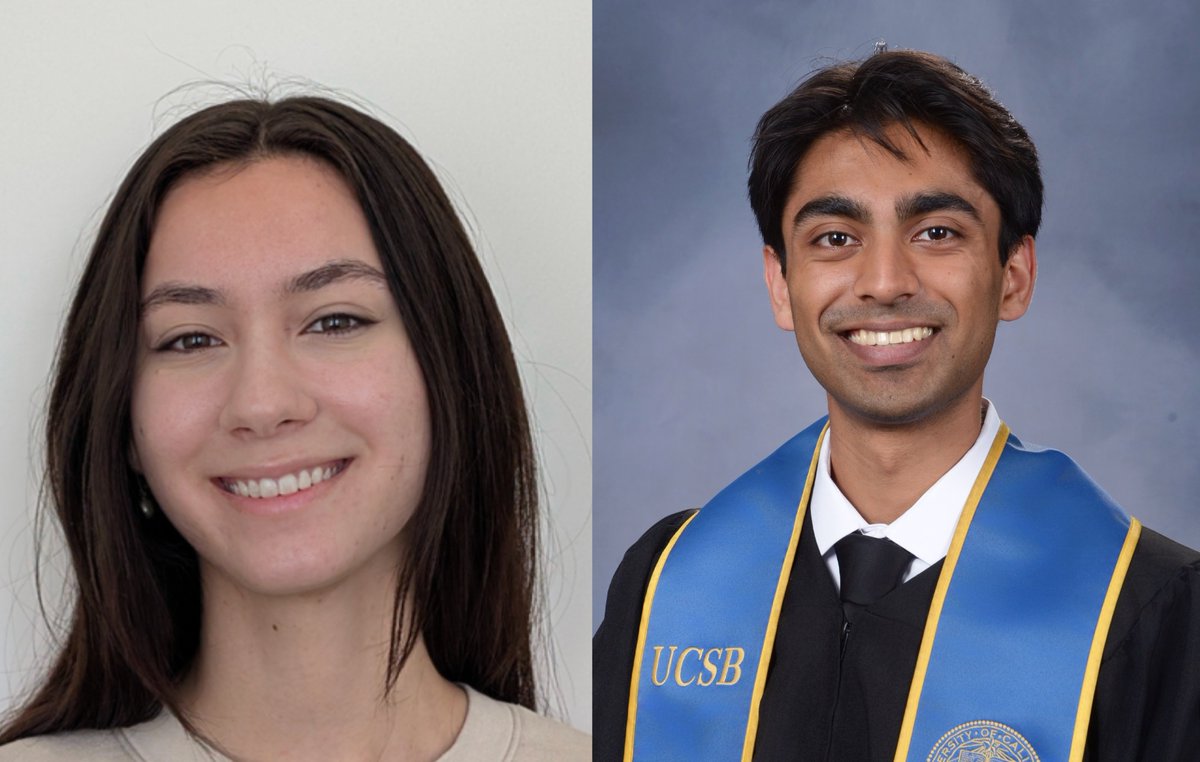
UCSB CS alum Lucas Bang (PhD ’18) receives the 2026 CRA Undergraduate Research Faculty Mentoring Award. Now at Harvey Mudd College, he has mentored 65+ undergraduates in student-led research. Read more: cs.ucsb.edu/happenings/ann… Photos Credit: © 2026 Harvey Mudd College
UCSB Computer Science Department tweet mediaUCSB Computer Science Department tweet media
English
0
1
1
163
UCSB Computer Science Department retweetledi
The Robert Mehrabian College of Engineering
Michael Beyeler, an assistant professor of @ucsbcs and @UCSBpsych, is the 2024-’25 recipient of the highly regarded Harold J. Plous Memorial Award. The UCSB selection committee recognized him for his outstanding contributions in research, teaching, and service.👏🔬
The Robert Mehrabian College of Engineering tweet media
English
2
1
7
570
UCSB Computer Science Department retweetledi
Xin Eric Wang
Xin Eric Wang@xwang_lk·
Life update: Excited to announce that I’ll be joining UCSB CS (@ucsbcs) as an Assistant Professor in Fall 2025—where my research dream began! If you’re interested in PhD research (3+ openings) on multimodal, GenAI, or agents (embodied/digital), apply to UCSB CS by Dec 15! 1/n
Xin Eric Wang tweet media
English
53
24
482
97.9K
UCSB Computer Science Department retweetledi
UC Santa Barbara
UC Santa Barbara@ucsantabarbara·
A new study finds a federal subsidy program to provide broadband to rural areas largely failed, leaving many communities with inadequate service. According to @ucsbcs researchers, only 55% of addresses received service and only 33% met speed requirements. ow.ly/yMxp50Twxz8
English
0
1
7
1.3K