Ulrik Lyngs

530 posts

Ulrik Lyngs banner
Ulrik Lyngs

Ulrik Lyngs

@ulyngs

Computer scientist & cognitive psychologist. Postdoc @CompSciOxford and the Carlsberg Foundation. I play stuff in the https://t.co/QslmWQV2il

Oxford, England Katılım Mart 2014
282 Takip Edilen396 Takipçiler
Sabitlenmiş Tweet
Ulrik Lyngs
Ulrik Lyngs@ulyngs·
Thrilled to share the official version of my DPhil thesis "Ulysses in Cyberspace: Examining the Effectiveness of Design Patterns for Digital Self-Control"! 😁🎉 I explore how digital devices’ design can help us use them in line with longer-term goals. 🧵 ulyngs.github.io/phd-thesis/
Ulrik Lyngs tweet media
English
1
5
35
0
Ulrik Lyngs
Ulrik Lyngs@ulyngs·
Fortunately if we teach kids how the web works, we can give them simple & effective ways to protect themselves from nefarious designs -- e.g. with a few clicks you can get rid of anything on the web thanks to browser extensions (easy to build github.com/ulyngs/reddfoc…) Let's teach kids how to hack the digital world to work for them instead of telling them they're doomed
Jonathan Haidt@JonHaidt

In The Anxious Generation, I underestimated the harm from the phone-based childhood because I focused on the mental health outcomes, which is where we had the best data while I was writing the book. I now believe that the widespread diminishment of the human capacity to pay attention is an even larger harm, affecting the majority of children, and even many adults. Diminished focus, executive function, and book-reading means diminished life chances.

English
0
0
1
31
Ulrik Lyngs
Ulrik Lyngs@ulyngs·
Yay, we built a new open-source tool at the Reduce Digital Distraction Project, check it out: reddfocus.org/reddtodo It's the fix I've always wanted for not forgetting what I meant to do when opening my inbox
English
0
1
1
72
Ulrik Lyngs retweetledi
David Perell
David Perell@david_perell·
Jony Ive once said: "Who here would actually want to spend time in a conference room? I can’t think of a more soulless and depressing place.” In their heyday, Apple’s design team used to meet in a team member’s living room once per week. Looking back on it, I swear you can feel the fruits of that ritual in the products Apple released. Think of the click-wheel on the original iPod, the sleek futurism of the original iPhone, or the theatrical elegance of opening up a new MacBook. I doubt that joy could’ve been dreamed up from under the fluorescent lighting of a sleek corporate boardroom. We know our spaces shape our thinking, but our actions betray this obvious truth. It’s a strange feature of our modern world that we doubt the mind-body connection between the spaces we inhabit and the thoughts we produce in those spaces. Take churches. We once built grand cathedrals with vaulted ceilings where light and sound reverberated in ways that awakened a divine connection with us. Now we build square boxes in strip malls. The ornamentation is gone. At some churches, you won’t even find a cross on the walls. Stained glass windows, too, have been replaced with LED screens of the sort you’d see at Coachella. Sometimes I wonder if God is dead because we killed him with bad architecture.
The Cultural Tutor@culturaltutor

I’ve made a short film. Look at the things around you: doors, bins, staircases, furniture, railings, doorhandles, windows. Do you like how they look, or not? Modern design has become boring, but it doesn’t have to be this way. The word “beautiful” is overused. We don’t need “beautiful” lamps, bus stops, and water fountains – we just need lamps, bus stops, and water fountains that are interesting, that actually mean something. Or, at the very least, not boring. Because the aesthetics of architecture and urban design aren’t just a bonus; they totally change how we think, feel, and behave. Boring environments make us more stressed and less productive; they erode our sense of community; they make us sadder, less trusting, and lonelier. A boring world is one where we spend even more time online and where our addictions are even harder to battle. The Problem There is global, widespread dissatisfaction with how the world looks. In this film, and the series it will lead to, we want to investigate that feeling and give it a voice. The point isn’t that we should return to the past or get rid of modernism. It’s about learning from the past in order to improve the present, and about giving the public what they very clearly want, which isn’t the eradication of modernism but the co-existence of modernism AND traditionalism. Just look where tourists go, where they take their photos, and that tells you everything you need to know about what most people find interesting or beautiful. And look at where people go on holiday. It’s always to cities filled with old architecture and design, with churches and mosques and palaces, with charming little alleyways and stone staircases and wrought-iron railings. Of the world’s fifty most visited buildings, only four were made in the 20th century, and they’re all museums or memorials. There’s a reason why posts about this go viral online all the time. Regardless of why the change happened, it is clearly the case that we no longer make things how we used to. People are rightly confused by the fact that old lamp posts (to take the example we focus on in the film) are usually so pretty, while modern ones are usually so boring. Some people say this is just an example of survivorship bias… and they’re mostly correct. But that’s the whole point! Saying old buildings are usually prettier than modern buildings is not to say that architecture used to be better, or that the past was better. It is simply to say that certain kinds of buildings, because they have been preserved, are good examples of what people like most. In which case... shouldn't we try to design at least some buildings in a way that we know people like? A Unifying Cause Everybody, from all sides of the political spectrum and all backgrounds, stands to benefit from a world that is designed more thoughtfully and imaginatively. The world could be such a colourful, meaningful, and thrilling place! So this isn’t about left versus right or conservatism versus progressivism; it’s about making our world a more interesting and meaningful place to live in. This should be a unifying cause, because everybody loses out when our homes and cities are badly designed. I want this film to unite people who think they’re on opposite sides, and to create a consensus that we need to change our approach to how we design our buildings and the objects – benches, bus stops, bins, lamp posts, aircon units – that fill our cities. The Importance of Details We are incredibly rich and have a sprawling choice of shows to stream, phones to buy, or shoes to wear… but everything feels more and more generic all the time. If you want to understand a society, don’t listen to what it says about itself – look at what it creates. You can learn everything about the Victorians – the good and the bad – just by looking at their lamp posts. And what do the ordinary details of the modern world say about us? That we are technologically advanced, very efficient… and care more about making money, about making things as quickly and cheaply as possible, than making our world an enjoyable place to actually live in. It’s important to learn about why and how things have changed, but that’s for another time. The first step is establishing that the public aren’t happy with modern architecture and design, and that something needs to be done. But what we need isn’t a total revival of so-called ‘traditionalism’; the truth is that traditionalism and modernism can (and should) co-exist. The trouble right now is that we only have one, and that people are tired of it. The Power of Noticing But this film (and the series it will, all being well, lead to) is about more than the specific argument it presents. Above all it’s about a way of seeing the world around us, a way of noticing and thinking. “How you do anything is how you do everything.” That is probably true, and it also applies to whole societies, not just individuals; a single doorbell implies everything else about the whole socio-economic and political system that gave rise to its creation. And, beyond being merely “useful”, the ability to notice details makes the world a richer place to live in, and life a richer thing to lead. This is what the film is about, more than anything: the power and joy of noticing. A Bigger Project This short film is just the beginning. We want to make a full series about the history of art and architecture, both for their own sake and also to see what we can learn about life in the twenty-first century and how to improve it. To keep updated you can join our email list over at our website, linked in the reply below. Final Words You can watch the film here on X, or over on YouTube, also linked in the reply below. So… this is where the dream begins, the dream of a new series and the dream of a more charming, more interesting, more meaningful modern world. Spread the word.

English
64
139
1.9K
311.3K
Ulrik Lyngs retweetledi
Andrej Karpathy
Andrej Karpathy@karpathy·
Very impressed with Veo 3 and all the things people are finding on r/aivideo etc. Makes a big difference qualitatively when you add audio. There are a few macro aspects to video generation that may not be fully appreciated: 1. Video is the highest bandwidth input to brain. Not just for entertainment but also for work/learning - think diagrams, charts, animations, etc. 2. Video is the most easy/fun. The average person doesn't like reading/writing, it's very effortful. Anyone can (and wants to) engage with video. 3. The barrier to creating videos is -> 0. 4. For the first time, video is directly optimizable. I have to emphasize/explain the gravity of (4) a bit more. Until now, video has been all about indexing, ranking and serving a finite set of candidates that are (expensively) created by humans. If you are TikTok and you want to keep the attention of a person, the name of the game is to get creators to make videos, and then figure out which video to serve to which person. Collectively, the system of "human creators learning what people like and then ranking algorithms learning how to best show a video to a person" is a very, very poor optimizer. Ok, people are already addicted to TikTok so clearly it's pretty decent, but it's imo nowhere near what is possible in principle. The videos coming from Veo 3 and friends are the output of a neural network. This is a differentiable process. So you can now take arbitrary objectives, and crush them with gradient descent. I expect that this optimizer will turn out to be significantly, significantly more powerful than what we've seen so far. Even just the iterative, discrete process of optimizing prompts alone via both humans or AIs (and leaving parameters unchanged) may be a strong enough optimizer. So now we can take e.g. engagement (or pupil dilations or etc.) and optimize generated videos directly against that. Or we take ad click conversion and directly optimize against that. Why index a finite set of videos when you can generate them infinitely and optimize them directly. I think video has the potential to be an incredible surface for AI -> human communication, future AI GUIs etc. Think about how much easier it is to grok something from a really great diagram or an animation instead of a wall of text. And an incredible medium for human creativity. But this native, high bandwidth medium is also becoming directly optimizable. Imo, TikTok is nothing compared to what is possible. And I'm not so sure that we will like what "optimal" looks like.
Gina Acosta@ginacostag_

It's been only a day since Google dropped Veo 3. The new model creates video and audio simultaneously from a single prompt! Here are 13 wild examples so far: 1. Self-aware AI characters

English
305
696
6.2K
1M
Ulrik Lyngs retweetledi
Daniël Lakens
Daniël Lakens@lakens·
Finally got around to incorporating all Github feedback on my open access textbook, making around 20 minor improvements, and updating some references. 17 chapters of state of the art stats and methods education, freely available for any course you teach. lakens.github.io/statistical_in…
Daniël Lakens tweet media
English
5
102
407
21.9K
Ulrik Lyngs
Ulrik Lyngs@ulyngs·
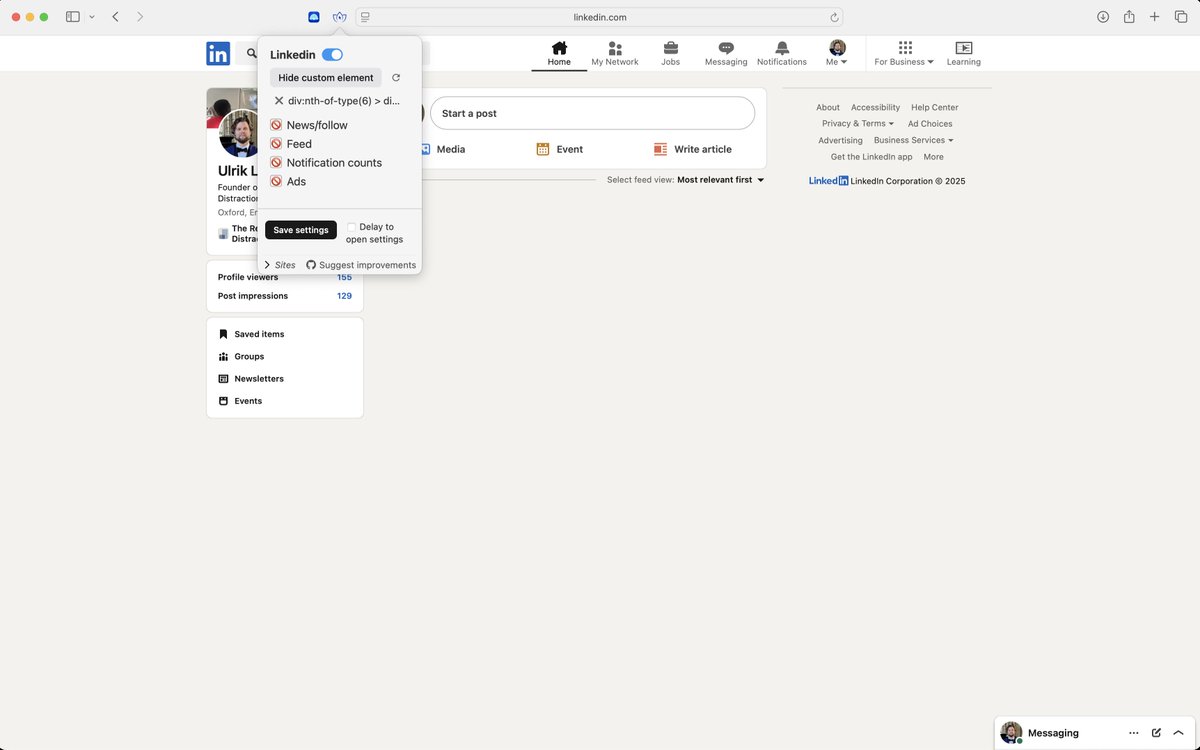
Excited that the ReDD Project's open-source tool for hiding online distractions is now available for all browsers (Safari, Firefox, Chrome, ...): redd-project.org/mindshield 🥳 It can e.g. hide YouTube's recommendations, Instagram's feed, or anything else on any website, really. 🤓
English
0
0
2
162
Ulrik Lyngs retweetledi
Carlsbergfondet
Carlsbergfondet@Carlsbergfondet·
At skabe gode digitale rum, der passer til den enkeltes behov, er lettere sagt end gjort. For hvad der fungerer for ét menneske, passer ikke nødvendigvis på andre. 👉 Læs om @ulyngs #dkforsk på området og få konkrete tips til, hvad du selv kan gøre bit.ly/3RKNbK7
Carlsbergfondet tweet media
Dansk
0
1
1
271
Ulrik Lyngs
Ulrik Lyngs@ulyngs·
The one place an infinitely scrolling feed would really make sense is in Google search results.
English
0
0
1
44
Ulrik Lyngs
Ulrik Lyngs@ulyngs·
@JonHaidt @ahc What's wrong with this solution: when you give this 'instant, effortless power' to kids, you also teach them how to organise that power? E.g., how to use blocking tools to decide when TikTok's available; how to customise websites to their needs etc. dl.acm.org/doi/10.1145/36…
English
0
0
1
83
Jonathan Haidt
Jonathan Haidt@JonHaidt·
Technology is like magic: it can give you "instant, effortless power." But when you give such power to kids, it undermines the effort needed to learn and grow into a "morally formed" adult. Andy Crouch @ahc lays out the problem, at AfterBabel.com afterbabel.com/p/where-the-ma…
English
24
116
553
45.7K
Ulrik Lyngs
Ulrik Lyngs@ulyngs·
Tried playing around with Grok and not impressed. Its main advantage is supposedly that its real-time access to twitter makes it more accurate. Instead it just confidently makes up non-existing tweets:
Ulrik Lyngs tweet media
English
0
0
0
68
Ulrik Lyngs retweetledi
konrad kollnig
konrad kollnig@FascinatingTech·
🚨PhD student + team player sought. Please share, repost, or apply.. Are you passionate about how digital technologies affect citizens, curious about the social element of those technologies, and eager to work in a truly interdisciplinary team? Then, you may want to consider joining us in the #RegTech4AI project at the Law & Tech Lab in the beautiful city of Maastricht (Netherlands). As of this month, we already have a team of four outstanding interdisciplinary researchers, trying to define the future of AI & Digital Technologies. Link to application site: vacancies.maastrichtuniversity.nl/job/Maastricht… Project details: regtech4ai.maastrichtlawtech.eu
konrad kollnig tweet media
English
0
9
13
3.3K
Ulrik Lyngs retweetledi
konrad kollnig
konrad kollnig@FascinatingTech·
In the US, Google was found to operate an illegal monopoly in online search. Surprising, right? Google it if you've not heard of it. The company now shared their rebuttal to any potential court-ordered remedies. I'll point out what I think of it. ➡️ "Forcing Google to share your search queries, clicks, and results with competitors risks your privacy and security." It's new to me that Google cares about privacy. They're the largest collector of data about people online. If they really cared about privacy, they should follow through with it. Instead, this strikes me as fear-mongering. papers.ssrn.com/sol3/papers.cf… ➡️ "Hampering Google’s AI tools risks holding back American innovation at a critical moment." Google had had an AI chatbot like OpenAI's but chose not to release it. Incumbents are usually terrible at innovating when it potentially hurts their core business model, as famously found by Clayton Christensen. AI is one of them. It's Google incentive to hold back those efforts, insofar as they could disrupt information discovery online. en.m.wikipedia.org/wiki/The_Innov… ➡️ "Splitting off Chrome or Android would break them — and many other things". Google claims these are open-source tools, when this is false and misleading. They're tightly controlled by Google and built to reinforce Google's other business lines in an anticompetitive way. My co-authors and I wrote a widely read paper on it. We think that critical digital infrastructure shouldn't be abused in the way that Google current does it. papers.ssrn.com/sol3/papers.cf… ➡️ "Changes to the online advertising market would make online ads less valuable for publishers and merchants, and less useful for consumers" This is very speculative. We can't know this for sure. In the short-term, this might be true, as for any market disruption. Yet, we can wonder what the internet should be built for. Should it be built to support ads, as it does currently, or rather to support anything else, as most users probably wish? We don't turn to Google Search to study ads but this is what we get. Due to lack of competitive pressure, Search has gotten worse and worse over the past years. Google doesn't have an interest in letting you find information fast but rather showing you many ads on Google Search and also on third-party website, where, too, they told the largest market share in advertising provision. It's time to correct this. ➡️ "Unreasonable restrictions on how Google promotes our search engine would create friction for consumers and harm businesses." This seems to engage with the heart of the US court decision, which is Google's annual 20+bn USD payments to other companies to be the default search engine. Google acknowledges that it won't stand a chance to convince the court that this claim is true and therefore put this argument last in its list of arguments. Source: blog.google/outreach-initi…
konrad kollnig tweet media
English
1
3
9
1.8K
Ulrik Lyngs retweetledi
Itai Yanai
Itai Yanai@ItaiYanai·
Doing good science is 90% finding a science buddy to constantly talk to about the project.
Itai Yanai tweet media
English
178
3.2K
17.9K
1.8M
Ulrik Lyngs retweetledi
Richard McElreath 🐈‍⬛
Richard McElreath 🐈‍⬛@rlmcelreath·
What happened when MIT stopped paying Elsevier? Not much except they are saving a lot of money. "MIT is interested in collaborating with other libraries to reinvest these funds in community-controlled open publishing initiatives..." sparcopen.org/our-work/big-d…
Richard McElreath 🐈‍⬛ tweet media
English
10
309
1.1K
298.5K