Eddie
442 posts


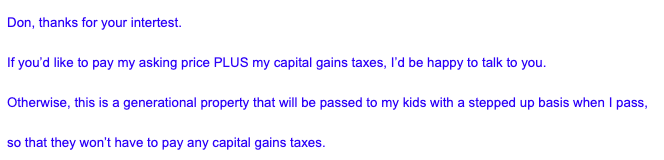
@JBMason @realEstateTrent The guy has money; he owns a generational commercial property..
It’s not solely due to taxes, it’s because he did exactly what he wanted to do and now his kids will benefit without transaction cost or government taking their share.
Lots of families follow the same playbook
English


@uncleeddie26 @realEstateTrent sure, but what if his kids don't want the house?
what if he could use the money now?
what if the house is too big or inconvenient for him in old age?
refusing to consider selling solely due to taxes is questionable decision making imo.
English

@realEstateTrent @SimpleCRE And other families have formed family offices and grown
English

@SimpleCRE leaving kids w jointly owned assets has broken up many families
English

@JBMason @realEstateTrent Because his kids don’t have to pay ANY taxes when they inherit it. There’s no reason to sell.
There’s a cost to transact (3-5%) and his property taxes on upleg if he does exchange will be substantially higher annually.
English

@realEstateTrent I just don't understand this logic. Know someone that has a 20x+ gain on their home.
Won't sell it because they would owe too much taxes.
Like the taxes are paid out of pocket or something. You're paying the taxes because you sold for a gain and therefore have the $$.
English

You guys thought I was joking?

Austin Nissly@atnissly
Our bids on LA apartments right now are about at 2012-2015 purchase prices.
English

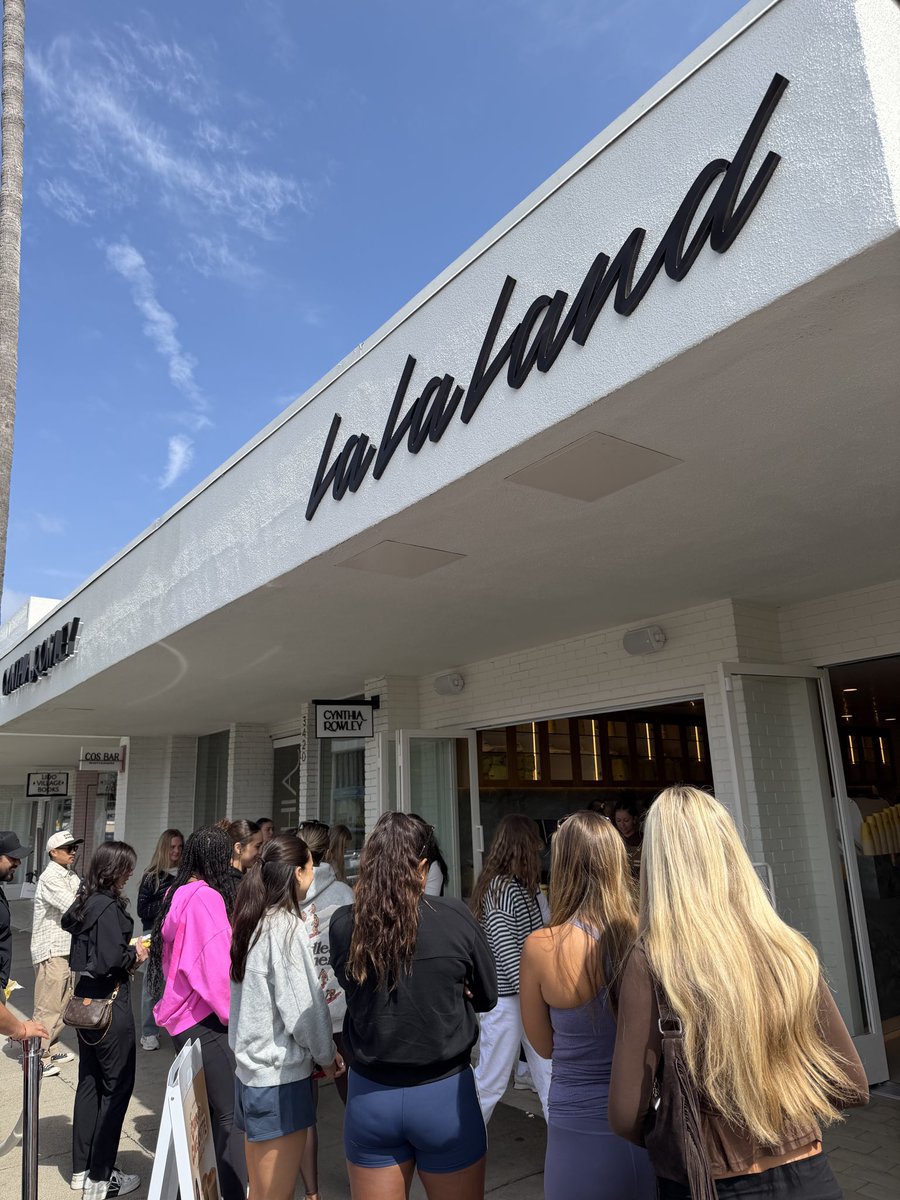
@SinaiLawFirm @realestatedude0 No idea how people stand in line for an hour at this place. Baffles me
English

@realestatedude0 Decent coffee and good scene but the baristas dress very casually and it gives me the ick
English

@credealjunkie I understand. But if they buy ~3.5 cap, with natural turnover at some point they’ll be sitting pretty. For a family office or younger investor with long term outlook.
English

@uncleeddie26 It’s the pro forma rent, and there’s rent control
English

hose buyers will only make money if cap rates compress a few points and they sell
No idea why you would buy those otherwise, especially in this market. There’s a lot of 60s-70s RSO product available at roughly same yields, why would you buy anything worse? Those buyers are blinded by price per foot and price per door. UYOC if including cap ex is often much lower
Expenses are also more variable for those product times
English

Another reason older dilapidated RSO buildings are in free fall:
Risk is sometimes easy to quantify.
The staircase is failing, someone can fall and die, and it costs $20k to replace the staircase and mitigate that risk. Done.
But some risks are harder to quantify.
For example, habitability is excluded from most policies today. So, you just have this fat left-tail legal risk looming over your head during the hold period, which can essentially wipe out 10 years of cash flow with a single claim.
How do you price this?
Or do you just avoid buying altogether?
English

I understand all of that. Point is regardless it’s priced into the deal, especially in commercial space. It’s also ridiculous to market a building and imply that the seller won’t negotiate 2% off the price, really?
We’re all focused on the net number, whether buyer or seller.
“Buyer pay your fee” often times means that seller is paying a full fee, so if they added your fee as well the seller would call them out for charging a ridiculous fee, even if the net number was higher
English

Listing brokers generally make 2-2.5 points. Not 3-4%.
Buyer’s agents are required to have a buyer sign a compensation agreement now. It can say the buyer is willing to pay the commission or not. Seller or Buyer isn’t required to pay it.
Then it’s up to the agent whether or not they want to engage in a deal with the idea they may not be paid by either party.
In general agree with you. But no one is doing a deal to make 1 point.
English

Objectively any fee paid by the seller should be split evenly. It’s all priced into the deal. Cut the BS and encourage broker cooperation. It’s best for the market. If you’re taking a deal to market, split the fee. It’s your fault you couldn’t get the seller to pay a higher commission, maybe they’re not a seller then.
Half the time listing broker is making a 3-4% fee anyways and are being greedy.
English

The answer is the fee should be split. It doesn’t matter where the deal comes from.
If a buyer wants outside representation then that’s their prerogative.
Commissions are a different conversation because of the NAR lawsuit.
Sellers are not obligated to pay a buyer’s agent fee. Agent can ask for it from the seller, but the seller can say no.
Then what?
English

@weddingowner @shawngorham Listing agent had their own buyer.
A bit surprised you’re not going with the listing agent on competitive deals.
English

90044 and 90047 are south central zips
The entire area is being gentrified in a huge way.
One older lady paid $8,000 for her house and sold it recently for $465,000
Flipper then fixed it and sold it for $200k more
South Central near Inglewood has homes well over $1M now. Pretty wild to witness areas like south central, Watts, Compton and Inglewood become expensive and “desirable” areas
Dom Lucre | Breaker of Narratives@dom_lucre
🔥🚨DEVELOPING: White people who are moving into South Central Los Angeles has been getting filmed by locals due them having a hard time believing that the one of the most urban parts of America is now being.’gentrified’ for decades South Central has been dominated by the Black and Hispanic community, I lived in South Central for a summer in 2017, that place is so different from the rest of the U.S. that spotting a White woman with a baby stroller is news.
English

@JulieChangRE Those people are usually bad with money anyways
What happens after they sell and then need money, but have nothing to sell? F it
English

Unpopular opinion
The people with the most equity dont need it
The people who need to tap it and use their houses as ATMs might end up upside down if housing values fall further
If you can't afford your lifestyle, sell
Colin Robertson@mortgagetruth
$10.7 TRILLION in tappable home equity. 97% of it untouched. And locked in at 2-4% on a 30-year fixed. Wild.
English

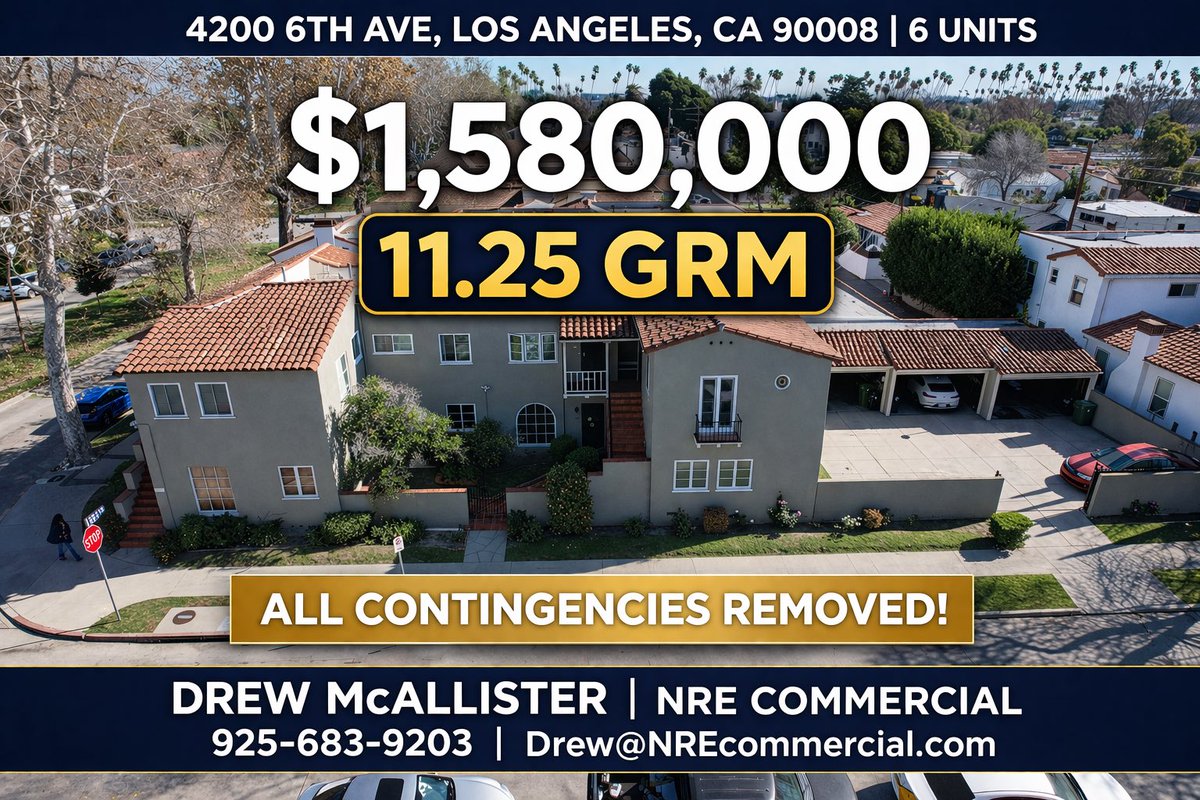
@BarryRoland19 @LPInvestor In Ktown and E Hollywood likely no chance at even a 13 GRM lol. 13 GRM is kind of crazy. Your GPs would’ve bought the entire sub market which is basically a 10 GRM if that was really their pricing.
English

@LPInvestor Tough to say without a little more context. The 14.5 is out is the question. The 13 may be closer, but, again, depends on more information.
English

If I had to quantify what has caused the value destruction in LA RSO buildings since ~2021, it would probably be:
(1) 40% bc of NOI erosion during that timeframe, with a decent likelihood of continued erosion
(2) 30% bc of increased regulatory risk
(3) 30% bc of higher interest rates
Obviously variations bw submarkets and buildings (eg, buildings with lower NOI margins in 2021 have been disproportionately affected by NOI erosion), but I think rates are only like 30% of the story tbh.
English

One of my best clients wants me to co-invest with him in experiential real estate.
I’m talking luxury builds near golf courses or race tracks, high end boat storage near major rivers, high society social clubs, immersive experiences, live events, etc.
He’s convinced AI is changing the world and the way we will work.
Thinks people will need to work 75% less than they do now.
We will all crave experiences and human interaction even more.
English

@SinaiLawFirm @realestatedude0 Those are market rents basically
You can get a 1 bedroom right there for 3k a month
How much more are you going to pay for an ocean view?
English

@realestatedude0 Feels like they should be higher, minimum $7-10k a unit
English

@thejfgapts When more good brokers like you give accurate guidance to owners. Too many brokers fluffing bullshit BOVs.. keeps us at a 8-12 month backlog at minimum.
English

My thoughts:
The apartment building market in Los Angeles: Uncertainty rules the day. The market has made adjustments to municipal, county and state regulatory pressure. Higher expenses led by insurance and utilities are decreasing returns and broadly lowering values (as are the new rental increase policies instituted by the Los Angeles City Council). I believe we are currently in a declining market. Many individuals are struggling to make ends meet and rents are finally being affected. This continues to decrease future returns and contibutes greatly to value declines we have seen in recent years.
The question is: when will equailibrium return to the divide between Buyer's return expectations and Seller's price goals?
Transaction volume will depend on this!
#LosAngeles #Multifamily #Apartments #RealEstate #ReTwit

English

@TheRealEstateG6 How do you think about major capex items that won’t move NOI, given you’re not planning to hold for the long-term?
English

What does a renovation typically cost me?
Generally a renovation for a Class C 1-bed unit costs me $10k-$15k
Below are the items I focus on when touring to maximize rent and minimize cost
You should think about the property in the 3 categories outlined below
1. Bathroom (~$5k)
2. Kitchen (~$8k, grouping in all appliances & materials)
3. Floors/Paint/Other (~$2k)
Bathroom
1. Shower/Tub: What’s there right now? Do you have to rip everything out or can you reglaze or tile over? Does the shower valve & fixture need replacing? Will you tile the shower or install an acrylic shell? [Costs to redo can run you between $250 & $2.5k]
2. Floor: Are you going to tile the bathroom or run LVP? Can you run the LVP over what’s there now? [LVP is going to run you ~$5/SF & tile will run you $7-15/SF]
3. Toilet/vanity/mirror/lights: Do you need new ones? [Price materials online, the labor for installation should be minimal (~$50-100/item)]
4. Extras: Do you want to add something extra to increase longevity or attractiveness? Embellish walls (tile, shiplap, wainscoting), shower niche, sliding glass shower door, stone countertop, shower ledge, etc [Here costs can get out of control. Way to avoid this is to look at the comps achieving the market rent in your market. Only renovate to that scope & do nothing more. Additional renovations won’t get you a higher rental rate]
Kitchen
1. Cabinets: Do you like the layout of the kitchen? If so, can you refinish & reuse the cabinets? If not, can you just buy new doors for the cabinets? [Even just sanding & painting cabinets can cost $1k for a medium-sized kitchen. Going new is usually the move unless you really don’t need to change anything. New cabinetry will probably run you $2k-$4k with installation]
2. Countertop: Can you keep the countertop? If you replace, will you use laminate or stone? Will you use a counter lip, tile backsplash, or both? [Countertop costs ~$35/SF on laminate & ~$50/SF+ for stone with installation]
3. Appliances: Can you reuse any appliances? Will you add a dishwasher? [Can get a decent one in the $1k range]
4. Floors: Are you going to tile the kitchen floor or run the LVP? [Same as above, ~$5/SF for LVP with labor]
5. Lighting: Do you need new lighting under the cabinets, overhead track lights, or pendants over an island/counter? [Can do for $250-500 all-in. Just don’t small-talk the electrician, get him in & out]
6. Extras: Removing the wall for an open floor plan kitchen, gooseneck faucet, barn sink, garbage disposal, under mount sink, glass door cabinets, butcher block counter, etc. [Keep to the original scope and only upgrade the kitchen as needed]
Floors/Paint/Other
1. Floors: What type of floor is in place? Do you want to change the flooring? Is it hardwood & if so does it make sense to refinish? Can you go over the floor with LVP (this can be difficult but possible with carpet)? Do you want carpet in the bedrooms? What quality LVP will you use? [Refinishing the floor will run you ~$4/SF]
2. Paint: Do you want to repaint the unit? Do you have to repaint the ceiling? [Paint is cheap, but the labor adds up. All-in this can cost $1k-2k for a medium size 600 SF unit]
3. Other: Can you add a washer dryer in the unit? Can you add an extra bedroom? Does the unit need new doors, lighting fixtures throughout, windows, doorknobs, closet shelves, blinds, partitions, etc. [Try to include all these smaller items in the initial scope]
That’s mostly it
In terms of items that actually meaningfully move the needle for asking rent, look at adding a bedroom (~$2.5k), washer/dryer (~$3k), or dishwasher (~$1k)
Lastly, there are few single places where you can save large chunks of money - a successful renovation scope & execution is achieved by making over a hundred good small decisions
English