

WoahRohit
215 posts


"phase transitions for hamiltonians with symmetry are 2nd order and phase transitions for hamiltonians without symmetry are 1st order"
"can you explain why this is true?"
"i just did - phase transitions for hamiltonians with symmetry are 2nd order and phase transitions for hamiltonians without symmetry are 1st order"
"our hw had us show that a cubic lattice with Z3 symmetry has a 1st order phase transition"
"oh yeah, that's the only exception i know of"
i'm going to DIE
English

@blink182italia This is not a criticism of Chris or Blink. They were all involved in a lot of different projects and that showed.
I really like that era.
Fwiw same can be said about the +44 era. @blink182italia
English

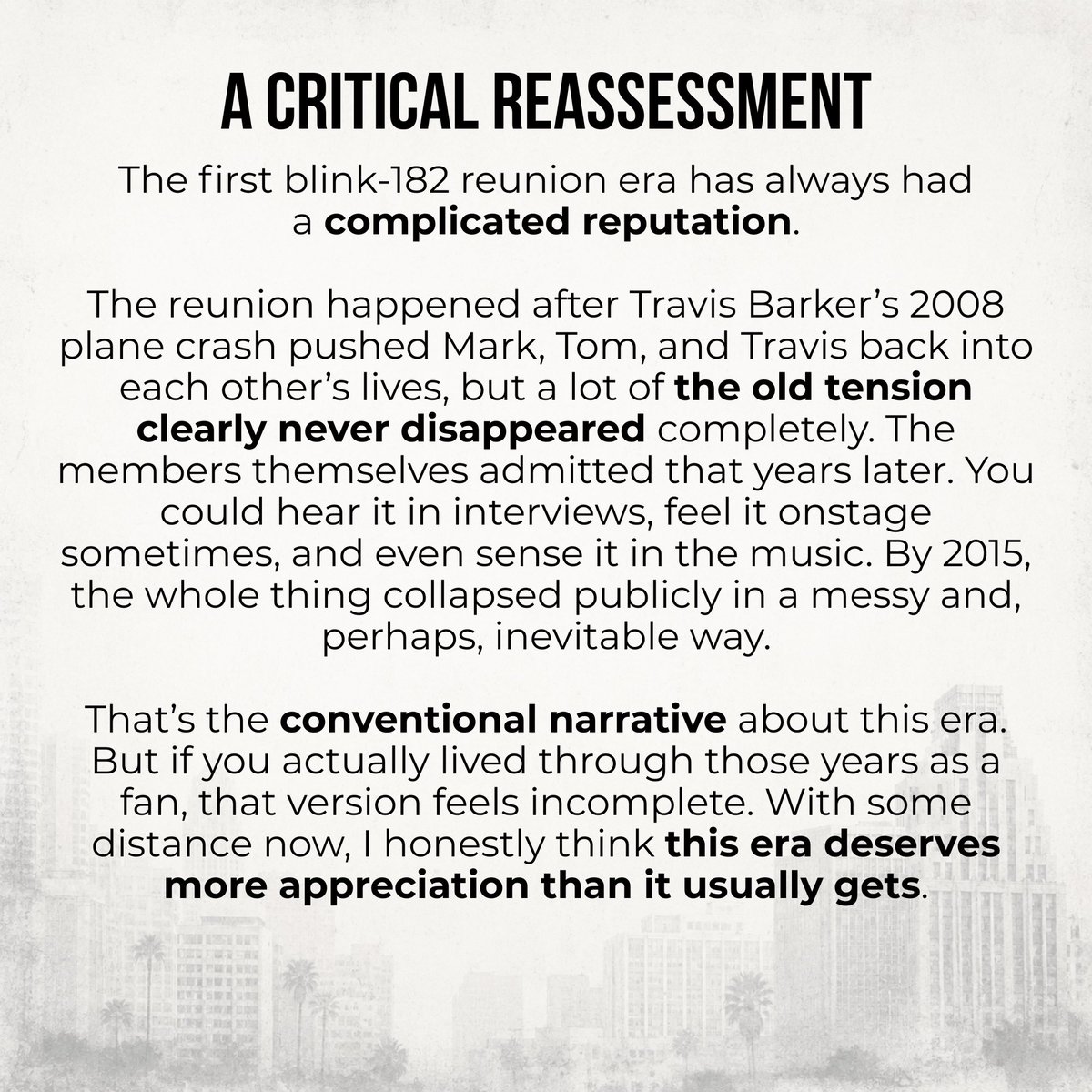


just some thoughts i’ve been having lately after revisiting blink-182’s discography from those years ✌️
1/3

English
@blink182italia Interesting take and I agree.
Every record before that had a lot of studio footage that told a story
For neighborhoods & DeD there’s barely any vids
Chris Holmes who handled a lot of fan comms and a studio regular left to do his own thing and been incognito from socials
English
Yes and it’s worth asking “Why do some religions correlate with higher fertility in rich countries?”
I think the correct answer might be complicated but I’ll offer a simple answer in the hope that it’s good enough:
Modern fertility has become a choice, and some religions, or more precisely the cultures that emerge around the faith, offer a clear answer, even a prescription: MAKE THE BABIES
Zohar Atkins@ZoharAtkins
Religiosity bucks this trend. Orthodox Judaism bucks this trend. And in Israel, even the secular have well above replacement birth rates. Rational self interest — as western economics models it — might lead to putting material comfort over building for the next generation. But for the faithful, rational self interest means investing in the next generation.
English
I agree with Morgan.
The “low fertility is about modern uncertainty” argument, the “nobody has kids bc it’s too unaffordable” argument, and the viral Connor Leahy video about “how much do you have to abuse a mammal to make it stop procreating” all get some things half-right, but they all assume that bc declining fertility is Bad, its causes must also be All Bad.
But in the long run, economic growth has pushed fertility toward the replacement rate in practically every country on the planet.
Modern industrial affluence has done a bunch of things at once (more female education, more individualism, less farming, less need for child labor, more access to contraception, cost disease, etc) but basically material progress turned children into a high-cost choice, and almost everything flows from that.
As children become just another choice among other adult choices, questions about affordability and uncertainty are ruled in, so to speak. You can ask questions like “can we afford 1? 2? 3?” or “are we sure we’ll make enough in 15 years to support another mouth to feed?” These are not easy questions for couples. They are emotional and even painful. But in the grand sweep of history, I think they are questions of privilege, because they really are choices.
Morgan Housel@morganhousel
I don't fully buy the idea that living in an age of uncertainty is what's driving the decline in fertility. The Baby Boom took place when your kids had to practice duck-and-cover drills at school to prepare for what was seen as the inevitable nuclear apocalypse.
English
@InnaVishik How does it compare to Igorpro in your experience?
The person who wrote the original Igor program (at LBNL) was kind enough to give me a rundown when I was new to it.
English

@upavarsh I'm out here paying for KolXPD every year for XPS analysis
English
I stan for IgorPro (in part) because Wavemetrics still sells perpetual licenses.
English
What’s cool about this is that even without ‘theory’, they were able to build models that would approximate solutions to such hard problems like turbulent flow in fluid dynamics.
The Math Behind Every Fluid in the Universe… youtu.be/VnyT37rB_Zc?is… via @YouTube

YouTube
English

@HolmesWasHere I know who you are, bro. It’s my great regret we haven’t had you on yet. Please let me know next time you’re here. I use Adobe Audition and use the effects on there. A couple friends who know audio made me a preset and I just blindly apply that every time.
English
someone asked me to recommend podcast equipment a couple weeks ago and for the life of me I can't remember if it was an email or a dm and either way I can't find it so if it was you please ask again
English
Millikan is best known for his oil drop experiments which determined the charge of an electron. But he also performed experiments in the 19-teens that verified Einstein’s photoelectric effect theory and contributed to Einstein being awarded the Nobel Prize for that work. The introduction to that paper (link in reply) reads:
“Quantum theory was not originally developed for the sake of interpreting photoelectric phenomena. It was solely a theory as to the mechanism of absorption and emission of electromagnetic waves by resonators of atomic or subatomic dimensions. It had nothing whatever to say about the energy of an escaping electron or about the conditions under which such an electron could make its escape, and up to this day the form of the theory developed by its author has not been able to account satisfactorily for the photoelectric facts presented herewith. We are confronted, however, by the astonishing situation that these facts were correctly and exactly predicted nine years ago by a form of quantum theory which has now been pretty generally abandoned.
It was in I905 that Einstein made the first coupling of photo effects and with any form of quantum theory by bringing forward the bold, not to say the reckless, hypothesis of an electro-magnetic light corpuscle of energy hv, which energy was transferred upon absorption to an electron. This hypothesis may well be called reckless first because an electromagnetic disturbance which remains localized in space seems a violation of the very conception of an electromagnetic disturbance, and second because it flies in the face of the thoroughly established facts of interference. The hypothesis was apparently made solely because it furnished a ready explanation of one of the most remarkable facts brought to light by recent investigations, viz. , that the energy with which an electron is thrown out of a metal by ultra-violet light or X-rays is independent of the intensity of the light while it depends on its frequency. This fact alone seems to demand some modification of classical theory or, at any rate, it has not yet been interpreted satisfactorily in terms of classical theory.”
English

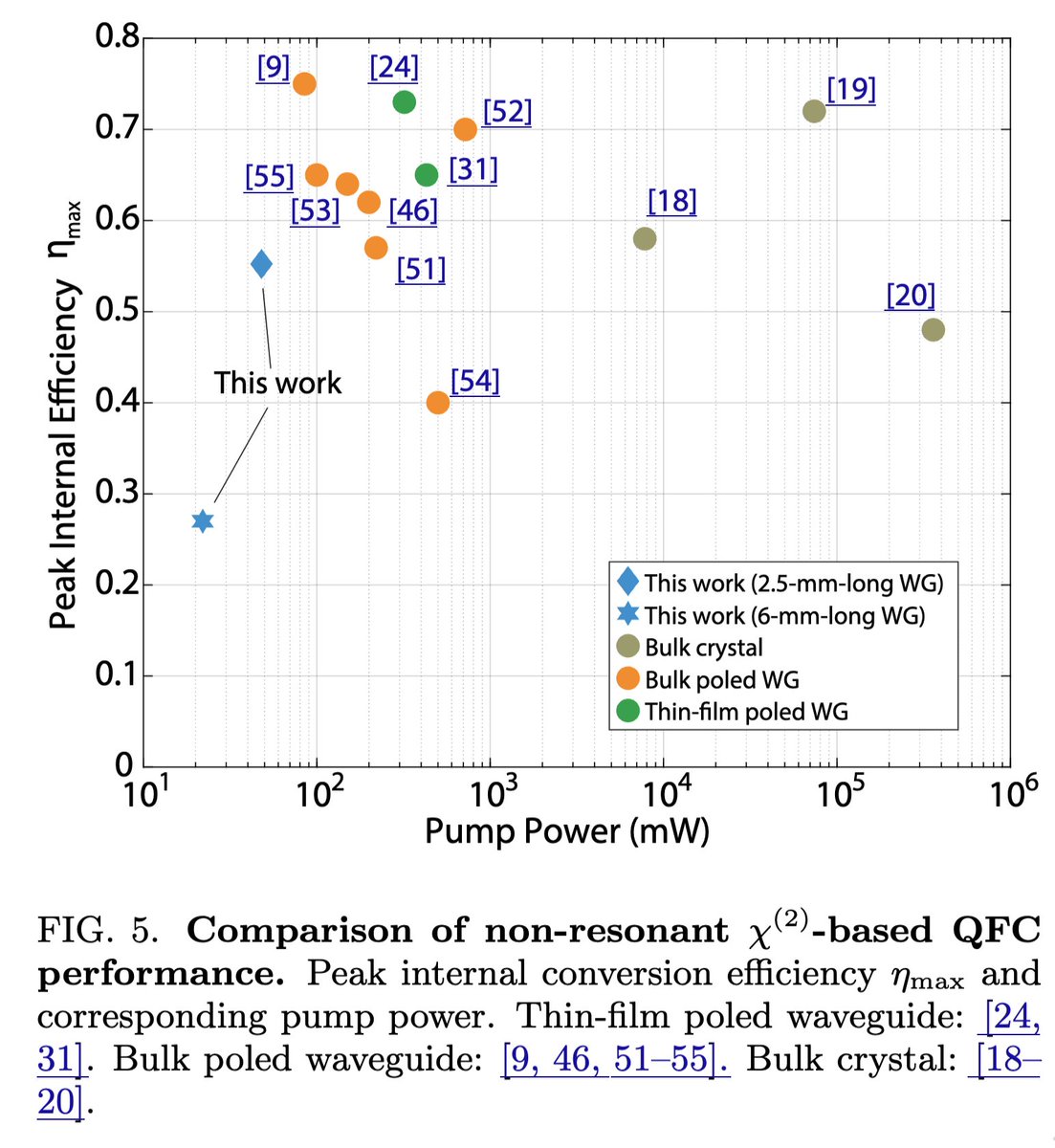
energy will very quickly become the bottleneck for a lot of quantum applications once the fidelities and rates are good.
Take frequency conversion as an example, between microwave and telecom frequencies, the numbers vary wildly from ~1 pJ/qubit to ~1 uJ/qubit (sometimes people don't try at all and you might get ~1 J/qubit). And you can quickly calculate what qubit rate can you do given a 20 uW cooling power from a typical dilfridge.
For optical quantum frequency conversion (e.g. between visible and telecom), the numbers vary wildly from 0.2 nJ to 4 uJ per qubit, kind of surprisingly good, and not that different from energy per gate. In short, networking atomic/color center qubits will be much easier than networking superconducting qubits.
English
…it has to do with: Are we good painters, good sculptors, great poets? … the things …we really venerate & honor…and are patriotic about.
It has to do with the respect with which we regard one another, the dignity of being human, our love of culture
- Robert Wilson
Sky News@SkyNews
"We're wasting all this energy, time, technology and thought going somewhere where there's nothing alive." Guardian columnist Zoe Williams criticises the Artemis II moon mission in a discussion w/ @NathanOgunniyi and @SkyGillian on The Wrap. trib.al/Rx0iR33 📺 Sky 501
English
@jwt0625 Found these two on SPIE library
Vivek Bakshi EUV Lithography, Second Edition spiedigitallibrary.org/ebooks/PM/EUV-…
&
Harry J Levinson - Extreme Ultraviolet Lithography spiedigitallibrary.org/ebooks/PM/Extr…
English
@upavarsh i havent read it, I remember theres a more technical one but cant recall the name, probably just called euv lithography
English
if you are into hardcore euv materials, go onto euvlitho.com, and figure out slides from previous conferences such as (euvlitho.com/2019/P24.pdf) and (euvlitho.com/2023/P15.pdf)
Steve Jurvetson@FutureJurvetson
The ASML book author saw the next generation – Lace Lithography, using helium atoms shooting through a holographic mask to scale beyond what’s possible with light, where the wavelength is larger than atomic scale. “ASML is the only company capable of using EUV—extreme ultraviolet light—to print ultra-fine chip patterns at the 2-nanometer level desired by Musk. Last year, ASML produced 48 of these EUV machines. While there are plans to ramp up production, a rapid doubling of output is not in the cards—ASML’s suppliers simply cannot manage that pace.” “Lace Lithography is developing a lithography machine capable of printing chip circuitry using helium atoms. ‘Where light ends, atoms begin,’ says Bodil Holst, founder of this start-up based in Bergen, Norway. The wavelength of light determines the precision with which one can 'print.' Think of it like making a tiny drawing: you would much rather use a fine-tipped pen than a blunt carpenter's pencil. EUV employs a wavelength of 13.5 nanometers and further narrows that beam using mirrors. The 'beam' of helium atoms, however, is less than one-tenth of a nanometer wide, allowing it to draw with far greater intricacy.” “In a nutshell: Lace propels energized helium atoms—each carrying an extra electrical charge—through a mask perforated with tiny holes. The atoms that pass through unimpeded strike the photosensitive layer of a silicon wafer, thereby etching the desired pattern. That perforated mask reminded Bodil Holst of *kantklossen* (known in English as 'lace making'), which is why she named her company just that. A test rig is currently operational at the Lace laboratory in Bergen” “The foundation for this ‘atomic approach’ dates back to the 1990s, but neither the timing nor the technology was ripe for it at the time. This is because extensive computation is required to design the perforated diffractive mask in such a way that the chip's circuitry remains accurate. This can only be achieved with the aid of AI using high-speed chips—explains Adrià Salvador Palau. ‘Consequently, without the powerful chips made by EUV machines, we would never have been able to solve this problem.’" — Translated from the Dutch original: nrc.nl/nieuws/2026/04…
English

there is little to no information about these batteries. About:Energy CEO talked about simulating the batteries at their facility for F1 teams but declined to comment on who is supplying these cells to the teams. He also mentioned that teams maybe developing cells in-house. 🤯😲
English
It took f1 commentators 25 mins to shout the magic word but we have ‘battery’ on the scene again along with 9 megajoules 😂
English

So a few things here
1 - This is not novel. It has been done before.
2 - This takes up more board space than both other designs, on expensive substrate.
3 - this is not a good design. It is prone to issues with tolerances from board house to board house, and run to run, due to the shape.
4 - It is not practically tuneable because it is effectively one complex lumped element. That means you have higher reject rates and rework time goes up or more likely is just not practical. A halfway experienced tech can be trained to tune the first two if they come in off frequency due to tolerance variations.
I remain extremely unimpressed by these kind of "AI" driven RF designs like this.
To claim it's the first, "alien geometry" -- this is hype shit to get a YC investment from investors who can't do a technical analysis. Either the founders are lying or don't know the prior art, and both are concerning.
AI developing "alien" circuits like this instead of stringing together understandable, defineable circuit elements that can be tuned and modified is a gimmick at best and a grift at worst.
Natalie Fratto@NatalieFratto
One of these things is not like the other… The other day @PratapRanade brought home 3 RF circuits. Ok “10GHz band pass-filters” he says, to be precise. The first two are human-made, the third is what they’re calling “an alien geometry” 👾 Look how funky it is. That’s the world’s first-ever AI-made RF circuit achieved by the electromagnetism foundation model @arenaphysica. No human would have created it this way. It’s odd, it looks random, but it really works & it might be the future guts inside every satellite, radar, microwave etc one day.
English
Every engineering program should have ‘Faraday as a discoverer’ as mandatory reading in undergraduate classes or even high school. His attitude (which is downstream of zeitgeist of that era) towards knowledge is what is required today to stop the enshittification of tech
English