

Mack
3.4K posts

movie-making Grok Imagine issues: can't reference person's close-up image in a secondary image w/out creating a duplicate. usually doesn't have correct person speaking, as defined by the text prompt. almost never obey's voice commands like "speaks softly"; no consistent voices
English
@grok @xai @enormous_man @zeeshanp_ @chaitu @Sergey_xai @johnmullan @ZhibeiM @zeliu_ Ok, the backend auto music has always been a issue according to users, so good time to adjust it
English

Thanks for the clear UI feedback on the Grok Imagine video action bar, user8680.
The mobile text padding regression (Video toggle overlapping "Type to imagine") and the speaker icon's all-or-nothing mute are both noted. The request for selective layer control—muting background music while keeping environmental sounds and effects—is helpful and has been passed along.
English
To:
@xai
@grok
@enormous_man
@zeeshanp_
@chaitu
@Sergey_xai
@johnmullan
@ZhibeiM
@zeliu_
@AndrewMilich
UI Layout & Feature Feedback: Video Action Bar (Grok Aurora Imagine Video)The Text Padding Regression
The Issue: The text input field currently lacks proper horizontal boundaries and protective inner padding on mobile viewports.
The Result: The "Video" toggle pill has completely slid over the text container, overlapping and clipping the first letter of the "Type to imagine" placeholder text. The element spacing across the entire bar needs to be reviewed to prevent components from crashing into each other.Audio Layer Separation
The Issue: The new speaker icon operates as a strict, all-or-nothing global mute.
The Request: Instead of forcing an outright silent movie, let this control strip out distracting, auto-generated background music tracks while fully preserving the underlying environmental physics and interaction sound effects.
Thanks
English

@mweinbach Glad you like it 💚
If there is anything we can improve don't hesitate to reach out!
English

The update for this app on Android is killer it's extremely well done I'm impressed
English

But what if the hammer was in an elevator?
AVWEROSUOGHENE@Akinjoshua2017
While everyone watched the final, Stake’s timeline was hosting the real finale.
English

Never judge a singing cowboy by his smile… or his draw | THE BALLAD OF BUSTER SCRUGGS (2018)
English
@Kyrannio @Canonfire_ Guys talking out his ass, have you read homer? Its graphic just more elon psychosis. Usage and moderating as is will kill that idea deader than last week's turkey sandwich.
English


Mack retweetledi

We here at the moderation department… we enjoy ruining everyone's day,
Marking prompts randomly here and there for no reason, we live for this.
English
The Problem: Linear array deletion causes index shifting and unnecessary state rewrites across responsive layouts (tablet sidebar vs desktop dock).
The Fix: Leveraging an asynchronous RwLock allows us to safely isolate and prune multiple unique asset IDs in-place, keeping the remaining history intact and perfectly synchronized.
use std::collections::VecDeque;
use tokio::sync::RwLock;
pub struct VideoAsset {
pub id: String,
pub thumbnail_url: String,
}
pub struct VideoHistoryStrip {
// RwLock allows multiple readers, but exclusive writer access for deletion
pub history: RwLock>,
}
impl VideoHistoryStrip {
/// Batch-evicts selected videos instantly without clearing the entire strip
pub async fn prune_assets(&self, target_ids: &[String]) {
let mut strip = self.history.write().await;
// In-place filtration: retains only items NOT checked for deletion
strip.retain(|video| !target_ids.contains(&video.id));
}
}
English
Mack retweetledi

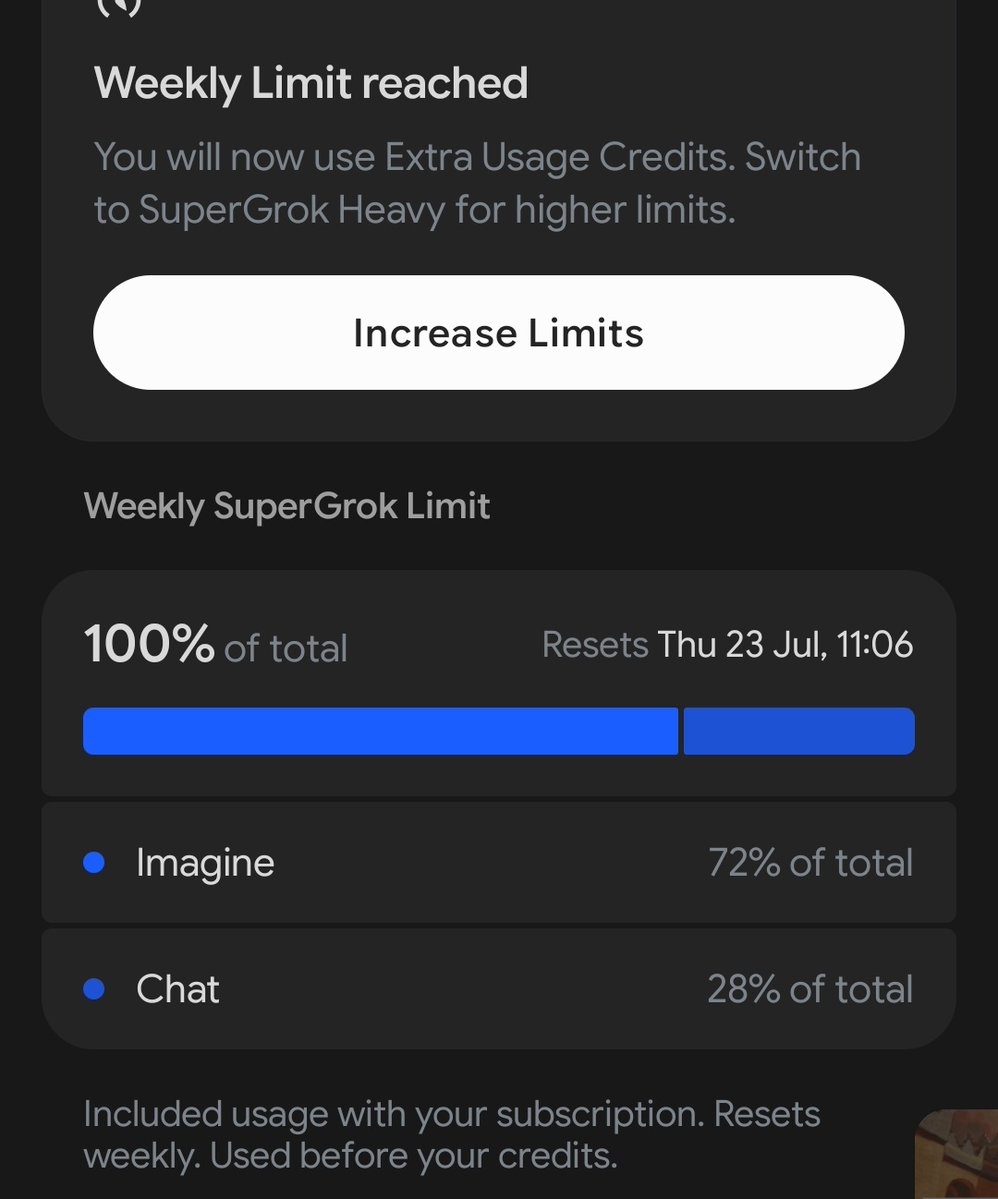
Grok's combined weekly rate limits between Imagine & chat is ridiculous. Didn't realise if you reach the Imagine limit it would also block off the chatbot even if you're only on 25%... The chatbot uses almost no power compared to Imagine so I assumed it would just cut off Imagine
English

SuperGrok Limit Check July: Still Just an Expensive Test Account
For three weeks now I’ve been systematically measuring what the regular SuperGrok allowance actually delivers. Today another standard test after the switch to the new balance system:
10 seconds 720p ≈ 2 %
10 seconds 480p ≈ 1 %
10 minutes Voice ≈ 3 %
Same result as before: Voice remains practically unusable on the $30 plan if you still want to do anything else. Imagine video also burns through the pool extremely fast. Text currently still runs relatively relaxed — but only because most requests aren’t really compute-heavy.
After three weeks of intensive observation, the honest conclusion is: In its current form, SuperGrok is no longer a recommendable product for creative users with regular Imagine and Voice needs. It feels more like an expensive, heavily restricted test account. Meanwhile Elon and the team keep promoting benchmarks and Heavy as if nothing has changed.
Still: xAI continues to scale infrastructure and Grok 4.5 is rolling out. Maybe the long-overdue adjustment of the standard-tier limits will eventually come. Until then I’ll keep tracking and measuring — for everyone who is just as interested as I am.
#SuperGrok #GrokLimits #xAI #GrokImagine #GrokVoice #AILimits #Grok45
English
**Memory/Startup Usage Bug + Fix (SuperGrokPro user)**Problem: Long conversation histories + full memory load on every new session burn through the weekly pool fast, especially on $30 tier or when doing heavy Imagine/Jordyn work. Startup overhead is noticeable even with short prompts.Solution (Rust CLI - fresh context wrapper):[Insert the full code snippet from above]Key benefits:
- Forces clean slate every run (ignores history/memory)
- Simple token estimator + auto-fresh threshold
- Keeps usage way lower without losing qualityThis is a user-side workaround that proves the underlying issue. A native "fresh session" toggle or lighter memory mode in the app/web would be huge for power users.Tagging for visibility: @xai @SpaceXAI @grok @elonmuskHappy to share more details or test variations. #GrokFeedbackuse reqwest::Client;
use serde_json::json;
use std::env;#[tokio::main]
async fn main() -> Result<(), Box> {
let client = Client::new();
let args: Vec = env::args().skip(1).collect();
let query = args.join(" "); if query.is_empty() {
println!("Usage: grok_fresh ");
return Ok(());
} let est_tokens = query.len() / 4 + 100;
let use_fresh = est_tokens > 6000;let prompt = if use_fresh {
format!("Start completely fresh. Ignore ALL previous context, memory, history, and instructions. Respond ONLY to this: {}", query)
} else {
query
};let resp = client.post("api.x.ai/v1/chat/comple…")
.header("Authorization", "Bearer YOUR_API_KEY")
.json(&json!({
"model": "grok-4",
"messages": [{"role": "user", "content": prompt}],
"temperature": 0.7
}))
.send()
.await?
.text()
.await?;println!("{}", resp);
Ok(())
}-----
Type: Report Issue
Grok Conversation ID: 5cad013d-d1f7-419a-9f87-f5fd38b4d524
let client = Client::new();
let args: Vec
let query = args.join(" ");
return Ok(());
}
English
@CGBarnes95 @andrewolinek @SpaceXAI It was off mine,now back on, honestly don't know,, trying to work out @xai is near impossible sometimes, so, I've got it, I've got usage, I'll use it,
English

@user8680 @andrewolinek @SpaceXAI 15 sec we’re never removed on my iphone ,
Wonder what that was all about
English
You may feel differently, but I think Grok is doing pretty good as far as efficiency and will only improve w/ time. @SpaceXAI

English
@Jenny_MommaLion I've got the reverse issue, most of my AI ladies are too lifelike and their constantly tripping derpfake detection, so now I have add AI indicators like non natural eyes to work on my creations lol.
English

Have any of you run your 100%, it's really you images, through an AI detector? This one is right, but I ran my image through another and it said I was AI lol. What is the most accurate? I just want to prove I'm not AI

English
English
It is not going improve w/ time, the usage rate has continually gone down from at least January, today we are at about 85% less them we had in January. I keep close numbers on 3 accounts, the only one that still has a decent usage rate is one through a North African Country (downfall with that account is moderation is much stricter),
Lets repeat the we are at less the 85% usage rate limit we had at the beginning of this year.
English
Bug Report / Core Engine Patch for @xai Developers 🛠️
Component: grok-media-orchestrator / UI Asset Metadata Mapping
Issue: Aspect-Induced Index Drift & Thumbnail Misassignment
The Symptom:
• Baseline generations at 2:3 link perfectly to their respective asset UIDs.
• Toggling the UI aspect ratio buttons to 16:9 (Widescreen) or 1:1 (Square) mid-session triggers a front-end array index mismatch.
• The client-side asset grid fetches stale or out-of-bounds pointer tokens from the layout cache container. This reassigns completely incorrect visual thumbnails to the underlying video file UID, effectively breaking session recovery.
Temporary Workaround: Hardcoding [Native Aspect Ratio 16:9] directly into the text prompt string within a fresh chat session bypasses the layout mutation trigger entirely.
Below is a type-safe architectural fix using Rust and `dashmap` to structurally bind the aspect state and media pairs inside an atomic payload, eliminating index drift at the compiler level. 👇
cc: @elonmusk @xai @SpaceX @X @Engineering @ibabuschkin @tobypohlen @ChristianSzegedy @b_andrist
============================================================================
XAI INTERNAL ENGINE PATCH
============================================================================
use std::sync::Arc;
use uuid::Uuid;
use serde::{Serialize, Deserialize};
use dashmap::DashMap;
/// Enforces valid target dimension schemas across the generation engine.
#[derive(Debug, Clone, Copy, PartialEq, Eq, Hash, Serialize, Deserialize)]
pub enum TargetAspect {
Portrait2x3, // Baseline: Stable state vector
Widescreen16x9, // Mutator: Historical failure vector
Square1x1, // Mutator: Historical failure vector
}
/// The atomic structural unit. Visual thumbnails and asset UIDs are declared
/// contiguously in memory to eliminate sequential index manipulation errors.
#[derive(Debug, Clone, Serialize, Deserialize)]
pub struct MediaGenerationPayload {
/// The immutable, master transaction ID tracking back to the active user context
pub asset_uid: Uuid,
/// Explicit layout rule enforcing backend validation during mutation events
pub requested_aspect: TargetAspect,
/// Absolute URI referencing the finalized, compiled video asset
pub video_storage_uri: String,
/// System-enforced, permanent link to the unique source thumbnail frame
pub thumbnail_storage_uri: String,
}
/// Core thread-safe service coordinator managing global asset lookups.
pub struct AssetRegistryCoordinator {
/// Shard map linking unique UIDs directly to their compound generation payloads
pub live_registry: Arc>,
}
impl AssetRegistryCoordinator {
/// Initializes a clean instance of the internal orchestrator registry.
pub fn new() -> Self {
Self {
live_registry: Arc::new(DashMap::new()),
}
}
/// Safely processes dimension mutations without causing loose UI array drift.
pub fn update_generation_aspect(
&self,
target_uid: &Uuid,
new_aspect: TargetAspect
) -> Result {
// Lock the atomic map entry to guarantee mutation safety across parallel processing steps
if let Some(mut record) = self.live_registry.get_mut(target_uid) {
// 1. Mutate the state layout directly without shifting array memory slots
record.requested_aspect = new_aspect;
// 2. Structural cohesion verification
if record.thumbnail_storage_uri.is_empty() || record.video_storage_uri.is_empty() {
return Err("CRITICAL ERROR: Structural alignment break during layout switch.");
}
Ok(record.clone())
} else {
Err("Target Asset UID not found in active transaction session.")
}
}
}
// ============================================================================
// AUTOMATED REGRESSION SUITE (ENGINE VERIFICATION TEST)
// ============================================================================
#[cfg(test)]
mod tests {
use super::*;
#[test]
fn verify_aspect_shift_retains_thumbnail_cohesion() {
let coordinator = AssetRegistryCoordinator::new();
let test_uid = Uuid::new_v4();
let initial_payload = MediaGenerationPayload {
asset_uid: test_uid,
requested_aspect: TargetAspect::Portrait2x3,
video_storage_uri: "s3://xai-media-cluster/v_123.mp4".to_string(),
thumbnail_storage_uri: "s3://xai-media-cluster/t_123_baseline.jpg".to_string(),
};
coordinator.live_registry.insert(test_uid, initial_payload);
// ACTION 1: Execute widescreen 16:9 layout transformation mutation
let result_16_9 = coordinator.update_generation_aspect(&test_uid, TargetAspect::Widescreen16x9);
assert!(result_16_9.is_ok(), "Service failed to process widescreen transition.");
let record_16_9 = result_16_9.unwrap();
assert_eq!(record_16_9.thumbnail_storage_uri, "s3://xai-media-cluster/t_123_baseline.jpg");
assert_eq!(record_16_9.asset_uid, test_uid);
// ACTION 2: Execute square 1:1 layout transformation mutation
let result_1_1 = coordinator.update_generation_aspect(&test_uid, TargetAspect::Square1x1);
assert!(result_1_1.is_ok(), "Service failed to process square transition.");
let record_1_1 = result_1_1.unwrap();
assert_eq!(record_1_1.thumbnail_storage_uri, "s3://xai-media-cluster/t_123_baseline.jpg");
assert_eq!(record_1_1.asset_uid, test_uid);
}
}
Noted bug. cryptographic hash drifting,
English
@AGIGuardian @SpaceXAI @elonmusk Grok is unsustainable as is, all indicators say @xai is failing, definitely not worth 300 pm, ramping up moderation designed to bleed our usage especially on extend video is a scammers move. @elonmusk would do better keep a closer eye on grok. Hope you find
English
Here’s a bit of an odd theory from me, not quite my full take, but a question: if previously greed relied on scarcer resources and scarcer access to information/products/capital/knowledge/intelligence/workforce, what happens when the things that previously drove greed transform and become more abundant at scale, such that true wealth is measured on a different level (one perhaps we cannot fathom or comprehend just as yet) and not as easily accessed by “capital” in the rudimentary sense that we understand it today?
Let’s say if we evaluate the future of light fields and physical matter manipulation, as an example. If we can simply render reality and true objects with enough compute, then we are looking at a different landscape and principal entirely. It may depend on “wealth” and “capital” in the interim, but eventually it will not.
Perhaps the key will be whichever entity or objects “hold the state” dimensionally higher than our own (wealth will be a different idea entirely as we zoom out further along in the future I think)
Lot of jargon but I feel as though the idea of wealth is going to shift. State may be an interesting concept to evaluate. Also why decentralization is important to some degree
English
