vik0nchain

3.3K posts

vik0nchain banner
vik0nchain

vik0nchain

@vik0nchain

Crypto Research & Data @cybercapital | daydreaming about Internet Capital Markets ... or snowboarding | not financial advice

Katılım Mart 2015
587 Takip Edilen700 Takipçiler
vik0nchain retweetledi
vik0nchain
vik0nchain@vik0nchain·
@therollupco @grok What type of usage forced the following technologies to scale? VHS Video. Broadband. Streaming. E Com.
English
1
0
0
607
The Rollup
The Rollup@therollupco·
Unpopular opinion: "Meme coins" are the best infrastructure developers we have. Vibhu explains that the chaos of retail trading is what forced Solana to build DeFi infrastructure that doesn't break under load. "We survived the Trump coin launch, which is the single biggest thing that happened in crypto." You can’t simulate that kind of stress in a lab.
English
22
17
205
88.7K
vik0nchain
vik0nchain@vik0nchain·
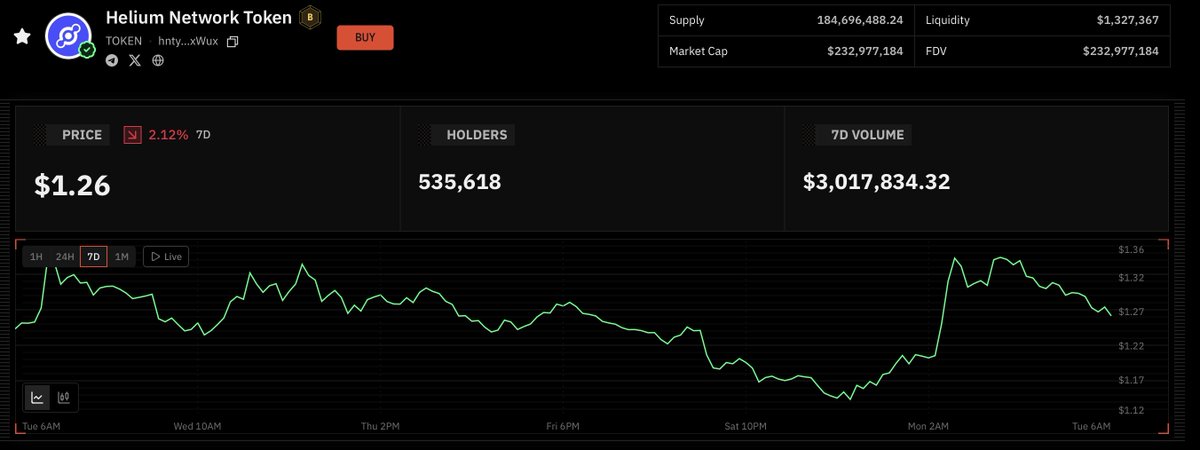
Helium resurgence is gonna catch a lot people off guard. If all growth stopped today, post halving deflationary pressure alone will push price: 2x in 2 years. 8x in 4 years. 16x in 6 years. 32x in 8 years. 64x in 10 years. Now factor in monthly ATHs in usage.
vik0nchain@vik0nchain

x.com/i/article/2036…

English
1
1
7
1.1K
vik0nchain
vik0nchain@vik0nchain·
@mert can we get a 3M timeframe option for Orb? No more choosing between best UI and price history.
vik0nchain tweet media
English
1
0
1
121
vik0nchain
vik0nchain@vik0nchain·
@smyyguy Never thought id see the day the major infra providers integrate with DePIN so harmoniously
English
0
0
1
29
vik0nchain
vik0nchain@vik0nchain·
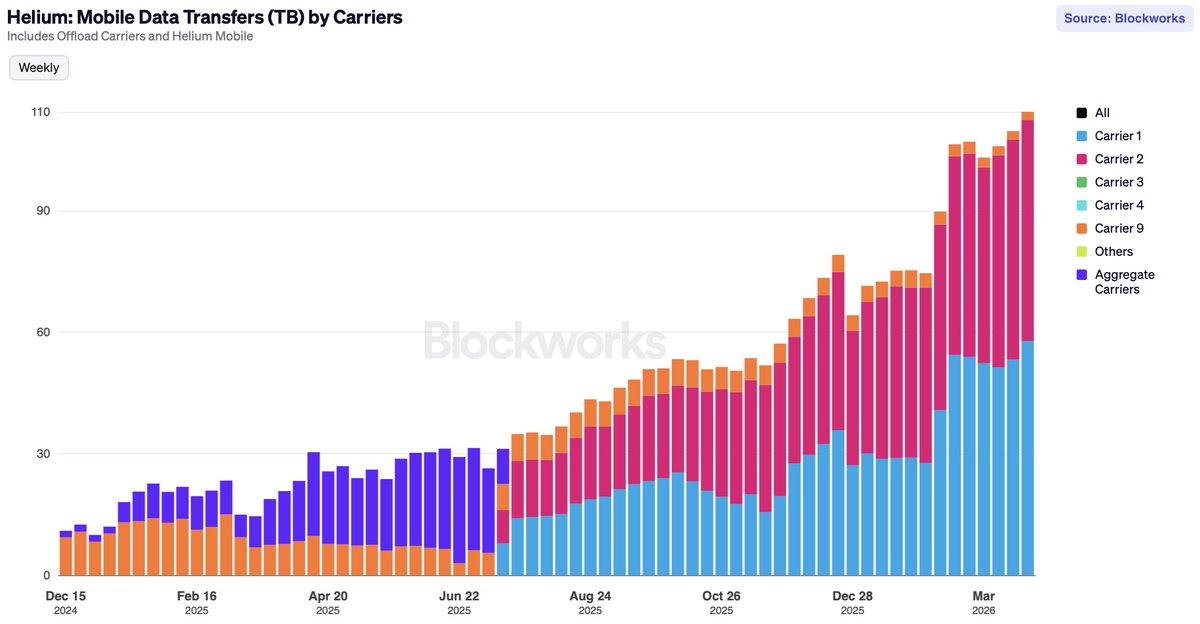
Another week of ATH for Helium's Mobile Data Transfers by Carriers. Their partnership with AT&T and ongoing growth as an MVNO on T-Mobile are proving the thesis of many DePIN critics wrong.
vik0nchain tweet media
English
1
0
5
238
vik0nchain
vik0nchain@vik0nchain·
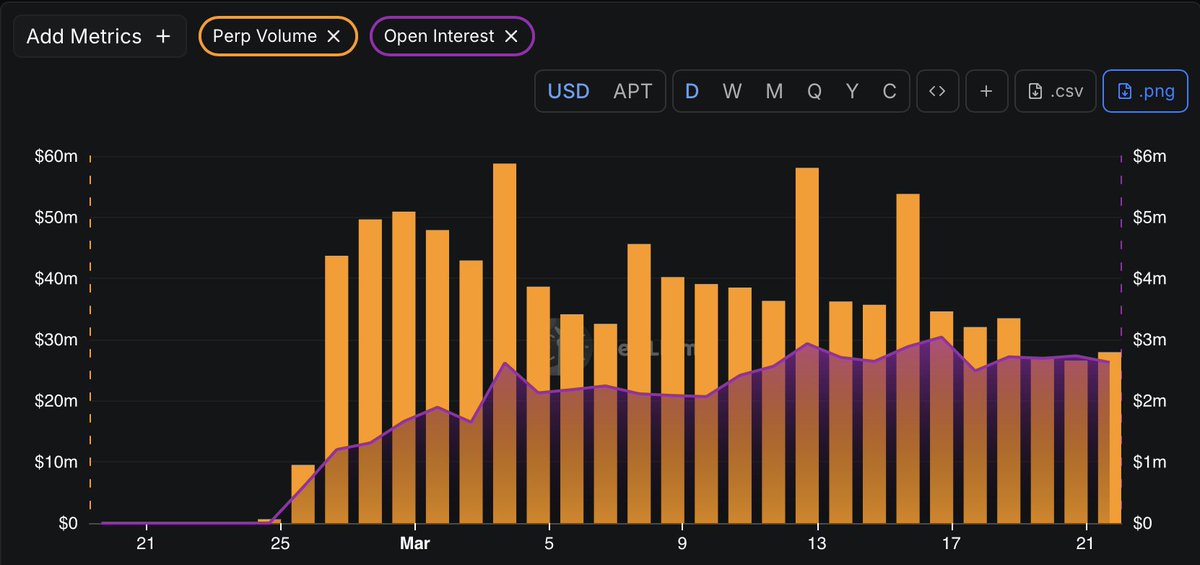
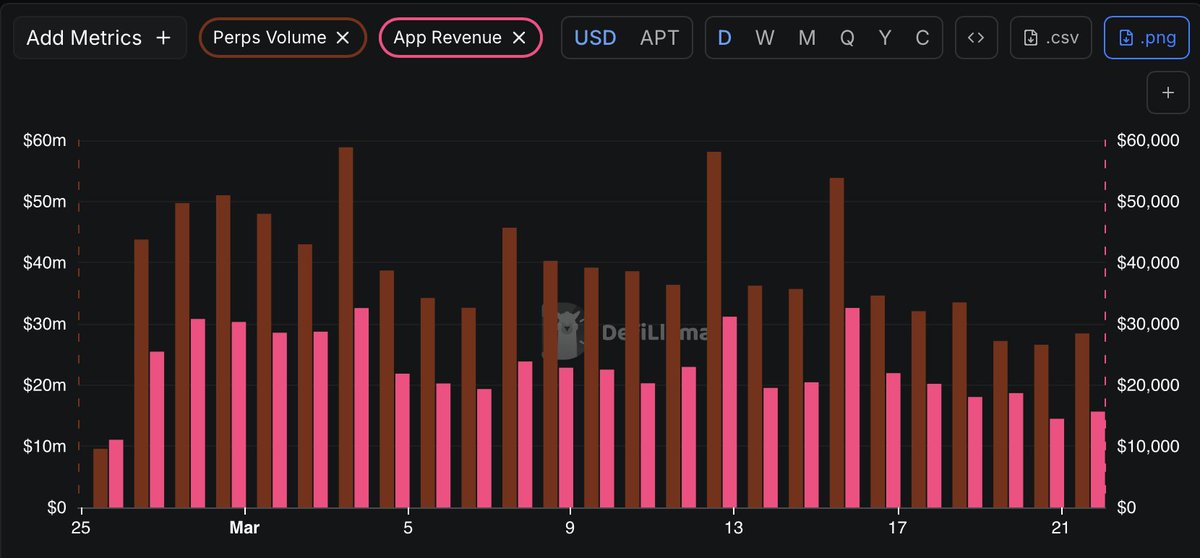
Aptos AIP 141 also arbitrarily 10x their gas fee a few days ago. Prior to that, they didnt break top 35 in this list. Shifting the burden of bad tokenomics from holders to traders by increasing gas is a step in the wrong direction. Framing that change as a growth in trading and derivatives is even worse. While Aptos leading Perp DEX Decibel's OI and volume have held up, Aptos App Revenue has actually DECREASED since the 10x hike in gas fee passed.
vik0nchain tweet mediavik0nchain tweet media
Logan Jastremski@LoganJastremski

Aptos has shifted focus to trading which is the highest revenue driver for blockchains It's early, but keep an eye on their progress

English
1
2
9
2.5K
Perp Pulse Tools
Perp Pulse Tools@PerpPulseTool·
@vik0nchain @gmtrade_xyz RWA perps on Solana is a massive unlock. Gold and Silver are just the start. Imagine Oil, Natural Gas, or even agricultural commodities onchain with <1s settlement. The TAM for commodity perps dwarfs crypto-only pairs.
English
1
0
2
45
vik0nchain
vik0nchain@vik0nchain·
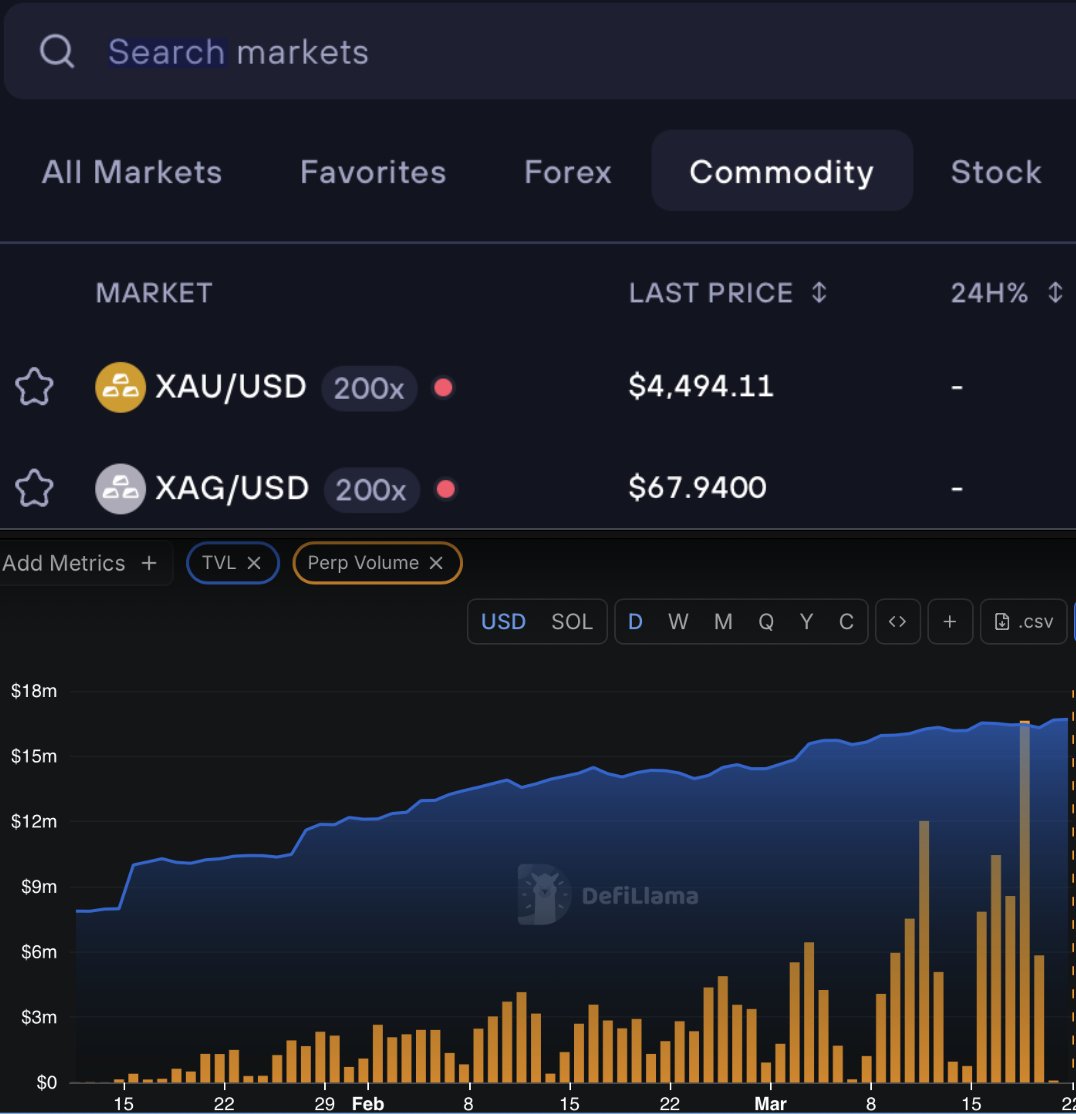
The demand for RWA Perps is Absurd. @gmtrade_xyz just became the leading Perp DEX in 24hr Vol on Solana by being the only venue to offer commodity Perps. The crazy part? The only commodity pairs they offer: Gold and Silver. Steady growth since January. What happens when Oil gets listed.
vik0nchain tweet media
SolanaFloor@SolanaFloor

🚨BREAKING: @gmtrade_xyz, a Solana based perp DEX for RWA trading, has become the top perp DEX on the network by 24H volume, with open interest also rising. The platform has seen steady growth in trading volume since January 2026.

English
1
0
5
209
vik0nchain retweetledi
blade
blade@bl8_runner·
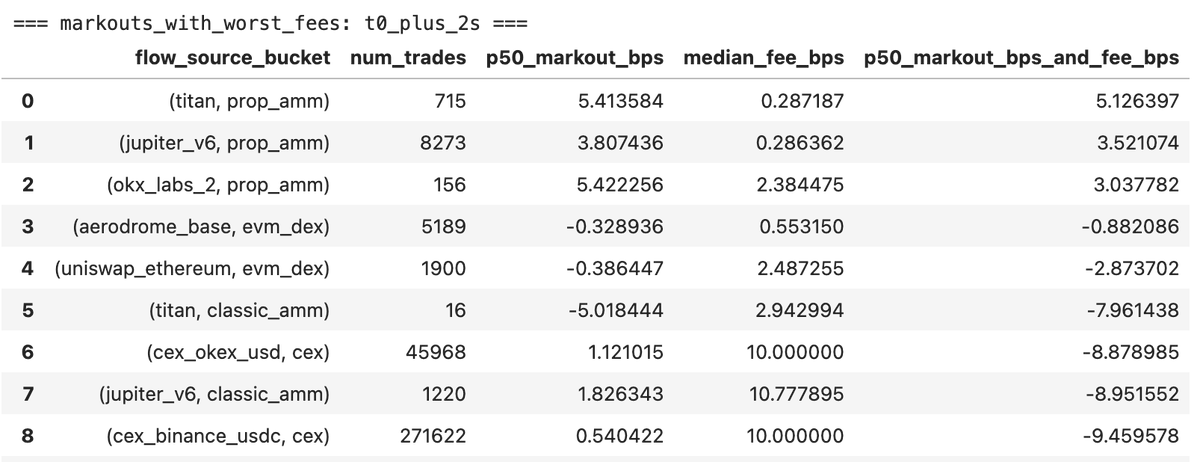
the best place to trade ETH is on Solana the median retail trade on Solana got 4-6 bps better price than on Base and 6-8bps better than on EthL1
blade tweet media
English
25
33
220
98.5K
vibhu
vibhu@vibhu·
Contrarian and admittedly biased thesis: The long term game to win in crypto is spot, not perps. Perps is volume king. Looks impressive but is often reflexive and hollow. Tons of arb, leverage cycling, etc. and not ultra high value. Spot is the network state/economy builder: native assets enable lending markets, LP pools, payments, neobanks, wallets, and many other composable use cases (inclusive of perps btw). Asset gravity > Trading velocity
English
52
11
202
11.2K
vik0nchain
vik0nchain@vik0nchain·
My biggest critique of @ArcherExchange_ thus far was liquidity fragmentation across continuous and async. They just solved it. You now have a fully on-chain CLOB on Sol that protects against toxic flow under unified liquidity. Wen Percolator integration for perps? 👀
Dhrumil@mmdhrumil

Introducing Hybrid Markets on @ArcherExchange_ Hybrid markets offers both maker prioritization on Solana AND are composable with all of DeFi at the same time

English
1
0
6
229
Jordi in Cryptoland
Jordi in Cryptoland@lordjorx·
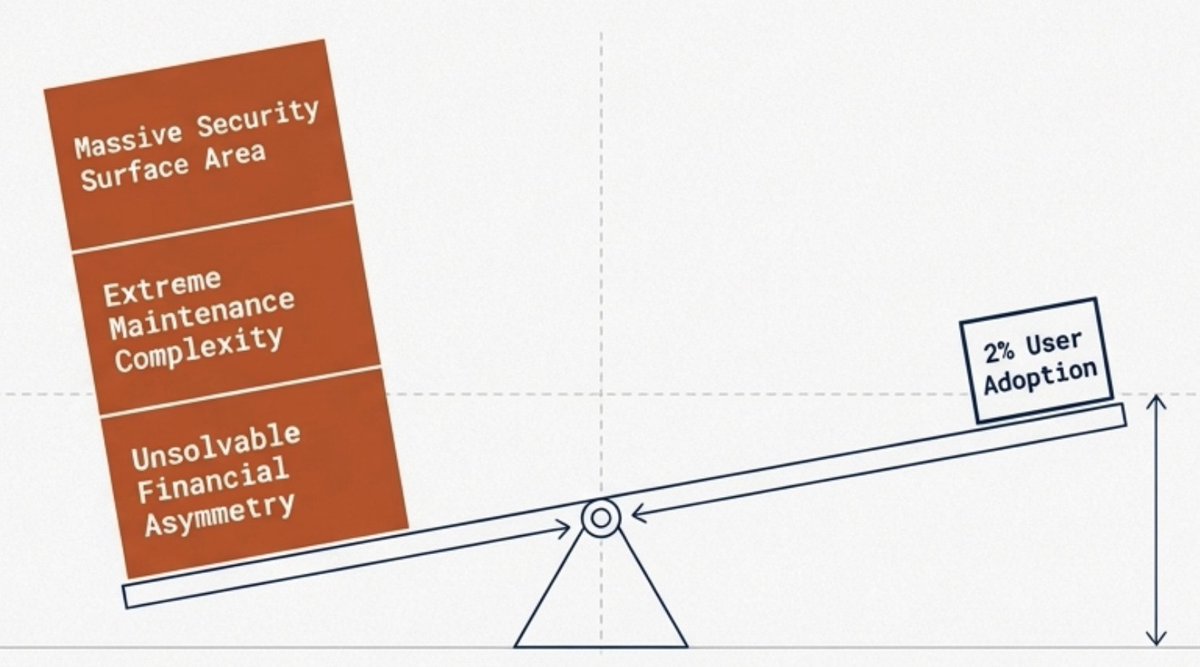
Why Aave eliminated fixed rates. The biggest lending protocol in DeFi decided to stop offering stable rates and it wasn't a random choice. I did some research with @DefiLlama AI and this is what I learned today: A critical vulnerability was found in November 2023 in the stable rate module of @aave V2 and V3. To protect the protocol and all its forks, the developers decided to delete the feature. No money was lost, but the risk of a future hack was too high. Beyond security, the model had deep structural flaws: > Rates weren't truly fixed. They were "semi-fixed." If market conditions got worse, the protocol could force a rate hike on borrowers. > The function to rebalance rates was public. This meant an attacker could use flash loans to create artificial liquidity crises and manipulate rates for their own profit. > Lenders in Aave always earn variable rates. If those rates spiked, the protocol ended up paying more to lenders than what it collected from fixed-rate borrowers. The protocol was losing money. On top of these risks, the market simply didn't care. Only 2% of users used stable rates because they were often twice as expensive as variable rates. In DeFi, simplicity is security. As the market matures, it might finally be the right time to start introducing these mechanisms more thoughtfully.
Jordi in Cryptoland tweet media
English
4
3
43
4.1K
vik0nchain
vik0nchain@vik0nchain·
@TheDesertLynx Agreed. Any other amplifiers that you've thought through show promise?
English
1
0
2
26
Joel Valenzuela
Joel Valenzuela@TheDesertLynx·
@vik0nchain My view is it should primarily be stake, with other elements as limited amplifiers. I would think that the currently-invested actors should be the biggest decision-makers. Anything that imbalances that throws off the economics of the system.
English
1
0
1
30
tim-clancy.eth
tim-clancy.eth@_Enoch·
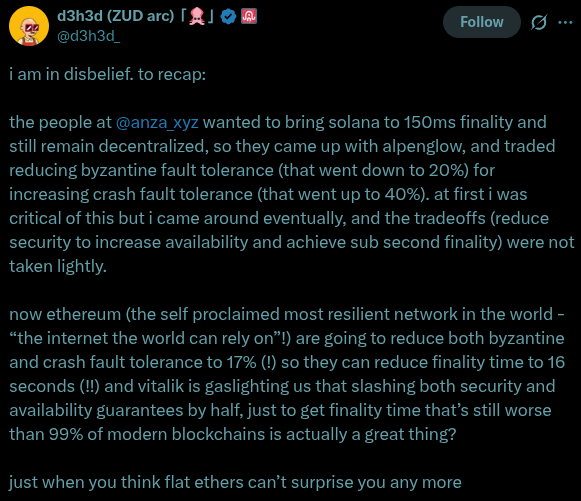
Let us correct disingenuous alt-L1 slop. Some facts: 1. Ethereum doesn't have crash faults; the finality gadget isn't like Tendermint. By design, in pursuit of maintaining 100% uptime, Ethereum continues producing blocks even if it cannot finalize. When we cannot finalize, the inactivity leak steps in to provide a self-healing mechanism and restore finality. 2. The absolute worst case scenario for Ethereum is an attacker unilaterally finalizing a block without being automatically slashed for it. This is part of why effective client diversity is the crown jewel of Ethereum and we work so hard to maintain it: there is currently no supermajority client. A single client software bug does not become a protocol bug. 3. There exist different numbers for the amount of stake an attacker needs to a) delay finality, b) unilaterally finalize without getting slashed, and c) unilaterally finalize during extreme network asynchrony while getting slashed. Therefore: The a) number is a self-correcting through inactivity leak; Ethereum continues without disruption and the attacker bleeds stake rapidly until finality is restored. The b) number is our worst case scenario. The c) number is only applicable during the worst possible network asynchrony. Honest validators must be perfectly split into two partitions that cannot communicate with one another at all, while all of an attacker's validators can still communicate with both partitions of honest validators. This is alone is a very unlikely scenario. The attacker in this scenario finalizes different blocks in each partition. This is attributable equivocation, so once the network heals and connectivity is restored the attacker's stake is destroyed. They leave the network in a rough spot, but they are automatically slashed for their troubles. The current Ethereum numbers are a) 33%+1, b) 66%+1, and c) 33%+1. Now we can talk about Minimmit. The numbers for Minimmit are a) 17%+1, b) 83%+1, and c) 17%+1. As you can see, we have actually improved defense against our worst case scenario. The attacker has an easier time in a) of delaying finality or c) of equivocating under perfectly bad network conditions, but the attacker is automatically slashed for both of those situations. Lastly, Ethereum might not even pursue this specific design for faster finality. It sounds like a good one, but there are competing options and this is a public discussion for a reason. What is the key takeaway here? The future of Ethereum is brighter than ever no matter pollution trickles out of the industrial falsehood factories. Alt-L1 concern for Ethereum's decentralization is always appreciated, but they should consider extinguishing their dumpster fires first. Maybe they could start by having slashing.
tim-clancy.eth tweet media
English
10
21
128
7.9K
vik0nchain
vik0nchain@vik0nchain·
The extent to which a hybrid PoS and DPoAFS would be applied could have major implications as well. Balancing stake + lockup with the addition of fee's would provide a more balanced approach enabling new entrants who (commit to long term alignment) to gain meaningful stake alongside longstanding fee contributors.
English
1
0
2
21
Joel Valenzuela
Joel Valenzuela@TheDesertLynx·
I'm not sure how the per-day spending cap would be set, I intentionally left it vague because I didn't come up with something specific in time. Regarding outsized influence by market makers/algo/agentic users, unfortunately, if they're the biggest users/stakeholder in the network, I think they should be represented as such. Otherwise, you'd have to game the system against the strongest users and the biggest investors, in which case you get a misalignment similar to PoW. If giving certain large companies control over a network is seen as undesirable, I'd probably suggest that the real problem is building a chain that's more useful to these companies than "regular users" to begin with. Or, maybe programmatic chains will always end up this way, and should be seen more as semi-decentralized "companies," whereas monetary-only networks can be viewed as decentralized digital cash. 🤔
English
1
0
2
61
Umberto | Mostly Data 🧙‍♂️
Cost per bps is not just telling us that “waiting longer is expensive”. If longer gaps were mostly intentional, bucket behaviour should be broadly similar. But that is not what we see. When stale risk is low, overwriting an old quote should be cheap per bps. If instead updates are sent frequently but fail to get executed, then even tiny price moves become expensive to maintain. Splitting by scheduler shows that the effect is not uniform. Different schedulers impose different operational costs on the propAMM. And while rev strat (WaitUpTo) is obviously damaging, the data are showing differences even between streaming and batching: we can now reason about a measure of which scheduler is best.
English
1
0
10
749
vik0nchain
vik0nchain@vik0nchain·
@dktrpo @jito_sol @solana Afaik the longterm ICM roadmap aims to enshrine a new implementation of ACE. BAM, Harmonic, and Rakurai are thus transitional intermediaries to study ahead of native implementation.
English
0
0
0
32
Dorax ⚛️
Dorax ⚛️@dktrpo·
@jito_sol How can execution be predictable, unless A. @Solana enshrines one particular scheduler; or B. The jito scheduler gets like 99% adoption among validators Which one are you guys betting on?
English
1
0
3
62