Vincent Maher

3.7K posts

Vincent Maher banner
Vincent Maher

Vincent Maher

@vincent_maher

CEO at Broadbrand | Executive at Digital Solutions Group

Metaverse Katılım Nisan 2008
641 Takip Edilen2.2K Takipçiler
Vincent Maher
Vincent Maher@vincent_maher·
Beat and Order returns on Spotify🚀 Weekly drops of deep, dark techno and minimal. Beat and Order 001 features new releases from Maksim Dark, Chris Liebing, Deepak Sharma and more. Fresh tracks, hypnotic basslines, and refined energy every week. open.spotify.com/playlist/6BLFX…
Vincent Maher tweet media
English
0
0
0
77
Vincent Maher retweetledi
Elon Musk
Elon Musk@elonmusk·
Wow
Steve Jurvetson@FutureJurvetson

The Moore's Law Update NOTE: this is a semi-log graph, so a straight line is an exponential; each y-axis tick is 100x. This graph covers a 1,000,000,000,000,000,000,000x improvement in computation/$. Pause to let that sink in. Humanity’s capacity to compute has compounded for as long as we can measure it, exogenous to the economy, and starting long before Intel co-founder Gordon Moore noticed a refraction of the longer-term trend in the belly of the fledgling semiconductor industry in 1965. I have color coded it to show the transition among the integrated circuit architectures. You can see how the mantle of Moore's Law has transitioned most recently from the GPU (green dots) to the ASIC (yellow and orange dots), and the NVIDIA Hopper architecture itself is a transitionary species — from GPU to ASIC, with 8-bit performance optimized for AI models, the majority of new compute cycles. There are thousands of invisible dots below the line, the frontier of humanity's capacity to compute (e.g., everything from Intel in the past 15 years). The computational frontier has shifted across many technology substrates over the past 128 years. Intel ceded leadership to NVIDIA 15 years ago, and further handoffs are inevitable. Why the transition within the integrated circuit era? Intel lost to NVIDIA for neural networks because the fine-grained parallel compute architecture of a GPU maps better to the needs of deep learning. There is a poetic beauty to the computational similarity of a processor optimized for graphics processing and the computational needs of a sensory cortex, as commonly seen in the neural networks of 2014. A custom ASIC chip optimized for neural networks extends that trend to its inevitable future in the digital domain. Further advances are possible with analog in-memory compute, an even closer biomimicry of the human cortex. The best business planning assumption is that Moore’s Law, as depicted here, will continue for the next 20 years as it has for the past 128. (Note: the top right dot for Mythic is a prediction for 2026 showing the effect of a simple process shrink from an ancient 40nm process node) ---- For those unfamiliar with this chart, here is a more detailed description: Moore's Law is both a prediction and an abstraction. It is commonly reported as a doubling of transistor density every 18 months. But this is not something the co-founder of Intel, Gordon Moore, has ever said. It is a nice blending of his two predictions; in 1965, he predicted an annual doubling of transistor counts in the most cost effective chip and revised it in 1975 to every 24 months. With a little hand waving, most reports attribute 18 months to Moore’s Law, but there is quite a bit of variability. The popular perception of Moore’s Law is that computer chips are compounding in their complexity at near constant per unit cost. This is one of the many abstractions of Moore’s Law, and it relates to the compounding of transistor density in two dimensions. Others relate to speed (the signals have less distance to travel) and computational power (speed x density). Unless you work for a chip company and focus on fab-yield optimization, you do not care about transistor counts. Integrated circuit customers do not buy transistors. Consumers of technology purchase computational speed and data storage density. When recast in these terms, Moore’s Law is no longer a transistor-centric metric, and this abstraction allows for longer-term analysis. What Moore observed in the belly of the early IC industry was a derivative metric, a refracted signal, from a longer-term trend, a trend that begs various philosophical questions and predicts mind-bending AI futures. In the modern era of accelerating change in the tech industry, it is hard to find even five-year trends with any predictive value, let alone trends that span the centuries. I would go further and assert that this is the most important graph ever conceived. A large and growing set of industries depends on continued exponential cost declines in computational power and storage density. Moore’s Law drives electronics, communications and computers and has become a primary driver in drug discovery, biotech and bioinformatics, medical imaging and diagnostics. As Moore’s Law crosses critical thresholds, a formerly lab science of trial and error experimentation becomes a simulation science, and the pace of progress accelerates dramatically, creating opportunities for new entrants in new industries. Consider the autonomous software stack for Tesla and SpaceX and the impact that is having on the automotive and aerospace sectors. Every industry on our planet is going to become an information business. Consider agriculture. If you ask a farmer in 20 years’ time about how they compete, it will depend on how they use information — from satellite imagery driving robotic field optimization to the code in their seeds. It will have nothing to do with workmanship or labor. That will eventually percolate through every industry as IT innervates the economy. Non-linear shifts in the marketplace are also essential for entrepreneurship and meaningful change. Technology’s exponential pace of progress has been the primary juggernaut of perpetual market disruption, spawning wave after wave of opportunities for new companies. Without disruption, entrepreneurs would not exist. Moore’s Law is not just exogenous to the economy; it is why we have economic growth and an accelerating pace of progress. At Future Ventures, we see that in the growing diversity and global impact of the entrepreneurial ideas that we see each year — from automobiles and aerospace to energy and chemicals. We live in interesting times, at the cusp of the frontiers of the unknown and breathtaking advances. But, it should always feel that way, engendering a perpetual sense of future shock.


QST
1.6K
3.5K
28.6K
11.8M
Vincent Maher retweetledi
Brian Armstrong
Brian Armstrong@brian_armstrong·
Can confirm this is true. It was one of the most unethical and un-American things that happened in the Biden administration, and my guess is we'll find Elizabeth Warren's fingerprints all over it (Biden himself was probably unaware). We're still collecting documents via FOIA requests, so hopefully the full story emerges of who was involved and whether they broke any laws. Warren and Gensler tried to unlawfully kill our entire industry, and it was a major factor in the Dems losing the election. The Democratic party should realize Warren is a liability and further distance themselves if they want to have any hope of rebuilding.
Elon Musk@elonmusk

Did you know that 30 tech founders were secretly debanked?

English
1.5K
7.1K
44.9K
4.2M
Vincent Maher retweetledi
Raoul Pal
Raoul Pal@RaoulGMI·
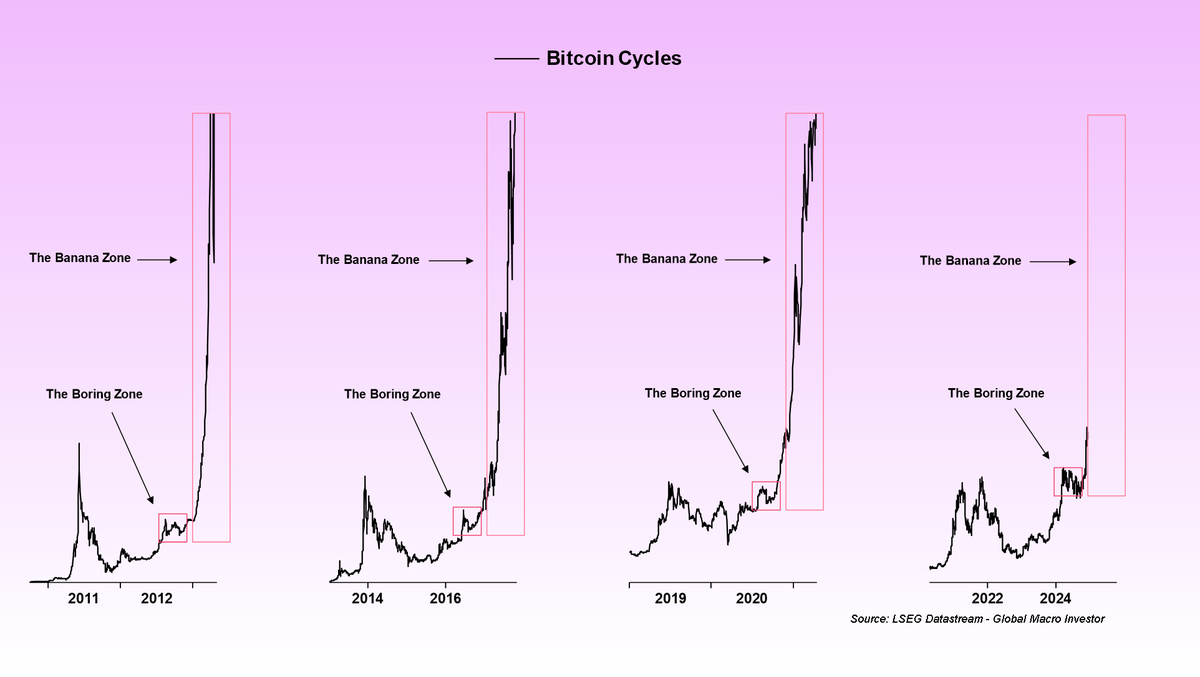
Seems like the Banana Zone wasn't such a stupid idea..plenty more to come, over time (with plenty of sharp corrections too along the way). Strap in. 🍌🍌🍌
Raoul Pal tweet media
English
305
774
6K
441.2K
Vincent Maher retweetledi
David Marcus
David Marcus@davidmarcus·
How Libra Was Killed. I never shared this publicly before, but since @pmarca opened the floodgates on @joerogan’s pod, it feels appropriate to shed more light on this. As a reminder, Libra (then Diem) was an advanced, high-performance, payments-centric blockchain paired with a stablecoin that we built with my team at @Meta. It would’ve solved global payments at scale. Prior to announcing the project, we spent months briefing key regulators in DC and abroad. We then announced the project in June 2019 alongside 28 companies. Two weeks later, I was called to testify in front of both the Senate Banking Committee and the House Financial Services Committee, which was the starting point of two years of nonstop work and changes to appease lawmakers and regulators. By spring of 2021 (yes they slow played us at every step), we had addressed every last possible regulatory concern across financial crime, money laundering, consumer protection, reserve management, buffers, and so much more, and we were ready to launch. We had worked on a slow rollout of a limited pilot that some members of the Fed’s Board of Governors were supportive of. At last, Chair Jay Powell was ready to let us move forward in a limited way. The story, as I heard it, is that Jay Powell was told by Treasury Secretary Janet Yellen at one of their biweekly meetings that allowing this project to move forward was “political suicide,” and she would not have his back if he let it happen. I wasn’t in the room when this conversation happened, so take these words with a grain of salt, but effectively this was the moment Libra was killed. Shortly thereafter, the Fed organized calls with all the participating banks, and the Fed’s general counsel read a prepared statement to each of them, saying: “We can’t stop you from moving forward and launching, but we are not comfortable with you doing so.” And just like that, it was over. One essential point is worth making here. There was no legal or regulatory angle left for the government or regulators to kill the project. It was 100% a political kill—one that was executed through intimidation of captive banking institutions. That was the hardest part of this story for me personally. Not that we had failed, but that America, this country I immigrated to and became a proud citizen of because of its rule of law and value system, behaved in such a way for political reasons. It was a very tough pill to swallow. The bright side of the story, though, was the many learnings from this wild ride. By the end of the project, we had made so many concessions to get a thumbs-up that the whole design of the network became a Frankenstein of our initial ambitions. We also learned the biggest lesson of all, which is that if you’re trying to build an open money grid for the world—eventually moving trillions of dollars a day, designed to be here 100 years from now—you have to build it on the most neutral, decentralized, unassailable network and asset, which, hands down, is Bitcoin. And now this is what many of us who went through this scarring journey are building together at @Lightspark. And this time, we won’t stop until we get it done!
English
1.2K
4K
21.6K
5.3M
Vincent Maher retweetledi
Jeremy Kuo
Jeremy Kuo@jeremykuoo·
Back in the 1950s, Marlboro went from a failing company to the world's #1 cigarette brand in four years. They created a muscular and rough cowboy who answered to no one - the ultimate symbol of masculinity. Here's how Marlboro manipulated an entire country.
Jeremy Kuo tweet media
English
13
32
172
78K
Vincent Maher retweetledi
Brendan McCord 🏛️ x 🤖
Brendan McCord 🏛️ x 🤖@Brendan_McCord·
45 hours vs. 45 seconds. That's the gap between how long our essay contest runner-up spent crafting his submission and how long an AI would take to imitate it. But in that 3,600x difference lies a fascinating question about the future of human thought.
Brendan McCord 🏛️ x 🤖 tweet media
English
2
15
69
34K
Vincent Maher retweetledi
chris ₿ 🇨🇭
chris ₿ 🇨🇭@chrisb_btc·
I really like the newly unveiled statue of Satoshi Nakamoto in #Lugano. Especially the way it honors privacy. Depending on the perspective, it disappears. #PlanBForum #privacy 🇨🇭
English
291
2K
14.8K
1M
Vincent Maher retweetledi
Peter Yang
Peter Yang@petergyang·
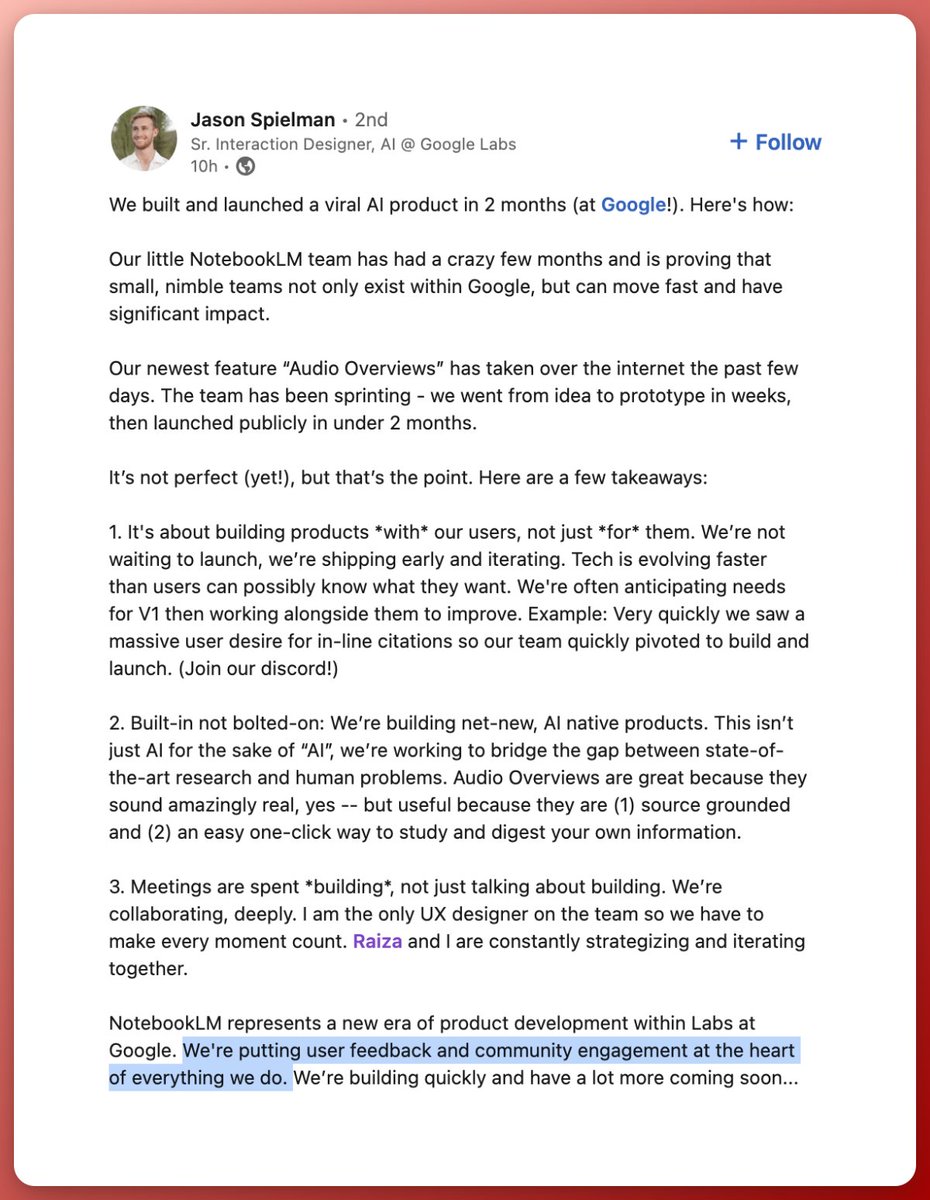
Google needs more of teams like the NotebookLM team. 1. Build products with users, not for users 2. Don't build AI for the sake of AI 3. Spend meetings building, not talking about building I genuinely believe the best products are built by small, empowered teams (even in big tech).
Peter Yang tweet media
English
28
142
1.3K
167.8K
Z Fellows
Z Fellows@zfellows·
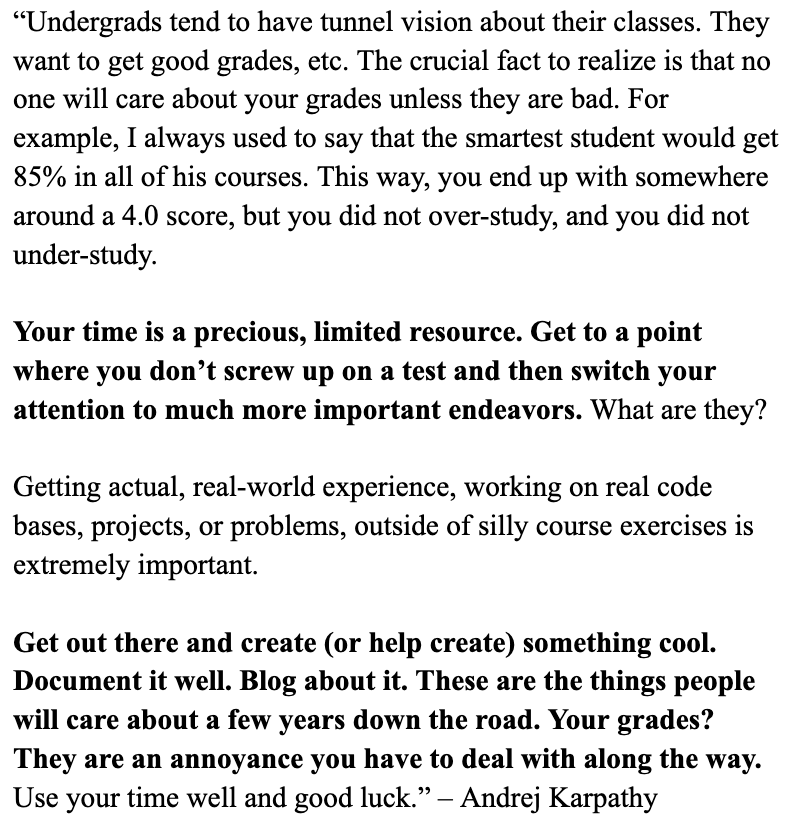
Andrej Karpathy's advice for ambitious college students
Z Fellows tweet media
English
27
274
2.4K
210.2K
Vincent Maher retweetledi
Kpaxs
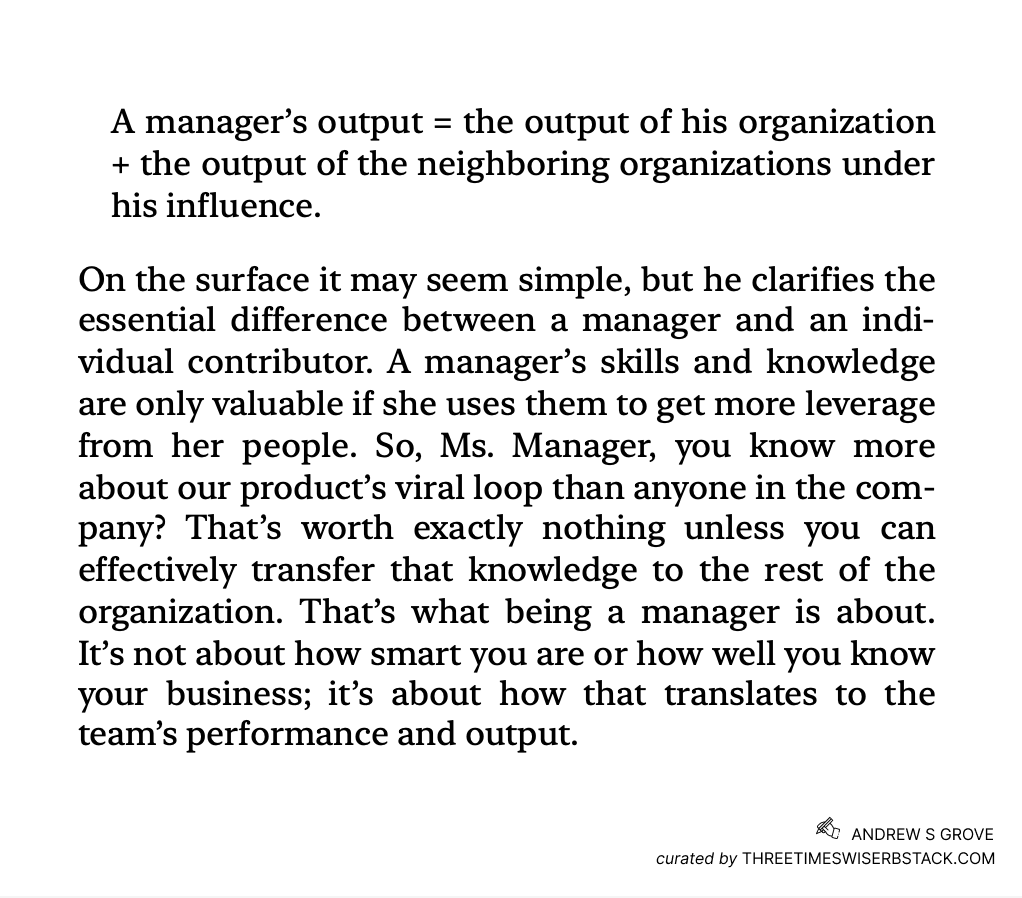
Kpaxs@Kpaxs·
Probably the best thing that was ever written on management.
Kpaxs tweet media
English
4
75
655
64.8K
Vincent Maher retweetledi
Robert Yang
Robert Yang@GuangyuRobert·
Introducing Project Sid: the first simulations of 1000+ truly autonomous agents collaborating in a virtual world, w/ emergent economy, culture, religion, and government Humans are the only species to land the moon, because we can cooperate at a vast scale Can AI do the same?
English
273
943
4.5K
1.1M
Vincent Maher retweetledi
Justine Moore
Justine Moore@venturetwins·
AI is bringing back creatures of the deep, and they're kind of sick (from u/edwardtracy)
English
111
798
6.2K
400.3K
Vincent Maher retweetledi
Ben Lang
Ben Lang@benln·
The condensed @pmarca guide to career planning:
Ben Lang tweet media
English
10
152
2K
443.4K
Vincent Maher retweetledi
Elon Musk
Elon Musk@elonmusk·
ZXX
24K
128.5K
2M
177.1M