Voxilens
158 posts

Voxilens
@voxilens
The Africa Report. Business • Tech • Critical Minerals. The intersection of Africa’s natural wealth and digital future. Join the journey to $7T:
Africa Katılım Nisan 2026
95 Takip Edilen7 Takipçiler

@moneyacademyKE This has crippled the national budget, with debt servicing now consuming roughly 70% of all ordinary revenue collected.
English

@Sophie_Mokoena Geographically, the Democratic Republic of the Congo (DRC) is located in Central Africa. However, politically and economically, the DRC is in East Africa.
English

@chothep @moneyacademyKE It's actually the fear of most anonymous people.
English

@voxilens @moneyacademyKE Plausible but camouflage. It's all about controlled info and it's outreach
English

@moneyacademyKE An increase in diesel prices is an automatic increase in electricity
English

While they avoid a formal alliance to protect their own independent interests and avoid secondary sanctions, they are heavily aligned against United States global influence
Russian Embassy in South Africa 🇷🇺@EmbassyofRussia
🇷🇺🇨🇳 At the invitation of President of China Xi Jinping, President of Russia Vladimir Putin will pay an official visit to China on May 19-20 The visit is timed to coincide with the 25th anniversary of the signing of the Treaty of Good-Neighbourliness, Friendship and Cooperation
English

@Sophie_Mokoena These two avoid a formal alliance to protect their own independent interests and avoid secondary sanctions, they are heavily aligned against United States global influence
English


@moneyacademyKE What happens if Elon Musk refuses to comply with the 90-day office directive?
English

@moneyacademyKE Kenya’s fuel prices are usually higher than those in other East African countries because of a combination of taxes, import systems, exchange rates, and government policy choices. Not just the global oil price itself.
English

@CyrilRamaphosa The government should tackle xenophobic attacks. It's shameful to a respected country like SA to chase away investors. Let's learn from the developed world
English

We are working to tackle poverty and address the high cost of living that is putting strain on individuals and households, particularly the poor and vulnerable.
#PeoplesParliament
x.com/i/broadcasts/1…
English

@BravinYuri Also, talk about the long-term impacts of AI on human cognition. We might celebrate efficiency but our your kids are losing it, we're overlooking the erosion of key cognitive human behaviors.
English

There is something I have been observing for a long time now and the more I watch society evolve, the more the pattern keeps revealing itself.
We once lived in a world where paper was central to knowledge. Libraries existed everywhere, shelves were filled with books, newspapers circulated freely, and people physically owned information.
You could hold knowledge in your hands, store it in your house, pass it down to your children, underline pages, revisit ideas decades later, and no one could alter what was written on your copy unless they physically took it from you.
Then industries like Pan Paper collapsed and slowly, the foundation of paper culture began weakening.
Next came the rapid rise of technology. Audiobooks emerged. PDFs became common. Soft copies became the norm. Social media shortened attention spans. Video replaced reading. Entire generations began consuming information in fragments rather than in depth.
Today, many people barely read complete books anymore. A headline, a short clip, or a summarized thread is enough to shape opinions.
Technology then pushed deeper into schools. Notes became digital. Assignments moved online. Tablets and screens started replacing exercise books in some places. And if you remember in Kenya we were even scammed under the laptop project. Saitan! Cloud storage has become more important than physical archives. Step by step, society is normalizing the idea that knowledge no longer needs to physically exist.
Then came the global climate change push. Save trees. Reduce paper usage. Digitize systems. Go green. And while environmental conservation is important, I cannot ignore the direction this pattern seems to be taking.
What happens when environmental arguments, technological dependence, and policy-making eventually merge into one?
I believe a time may come when governments and institutions will begin pushing directives, much like the Type C charger transition for iPhone, where physical books are gradually phased out in the name of efficiency, modernization, and environmental conservation. It will sound progressive. It will sound necessary. It will sound responsible.
At first, people will celebrate the convenience.
“Why carry books when everything is online?”
“Why cut trees for paper?”
“Why print when a tablet can store thousands of books?”
But convenience often hides dependency. Because once society fully depends on digital access for knowledge, ownership of information changes completely. You no longer truly own knowledge. You merely access it through systems controlled by corporations, governments, internet providers, and digital platforms.
A physical book in your house cannot suddenly disappear because someone changed a server policy. A printed page cannot be remotely edited overnight. But digital information can be altered silently, restricted instantly, or erased completely without most people even noticing.
And that is where my concern deepens.
A future where hard-copy books become rare is also a future where access to information becomes conditional. To read, you may need subscriptions. To research, you may need internet access. To learn history, you may need approval from centralized platforms. Knowledge slowly stops being a right and starts becoming a controlled service.
Then comes the most dangerous part of all: the rewriting of history.
History has always been shaped by those with power, but physical archives created resistance against total manipulation because old books, newspapers, and documents remained scattered across homes, libraries, and institutions worldwide. They became evidence that could not easily be erased.
But in a fully digital world, information becomes fluid. Edits become invisible. Narratives can be adjusted gradually. Uncomfortable truths can disappear from search engines. Entire generations may grow up only knowing the version of reality that algorithms choose to prioritize.
English

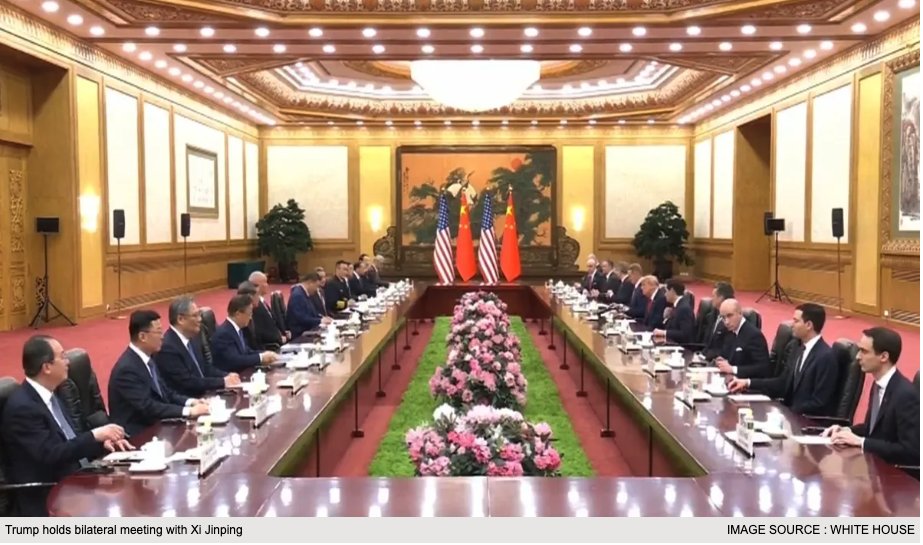
NOW: President Trump departed China aboard Air Force One, wrapping up his two-day summit with Chinese President Xi Jinping.
A brief ceremony was held on the tarmac before his return flight to the U.S.
Trump touted “fantastic trade deals” following his meetings and said the two leaders were aligned on Iran.
English

@Sophie_Mokoena Military strategy, tariffs, technology, security — are often staged around authority and hierarchy. Governments tend to send senior officials from defense, commerce, intelligence, or party structures, fields where women remain underrepresented globally.
English


@BRICSinfo China is definitely a superpower, Trump had to humble himself
English