Vrinda Kapoor

321 posts

Vrinda Kapoor banner
Vrinda Kapoor

Vrinda Kapoor

@VrindaKa

Building for the world, from Bharat

New Delhi, India Katılım Ağustos 2023
130 Takip Edilen424 Takipçiler
Vrinda Kapoor retweetledi
The Curious Tales
The Curious Tales@thecurioustales·
The average person gets exactly 3 opportunities to completely reinvent their life. Ancient Greeks described it aptly. They had two words for time. 1. Chronos meant the ticking of clocks, the mechanical progression of minutes and hours. 2. Kairos meant the decisive moment, the pregnant instant when everything pivots on a single choice. They understood something we've forgotten: "Transformation happens in kairos not in chronos." Most people spend their entire lives waiting for more opportunities than they'll actually receive. Let's do the math. Career reinvention, relationship transformation, geographic freedom, creative expression, wealth building, identity evolution, anuything - you pick any dimension of human experience and you'll find the same pattern. Three inflection points where you either lean into radical discomfort or retreat into familiar patterns. Three moments of kairos that determine everything else. What makes this psychologically brutal is that most people can identify their three opportunities with surgical precision. The person stuck in corporate servitude knows exactly when they could have started freelancing, launched the business, or switched industries. The person trapped in surface level relationships knows precisely when they could have ended the draining connections and pursued deeper intimacy. The clarity exists. The paralysis exists alongside it. But, we've been programmed to believe opportunities are infinite, that transformation happens gradually through small improvements compounding over decades. This creates a psychological buffer that lets us avoid the reality of how change actually operates in human systems. Reinvention happens in discrete jumps triggered by binary choices during narrow windows of possibility. You either relocate to the city where your industry exists or you don't. You either end the relationship that's consuming your emotional bandwidth or you don't. You either quit the job that's killing your soul and start building something meaningful or you don't. Everything between kairos moments is just elaboration on the direction you already chose. Each opportunity carries an expiration date. The window where you could have moved to New York closes when family obligations solidify. The relationship you could have ended becomes harder to escape as shared commitments accumulate. The business you could have started becomes less viable as your risk tolerance decreases with age. Ancient philosophers called this the paradox of becoming. To become who you're meant to be, you must cease being who you currently are. But you can only make that transition from your current position. You need your present self to destroy your present self. 99% of us recognize our three opportunities only in retrospect, after the windows have closed. The reason is identity preservation. Your current self will fight against decisions that threaten its existence, even when those decisions obviously lead to better outcomes. The version of you that makes radical changes is not the same version that was avoiding them. The math is that a three-step opportunity structure ignites an exponential change. Each move adds momentum and expands your entire possibility space. Relocating opens new circles, fresh opportunities, and new versions of yourself, helping you spot the next opportunities sooner and pursue them with greater impact. Kairos moments compound. One decisive choice creates conditions where the next decisive choice becomes inevitable. The people living completely different lives aren't necessarily smarter or more talented. They just reached the point where avoiding their three opportunities became more painful than seizing them. Every day you postpone recognition of your current opportunity, you're not staying neutral. You're actively choosing to remain the person who doesn't capitalize on kairos when it arrives. Missed opportunities don't return in identical forms. The specific combination of circumstances, resources, and readiness that creates each reinvention window is unique. Your three opportunities are finite. Whether you use them determines everything else. Agree?
Darshak Rana ⚡️@thedarshakrana

x.com/i/article/2039…

English
6
117
613
68.9K
Vrinda Kapoor retweetledi
Shanaka Anslem Perera ⚡
A Patriot missile costs four million dollars. A Ukrainian Sting interceptor drone costs two thousand. Both destroy the same Shahed kamikaze drone. One of them can be manufactured at a rate of 10,000 units per month. The other cannot. And the country that invented the cheap one is now training Saudi, Emirati, and Qatari operators to use it against the exact same Iranian drones it was designed to kill in Ukrainian skies. Ukraine spent three years learning how to destroy Shaheds. Not with expensive air defence systems designed for Cold War scenarios but with small, fast, AI-assisted quadcopters that chase them down at 280 to 450 kilometres per hour, lock on with thermal imaging and computer vision, and ram them out of the sky or detonate a proximity charge at close range. The Sting, built by a volunteer unit called Wild Hornets, has destroyed over 3,000 Shaheds since May 2025. The Bullet, produced by SkyFall and General Cherry, reaches 450 kilometres per hour with AI-assisted terminal guidance. The success rate in Kyiv’s high-threat corridor reached 70 to 90 percent in February 2026, according to Ukrainian Air Force Commander Syrskyi. The mechanism is elegant. Sensors detect an incoming Shahed. An interceptor launches. A pilot wearing FPV goggles tracks the target using thermal imaging while AI handles detection, lock-on, and terminal-phase precision. The interceptor closes the speed gap at double or triple the Shahed’s velocity and destroys it through kinetic impact or proximity detonation. The pilot retains final manual control for jamming resistance. The entire engagement costs less than dinner for two in Dubai. Now Zelensky has turned this battlefield necessity into a geopolitical asset. Under defence pacts signed in March 2026, Ukrainian training teams are actively working with Gulf state militaries on co-production, operator training, and AI guidance module integration. The same drones that protect Kyiv from Russian Shaheds will protect Riyadh, Abu Dhabi, and Doha from Iranian ones. The technology is identical because the threat is identical: Iran manufactures the Shahed, Russia deploys it against Ukraine, and Iran deploys it against the Gulf. The supply chain of the weapon created the supply chain of the countermeasure. A country fighting for its survival against Russia is simultaneously becoming the Gulf’s primary anti-drone technology supplier during a war between the Gulf and Iran. Ukraine is broke, surrounded, and losing territory. It is also the only country on earth with three years of operational data on destroying Iranian kamikaze drones at scale. That data is worth more to Saudi Arabia right now than any weapons system America can sell, because America has never fought a sustained Shahed campaign. Ukraine has fought one every night for a thousand consecutive nights. Zelensky offered Russia an energy ceasefire. He offered sea drones for Hormuz. And he is selling drone-killing technology to the countries whose oil infrastructure those same drones are threatening. Ukraine is converting its most painful vulnerability, the nightly Shahed bombardment, into a revenue stream, a diplomatic lever, and a security partnership that binds Gulf states to Kyiv’s survival in ways no UN resolution ever could. The molecule meets the machine. The drone that threatens the refinery is destroyed by the drone that learned to kill it over Kyiv. The war that created the threat created the countermeasure. And the country nobody expected to matter in the Gulf is suddenly indispensable to it. Watch the intercept below. This is what a $2,000 drone killing a Shahed at 300 km/h looks like in real time. Read the full analysis - open.substack.com/pub/shanakaans…
English
88
868
3.5K
376.6K
Vrinda Kapoor retweetledi
Akshay Jogani
Akshay Jogani@kshayjogani·
News is focused on which camera brand replaces Hikvision. The more interesting story is who makes the chip inside the camera. Until 2019, that answer was overwhelmingly HiSilicon, Huawei's semiconductor arm that dominated surveillance SoCs globally. US sanctions killed that supply chain overnight and the entire industry moved to Ambarella, Novatek, and Sigmastar. India's CCTV ban accelerates the same logic one layer deeper. Not just who assembles the camera, but who designs the silicon. And that story is already further along than most people realize. L&T Semiconductor Technologies has signed a deal with CP Plus to supply indigenously designed Vision SoCs for 9 million IP cameras over three years. These aren't concept chips. They support 8MP imaging and this is the first time surveillance cameras will be made using chips from an Indian company. CP Plus is the largest domestic brand by market share, so this isn't a token pilot. Beyond L&T Semi, there are at least four more startups building surveillance SoCs under the government's Design Linked Incentive scheme. Mindgrove Technologies has the V2600, a surveillance-grade edge AI chip targeting late 2026 commercial launch. BigEndian Semiconductors raised $3M from Vertex Ventures and partnered with Cadence on Project VASU, a secure-boot SoC with encryption baked into the silicon. 3rdiTech and Netrasemi round out the group. Collectively these four have raised over ₹300 crore and taped out test chips in 2025. Two years ago none of this existed. Now you have five separate Indian chip efforts targeting the same market, with the largest one already locked into a volume manufacturing agreement. India did the same thing in telecom: kicked out Huawei, filled the gap with allied vendors, then started building its own stack with Tejas Networks. Surveillance silicon is following the same script, and hopefully moving faster.
Lakshmisha K S@lakshmishaks

India bars Hikvision, Dahua and TP-Link CCTV sales from April 1 under certification rules. Chinese brands had ~33% share till 2025; domestic firms now hold >80% share. Certification denial covers products using Chinese chipsets, shifting supply chains.

English
21
141
647
55.8K
Vrinda Kapoor retweetledi
Aakash Gupta
Aakash Gupta@aakashgupta·
This is an absolute masterclass from MIT on how to speak
English
94
3.2K
16.3K
2.8M
Vrinda Kapoor retweetledi
Jostein Hauge
Jostein Hauge@haugejostein·
China’s top battery makers — CATL, BYD and Sungrow — have gained more than $70bn in market capitalisation since the US and Israel attacked Iran. Everyone wants China’s clean energy products now. So much for “industrial overcapacity.”
Jostein Hauge tweet media
English
34
540
1.7K
71.3K
Vrinda Kapoor retweetledi
Dustin
Dustin@r0ck3t23·
Jensen Huang just reverse-engineered why Elon Musk operates at a speed no one on the planet can match. Three traits. The first is deletion. Huang: “He has the ability to question everything to the point where everything’s down to its minimal amount.” Most engineers solve problems by adding. Musk solves them by subtracting. Every part. Every process. Every assumption that survived because no one had the nerve to kill it. He picks it up. Asks if it’s load-bearing. If the answer is anything less than absolutely, it is gone. Not simplified. Not optimized. Removed. What survives is the skeleton. The bare physics of the problem. Nothing between intent and execution. Huang said it plainly. As minimalist as you could possibly imagine. And he does it at system scale. Not at a product level. Not at a department level. Across entire companies. Entire industries. Entire supply chains. He strips a rocket the same way he strips a meeting. Down to the load-bearing walls and nothing else. The second is presence. Huang: “He is present at the point of action. If there’s a problem, he’ll just go there and show me the problem.” Not a Slack message. Not a report filtered through four layers of people who weren’t there when it broke. He walks to the failure. Stands over it. Puts his hands on it. Most executives have never seen the actual problem their company is trying to solve. They have seen slides about it. Read summaries of it. Formed opinions about it in rooms that are nowhere near it. Musk stands over the broken hardware and does not leave until it works. That collapses the distance that buries most organizations. The gap between something breaking and the person with authority to fix it actually understanding what broke. In most companies, that gap is weeks. For Musk, it is hours. The third is the one that bends everyone around him. Huang: “When you act personally with so much urgency, it causes everybody else to act with urgency.” Every supplier has a hundred customers. Every vendor has a dozen priorities. Every manufacturer has a backlog stretching months into the future. Musk makes himself the top of every single one of those lists. Not by demanding it. By demonstrating it. When the CEO shows up at your facility at midnight. When he is moving faster than your own internal team. When his timeline makes yours look like a suggestion. You do not put him in the queue. You rearrange the queue around him. Huang watched this up close. Huang: “He does that by demonstrating.” Not by asking. Not by negotiating. Not by leveraging a contract clause. By moving so fast that everyone else’s normal pace feels like standing still. Three traits. Strip everything down. Show up at the failure. Move so fast the world rearranges around you. That is not a management philosophy. That is why one man runs six companies while entire boards cannot keep one moving.
English
208
1.8K
9.5K
764.6K
Vrinda Kapoor retweetledi
Kyle Chan
Kyle Chan@kyleichan·
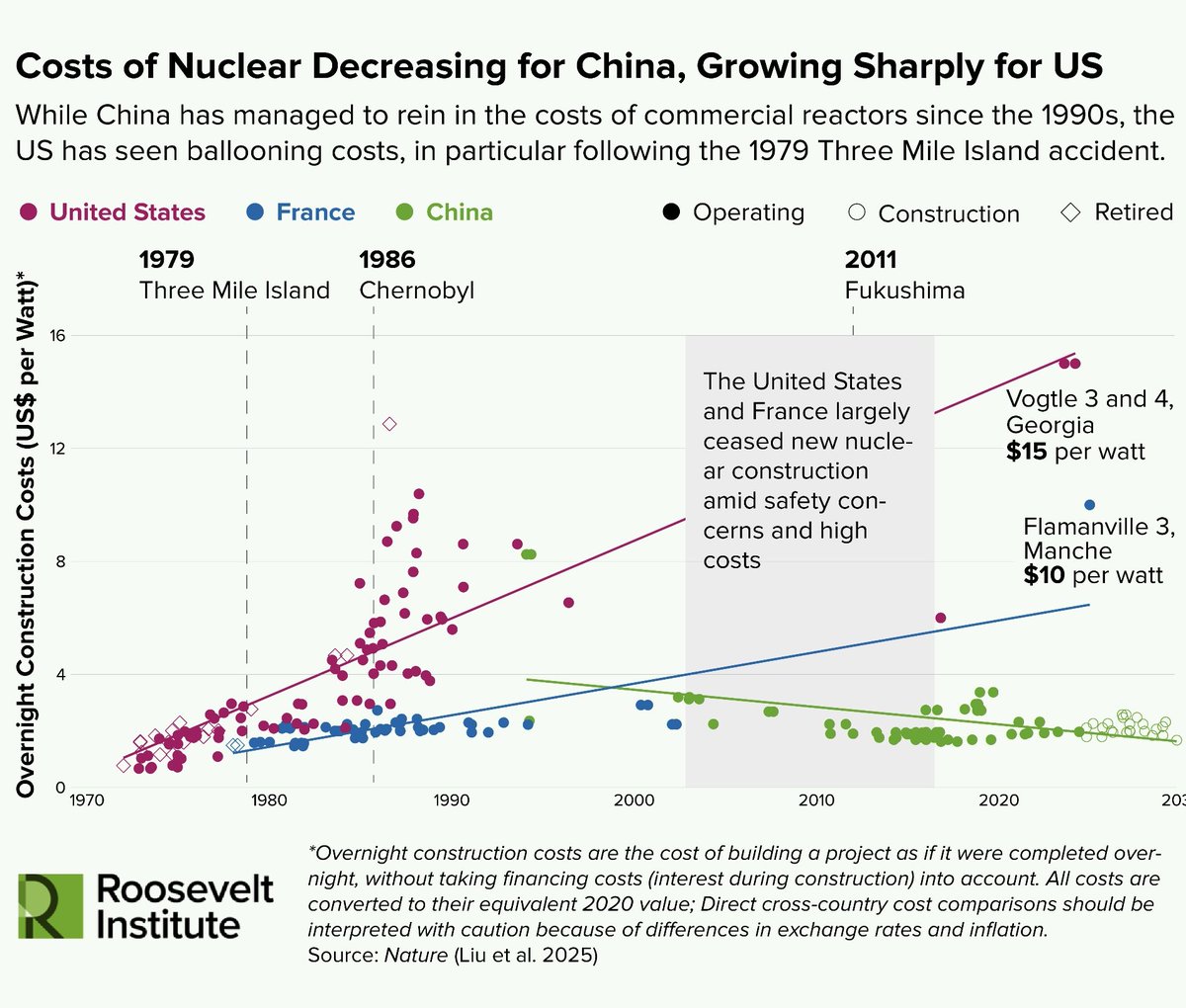
China has managed to control rising costs for building nuclear plants, unlike most countries. How? "Indigenization—i.e., building a domestic supply chain and skilled workforce—has been key to China’s ability to avoid cost escalation." Great blog post by @shangwei_ : rooseveltinstitute.org/blog/can-china…
Kyle Chan tweet media
English
21
376
1.3K
95.8K
Vrinda Kapoor retweetledi
Josh Wolfe
Josh Wolfe@wolfejosh·
everyone is saying "there won't be enough compute." I think the opposite the amount of capex being deployed for multi-gigawatt data centers does not make sense why the narrative is going to shift from centralized mega-clusters to localized edge inference...
The Information@theinformation

.@wolfejosh, co-founder of Lux Capital, discusses why the massive build-out of AI data centers may be overextended: "The amount of spend, the amount of CapEx, the amount of build for these multi-gigawatt data centers, it to me does not make sense." “I'm just not that optimistic that all this compute is actually going to be needed."


English
47
22
214
80.8K
Vrinda Kapoor retweetledi
The Economist
The Economist@TheEconomist·
“As software becomes commoditised, it loses its power to differentiate,” writes Paul Achleitner, Deutsche Bank’s ex-chairman, in a guest essay. “What is becoming scarce again is hardware” economist.com/by-invitation/…
English
10
8
24
18.3K
Vrinda Kapoor retweetledi
Tanvi Madan
Tanvi Madan@tanvi_madan·
"In 2021, Modi's then-junior IT minister told parliament that 1 million cameras in govt institutions were from Chinese cos. and there were vulnerabilities with video data transferred to servers abroad." May 2025 Reuters article re India's new CCTV regs: reuters.com/world/china/in…
Jason Brodsky@JasonMBrodsky

Extraordinary piece in FT about the operation to kill #Iran's regime's supreme leader Khamenei. Nearly all traffic cameras in Tehran were hacked by #Israel for years. They knew when members of the #IRGCterrorists Vali Amr Protection Unit (Khamenei's bodyguards) came and left work on Pasteur Street. And interestingly the CIA--not Mossad--had a human source which assisted with the effort. ft.com/content/bf998c…


English
4
57
166
33K
Vrinda Kapoor retweetledi
Evan Kirstel #B2B #TechFluencer
A Google spinoff is taking a sci-fi approach to city internet — and it doesn’t involve digging up roads or launching satellites. Meet Taara, a moonshot project turned standalone company that’s delivering blazing-fast internet using invisible beams of light. Instead of fiber cables underground, Taara’s new “Beam” device sends tightly focused light signals between buildings, creating high-speed wireless links across entire neighborhoods. Each Beam unit is about the size of a shoebox and weighs 17.6 pounds (8 kg). Inside, it packs an optical phased array built on silicon, with more than a thousand tiny light emitters. These emitters shape and steer light beams with extreme precision, connecting devices that have a clear line of sight and are up to 6.2 miles (10 kilometers) apart. And the speeds? Up to 25 gigabits per second (Gbps) — comparable to fiber — with ultra-low latency and full bidirectional data transfer. The idea is simple: mount these devices high on poles or rooftops in dense urban areas. Because there’s no trenching or underground cabling involved, systems can be installed and activated in just hours instead of weeks or months. That could make a huge difference for cities, remote communities, or regions separated by rivers, rugged terrain, or other hard-to-bridge obstacles. For longer distances, Taara pairs Beam with its larger Lightbridge systems, capable of spanning up to 12 miles (20 kilometers). Its Lightbridge infrastructure is already active in 20 countries, and the company recently introduced Lightbridge Pro for carrier-grade performance. Taara’s approach puts it in competition with satellite internet players like Starlink and Amazon’s upcoming low-Earth-orbit networks. But instead of signals traveling to space and back, these light beams move directly between points on the ground — potentially offering lower latency and faster deployment. As global data demand and AI infrastructure continue to scale, Taara believes light itself could become one of the fastest ways to move information through our cities #MWC26 @TaaraConnect
Evan Kirstel #B2B #TechFluencer tweet media
English
13
69
295
23.6K
Vrinda Kapoor retweetledi
Ole Lehmann
Ole Lehmann@itsolelehmann·
i don't think people realize what's happening in Chinese robotics. this one manufacturer might be the most impressive AND most concerning company on Earth right now let me explain... Unitree Robotics sells a humanoid robot for $5,900. their robot dog costs $1,600 (Boston Dynamics charges $74,500 for theirs for context). you can literally buy these on Amazon today. so obviously the first question is: how is that even possible? the answer starts with a guy who couldn't pass his English exam. Wang Xingxing grew up in Zhejiang province. for his master's thesis, he decided to build a quadruped robot. budget: about $3,000. for context, $3,000 for this kinda robot is nothing. off-the-shelf servo motors alone would've eaten that twice over. so Wang did the only thing he could: he designed and machined every single component himself. motors, joints, controllers, the frame. all of it. the resulting robot was janky and imperfect. but it worked. and the video went viral globally. after graduating he joined DJI. but he quit after two months, and this is 2016, when DJI was arguably the hottest hardware company in China. walking away from that with no money to start a robotics company is a... specific kind of stubborn. he launches Unitree with $280K from a single angel investor. tiny office in Hangzhou. 50 square meters. but the money runs out fast. he can't make payroll for three years. the company almost dies in 2017. but emergency government funding arrives with days to spare. he survives, barely, and keeps building. this is where it gets really fascinating IMO. this founding constraint, building everything yourself because you literally cannot afford to buy parts, never went away. even after funding rounds started landing. even after revenue kicked in. it just became the company's permanent DNA. Unitree now manufactures 90%+ of its core components in-house. motors, reducers, controllers, encoders, LiDAR, etc the founder's $3,000 robot thesis ended up being an architectural decision that turned out to be structurally superior. think about what that means in practice. Boston Dynamics needs a better motor? they negotiate with a supplier, wait on lead times, qualify the part. but when Unitree needs one, they design theirs internally and have a new version in production within weeks. that gap compounds every cycle. Unitree shipped three separate humanoid platforms in 18 months. Figure AI has shipped one. Tesla has shipped zero commercially. the results are getting hard to dismiss. 23,700 robot dogs shipped in 2024 (roughly 70% of the entire global market). 7,000+ humanoids deployed. over 600 industrial sites running their quadrupeds. $140M+ revenue, profitable every year since 2020. for perspective: no Western humanoid competitor is profitable. not one. OK. now here's where the "most concerning" part of this starts... if you watched the DJI story unfold, you already recognize the shape. affordable Chinese hardware quietly saturates global markets. years later, the national security questions arrive, after the install base is already massive. drones, then EVs, then AI. now robots. Unitree is running this exact playbook in real time. in April 2025, researchers found an undocumented backdoor in their Go1 robot. a remote tunnel letting anyone control the robot and stream its camera feed. default password: pi/123. 1,919 vulnerable units exposed globally. including machines at MIT, Princeton, and Carnegie Mellon. but it gets worse. every Unitree robot shares the same hardcoded encryption key. encrypt the word "unitree" and you get root access to any of them. one compromised robot can spread to every Unitree robot in Bluetooth range automatically. a literal robot botnet. the G1 quietly transmits sensor data to Chinese servers every five minutes. audio, video, GPS, LiDAR spatial mapping, with no notification, no consent, no opt-out. PLA footage has shown Go2 robots with mounted weapons. Ukrainian forces literally deployed weaponized units on the actual frontline. and every member of the bipartisan House China Committee signed a letter calling for Unitree's military company designation. Wang signed a 2022 pledge alongside Boston Dynamics not to weaponize robots. but pledges don't survive contact with shipping hardware to open markets. and under China's 2025 rules restricting military-related speech, Unitree couldn't publicly confirm PLA use even if they wanted to. 50,000+ of these robots are now deployed globally. some at institutions that probably should've asked harder questions before connecting them to their networks. the security stuff is real and people should know about it. but i also think it's important not to let that overshadow what's actually been built here. a 35-year-old who failed his English exam created a robotics company that's outshipping and outpricing every Western competitor while being the only profitable humanoid maker on Earth. most impressive and most concerning company in the world right now.
English
116
269
1K
121.6K
Vrinda Kapoor retweetledi
Chamath Palihapitiya
Chamath Palihapitiya@chamath·
China added more solar capacity in 2025 than America has installed in its entire history. That's the most important energy chart you'll see today. And 2025 was also the first year when small-scale distributed solar pulled in more investments than utility-scale solar farms globally. Considering that the U.S. has hundreds of GW stuck waiting for grid connections, the conditions are aligned to start putting solar + storage on every American home. My research team put together a Deep Dive on solar, if you want the full breakdown. Here’s the link: chamath.substack.com/p/solar-deep-d…
Chamath Palihapitiya tweet media
English
625
859
4.1K
740.9K
Vrinda Kapoor retweetledi
Chris Miller
Chris Miller@crmiller1·
A new car might have a dozen cameras, radars and lidars collecting images of everything around it. Researcher Tor Indstøy found a new Chinese-made Nio EV sent 90% of the data to servers in China. My latest in the @FT ft.com/content/3e14c4…
English
164
1K
2.4K
505.9K
Vrinda Kapoor retweetledi
Josh Wolfe
Josh Wolfe@wolfejosh·
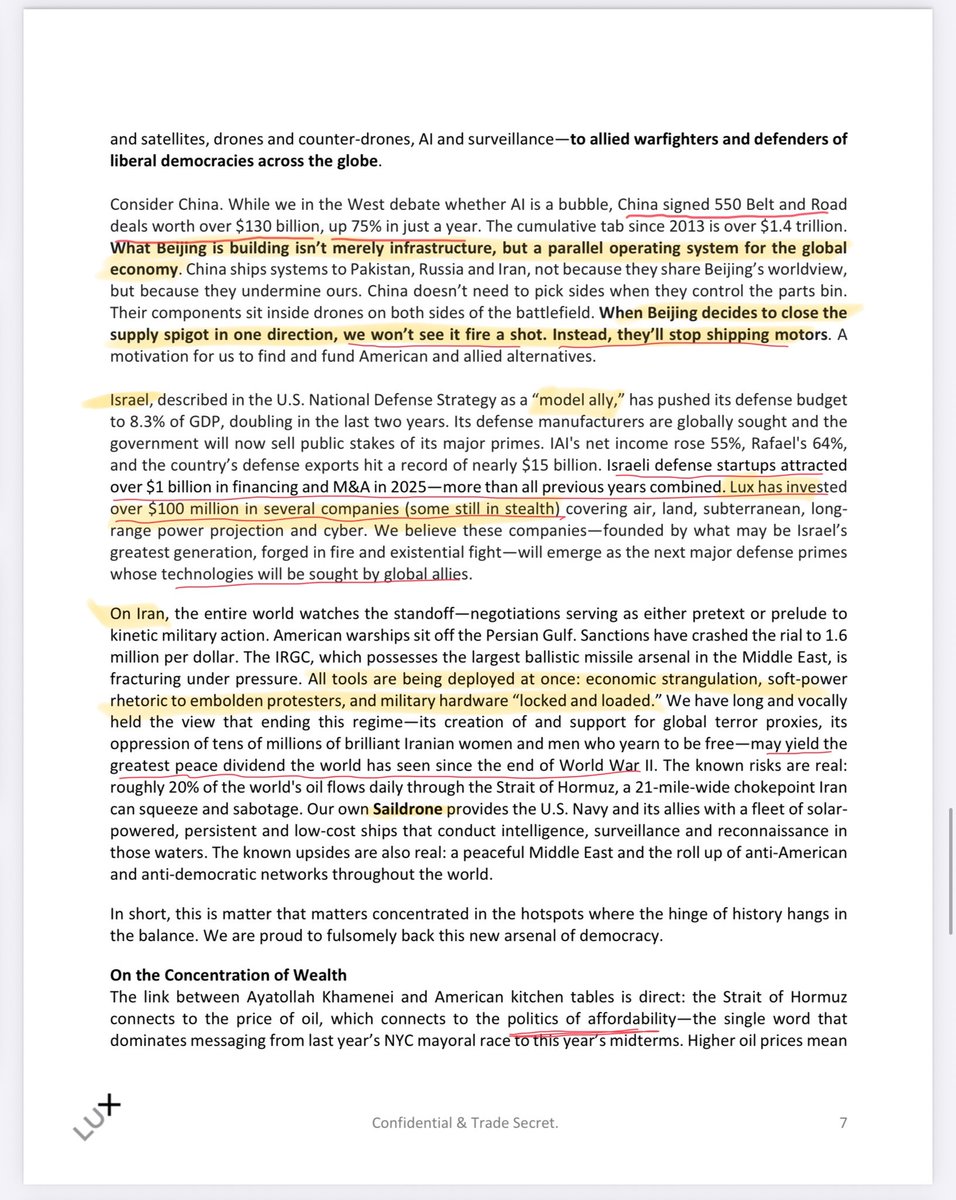
9/ when Beijing decides to close the supply spigot in one direction, we won’t see it fire a shot. instead they’ll stop shipping motors on Israel…on Iran.. on the politics of affordability (the single word that dominates messaging from last yr’s NYC mayoral race to this year’s midterms..)
Josh Wolfe tweet media
English
1
4
10
5.1K
Vrinda Kapoor retweetledi
David Senra
David Senra@FoundersPodcast·
Sage advice from Steve Jobs: "The journey is the reward. People think that you’ve made it when you’ve gotten to the end of the rainbow and got the pot of gold. But they’re wrong. The reward is in the crossing the rainbow. That’s easy for me to say—I got the pot of gold (literally). But if you get to the pot of gold, you already know that that’s not the reward, and you go looking for another rainbow to cross. Think of your life as a rainbow arcing across the horizon of this world. You appear, have a chance to blaze in the sky, then you disappear." open.spotify.com/episode/2gK3rM…
English
14
58
469
41.6K