RocketGuy
247 posts


“Why send humans to space, why not robots?” - @Farshchi … Many people are saying this @Icarus_Robotics


Gravitics has begun execution of its STRATFI contract with the U.S. Space Force, advancing the development of pre-positioned orbital infrastructure for responsive space operations. This phase includes two in-orbit demonstrations: ◾️An Orbital Carrier pathfinder ◾️A Viper OTX mission for high-energy orbit delivery This marks the transition from development to funded execution and movement toward in-orbit validation. gravitics.com/news/space-for…


The future of space business depends on a rocket that keeps blowing up dlvr.it/TRp9X1


I'm excited to announce we have achieved our Tier 1 mission success criteria and have begun gathering a tremendous amount of data on how this brand new spacecraft performs. On March 30th, 13:17:08Z, the Gravitas spacecraft separated from the SpaceX Transporter-16 stack to begin its mission as one of the highest power free-flying satellites ever launched. Immediately after separation, the spacecraft autonomously: - Executed detumbling maneuvers - Established two-way communications with the ground (on our very first ground station pass) - Deployed its 20kW solar arrays - Slewed to a safe and stable attitude to await further ground commands These actions alone are a testament to the incredible work of our in-house engineering, software, and GNC teams to build a robust spacecraft. Since then, our operations team completed all initial system activations and checkouts, confirming the vehicle is in a power positive and thermally stable state with no major anomalies observed at this time. We completed this phase of the mission ahead of schedule. Next up we will be powering up and downlinking data for all payloads aboard the Gravitas spacecraft in support of our customers and partners while continuing to put the spacecraft through its paces. As we noted ahead of launch: The goal of this mission is to experiment and push our systems to the limit to inform future missions. I look forward to sharing more on our successes and challenges as the mission proceeds. Video of our satellite below; link to full T-16 webcast: x.com/SpaceX/status/…

Productive day at The Pentagon for @Starcloud_ 💪 @ezrafeilden


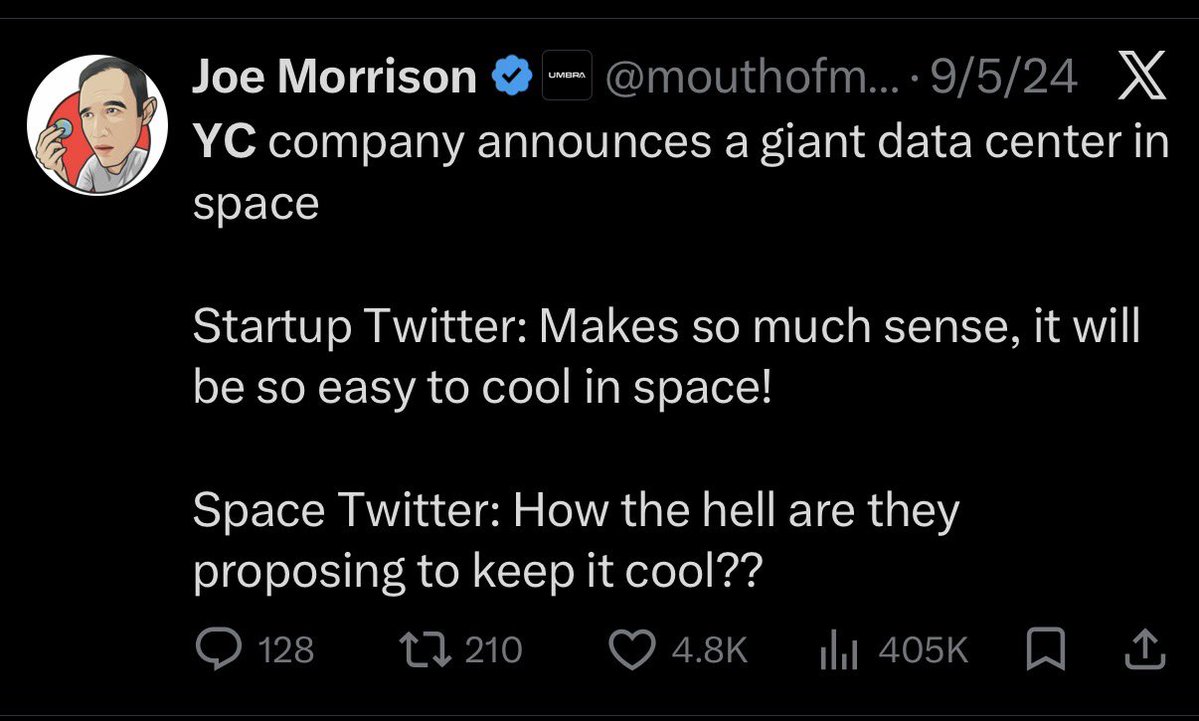
I am super excited to share that @Starcloud_ has raised a $170M Series A at a $1.1bn valuation to fuel our development of data centers in space 🚀 The round comes after the successful deployment of our first satellite, Starcould-1, a few months ago, which had the first @NVIDIA H100 on board and was the first to train an LLM in space. The funds will be used to develop our third satellite, which aims to be cost-competitive with Earth-based data centers in terms of AI inference cost. The round was led by @Benchmark and @EQT Ventures, and we are excited to welcome Benchmark GP, @Chetanp Puttagunta, to our board. We are also excited to welcome other new investors, including the world's largest infrastructure fund, @Macquarie Capital, @SevenSevenSix 7️⃣7️⃣6️⃣, Manhattan West, Adjacent, Carya, GSBackers, and Harpoon. We are very grateful for the continued support of existing investors, including @NFX, @NebularVC, @YCombinator, @FUSE_VC, @Soma_Capital, 3Capital Partners, Wyld VC, Tiny VC, and Taurus Ventures. Onwards!


Delivering 119 satellites to orbit at once! Falcon 9, which can carry ~20 tons to orbit (with a reusable booster & fairing), is a “heavy” class rocket by conventional standards.