Dylan Smith

2.7K posts

Dylan Smith banner
Dylan Smith

Dylan Smith

@warmMagnet

🇨🇦 Educator, Researcher, Writer. Recent book: "Ready to Learn: A Crash Course in Development, and How Children Experience School" https://t.co/jOywLdYlsl

Canada Katılım Temmuz 2024
247 Takip Edilen261 Takipçiler
Sabitlenmiş Tweet
Dylan Smith
Dylan Smith@warmMagnet·
A new trailer for my book, "Ready to Learn: A Crash Course in Development, and How Children Experience School." Thank you for sharing. Available now at Friesen Press BookStore: books.friesenpress.com/store/title/11… The book will become available in the coming days at your fav bookstores.
English
2
5
15
5.8K
SoL in the Wild
SoL in the Wild@SoLInTheWild·
@dperkinsed Feel free to describe a scenario in which cognitive overload would not be detrimental to learning.
English
2
0
1
245
Drew Perkins
Drew Perkins@dperkinsed·
Is this always the best way to think about learning? "So the answer is yes: cognitive overload is always detrimental to learning. When working memory is overloaded, students are unable to effectively process, organize, and integrate new information into long-term memory."
SoL in the Wild@SoLInTheWild

This is a mischaracterization of CLT. Just because a chart or any other content is complex or takes time to understand does not mean it is causing cognitive overload. CLT emphasizes optimizing the intrinsic cognitive load of the learning task while minimizing extraneous cognitive load. However, complexity and cognitive overload are not the same thing. CLT is not an argument for reducing complexity; it is about managing complexity. Learning often requires students to grapple with challenging ideas, analyze relationships, and construct meaningful mental models. The teacher’s role is to optimize intrinsic load by minimizing extraneous load, ensuring that students’ limited working memory is devoted to the productive thinking required by the task rather than consumed by unnecessary processing demands. Framing any challenging or complex learning task as “cognitive overload” misrepresents CLT and overlooks its central insight: working memory is limited, but effective instruction can help students optimize that limited capacity in ways that support learning. So the answer is yes: cognitive overload is always detrimental to learning. When working memory is overloaded, students are unable to effectively process, organize, and integrate new information into long-term memory.

English
2
0
2
850
Dylan Smith
Dylan Smith@warmMagnet·
You asked: Why does the goal need to be withheld from the students? It doesn't need to be witheld, it's just how I chose to roll it out. I knew from past experience that 1-2 Ss would know where I was going, and 1-2 others would guess correctly in-process. Once calculations are complete, I knew one of the Ss would recognize pi. In other words, I left ownership of the "discovery" to them. Think "hands-on-meaningful," and therefore "ready-to-apply" and "memorable." You asked: Do you really think they will learn less if you tell them the objective? I usually state lesson goals, or even post them. But if I think I have a discovery/inquiry/call-it-what-you-want activity that will hit them with impact, then I'll do the extra work to deliver a banger experience.
English
1
0
0
18
Darren Leslie
Darren Leslie@dnleslie·
Criticising discovery learning does not mean rejecting inquiry. Pupils should not have to discover essential knowledge that could have been taught clearly. But once they know enough, they can investigate, compare, explain and solve. Inquiry becomes more productive when knowledge and guidance are already in place.
English
7
4
23
3.9K
Dylan Smith
Dylan Smith@warmMagnet·
@oliviajune82 @dnleslie @mathillustrated In a subsequent re-post, I billed the anecdote as illustrating “some of the benefits of inquiry/discovery.” My unannounced goal was actually to derive the formula for area of a triangle in a highly engaging and memorable way. Clearly, I structured the activity with my guidance.
English
1
0
1
29
Olivia Mullins
Olivia Mullins@oliviajune82·
@warmMagnet @dnleslie @mathillustrated Is this discovery? I like the activity. With explicit instruction you'd simply teach how to do it beforehand. Then "can we get this to work on everyday objects?" There is perhaps "discovery" around measurement error but hands-on can be a part of explicit instruction.
English
1
0
1
41
Lee Bates
Lee Bates@MrLeeBates·
@warmMagnet @ProfDanielMuijs It is also becoming apparent that the people who are choosing to make claims about motivation are the same people who then choose, or are unable to discuss the details about those claims. This implies those claims are not well founded at least by the people that are making them.
English
1
0
2
41
Daniel Muijs
Daniel Muijs@ProfDanielMuijs·
Motivation - no, it's not 90% of learning, but it does matter to an extent - new substack from me on the relationship between motivation and attainment open.substack.com/pub/danielmuij…
English
4
3
11
3.4K
Dylan Smith retweetledi
Dylan Smith
Dylan Smith@warmMagnet·
I believe you’ve drawn an insufficently framed conclusion (attached). But I don’t blame you, I would point to the research from which you and like-minded colleagues draw your opinions. When the abstraction we refer to as “self-belief” is pitted against biological motivation in a longtitudinal study, self-belief should win out because it is established and defined over longer timescales. IMO, it is therefore favoured to explain more variance. But that only offers the appearance of a proper conclusion. On closer analysis, it is clear that an individual’s beliefs are established and defined with the very same valuations that form the basis for in-the-moment biological motivation. In the animal kingdom, generally speaking, non-implicit learning and problem solving is work that has forever relied on in-the-moment biological motivation to recruit the resources that working memory needs. In any particular human, more specifically, longer-timescaled self-beliefs can also factor in action planning, but that contribution can only occur via one’s in-the-moment biological motivation. A self-belief is an abstract concept with no veridical standing of its own. I have to say that I find Trad thinkers are quick to neglect such nuance and seem to need help to fully understand.
Dylan Smith tweet media
English
1
1
2
47
Dylan Smith
Dylan Smith@warmMagnet·
@Doug_Lemov One can only interpret via one's personal resources, although an effort can be made to detach and objectively infer songwriter intention. Reading comprehension is the same?
English
0
0
1
43
Doug Lemov
Doug Lemov@Doug_Lemov·
I always find it remarkable that you can listen to a song for years & have it accrue such meaning & then find out what it was “really about” & it’s some unrelated & likely mundane thing. Weirdly it doesn’t make the song any less meaningful tho. You just go ahead with what you’ve built around it.
English
6
0
19
5.2K
Dylan Smith
Dylan Smith@warmMagnet·
@mathillustrated @dnleslie No one encounters that. The sentence suggests that some use “discovery learning” to justify giving novices too little guidance. No one in their right mind would do that. In fact, he and others personally disagree with discovery learning for that reason.
English
0
0
1
12
Dylan Smith
Dylan Smith@warmMagnet·
This anecdote illustrates some of the benefits of inquiry/discovery.
Dylan Smith@warmMagnet

I’ve been posting a lot lately and wanted to dial things down, but I have to speak up here. When teaching area of circle to seventh graders, I’d ask students to bring in circular objects from home, such as pots and pans. They would be instructed to group themselves into 2s and 3s to measure the circumference and diameter of 3 or 4 objects using a tailor’s (cloth) tape measure. As groups completed their work, they’d enter their raw data onto a giant blackboard chart. Once all data had been entered, multiple cross-checking keeners would total the two long columns of diameter and circumference measurements. We'd then divide the larger circumference average by the smaller diameter average. More than once, I’ve had a class result exactly equal pi to 2 or 3 decimal places; that's always a thrill, even for me. But most importantly, the class would feel they had authentically derived the formula to calculate area of a circle. Also exciting. The active concrete learning experience too an entire period, but it was meaningful in a special way that direct instruction cannot replicate. And there were no lazy students letting the “smart kids” do all the work. But for me as teacher, the real value of that discovery activity was in gathering and lifting those students whose background knowledge had been wanting for whatever reason. They didn’t just learn the "important" lesson goal knowledge, they also learned incidental knowledge that we might categorize as life experience. Some students had never used tape measures before. Some didn’t know that measurement error is most likely with a smaller object. Most had no idea that calculation error will be less disastrous as long as you measure an object consistently, i.e., overestimating (or underestimating) both measurements was better than overestimating one and underestimating the other. The discovery activity made those incidental learnings more personally meaningful, even if those "extras" didn't click until my whole-class lesson consolidation.


English
0
2
5
606
Ralph Pantozzi
Ralph Pantozzi@mathillustrated·
@warmMagnet @dnleslie Your comments are much appreciated. I think there are good discussions to be had about the importance of different levels of guidance.
English
2
0
3
101
Dylan Smith
Dylan Smith@warmMagnet·
I’ve been posting a lot lately and wanted to dial things down, but I have to speak up here. When teaching area of circle to seventh graders, I’d ask students to bring in circular objects from home, such as pots and pans. They would be instructed to group themselves into 2s and 3s to measure the circumference and diameter of 3 or 4 objects using a tailor’s (cloth) tape measure. As groups completed their work, they’d enter their raw data onto a giant blackboard chart. Once all data had been entered, multiple cross-checking keeners would total the two long columns of diameter and circumference measurements. We'd then divide the larger circumference average by the smaller diameter average. More than once, I’ve had a class result exactly equal pi to 2 or 3 decimal places; that's always a thrill, even for me. But most importantly, the class would feel they had authentically derived the formula to calculate area of a circle. Also exciting. The active concrete learning experience too an entire period, but it was meaningful in a special way that direct instruction cannot replicate. And there were no lazy students letting the “smart kids” do all the work. But for me as teacher, the real value of that discovery activity was in gathering and lifting those students whose background knowledge had been wanting for whatever reason. They didn’t just learn the "important" lesson goal knowledge, they also learned incidental knowledge that we might categorize as life experience. Some students had never used tape measures before. Some didn’t know that measurement error is most likely with a smaller object. Most had no idea that calculation error will be less disastrous as long as you measure an object consistently, i.e., overestimating (or underestimating) both measurements was better than overestimating one and underestimating the other. The discovery activity made those incidental learnings more personally meaningful, even if those "extras" didn't click until my whole-class lesson consolidation.
English
4
0
8
779
Darren Leslie
Darren Leslie@dnleslie·
Because “discovery learning” is often used to justify giving novices too little guidance. The criticism is not of pupils exploring or thinking for themselves. It is of expecting them to discover important knowledge with limited support when clear instruction would be more efficient and reliable.
English
2
0
2
163
Dylan Smith
Dylan Smith@warmMagnet·
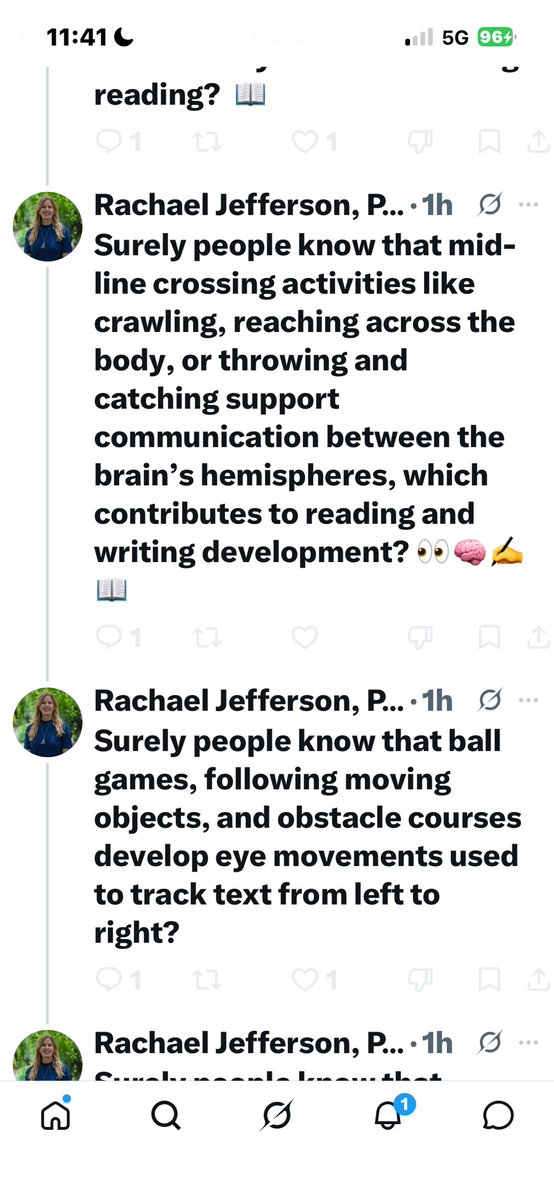
@PCSnow1604 @IBeconteacher @3dancingfeet I cited 2 papers that establish working memory activity in the whole brain requires hand-offs between hemispheres. It's the way we work. No kidding, we really have 2 brains that are quite independent but learn with practice to communicate fluently and get things done very well.
English
2
0
5
81
Pamela Snow
Pamela Snow@PCSnow1604·
@warmMagnet @IBeconteacher @3dancingfeet But what do midline crossing activities have to do with improving reading and writing ability? That was the original claim. If there is evidence to this effect I think many here would be keen to see it.
English
1
0
0
69
Pamela Snow
Pamela Snow@PCSnow1604·
I’m blocked by @3dancingfeet b/c of previous efforts to set the record straight on some of her posts so cannot reply to this directly (shared with me by a PG student). It’s important that current and future teachers know that this idea is not supported by empirical evidence. It’s also unfortunately sometimes promoted by OTs. @speechwoman and I address it in @EBPRoadmap
Pamela Snow tweet media
English
9
13
47
5.6K
Dylan Smith
Dylan Smith@warmMagnet·
@PCSnow1604 @IBeconteacher @3dancingfeet Line-crossing is real, a developmental reality. Crossed laterality is junk science. I think you've been discussing something other than the content of Rachael's original post. And that can happen. :)
English
1
0
4
63
Pamela Snow
Pamela Snow@PCSnow1604·
Cross-midline programs are built on the (empirically unsupported) belief that poor reading results from inadequate hemispheric integration or "crossed laterality", so children need to establish better left-right integration, which (it is argued) leads to better reading. I am not aware of any evidence to support this claim but am always happy to look at papers I may have missed.
English
1
0
0
56
Pamela Snow
Pamela Snow@PCSnow1604·
Actually this is not a reasonable inference from published evidence, e.g., Ferrero, M., West, G., & Vadillo, M. A. (2017). Is crossed laterality associated with academic achievement and intelligence? A systematic review and meta-analysis. PLOS ONE, 12(8), e0183618. These authors reviewed 26 studies involving more than 3,500 children. They concluded: - there is no reliable relationship between crossed laterality and academic achievement - there is no reliable relationship with reading performance - larger, better-quality studies consistently found null results; and - there is no empirical basis for interventions intended to “correct” laterality or improve learning through laterality exercises.
English
1
0
0
49
Dylan Smith
Dylan Smith@warmMagnet·
@IBeconteacher @PCSnow1604 @3dancingfeet Good question. Attributions of causality always require an inference. But seeing as mid-line crossing is how we function (cf papers), and given that we know the proficiency/fluency of mid-line crossing is acquired, it’s reasonable to infer that early exercise is supportive.
English
1
0
5
74
Simon Johnson
Simon Johnson@IBeconteacher·
@warmMagnet @PCSnow1604 @3dancingfeet How do the studies you cite demonstrate causality from mid-line crossing activities to reading and writing development? This was the original assertion in question.
Wakatobi, Sulawesi Tenggara 🇮🇩 English
1
0
3
77
Dylan Smith
Dylan Smith@warmMagnet·
@dnleslie There are a great many apparent reciprocals. IMO, "successful learning" is another abstract talking point but not an encoded outcome per se. However, it may prompt conscious appraisals in some individuals that can support motivation in a broader and loosely causal sense.
English
0
0
2
54
Darren Leslie
Darren Leslie@dnleslie·
The motivation debate has been interesting because the evidence appears more reciprocal than either simple account suggests. Motivation can support learning, but successful learning can also strengthen pupils’ confidence, interest and willingness to continue. I’m less certain that one direction is consistently stronger across contexts, but we probably underestimate how motivating growing competence can be.
English
4
0
5
608
Dylan Smith
Dylan Smith@warmMagnet·
@PCSnow1604 @3dancingfeet Feel free to beat up on Brain Gym all you want, Pamela. Someone other than Rachael brought that up. Meanwhile, the recent papers I shared above were both published out of what is probably the most highly reputed neuroscience lab in the world.
English
1
2
8
200
Pamela Snow
Pamela Snow@PCSnow1604·
The “fuss” is about ensuring that time and $$-poor schools and parents don’t waste precious resources and hope on approaches that have been shown to be ineffective. If these myths were not perpetuated in #ITE they would not need downstream debunking. Another example of low regard for evidence in education unfortunately. It’s disappointing that preservice teachers at @CharlesSturtUni will need to unlearn this when they graduate.
English
1
0
2
80
Dylan Smith
Dylan Smith@warmMagnet·
Let's summarize this "reciprocal" standing once and for all. "Attainment" is an abstract idea. Motivationally, there's nothing special about it. We may say it's one of a host of outcome-related factors that can impact how motivation will work going forward.
English
0
1
1
135