
Martin Wattenberg retweetledi
Martin Wattenberg
733 posts


Martin Wattenberg
@wattenberg
Human/AI interaction. Visualization as design, science, art. Professor at Harvard, and part-time at Google's People+AI Research initiative.
Katılım Temmuz 2008
486 Takip Edilen17.3K Takipçiler

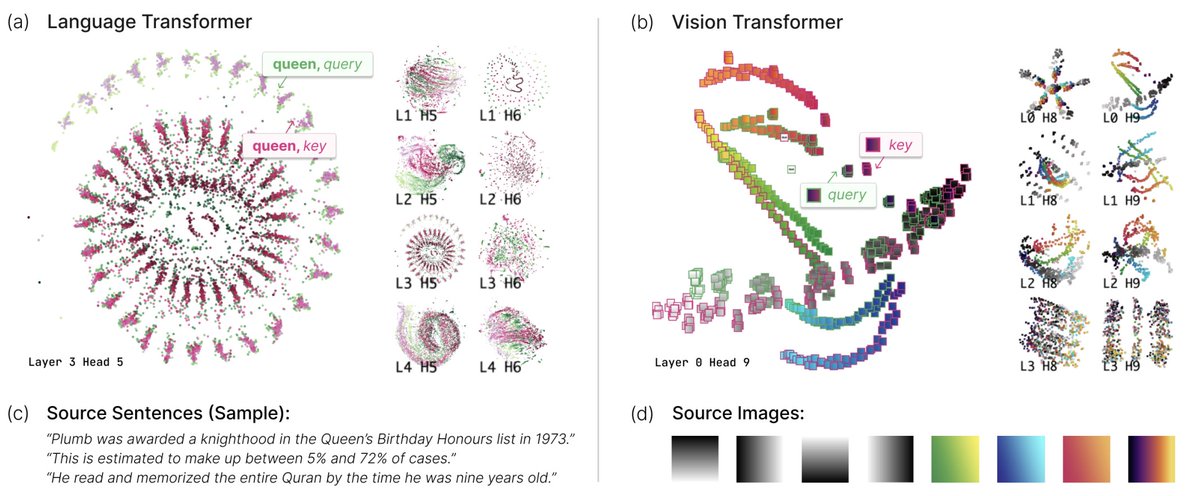
@filip_rejmus @viegasf Moreover, different heads have a different level of focus on position, which leads to "sharper" or "blurrier" spiral shapes. Finally, the input sequences we used are different lengths, so there are more points at earlier positions than later ones—that affects the shape as well.
English
@filip_rejmus @viegasf You'll notice that some spirals are more "connected" than others. These correspond to heads that pay attention to multiple nearby positions, so the queries / keys trace out a path between positional encodings. There's a kind of linear interpolation between position vectors. (2/n)
English
Visualize transformer attention!
AttentionViz, created by Catherine Yeh and expanded by Yida Chen, helps you explore transformer self-attention by visualizing query and key vectors in a joint embedding.
Paper: arxiv.org/abs/2305.03210
Website: attentionviz.com
English
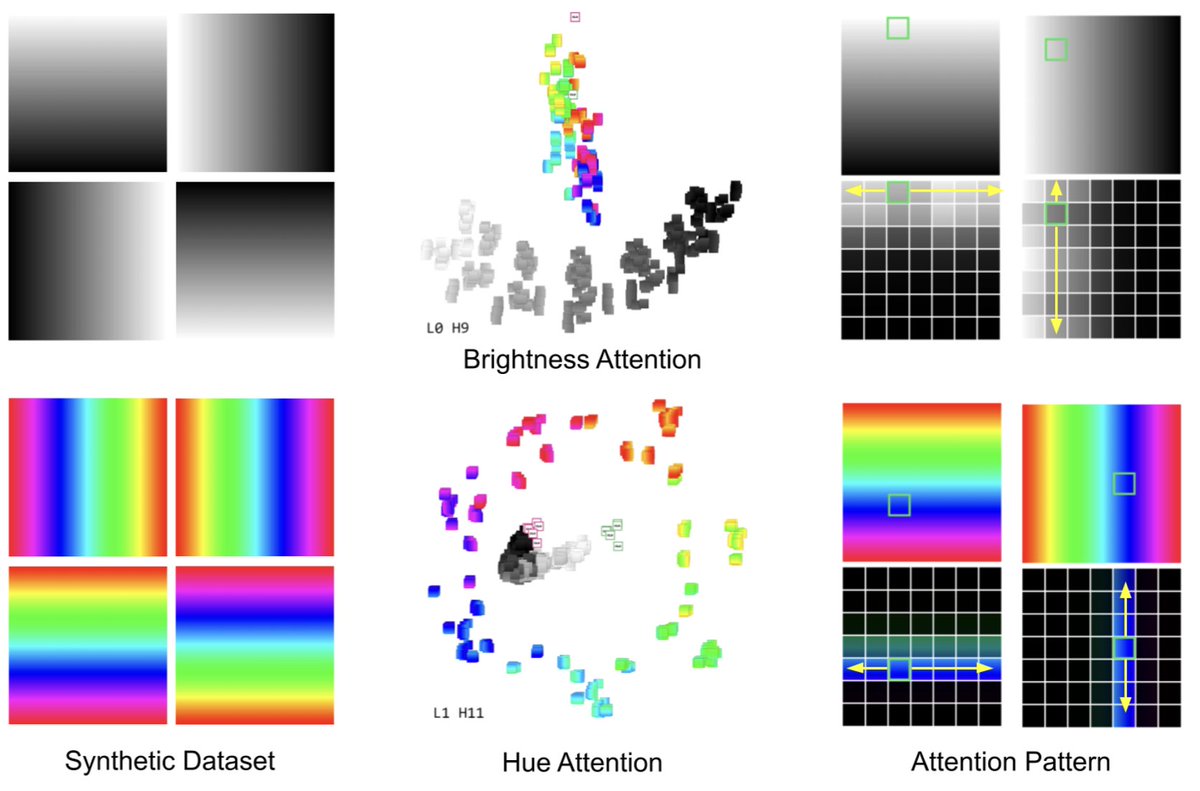
Here's a close-up of hue and brightness heads in a vision transformer. Work done with tremendous help from Aoyu Wu and @chenxcynthia!
English
Language models have some beautiful spiral plots reflecting positional patterns. And a vision model has heads that arrange images according to brightness and hues. But there’s a lot more to find! What else can you see?

English
Toasters have blinking lights, cars have speedometers. Should chatbots have dashboards too?
A speculative essay: The System Model and the User Model: Exploring AI Dashboard Design
arxiv.org/abs/2305.02469

English
Martin Wattenberg retweetledi

I want to show the NSF there would be broad support+utility for a "National Deep Inference" service for >100b LLMs.
If your research would be enabled by an inference service on open LLMs w API access+overrides to internal activations, params, gradients:
Please Like this thread!
English
Martin Wattenberg retweetledi

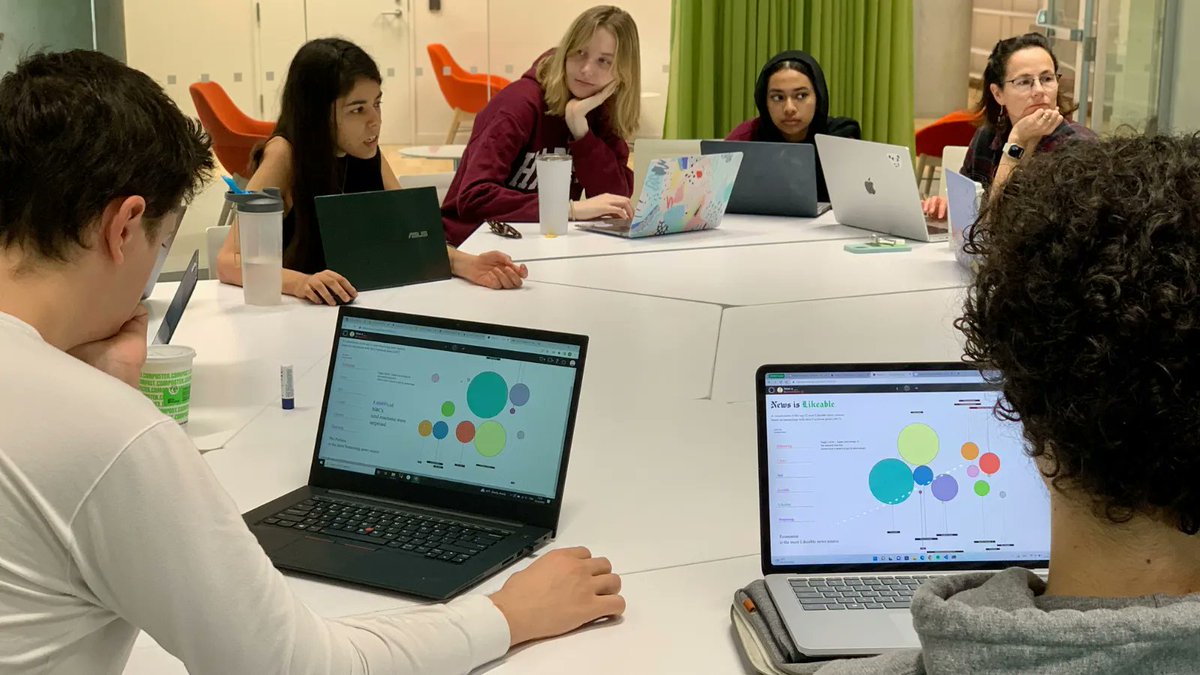
Students explore the aesthetics of computing in new computer science course at SEAS. "CS73: Code, Data, and Art" is co-taught by @wattenberg and @viegasf, and teaches students how to create abstract art and communicate data sets through visualizations. buff.ly/3GXpkTE
English
Starting to get used to Mastodon. Find me at @wattenberg@mastodon.social
English
For information on the application process, see seas.harvard.edu/computer-scien…
English
Thinking about grad school next year? Interested in visualization, machine learning interpretability, or human/AI interaction? Consider Harvard. @viegasf and I are continuing to build our lab!

English
Martin Wattenberg retweetledi

The labyrinthine patterns traced by birds on the wing – in pictures #Echobox=1667059659-1" target="_blank" rel="nofollow noopener">theguardian.com/artanddesign/g…
English
I'm teaching with @OpenProcessing for the first time, and am completely impressed with how polished and friendly the system is. Every detail is on point. Last class a student spontaneously said, "OpenProcessing is just so great." I agree!
English
The project is a systematic study of how a neural network represents more features than it has neurons, under a variety of conditions. (Oh, and I can't tweet without a typo, apparently. That's @AnthropicAI of course!)
English
Tiny neural networks have a surprisingly rich inner life, and may hold clues to how their larger cousins work. This image: evolution of feature vectors during learning. Full story: transformer-circuits.pub/2022/toy_model… (in collaboration with the great interpretability team at @AnthopicAI)

English
Martin Wattenberg retweetledi
SMASHOMANCY is a "divination system for cracked phone screens" and @djbaskin retains pole position as one of my favorite living creatives.
Danielle Baskin@djbaskin
We've had this dream for a while and now it's becoming real! @aleffert and I made a divination system for cracked phone screens called ⚡️SMASHOMANCY⚡️ We're doing screen readings at a repair shop TODAY from 4:30-6:30 PM at 1099 Irving St. in SF! Drop your phone & join us.
English
@gro_tsen I like this paper: columbia.edu/~on2110/Papers… Sample finding: If you ask people to review the last restaurant they went to, they're less polarized than if they freely choose a restaurant to review, evidence for your second hypothesis
English

I can think of two non-exclusive (and non-exhaustive) reasons for this bias toward extremes: ⓐpeople really tend to be highly satisfied or highly dissatisfied over intermediate values, or ⓑpeople with such strong opinions tend to express them more readily than “meh”. •3/5
English
@sharoz @RuthRosenholtz Wonderful, thanks! Part of the explanation should say why the "3" doesn't stand out when everything's the same color. The shape strongly contrasts with any other individual digit in a side-by-side comparison. And in fact it would stand out if all the other digits were 1's and 7's
English

@wattenberg @RuthRosenholtz That demonstrates contrast more than anything. If the 3s become darker and darker, and the task becomes harder and harder. I'm away from my laptop, but I'll post some examples you can discuss in a vis course.
English
Do you have a recent Sensation & Perception textbook? Please reply with:
1) Which textbook & edition
2) Whether it mentions pre-attentive processing
3) If yes, is it only in a historical context or "quotes"?
a photo of the relevant paragraph(s) would be appreciated
English