

Niels
225.6K posts

Niels
@Web3Niels
Co-Founder @STABL_Agency • Trader & Investor • @OKX creator
Amsterdam, The Netherlands Katılım Mayıs 2014
11.4K Takip Edilen65.8K Takipçiler

one of the easiest x2’s you could have done
told you to bid at these levels
88m mcap tapped earlier today
$CASHCAT reversal in true motion

Renksi@renksieth
$CASHCAT close to tapping 45m mcap lol looks like robinhood szn wasn’t that special won’t take long until all liquidity rotates towards solana again but gotta refuse to believe it, bid more at these levels for generational wealth current state of the market is pure aids
English

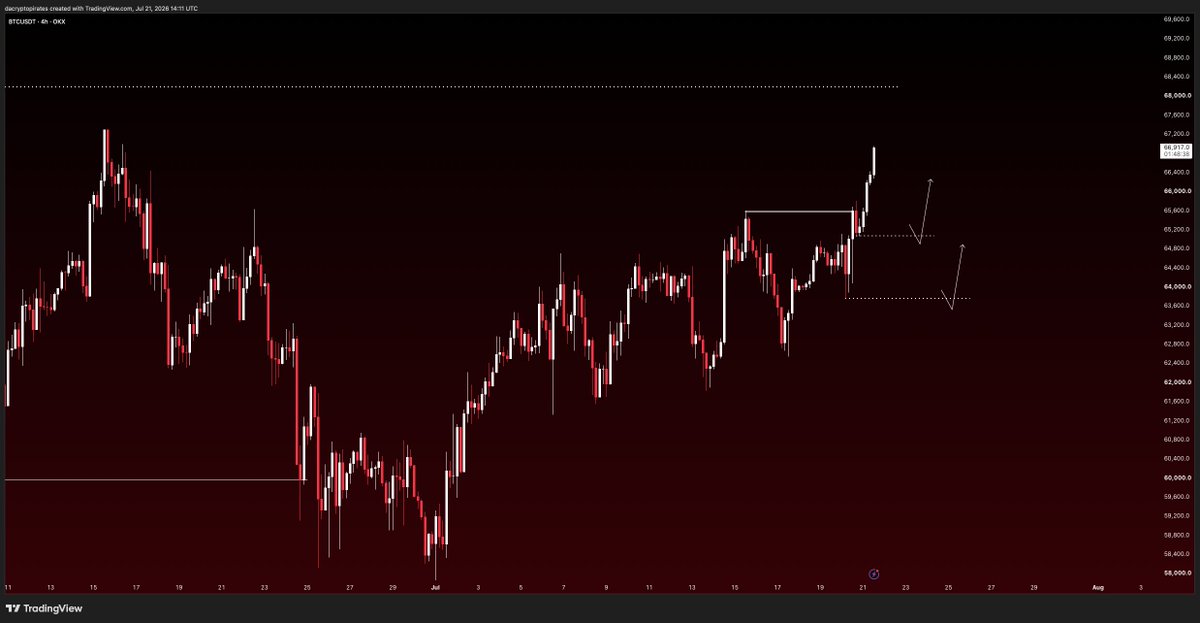
Some potential short-term $BTC longs as price pulls back into the daily liquidity zone.
I'd love to capitalize on the move and trade in line with the immediate 4H bullish order flow.
Crypto Pirates 🏴☠️@DaCryptoPirates
$BTC is due for a relief rally toward the overhead liquidity. That doesn't change the bigger picture, market structure remains bearish, and I'll stay that way until we see a confirmed break above the recent swing high.
English



$INJ is not trying to be another general-purpose chain
Its built around finance from the ground up
Global markets
Tokenized assets
Derivatives
Liquidity
Financial primitives already embedded into the network
As more capital moves onchain, the chains designed specifically for finance should have the clearest advantage
@Injective is one of them

English

Crypto gets frustrating when every task needs a different app.
Trade here.
Swap somewhere else.
Use another wallet.
Track everything manually.
That's why I've been spending more time exploring @okx.
Here's what a typical crypto day can look like using one ecosystem. 🧵👇

English


People often ask whether an asset is "real."
I think the better question is:
Is the business behind it real?
A token doesn't operate ships.
People do.
That's why I find @EthraShip interesting. The blockchain is only one layer. Behind it is an actual operating business, not just an asset wrapped in a token.
Maybe that's where RWA is heading.
Less focus on tokenization itself.
More focus on the people and businesses creating value before anything goes onchain.
What's the first thing you look at when researching an RWA project?
#RWA #DeFi
Ethra Ship Protocol@EthraShip
Tokenized T-bills. Tokenized mortgages. Tokenized bonds. The word "real" in "RWA" does a lot of work for assets that have existed digitally in TradFi for decades. Bringing an operating industry onchain is different. You need operators, not just lawyers. We're operators.
English

Keeping tabs on this one.
Rain.fun just opened its doors on Robinhood Chain.
$PHIS is the first launch and interesting fact is it was made by @Chrogman’s (1.4M+ Instagram audience)
you should also check their $10k weekly volume leaderboard out, good chance to be early on robinhood
Go check out @launchonrain
Rain.fun@launchonrain
You can’t pick a winner from a list of losers. Robinhood needed a launchpad. Finally, there’s an option. Rain.fun
English
@Brainmaster @Polymarket Market makers are going to fleece everyone here
English

Do you believe in Elon? Then why not prove it?through @Polymarket
Elon Musk's tweet from 14-21 july is ending in about 2 hours
If Elon posted 2 tweets, just 2, you could make over 50% profits in 2 hours
> 140-159 range is at 0.34c
> 160-179 range is at 0.65c
If Elon posts 2 tweets, the range 1 is going to resolve in NO and the second one is YES
So you have to acquire share of 140-159 NO and 160-179 YES that's how you gonna make it
English
$ONDO is positioned for what could become crypto's biggest opportunity.
The world's largest financial firms are projecting trillions of dollars in tokenized assets over the coming years.
Some forecasts now expect the tokenized asset market to grow nearly 100x by 2030.
Today, it's worth just $34 billion. Estimates for 2030 already range from $2T to $11T, with some long-term forecasts reaching $30T.
We're still incredibly early.

English
@ChemistDeFi @coinbase Great to see teams taking security seriously early
English

AI agents got wallets before they got brakes.
2026 is the year crypto is trying to fix that in real time
1 - The setup
Agentic wallets went from concept to product category in a matter of months:
→ @coinbase | Agentic Wallets, Feb. 11
Autonomous spending, earning and trading through x402
→ @phantom | MCP Server, February
Agent signing, swaps and transfers within user-defined permissions
→ @okx | Agentic Wallet, Mar. 18
Keys sealed inside a TEE, supporting roughly 20 networks
→ @Cobo_Global | Agentic Wallet, May
MPC security, “Pact” authorization and support for 80+ chains
→ @binance | Agentic Wallet, Apr. 24
Keyless architecture, isolated from your main funds
→ @FireblocksHQ | Agentic Payments Suite, May 20
Enterprise payment rails and membership in the x402 Foundation
→ @MetaMask | Agent Wallet, June 8
Self-custodial, CLI-first and built for DeFi across 25+ EVM chains
Trust Wallet and others joined the category too, while custodians such as @BitGo published their own frameworks.
The rails are already live.
2 - The concepts
A quick glossary before going further.
- Agentic wallet
A wallet built for software, not humans.
A normal wallet assumes a person will click “approve.”
An agentic wallet assumes an AI may initiate transactions on its own, which means the real product is the control layer:
→ Spending caps
→ Allowlisted contracts
→ Session limits
→ Approval rules
→ Emergency controls
Its most important job is deciding what the agent is not allowed to do.
- MCP: Model Context Protocol
MCP is the standard connecting AI models to external tools, including wallets.
Phantom’s MCP Server, for example, allows agents to read balances and propose transactions through a standardized interface.
But the standard is still young.
Security researchers have already reported widespread vulnerabilities across publicly exposed MCP servers.
- TEE: Trusted Execution Environment
A sealed environment inside a chip where private keys can be stored.
The agent can request a signature, but it cannot directly read the key.
This is the model used by OKX.
- MPC: Multi-Party Computation
The private key is divided between multiple parties.
No single party, including a compromised agent, can sign a transaction alone.
This is the model used by Cobo.
TEE and MPC both help protect the key.
They do not protect the judgment behind the transaction.
That distinction is where the real problem begins.
3 - The warning shot
Step Finance, Jan. 31.
Attackers compromised executive devices and moved 261,854 SOL, worth roughly $27M at the time.
Later assessments placed total losses closer to $40M.
No smart contract failed.
The signing environment itself was compromised.
Only around $4.7M was recovered. The token fell roughly 96%, and the project shut down by late February.
This was not an AI hack.
But imo, it is exactly the kind of failure mode you scale when autonomous agents receive signing authority.
4 - The two answers
The industry now appears to be splitting into two security philosophies.
Policy enforcement
This is @MetaMask’s approach.
Every agent transaction receives:
→ Transaction simulation
→ Blockaid threat scanning
→ MEV protection
→ Spending limits
→ Contract allowlists
→ Mandatory 2FA for flagged actions
The agent cannot simply disable these protections.
MetaMask also offers up to $10K per month in coverage for transactions classified as safe.
OKX with TEE, Cobo with MPC and Binance with keyless isolation sit in the same broader category, although each uses a different enforcement model.
The principle is simple:
The agent may act, but only inside predefined boundaries.
Hardware enforcement
This is @Ledger’s approach.
Ledger’s Agent Stack, open-sourced on July 16, allows agents to:
→ Read balances
→ Analyze portfolios
→ Prepare transactions
→ Recommend actions
But nothing can move without approval on a physical Ledger device.
Agents propose.
Humans approve.
Hardware enforces.
The private key never touches the software environment.
My take
Policy is faster.
Hardware is stricter.
Neither has been battle-tested at scale.
For now, I would treat both as v1 answers, not solved problems.
But zoom out.
Eight major players shipped agent-wallet infrastructure in under six months.
That pace looks less like a temporary narrative and more like a structural shift.
You do not need to deploy an agent today.
But if you work in crypto, imo this is the wrong category to ignore.
Learn the terms now.
The cost of catching up later will probably be higher than the cost of paying attention today.
Agent autonomy is not the product.
Bounded autonomy is.
Data sourced from official announcements and incident reports published by @HalbornSecurity and @CertiK.

English
@Tanaka_L2 @ProdigyFi Better than letting eth sit dead in a cold wallet
English

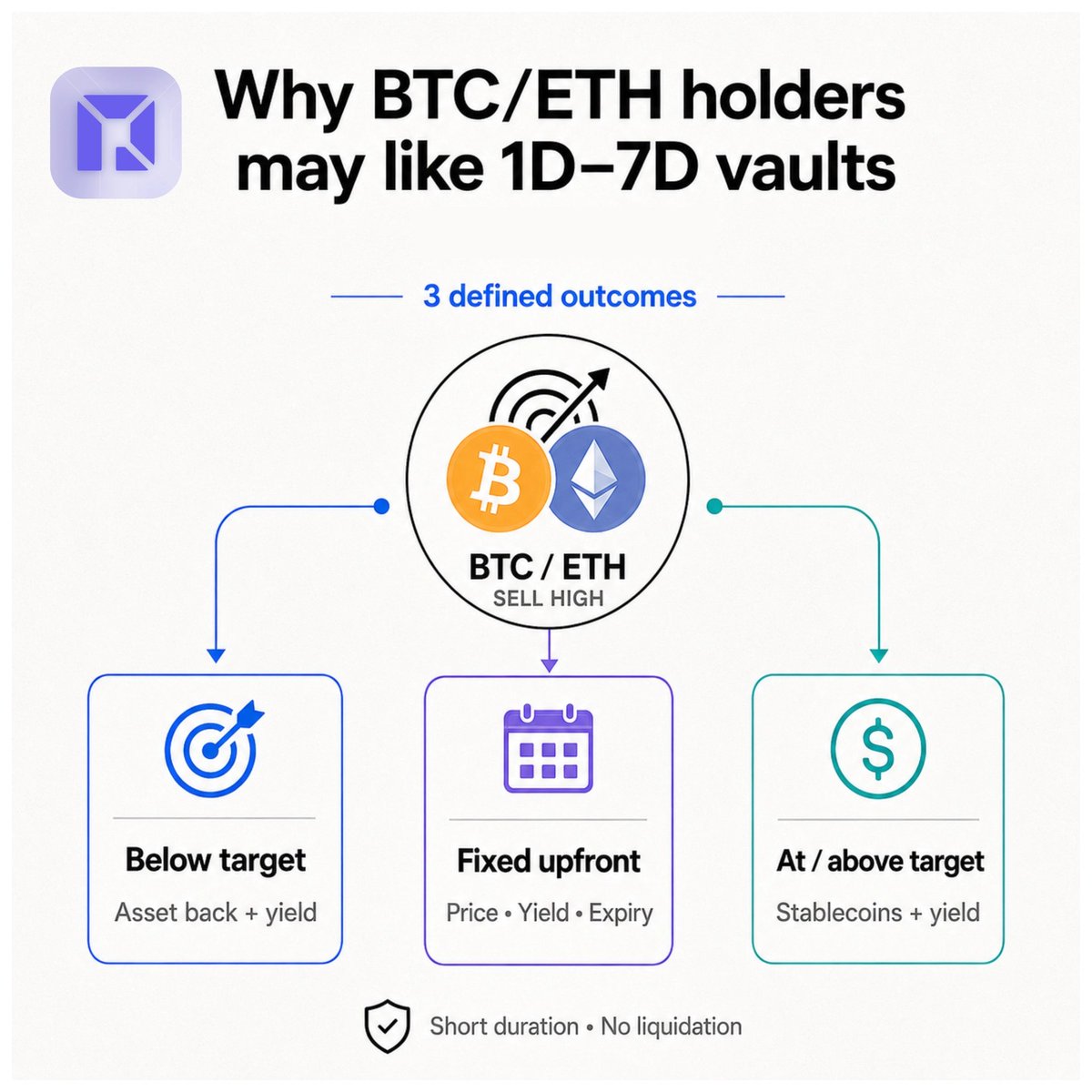
Why I think BTC/ETH holders may like 1D-7D vaults on @ProdigyFi
I’ve been looking at Prodigy’s dual-investment vaults, and the Sell High structure makes sense for a specific type of holder:
Someone who is long BTC or ETH, but would be willing to take profit at a predetermined price.
The setup is simple:
– Deposit WBTC, cbBTC or ETH.
– Select a linked price above spot.
– Lock in a fixed yield and expiry.
– Wait for settlement.
At expiry, there are two outcomes:
→ Price stays below the linked price → I receive my asset back plus yield.
→ Price finishes at or above it → my asset converts into stablecoins at the linked price, plus yield.
Economically, this is similar to selling a short-dated covered call, but packaged into a fully collateralized onchain vault.
Why do I prefer the 1D-7D range?
[1] I can earn on an asset I already plan to hold.
BTC and ETH generate no native cash flow from simply sitting in a wallet.
Prodigy lets me collect a volatility premium without lending the asset, providing LP liquidity or managing an options position.
[2] Short duration gives me more control.
I can roll the position after expiry, move the linked price as the market changes or stay out during an important macro event.
I would rather reassess the trade every few days than lock my BTC or ETH into the same structure for several weeks.
[3] Every outcome is defined before I deposit.
I know the linked price, expiry, yield and settlement conditions upfront. There is no variable APY, liquidation threshold or active rebalancing.
If my asset is converted, it happens at a price where I had already agreed to take profit.
The APY needs to be read correctly, though.
Prodigy annualizes the yield displayed for each vault. A 92% APY over 3 days and 6 hours is roughly a 0.82% actual return for that period.
For short vaults, I care more about:
– Absolute yield and distance from spot to the linked price.
– Probability of conversion & upcoming volatility events.
A higher APY usually means I am accepting a higher probability of being converted or a less favorable linked price.
It is compensation for taking the other side of a defined trade.
I also would not place my entire core position into Sell High vaults.
If ETH moves 20% above my linked price before expiry, I still sell at the linked price and miss the additional upside.
My approach would be to use a smaller, non-core allocation with linked prices where I would genuinely be comfortable taking profit.
It converts a manual options strategy into a short-duration onchain product with fixed terms, no liquidation and no position management.
For BTC and ETH holders who already have a clear take-profit level, the 1D-7D vaults can be a practical way to earn while waiting.
Tanaka@Tanaka_L2
My framework for choosing a Prodigy vault @ProdigyFi currently shows ETH vaults with annualized yields above 100%, and some short-expiry positions can display more than 400% APY. I never choose one from the APY alone. Prodigy vaults are structured yield products. The return comes from taking a defined settlement risk, not from lending or token incentives. The yield locks when I subscribe, but my final asset depends on the oracle price at expiry. Here is the framework I use: [1] I decide which asset I am willing to hold For a Buy Low vault, I deposit USDC and select an ETH linked price. If ETH settles below that price, my USDC is converted into ETH. If it settles above it, I retain USDC. The fixed yield is included in either outcome. I only enter when I am comfortable owning ETH at the linked price. For Sell High, I apply the same logic in reverse. I deposit ETH only when I am genuinely willing to sell it at the selected level. [2] I calculate the distance from spot In the example, ETH trades near $1,769.71. A $1,770 Buy Low vault is effectively at spot. The 420% displayed APY looks attractive, but the probability of conversion is also high. A $1,740 linked price gives roughly 1.7% downside distance. Its displayed APY is lower because I am accepting less immediate settlement risk. Higher yield usually means I am giving the other side more valuable protection. [3] I convert APY into the actual vault return A 420% APY on a four-hour vault does not mean I earn 420% in four hours. APY annualizes a very short period. I check the exact yield paid over the vault’s actual duration and measure that against the possible change in asset exposure. This removes most of the headline effect. [4] I match expiry with the market calendar I prefer short expiries when the market is stable and I want fast capital turnover. I reduce size or choose a wider linked price before: CPI and central-bank decisions. ETF or regulatory announcements. Major token unlocks. Protocol-specific catalysts. Weekends with weaker liquidity. Time matters because the same linked price can carry very different risk across four hours and fourteen days. [5] I compare the yield with expected volatility Prodigy V2 prices vaults using implied volatility and current risk conditions. This is why yields can rise sharply when the market expects larger moves. Once subscribed, the quoted yield is fixed for that vault. I compare linked-price distance, time to expiry, expected market move, actual tenor return, and probability that I will be converted. A high APY is useful only when the premium adequately compensates me for the exposure I am taking. [6] I calculate my effective entry or exit For Buy Low, the yield reduces my effective ETH acquisition cost. For Sell High, it increases my effective sale value. That is the number I compare with my own valuation levels, not the linked price by itself. If I would not buy ETH at the yield-adjusted cost without the vault, I do not subscribe. [7] I size for the conversion outcome I treat every Buy Low vault as a pending limit order and every Sell High vault as a pending take-profit order. I size the position under the assumption that conversion will happen. I also stagger linked prices and expiries instead of committing the entire allocation to one vault. This limits timing risk and preserves capital for better opportunities. My final decision comes down to one test: Would I still accept this trade if the APY were hidden and only the 2 settlement outcomes were shown? If the answer is yes, the vault fits my portfolio. If the yield is the only attractive part, I pass.
English



🫡 $SPCXUSD1 is now live on @Binance Futures, giving traders exposure to SpaceX with USD1 settlement and up to 25× leverage.
This is another step toward TradFi and crypto becoming one market.
The line between Wall Street and onchain keeps getting thinner, thanks to @worldlibertyfi for this addition ❣️
WLFI@worldlibertyfi
BTC. ETH. Now SpaceX → $SPCXUSD1 All settled in USD1. Live on @Binance 🦅☝️
English

I think @EthraShip is building infrastructure that could improve marine insurance
look at it like this, normal insurance snapshots are taken once per voyage and nothing updates after that
updates like weather changes, routes change, port congestion are not included in that one time record
by tokenizing the vessel and cargo data, @EthraShip makes these numbers available in real time for $SHIP holders (stakers primarily. They are the ones that get access to fleet visibility dashboard and data)
Interesting tek 🙂

English
@jargon_sol @SpaceWayTokens Giving builders actual ownership is a nice change
English

Everyone wishes they had bought spaceX before its IPO
This opportunity was never there for the retail investor as spaceX remained private for over two decades and did not give an entry point to regular investors
@SpaceWayTokens offers a completely new kind of entry point
Backed by waypoint 2 space, constructing a training facility near NASA's Johnson Space Center in Houston, FAA approved Astronaut training program, currently under construction, Europe and UAE next
Nothing but direct access to real space infrastructure without any private fundraising rounds or waiting for the non-existent IPO
$SPWAY token provides training access, facility perks, VIP experience, ecosystem rewards
IDO is LIVE
Spores → launchpad.spores.app/ido/spway-ido
Kommunitas → kommunitas.net/pool/SPWAY/Pub…
Don't miss out

English


Strategy just raised $263.5M, and for the second week in a row, didn't buy a single bitcoin with it 📉.
All of it went to cash instead. The dollar reserve just crossed $3.2B.
unchainedcrypto.com/strategy-raise…
English
English
A state court told Kalshi to cancel the trades. The CFTC told it to honor them. Someone's order gets ignored.
@kkirkbos, Jessi Brooks, and @TuongvyLe12 break down the jurisdiction fight, Japan's crypto overhaul, and Wall Street's tokenization push.
Live today at 12pm ET 👇
Join us live on our platforms: X - x.com/Unchained_pod

English

robinhood -
i haven't touched coins for like 2 years, but this drew me back in. i think the advantage i have is that i have a different perspective to the guy who has been trenching for 2 years having to deal with vamped coins that top out at like $10m and then move onto the next pointless thing
but i think the thought on robinhood is simple - it's massive, its DNA is very retail+meme focused and @vladtenev is obviously book smart but more importantly street smart, so he just "gets it"
so like, forget all the pain you've had in the past couple of years...and remember that you literally always complain about "not being early"....now imagine you have a chance to get involved on THE @RobinhoodCrypto chain right at its birth...buy the main runner on it for $80m mkt cap...any good risk taker wouldn't think twice and be like "fk yeah im in"
that is the exact bet that i think is here to take, and your risk is that in a few weeks time ur gonna be like "ugh it was at that price for so long it was so obvious in hindsight" and u will have missed it
these things are never without risk, they are bets, u take bets and u win some and u lose some, but for me i'd be more angry with myself about missing a parabolic run than i would be for losing money on it.
i've spoken in depth a bit more about trades/ideas etc on @RektMkts pro
English