Weijin Research

19 posts

Weijin Research banner
Weijin Research

Weijin Research

@WeijinResearch

Understanding China’s technology and energy transformation through industrial logic. Part of the @techbuzzchina Content Network.

Shanghai, China Katılım Nisan 2026
11 Takip Edilen2K Takipçiler
Sabitlenmiş Tweet
Weijin Research
Weijin Research@WeijinResearch·
Hi everyone! New to Twitter but not new to China tech. We are a prolific publication writing about China’s technology, energy, and industrial change for readers who want more than headlines. Founded by renowned media and business executive Zhou Jiangong, Weijin Research is built around serious, readable analysis of the systems shaping China’s future, from AI and energy to manufacturing and industrial policy. We're part of the @techbuzzchina Content Network and we are here to share our work in English. Please also subscribe to our substack!
Weijin Research tweet media
English
26
49
753
51K
Burnett Accett
Burnett Accett@AccettBurn·
@ruima @WeijinResearch Do you mean Chinese cities will be competing to max out as many tokens as they can, as a metric for innovation or something?
English
1
0
0
8
Rui Ma
Rui Ma@ruima·
Haha, @WeijinResearch thinks this kind of “tokenmaxxing” is where Chinese cities are headed too. And honestly, I think that is somewhat fine at the aggregate municipal level, especially if it is not being directly subsidized in the way Meta is effectively doing it with employees
Jyoti Mann@jyoti_mann1

Exclusive: Meta employees are “tokenmaxxing” and competing on an internal leaderboard called “Claudeonomics” for status as a token legend. Over a recent 30-day period, total usage on the dashboard topped 60 trillion tokens.

English
1
0
4
3.3K
Weijin Research
Weijin Research@WeijinResearch·
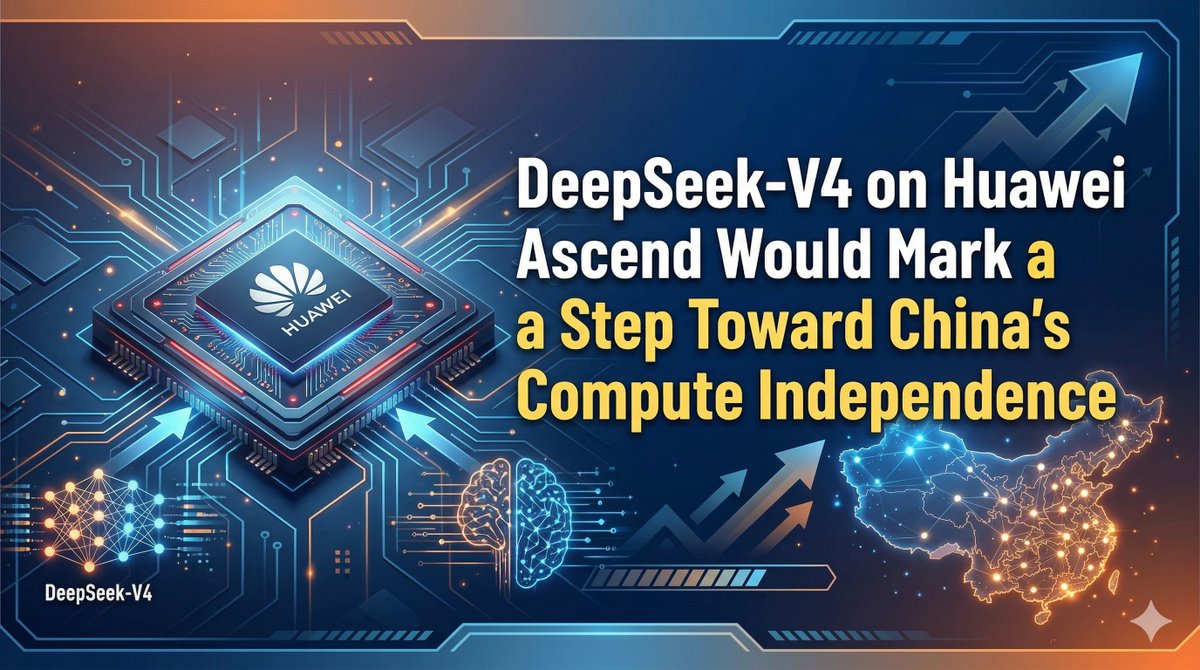
From our latest piece, maybe DeepSeek has other goals besides releasing a new model. "For DeepSeek, who wants to build models rather than applications, the most important thing may not be the release of DeepSeek-4 itself. Any individual model in China will eventually face commoditization. What matters is the role it can play in China’s AI compute and application ecosystem. If DeepSeek actively adapts to domestic chips, it is effectively endorsing and energizing the entire domestic compute supply chain. Every Chinese developer building applications on top of DeepSeek’s open-source models would then channel compute demand toward domestic hardware. The value of that for companies such as Huawei Ascend, Hygon, Cambricon, Moore Threads, and Suiyuan would be immeasurable. So yes, DeepSeek-4 is taking a little longer."
Weijin Research tweet media
English
2
5
22
8.1K
Weijin Research
Weijin Research@WeijinResearch·
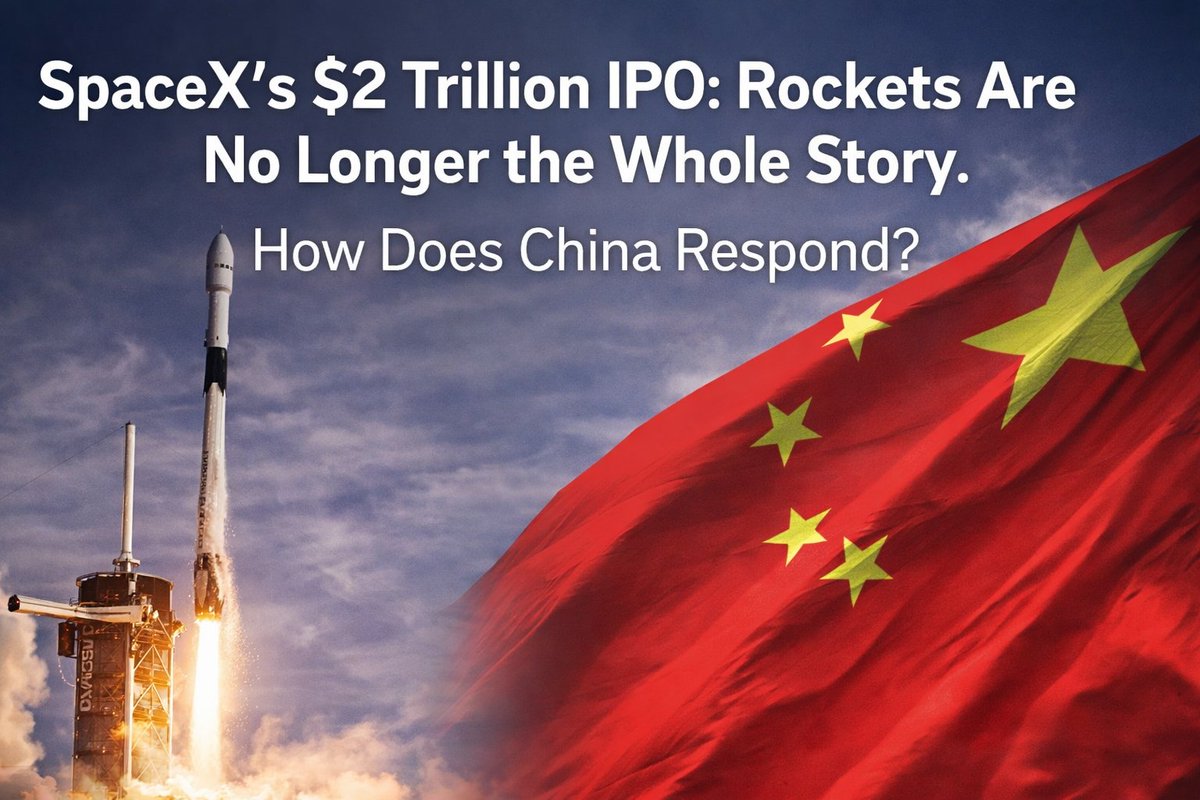
In its 15th Five-Year Plan (2026–2030), commercial space has been designated a new strategic industry. Satellite internet is classified as “new-type infrastructure,” and deep space exploration is listed as a frontier technology priority. Earlier this year, China submitted orbital filings to the ITU for over 200,000 satellites, and today the “Space Computing Power Special Committee” was formally established with ten major R&D priorities. Rather than saying China “lags behind” in commercial space, it might be more accurate to say that China’s terrestrial communications and energy infrastructure has been too successful, so much so that, for a long time, space simply was not an urgent industrial problem. If SpaceX goes public at around $2 trillion, it would immediately become the world’s sixth most valuable company, surpassing both Meta and Tesla. More importantly, for the first time, space infrastructure would be systematically priced in public markets. SpaceX is also reportedly aiming to raise $75 billion in the IPO, potentially creating a major siphon effect on capital markets. The core challenge for China is not just launch capability. It is industrial structure. CAS Space plans to raise ¥4.2 billion, with more than half earmarked for reusable rockets. LandSpace plans to raise ¥7.5 billion, with nearly all of it going toward reusable technology R&D and capacity expansion. But what Chinese commercial space still lacks is a true “chain leader” capable of anchoring the industry, setting prices, and driving integration across the sector.
Weijin Research tweet media
English
2
9
61
13.4K
Weijin Research
Weijin Research@WeijinResearch·
China’s cities already compete on growth, industry, and investment. Soon they may compete on AI token consumption too. Beijing has now put national token figures into the policy conversation. Once tokens are treated as a visible measure of AI adoption and economic activity, local governments will want to show momentum, publish their own numbers, and compare themselves with rival cities. Beijing, Shanghai, Hangzhou, Shenzhen: expect a token race.
English
2
5
48
6.6K
Weijin Research retweetledi
Rui Ma
Rui Ma@ruima·
Hey hey, so we are adding some new partners to the @techbuzzchina network, and here is the first, which I've already RT'ed in the past and 1700+ of you already followed, so thank you! A Note from Rui With the rapid improvement of generative AI and translation tools, we've been rethinking what kind of analysis actually adds value for our readers. Frankly, there's less and less reason to offer watered-down versions of what smart people inside China are already writing — especially when the original thinking is so much richer. So we're excited to announce our first content collaboration with Weijin Research (未尽研究), founded by Zhou Jiangong. I was introduced to Mr. Zhou last year through a good friend who has done a lot of work in climate change. But once I became a subscriber to his research platform, I quickly realized he and his team write about far more than energy — they cover AI, semiconductors, crypto, industrial innovation, and much more. They're prolific, and their perspective is genuinely valuable: China-centric, because they're writing for a Chinese audience, but on topics that are fundamentally global at this point. We'll occasionally feature translated pieces from Weijin Research on @techbuzzchina channels, but they have a full pipeline of content — to get the complete picture, we'd encourage you to subscribe to their substack or @weijinresearch directly. We’re helping to operate those and welcome your feedback. We think English-language audiences would really benefit from reading their work, and we're glad to help get it out there. About Zhou Jiangong Zhou Jiangong is the founder and CEO of Weijin Research, a Shanghai-based research firm covering technology, AI, and carbon neutrality. He is one of China's most experienced business media executives. He was a founding editor of Yicai Daily (First Financial Daily) in 2004, then served as Editor-in-Chief of Forbes China from 2009 to 2015. After Alibaba's RMB 1.2 billion investment in Yicai, he became CEO of the entire Yicai Media Group, overseeing its TV, print, digital, and new ventures — including launching the English-language Yicai Global. Before media, he was a research consultant at CSIS in Washington, D.C., working on China's pension reform. He founded Weijin Research in 2023, and has since published widely on generative AI, the economics of large model training, and China's role in the global energy transition. He authored Crossing the Unknown: From Infinite Labor to Infinite Computing and translated the Chinese edition of the Jensen Huang/Nvidia biography. He holds master's degrees from Johns Hopkins SAIS and Peking University.
Rui Ma tweet media
English
3
10
60
9.1K
Weijin Research
Weijin Research@WeijinResearch·
Zhipu, which released its first annual report since going public last night, reported that: - open platform and API revenue nearly tripled over the past year to RMB 190 million ($26.4 million) - this growth far outpaced the company’s overall revenue growth - API ARR reached roughly RMB 1.7 billion ($236 million), representing a 60x year-over-year increase - even after raising API prices by 83% in Q1, usage volume still rose 4x MiniMax also disclosed strong API momentum in its annual report: - API revenue reached about RMB 180 million ($25 million), up roughly 200% - as of February, ARR reached $150 million token consumption for its M2 series models grew 6x since the end of last year USD figures above are translated from company documents using a 7.2 CNY/USD exchange rate for 2025.
Weijin Research@WeijinResearch

x.com/i/article/2039…

English
0
2
18
4.9K
Weijin Research
Weijin Research@WeijinResearch·
Thanks, everyone! This account will be managed by both the Weijin and @techbuzzchina teams, and we’re excited to learn from all of you. We’d especially welcome your feedback on how to make our content easier for more people to access and engage with. Our main focus is the Chinese tech ecosystem, but we also regularly cover companies beyond China, because in many frontier technologies, innovation does not stop at national borders, and impacts can be felt globally.
English
0
0
5
748
Weijin Research
Weijin Research@WeijinResearch·
Hi everyone! New to Twitter but not new to China tech. We are a prolific publication writing about China’s technology, energy, and industrial change for readers who want more than headlines. Founded by renowned media and business executive Zhou Jiangong, Weijin Research is built around serious, readable analysis of the systems shaping China’s future, from AI and energy to manufacturing and industrial policy. We're part of the @techbuzzchina Content Network and we are here to share our work in English. Please also subscribe to our substack!
Weijin Research tweet media
English
26
49
753
51K