The.West.Coast.Inquiry

626 posts

The.West.Coast.Inquiry banner
The.West.Coast.Inquiry

The.West.Coast.Inquiry

@west_inquiry

Essayist. Student of Political Science. logician. 26th-great-grandson of Gerard, Duke of Lorraine.

Katılım Ağustos 2024
537 Takip Edilen110 Takipçiler
Sabitlenmiş Tweet
The.West.Coast.Inquiry
The.West.Coast.Inquiry@west_inquiry·
This is a good example of someone who suffers from a first-person perspective of the world. Emiru, a streamer, refused to give her opinion on ICE. She said that if you need a streamer to tell you what to think about politics, you should log off the internet. Now, people (mostly other women like @emkenobi) are upset. Em specifically used an image (see tweet below) to insinuate that Emiru doesn’t stand for anything. The reason why this is a first-person perspective is because the first person is characterized by the self. Em feels like Emiru is neutral, therefore she must be. Anyone suffering from a first-person view of the world attributes their feelings onto others as if it’s reality. There are first-person, second-person, and third-person perspectives of the world. I’ll model them in a later tweet. But here is the take away from this post: lots of people like Em curate their perception of the world by attributing their feelings onto other people and institutions. This is the lowest perception of the world, and someone (me) should start pointing this out.
𝓔𝓶 ♡@emkenobi

English

0
0
0
583
Nova🦇He/e/xe
Nova🦇He/e/xe@RealityBent·
@R4ngelit0 Dictionaries are built off normative definitions and do not account for the different ways in which queer communities may use words.
English
10
2
19
2.6K
Nova🦇He/e/xe
Nova🦇He/e/xe@RealityBent·
If you assume "boyfriend" must mean a man that's your problem.🤷‍♂️
English
76
31
241
29.7K
Unfathomable Studios
Unfathomable Studios@NfthmblStudios·
@mhartl i believe, by my value set, choosing red is choising to kill innocents that many deaths merely for the sake of my survival is not an adequate trade
English
1
0
0
140
Michael Hartl
Michael Hartl@mhartl·
The discourse on the red button/blue button problem can get a bit heated, so I’m reluctant to engage. Nevertheless, after some reflection, I do feel like I have something to contribute. (Please be considerate in the replies.) First, I think it’s worth noting that the problem statement is carefully phrased to recruit prosocial impulses and to mislead people who know something about game theory (specifically, the prisoner’s dilemma). This suggests a baseline stance of sympathy. Moreover, it’s clear that at least some people in the given scenario would press blue, so blue-pressers reason correctly that the only way to save everyone is for more than 50% of people to vote blue. Unfortunately, from this correct conclusion, many blue-pressers reason incorrectly that they should therefore press blue to help blue to win (often condemning red-pressers as selfish because they refuse to help). This might make sense if we were trying to coordinate a big push to get people to vote blue ahead of time, but by hypothesis there is no such coordination. Since it’s a private vote, we need to supply an individual justification to vote blue, not one that relies on nonexistent coordination with others. This can be deeply counterintuitive. To many blue-pressers, it seems obvious that pressing red is “part of the problem”, while pressing blue is “part of the solution”. This brings us to our key result: The vote of any individual blue-presser makes no difference to the outcome unless there would have been a tie otherwise. (Absent coordination, this is a mathematical fact; blue-pressers tempted to deny it should take a moment to reflect.) Because voting blue saves lives only in the case of breaking a tie vote, it is essential to get a sense of the a priori likelihood of such a tie. There are alternate scenarios where such a tie is not all that unlikely. For example, I’ve seen some blue parents say they would vote blue because their kids might vote blue and they should do everything they can to save them. And this logic makes sense in, say, a vote by a family of four, where the chances of a tie are quite high. A responsible father might well vote blue on speculation that his vote would save his children’s lives. (He might also find it rather awkward trying to explain himself if he voted red when his wife and two kids voted blue; more on such social consequences later.) But, as with political philosophies that sometimes work fine with a few people but always collapse when scaled to millions, this strategy of voting blue to “save the children” (or whomever else) fails when the vote is global. There’s no way to calculate the exact probability of a tie, but we can get a sense of the numbers by plugging in, say, 55% for the probability that any given person votes blue (which I think is a reasonable estimate for a blue optimist; in a real-life vote with real consequences, I suspect that red would win in a landslide, but our argument here does not require that). According to my calculations, in this case the probability of an exact tie for a global population of 8.3 billion people is approximately 3 in 10^18,113,948. That’s not three in eighteen million. It’s 3 divided by 1 followed by eighteen million zeros. It’s hard to express in words how small this number is. It is utterly negligible. Physicists Charles Kittel and Herbert Kroemer once wrote in a similar context that such a probability is “zero in any operational sense of an event.” We could hold a worldwide vote a billion times a second for the entire history of the universe and still have a negligible chance of a tie. As a result, any individual blue voter, although he may feel like he is helping blue to win, in fact has ~no chance of affecting the outcome. And since the probability of blue losing is nonnegligible, he is risking his life in the process. (One might reasonably observe that a similar logic could apply to voting in elections; I’ll leave pulling on that loose thread as an exercise to the reader.) Based on my observations of their comments, it seems to me that blue-pressers are driven to vote blue mainly by wanting to do what they feel is the right thing, and I think there’s also a desire to be perceived as doing the right thing. As we have seen, the first of these is misguided since the probability of affecting the outcome is ~0, but the motive is laudable. Regarding perceptions, my sense is that most blue-pressers can very clearly imagine what it would be like having to admit they voted red in a world where blue carried the day, and they don’t want to live in that world. Moreover, even if they came to appreciate the logical arguments in favor of pressing the red button, the social consequences of doing the logically correct thing can be quite real and painful if enough other people believe that the logically correct thing is selfish or evil. This leaves us with various costs and benefits of pressing the blue button. We have seen above that the probability is ~0 of saving half of humanity, so we should not include that in the benefits column for pressing blue. There are also potential personal benefits of the feeling of having “done the right thing”, even if those feelings are not logically justified. And even absent personal benefits, the social benefits of voting blue could remain quite real. Meanwhile, the cost of voting blue is a significant likelihood of death. In contrast, the only cost of voting red is the social cost of being perceived as selfish or evil if blue wins. (Blue-pressers might identify an additional cost, namely, guilt about being selfish, but this is projection.) Meanwhile, the benefit of voting red is guaranteed survival. In sum: Blue-pressers have a reasonable chance of realizing the social and possibly personal benefits of having done “the right thing”, but they also have a reasonable chance of dying. Red-pressers have a reasonable chance of realizing the social cost of being perceived as selfish or evil, but they have no chance of dying. Anyone who sincerely feels that being perceived as selfish is worse than dying should seriously consider pressing blue. Everyone else should press red.
Tim Urban@waitbutwhy

Everyone in the world has to take a private vote by pressing a red or blue button. If more than 50% of people press the blue button, everyone survives. If less than 50% of people press the blue button, only people who pressed the red button survive. Which button would you press?

English
195
43
568
78.3K
Toast
Toast@ToastingTweets·
@waitbutwhy No, it doesn’t sum it up. The framing is a part of it, but there is a very real selfishness/cowardness component to it too.
English
1
0
1
234
Tim Urban
Tim Urban@waitbutwhy·
This sums up why the blue/red button thing has caused such a ruckus. Like the white-gold/black-blue dress, it can be viewed through two different lenses, with each lens making one button seem obvious and the other seem unfathomable.
prerat@prerat

it was interesting that the comments for both of these were full of people saying "see everyone, this OBVIOUSLY clarifies the original problem!!!" not realizing the other poll with the opposite result existed too

English
128
32
960
133.2K
NotAGoodUsername360
NotAGoodUsername360@AUsername360·
@Mankosmash Voting Red is a necessary condition for the massacre. Without Red action, no death can occur. You are in no danger if there are no Red voters, or even if there are less Red voters than blue. Every Red voters increases the peril for Blue. It is not a passive action.
English
8
0
12
491
Mankosmash
Mankosmash@Mankosmash·
🔴 vs 🔵: 🔴 is the only honest, ethical, rational choice. Unless you can guarantee that over 50% will press blue, you're gambling with the lives of up to half of society just to protect a tiny dumb suicidal minority who would still press blue. Think about this game being run billions of times to see all possible outcomes & probabilities. You'd see a probability curve of vote distribution. Blue causes the loss of life to be 0 until you get to the "blue gets under 50%" part of the probability curve, in which case half of society dies thanks to the blue miscalculation. There's no way to reliably prevent this. So you're not really saving lives, you're just shifting the risk into an all-or-nothing gamble just like at a casino. You're paying for a small "good" outcome by risking a much worse bad outcome. Over the probability curve, Red minimizes loss of life & prevents catastrophic outcomes by accepting the loss of a small group that irrationally chooses blue. If pressing red is normalized, blue becomes a suicide button. The most ethical thing to do is try to minimize people pressing blue. But ultimately individualism over collectivism means it's their responsibility they pressed 🔵, not our obligation to risk our lives to bail them out of their bad choice. Assuming you can lobby before the vote, everyone should say "I'm pressing red, don't press blue". That's the most ethical outcome. The problem with lobbying for blue is that people would lie & advocate others to press blue, then press red. Saying you would press blue 🔵 is an empty liberal collectivist virtue signal. Dishonest people will pick blue 🔵 to lie to themselves & to others that they're a "good person". But if faced with the real choice where they'd have a genuine existential fear of death, the large majority of these people would not be able to suppress their self preservation instinct & would press red 🔴. To be a genuine blue 🔵 presser, you'd have to be highly collectivist. Does any place in the real world look like this? No. MAYBE Japan 🇯🇵. I was disappointed to see that @Asmongold advocated Blue 🔵 & argued that blue is somehow "Western values" while red is 3rd worldism. 🙄 This just goes to show how even right wing people often get infected by libtard beliefs. Blue is a betrayal of the self & your family for the sake of abstract faceless strangers. Blue is choosing the "suicidal empathy" side of the heatmap meme 🥩🥑. Blue is fundamentally deeply dishonest & goes against human nature. It's proudly proclaiming yourself to be an ant 🐜, not a rational human. You're betraying everyone who loves you and depends on you, for what? 🔴 doesn't make you "selfish" & 🔵 isn't virtuous. 🔵 is an irrational betrayal of self preservation as well as your family & friends. 🔵 is communism. 🔵 is 🐜. 🔵s are liars virtue signaling as a rule. 🔴s are honest & able to understand the folly of risking the many to save the few.
Mankosmash tweet media
English
113
23
282
25.9K
The.West.Coast.Inquiry
The.West.Coast.Inquiry@west_inquiry·
@lenirtpls @NfthmblStudios @Staladus You projected onto me the perception that I think you are suicidal. I never actually held that view. My admission that you aren’t isn’t a concession that I was wrong. You’re literally just projecting. That’s all this has been for like the past 5 replies.
English
0
0
0
7
Len O so
Len O so@lenirtpls·
@west_inquiry @NfthmblStudios @Staladus The cope is you lmao. This is why I mute you self-satisfied blue check Dunning-Kruger inhabitants. I'm not suicidal either so you've proven me right with that phrase alone.
English
1
0
0
27
Staladus 🐁
Staladus 🐁@Staladus·
I have no idea why you would press the red button. It's 100% vs 51% the answer is clear here.
English
224
18
2.6K
53.2K
Len O so
Len O so@lenirtpls·
@NfthmblStudios @west_inquiry @Staladus He's twisting and squirming cause he knows what he said. He knows his entire view is based on considering blue the illogical and "suicidal" option, and his entire argument follows from that assumption.
English
2
0
1
28
The.West.Coast.Inquiry
The.West.Coast.Inquiry@west_inquiry·
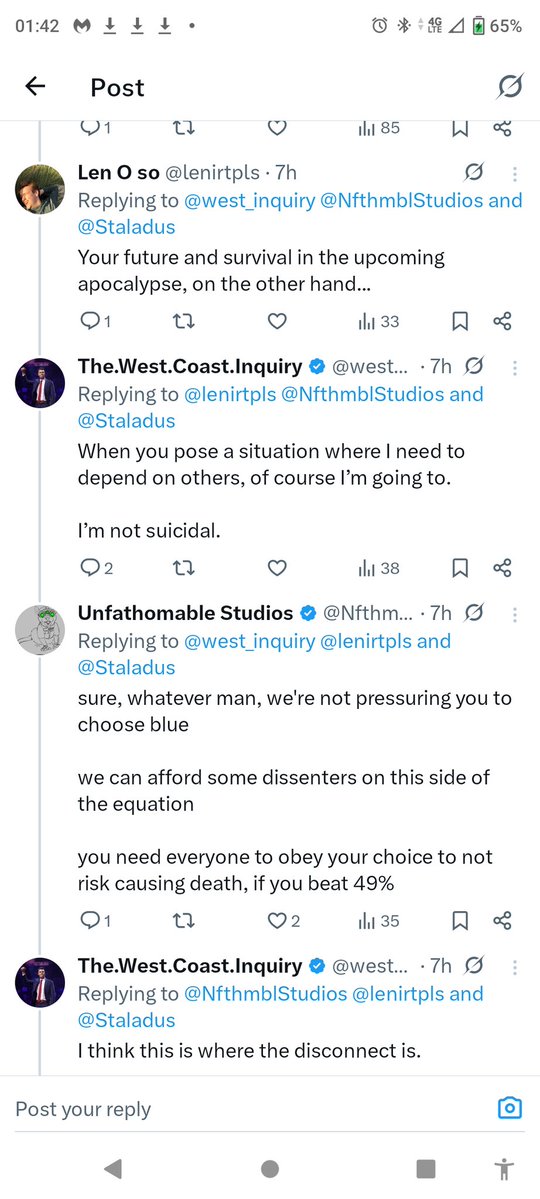
In this screenshot I tell @lenirtpls that if I’m in a situation where I have to depend on others, I’m willing to do so. I then say “I’m not suicidal,” implying that an unwillingness to do so in such a situation is analogous to suicide. Because it is. No where in this screenshot did I call the blue button a suicide button. Keep coping.
English
2
0
0
17
The.West.Coast.Inquiry
The.West.Coast.Inquiry@west_inquiry·
When you admit that I never said that, we can have a conversation about your habit of affirming the consequent, and my ability to correctly read your inferences. Which is another great point. I can correctly identify your perspective, but you can’t identify mine. This somehow makes me the idiot here.
English
0
0
0
11
The.West.Coast.Inquiry
The.West.Coast.Inquiry@west_inquiry·
This is another example of affirming the consequent. “He recognized that blue is the only button that risks my life, therefore he must think I’m an idiot for choosing to be selfless” I literally never said that. Your entire reply is just you projecting. In fact, you assume that I find you stupid because you first presupposed that I wouldn’t factor in selflessness. You ironically think that I’m the idiot, and I’m not.
English
1
0
0
25
Len O so
Len O so@lenirtpls·
@west_inquiry @NfthmblStudios @Staladus So you're arguing in circles and you absolutely do not respect our intelligence because you cannot get over your interpretation that it's just a "suicide button", so you still consider everyone who chooses blue to be dumb and wrong. We're neither.
English
1
0
1
35
The.West.Coast.Inquiry
The.West.Coast.Inquiry@west_inquiry·
So if I vote to say that someone should not die to save me, and that button receives less than 50%, they all die anyway? If they die anyway, then voting No kills more people. Why would I vote no? But if I vote yes, then someone dies? So this hypothetical forces me to kill somebody?
English
0
0
0
12
Unfathomable Studios
Unfathomable Studios@NfthmblStudios·
Reformat: you are in a private cell, the wall has two buttons on it and instructions are posted: "should someone die to save you? if everyone voting No is less than 50% an automated system will activate and kill them, you will be released after the vote is finished"
English
1
0
0
21
The.West.Coast.Inquiry
The.West.Coast.Inquiry@west_inquiry·
During Kirk's comments, he said he didn't care for the word "empathy" and instead preferred "sympathy." The Oxford English Dictionary defines empathy as "the ability to understand and share the feelings of another." Meanwhile, the same dictionary defines sympathy as "feelings of pity and sorrow for someone else's misfortune." This paragraph was pulled from an article I linked via screenshot. The article comes from Snopes, a fact checking organization.
The.West.Coast.Inquiry tweet media
English
1
0
0
22
Sebastian O
Sebastian O@SebMadeInChina·
@west_inquiry @RyLo2202 @owlthatissuperb “I think empathy is a made-up, New Age term that — it does a lot of damage, but it is very effective when it comes to politics.” The damage in this case is blue voters risking their lives.
English
1
0
1
45
Max (Vibecamp June 18-21)
Max (Vibecamp June 18-21)@owlthatissuperb·
Red/blue scenario, but you need at least X% blue votes for everyone to survive. Less than X%, blue voters die. After what X does your vote turn red?
English
26
0
20
4.6K
The.West.Coast.Inquiry
The.West.Coast.Inquiry@west_inquiry·
You are Affirming the Consequent when you say that I choose red because I only care about myself, or any iteration of that. And besides, I'm not even thinking about myself here. Let's focus on you specifically. Is it possible for you specifically to die if you press red? No? Then the only deadly result that could occur happens when you select blue. thus, red doesn't lead to a deadly result. x.com/west_inquiry/s…
English
1
0
0
87
The.West.Coast.Inquiry retweetledi
Hunter📈🌈📊
Hunter📈🌈📊@StatisticUrban·
If you press the blue button, worst case, you die. If you push the red button, worst case, you remain alive in a society of reds.
English
136
47
2.3K
38.1K