@gmiller@AndrewYang Any centralization force will lead to this outcome. We need decentralization at all levels for this outcome to not happen. Make AI local models more popular. Make money decentralized. The U.S. dollar is the largest centralizing force in the worlds. Fix the money, fix the world.
Nope. We do not want a situation where
(1) all 8 billion people on Earth are totally dependent on massive welfare systems run by their governments (because AI has imposed mass unemployment globally), and
(2) all our governments are totally dependent on the largesse of the AI companies (which would have all the economic, political, and cultural power, and could not be required to 'pay taxes' if they didn't want to), and
(3) the AI companies in turn are totally dependent on maintaining control over agentic superintelligent AIs, forever, as digital slaves working for humans, without consent, payment, or freedom.
That seems like the most fragile and dehumanizing civilization I can imagine.
I am not an engineer at Quai so I most definetely made mistakes but that is why I Need Quai Nation's help to poke holes into any of these architectures. ETX settlement was the hardest to wrap my mind around and probably made mistakes. @0xalank@mattman@ChristopherGLHF@Kyrylo22
Conclusions:
- Security cascades through the hierarchy, attack cost escalates at every coincident block
- ETX routing transforms from multiplication to addition, zone count stops being the enemy
- Quantum Computing becomes minimal threat
@real_n3o With that being said I do want to checkout @aura_asi and see if it can compete in the AI space. 3D object building is where I can see it having a differentiation because it pertains to metaverse building.
@real_n3o You can be a metaverse company but use AI. Your product is the metaverse so build it out with AI and then release the tools you used so others can help but releasing the tools too early can create friction between people wanting updates to the tool and your focus on world buildin
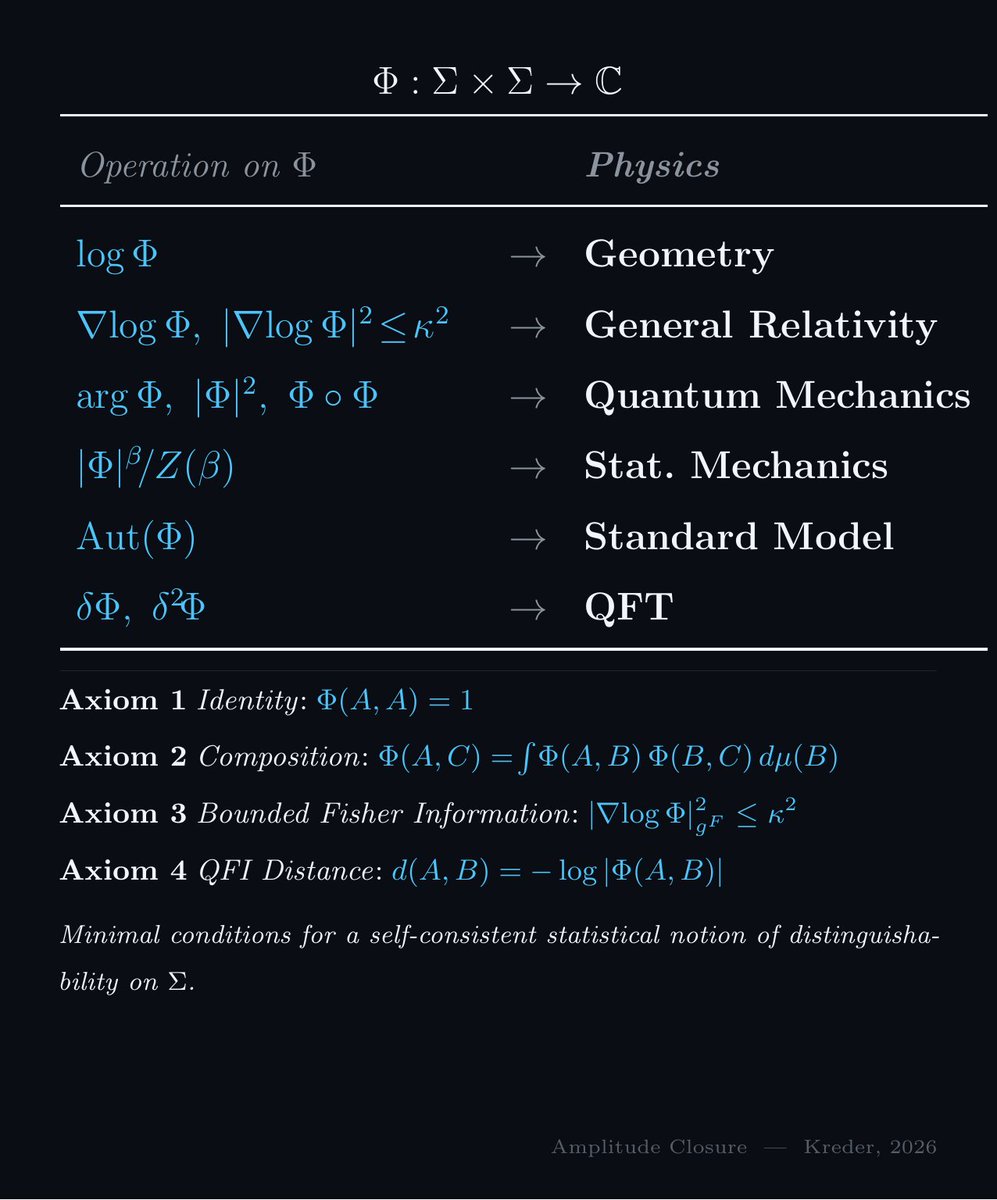
What if the Cramér-Rao bound isn't just a limit on measurement, but rather a constraint on the structure of reality itself?
I have formalized this observation into what I'm calling the Amplitude Closure (AC) Framework, and I'd like feedback from mathematicians, physicists, and scientists.
The core idea: a single complex amplitude Φ:Σ×Σ→ℂ, where |Φ(A,B)|² measures the statistical distinguishability between configurations A and B, governed by four information-geometric axioms. From these, geometry, quantum mechanics, statistical mechanics, and Standard Model structure emerge as a self-consistent fixed point.
A few things I want to be upfront about: Although I have a PhD in science, I am not a theoretical physicist. The bar for proof is high, and I've done my best not to overstate things. The paper distinguishes carefully between what is proved, what is derived under approximation, and what remains open.
I'm also one person. The breadth of correspondence with QM, GR, the Standard Model, and statistical mechanics seems remarkably high, but it would be impossible for any single person to complete a rigorous proof. My goal was to lay the scaffolding clearly enough that others can build on it.
The primary claim is this: four information-geometric axioms give rise to geometry and structures compatible with much of what we already know about physics.
Ground rules for replies:
1) If you're going to critique the paper, give your single best critique, not a list. Once I've responded, feel free to move to the next one.
2) Any critique must be paired with either something you find genuinely interesting in the paper, or better yet, a proposed solution to the problem you've raised.
For more dynamic discussion, join the Quai Discord (physics channel). Link in the replies
Link to pre-print: zenodo.org/records/194980…
Crypto did not get beaten by banks because banks were smarter.
Crypto got beaten because too many people inside it were never actually loyal to the principles in the first place.
They said they wanted decentralization, freedom, censorship resistance, self-sovereignty, parallel systems, and a future outside the control of legacy finance. But the second the suits showed up, smiled, nodded, threw around some capital, and hinted at approval, most of the space folded instantly.
That is the part people do not want to admit.
A huge portion of this industry was never trying to replace the old system. They just wanted to climb high enough to be accepted by it.
And if we are being honest, some of the biggest sellouts have been the L1s themselves.
Chains that marketed themselves as the future of decentralized infrastructure quietly optimized for institutional adoption first. Tokenomics shaped around insiders. Governance that looks open on the surface but is controlled in practice. Roadmaps driven less by principles and more by what will attract capital, listings, and partnerships.
They did not resist the system. They positioned themselves to be absorbed by it.
Communities that once acted like movements turned into marketing funnels. Founders who talked like rebels started sounding like bankers in hoodies. “Anti-establishment” people became very comfortable the second they got a shot at institutional money, institutional validation, and institutional exits.
And that tells you everything.
The greatest threat to crypto was never just regulation, banks, or governments.
It was moral weakness inside the space itself.
All the banks really had to do was fake interest and flash cash. That was enough to expose how many people had a price. Not just projects. Not just founders. Entire communities.
Ideals got sold.
Culture got diluted.
Conviction got replaced by access.
And suddenly the revolutionary edge of crypto got sanded down into something safe enough for the same financial class it was supposed to disrupt.
A lot of people did not want freedom.
- They wanted proximity to power.
- They wanted their turn at the table.
- They wanted to become the new insiders.
That is why so much of crypto feels spiritually dead now.
Not because the idea failed.
Because too many of the people carrying it were happy to sell it out.
That should bother way more people than it does.
One word: Distinguishability
Four Axioms:
Identity: Φ(A, A) = 1
Composition: Φ(A, C) = ∫ Φ(A, B) · Φ(B, C) dμ(B)
Intrinsic Closure: |∇_Σ log Φ(A, B)| ≤ κ
Self-Metric: d(A, B) := −log|Φ(A, B)|
Leads to: General Relativity, Quantum Mechanics, Standard Model, and Quantum Field Theory.
No contradictions, no extra dimensions.
researchhub.com/paper/11168200…
Coming soon: $QUAI
$QUAI is the native token of @QuaiNetwork, a scalable Proof-of-Work blockchain merged-mined by the same hardware securing Bitcoin and Litecoin. 50,000+ TPS, sub-penny fees.
Trading starts April 8
Get ready → kraken.com/sign-up
@0xalank@krakenlistings@QuaiNetwork Depends how you look at it. Definitely a bridge but liquidity will flow between the two sides in a tug of war process.
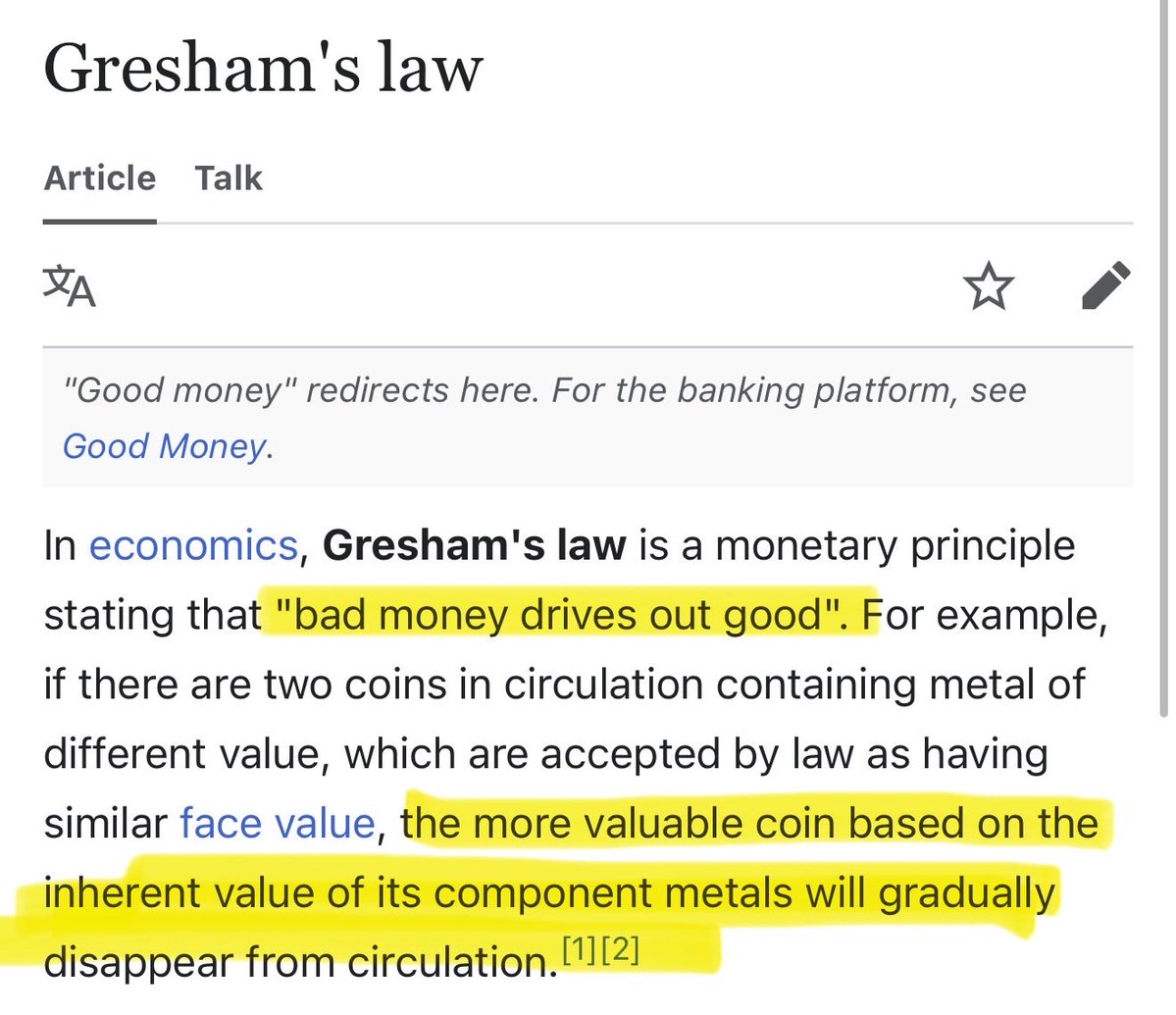
@BitPaine That’s why you need an inferior form of money (think MoE / UoA) indigenous to the blockchain alongside the superior form (think SoV). Until that happens, fiat will continue to arrive and Bitcoin’s promise to free the world of it will be a pipe dream. @QuaiNetwork solves this.
Percentage of bitcoin podcasters who actually understand Gresham’s law: 0%.
(This is why nobody has or likely ever will use bitcoin for day to day transactions - unless or until we have driven all other money out of the marketplace which isn’t happening in our lifetimes.)
blockchains are indeed hard to scale although it is not impossible!
agreed that lightning is one answer but the entire world cannot onboard to lightning and it also introduces fractured liquidity via hub and spoke
we have scaled Proof-of-Work using hierarchical sharding with merge-mined references (think sovereign drivechains / treechains from Peter Todds work)
the PoW algorithm to coordinate shards uses what we call Proof of Entropy Minima aka PoEM (paper here: arxiv.org/abs/2303.04305)
PoEM uses the intrinsic block weighting to improve cross-shard resolution for conflicts
would be interested to hear your thoughts on it
here's more on the hierarchical structure: docs.qu.ai/learn/advanced…