wildyields

528 posts

wildyields banner
wildyields

wildyields

@wildyields

structured credit

New York, NY Katılım Mart 2020
603 Takip Edilen203 Takipçiler
wildyields retweetledi
Conor Rogers
Conor Rogers@conorjrogers·
FIFA having its corrupt way with every single city and country its ever touched until suddenly being shocked and stunned into submission by a final, even more corrupt thing: New Jersey
English
142
3.9K
59.3K
1.5M
wildyields
wildyields@wildyields·
@ExcessDefaults PGY is hilarious because they constantly conjure up new slides and rubrics to “prove” how their originations are not “second look” but their credit performance repeatedly shows itself to be exactly that
English
1
0
2
78
ExcessDefaults
ExcessDefaults@ExcessDefaults·
So PGY gets sloppy seconds from front line originators’ flow they don’t want bc ai underwriting then pop to abs or sell to sample of flow partners:
English
5
0
10
2.9K
wildyields retweetledi
Aakash Gupta
Aakash Gupta@aakashgupta·
Every time you swipe to a new 30-second video, your brain releases a small pulse of dopamine in anticipation of what might come next. This is what neuroscientists call a variable ratio reinforcement schedule, the same mechanism that makes slot machines the most addictive form of gambling. The uncertainty does the work. And the feed delivers it 270 times per day. The average TikTok user consumes 167 to 271 videos per day. Each one is 21 to 34 seconds long. That’s a dopamine pulse every half-minute for hours. Your nucleus accumbens, the brain’s reward center, adapts to that cadence. It recalibrates what “normal stimulation” feels like. When you then sit down with a novel or a crossword puzzle, your brain registers the low stimulation as aversive. You feel restless. You reach for your phone. That restlessness is withdrawal operating below conscious awareness. The data on this is now stacking up. Average attention span on social media dropped from 12 seconds in 2015 to 8.25 seconds in 2025. Teens toggle between apps every 44 seconds, down from 2.5 minutes a decade ago. 52% of people now skip videos longer than 60 seconds even when they’re interested in the topic. Here’s the part that changes the conversation. Researchers interrupted participants during a task with either TikTok, Twitter, or YouTube, then asked them to resume. After TikTok, accuracy dropped to barely above random guessing. Twitter and YouTube showed zero measurable impact. The short-form feed format specifically degrades prospective memory, your ability to hold an intention across a time gap. The prefrontal cortex, which governs sustained attention and impulse control, doesn’t fully mature until around age 25. An entire generation is training that circuitry on rapid context switching 270 times per day. The brain wires to whatever you repeatedly expose it to. Full stop. Puzzles, board games, long novels, long-form video. These function as something like resistance training for the prefrontal cortex. They require sustained effort without algorithmic reward. That’s the point. The discomfort you feel 10 minutes into a book after a week of heavy scrolling is the same discomfort you feel on rep 8 of a hard set. The adaptation is on the other side of it. Your brain adapted to the feed. The same plasticity that allowed that works in reverse. But you have to actually put it under load.
Rissa@rissa_kimmy

Please get back to doing puzzles, sudoku, board games, crosswords, word search. Read long novels and watch long form videos. Seeing my students and even my age-mates uncomfortable being cognitively unentertained is... something. We’re losing patience with thinking deeply.


English
30
770
4.3K
379.4K
wildyields retweetledi
Kieran Goodwin
Kieran Goodwin@kieranwgoodwin·
My view is that credit is more reflexive and becomes more correlated than equity in times of stress. The results of those two characteristics are convexly powerful in down markets. Private credit reprice example: Good credit goes from S+ 450 to S+650 so price moves from $100 to $90 that moves price of so-so credit to ~ $80 Those simple MTMs cause reflexivity to kick in: If good credit refi's at S+650 then Higher cash interest causes lower FCF Lower FCF causes tighter covenants Sponsors cut capex which lowers growth potential Lower growth means less FCF potential So-so credit has a hard time refinancing since $80 means stress. Banks providing credit lines to funds/BDC might reduce lines are increase cost of line if too many credits are trading at $80. Prices down causes liquidity to tighten which causes fundamentals to weaken which causes prices to fall further. Why credit is more reflexive than equity: Credit fuels growth. A stock down 50% doesn’t trigger default. A loan at $80 can close the refi window. Spreads directly change cash flows. Equity prices don’t raise interest expense but credit spreads do. Why credit becomes more correlated in stress: Rising volatility, causes buyers to demand more spread given greater uncertainty. Spreads in public markets for HY, CLO tranches, BSL all affect private loan spreads. When liquidity tightens, everyone moves the same way at once. Equities can diverge on narrative. Credit converges on liquidity. Reflexivity + correlation = convex outcomes. 200 bps spread moves can cause nonlinear operating impact which synchronize tightening and amplify stress. Credit doesn’t just reflect the cycle. It accelerates it.
English
9
15
171
24.5K
wildyields
wildyields@wildyields·
@ExcessDefaults Would have to be resids in abs structures. First loss 0-5% type slices. No other way
English
0
0
1
58
ExcessDefaults
ExcessDefaults@ExcessDefaults·
So $ecc says it is allocating to private credit at what it bills as 18% gross for realized investments? Gotta be some mangy stuff to get that headline yield.
English
3
0
10
1.5K
Hunter 🌆
Hunter 🌆@rhunterh·
Butter is the ultimate veblen good for me. There's no price point at which I'll say "come on, it's just butter"
English
8
0
71
14.9K
wildyields retweetledi
Michael McNair
Michael McNair@michaeljmcnair·
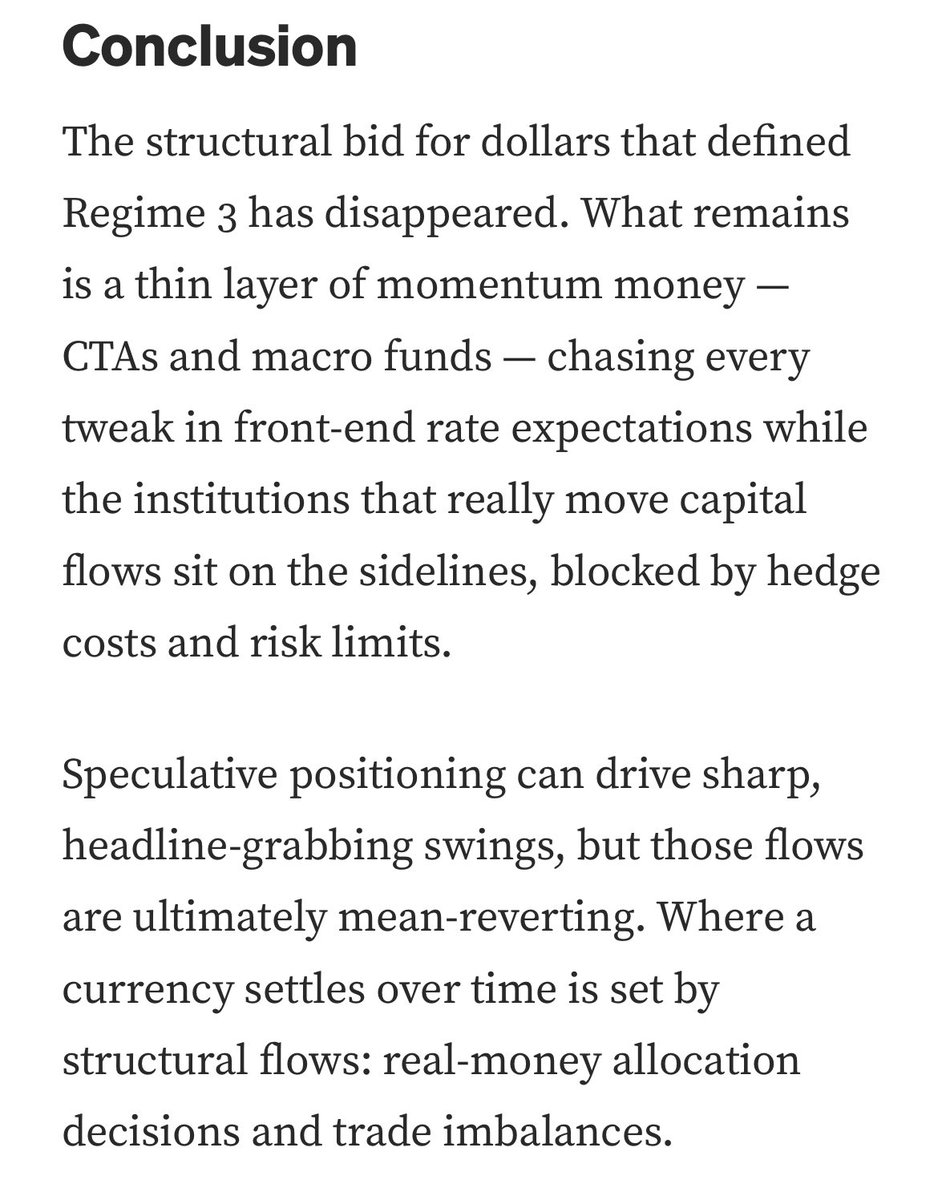
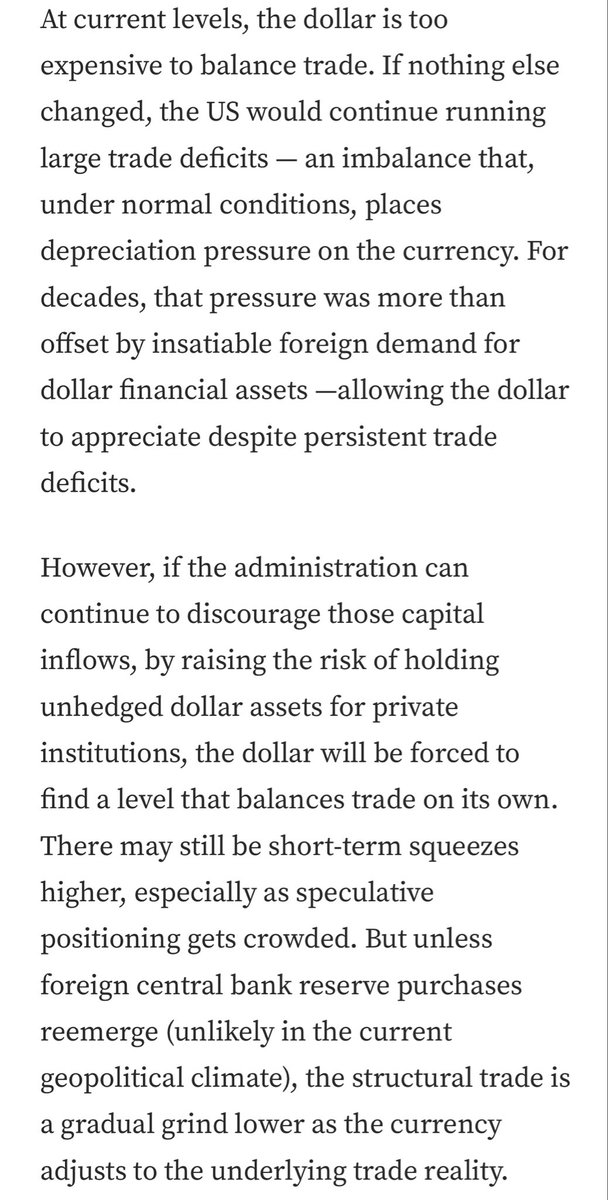
We’ve lived in a world where beggar-thy-neighbor policies have distorted FX markets for so long that people freak out and call it debasement when the dollar depreciates. Those mercantilist policies created structural capital inflows into dollar assets and kept currencies from clearing the way a properly functioning trade system is supposed to clear. In that world, people got used to treating a perpetually strong dollar as normal even when it coincided with persistent US trade deficits. But the whole point of flexible exchange rates, introduced at Bretton Woods in 1944 and fully realized after the dollar broke from gold in 1971, was to let trade imbalances trigger currency adjustment that helps reverse the imbalance. If trade flows are finally reasserting primacy over capital flow distortions, that’s not a crisis signal. It’s the system working closer to how it was designed…FX acting as the stabilizer that helps close external imbalances. *A note on gold and silver: Precious metals are relentlessly bid because the world is still running beggar-thy-neighbor growth models, policies that implicitly tax consumption and subsidize production. That creates excess saving (saving = production − consumption) that has to be parked somewhere. And there’s no clean reserve currency alternative large enough to absorb it. With the US now resisting the world’s excess savings parking in Treasuries without consequence, that savings doesn’t disappear, it has to reallocate. The result is that gold and silver become the obvious “neutral” reserve assets. One caveat: policymakers could eventually try to lean against large scale bullion flows. In the balance of payments, private bullion is recorded as a goods flow even though economically it behaves like a capital flow, (though central bank “monetary gold” is treated as a financial account transaction). If gold becomes the release valve for constrained capital flows, it’s not crazy to think governments may try to manage that channel too. But none of this should be surprising if you’ve been following my work. This is the story I’ve been laying out consistently since I started publishing publicly in late 2024.
Michael McNair tweet mediaMichael McNair tweet media
English
28
73
299
81K
wildyields retweetledi
Mike and Jeff show @AgrisAcademy
My Venezuela experience as head of trading in the region for Cargill. Cargill was/is the leading producer of critical staple ingredients such as flour, pasta, vegetable oil, and rice in VZ. I am not saying I agree with grabbing the dictator, but I did have a front row seat to the damage a kleptocracy did to innocent people. 1. The government took over our "minute rice" facility at gunpoint because we were "gouging" the nation's poor. The government was never able to run the plant. It never ran again. It was returned years later with no equipment inside 2. There are 1000's of generals in the army. They are each given a slice of the economy to loot. The large number of generals made it difficult to organize a coup against the regime. 3. The government opened grocery stores and sold staples below the cost we sold them to the government. In theory they used petro oil money to lower grocery prices. Our regular grocery outlets were forced out of business. When the government demanded we sell them products below cost we simply had to shut down. The populous became ever more dependent on the government handouts. (PS this is the mayor of New York City's proposal. 4. Dollars- We needed dollars to go buy raw materials like wheat from places like the US and Canada. The government would periodically allocate us some dollars that could only be spent for raw materials and freight. Eventually only the local companies that can and would pay bribes got dollar allocations. We had several facilities closed for lack of raw material 5. My employees liked working for Cargill. The office was an armed compound with access to a gym, high speed internet, global communications, and a weekly box of basic staples. Cargill provided a safe and secure environment if only for the working hours. 6. Employees became very close to others inside the apartment building. Going out on the street with a desperate population was not advisable. 7. I needed wood pallets for feed. We tried to export wood pallets to swap for grain. We refused to pay the bribes it would take to export the pallets 8. I once tried to set up a closed loop wheat planting to flour mill supply chain. A. They came and stole all the seed wheat for food. When we tried to ship in seed wheat in containers via US donors there was no way to get it out of the port without it being stolen 9. Livestock- Our feed business completely collapsed. Even if you could raise a pig, you couldn't defend it from being stolen. People with guns were hungry. 10. Employees- In the end my highly skilled team alone with other highly educated people chose to leave. Cargill often found jobs for them in other Latin countries. The regime was more than happy to see the well-educated leave the country. Setting these employees up with high quality stable jobs after fleeing remains one of the best things I ever did in my career. No one remembers millions in trading earnings. This is a short list. In my opinion the first money spent needs to happen now and it needs to be food. The US is already on the clock. The current regime does not care if it starves the population. The orgy of theft will actually accelerate if they believe their days are numbered. VZ should be an outstanding customer of US grown ag products. Rice, bread wheat, veg oil ect. Feed the people first. Jeff Kazin Former head trading Cargill
English
1.3K
9.6K
37.5K
3.2M
wildyields
wildyields@wildyields·
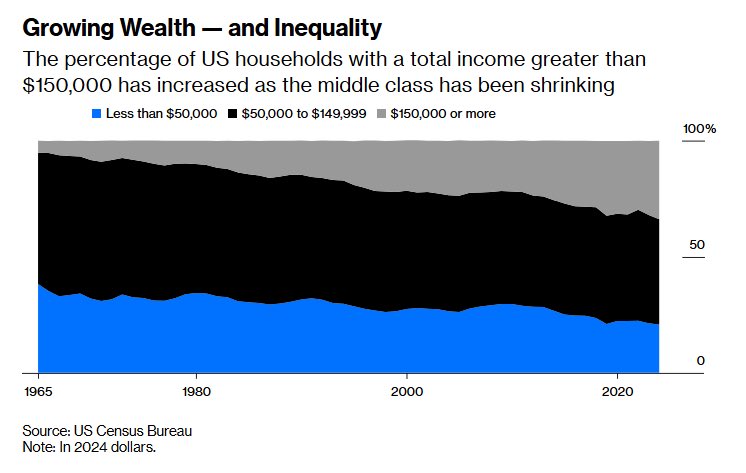
Hey @profplum99 any chance you could overlay your measure of the real poverty line on this chart? Would be a powerful graphic to drive the point home
wildyields tweet media
English
0
0
3
44
wildyields retweetledi
Chris Arnade 🐢🐱🚌
Chris Arnade 🐢🐱🚌@Chris_arnade·
In my 4th year of grad school I told my advisor I didn't want to do Physics for the rest of my life (didn't love it enough, and wasn't good enough at it, to enjoy being a lifetime academic migrant, which is what I would have been) and he told me, ok, take your time, and spend the next year figuring out what you want to do. So for a year, in the morning I wrote my thesis, and at night, in my row-house basement, I taught myself first hurricane research, because the Department of Defense was hiring on campus, and eventually wrote a paper on some esoteric modeling issue, but after three months I found the subject too boring, static, and bureaucratic . Then I ran into a post doc who told me he heard a rumor that Wall Street hired physicists -- But I didn't know anything about banking, at all, as in even the difference between stocks and bonds -- but I went to the library, found a pile of books on finance, and started reading them, and realized it had greater depth than I had thought. I also biked a few nights a week down to the continuing education school and sat in on evening finance classes, read the WSJ and FT every day, and even put together and tracked a play portfolio of commodities derivatives. Eventually I realized that the American Mathematical Society listed all its members by geography, and even the institution they worked for, such as JP Morgan, and so I got the 1990 AMS almanac, wrote down all the Math PhDs I could find working in Wall Street banks, and began cold calling them -- all from the library. They all answered, and all told me about their careers, and what I would need to know to get a job in finance. They wanted to brag, and all I had to do is set them off with a "How did you get to Wall Street?" Then, based on suggestions by a few of them, I wrote a paper solving a pricing problem they were currently working on (something to do with barrier options), and used that to set up more interviews. So for three months I would do weekly trips up to NYC, where I would take the early train from Baltimore, meet people in Manhattan all day, which morphed into official interviews, and then take the train back home at night. In the end I got eight offers, and not knowing much about the different firms, took the one that paid the most. Which was Salomon Brothers, which I didn't know had recently emerged from a scandal that almost took them down (Treasury price fixing), so that's why they were so desperate, and they paid the most to incoming recruits. PS: I had exactly one interview outfit, which I borrowed money to buy, which I had to clean after each trip, which meant I could only do about one round of meetings a week, since the dry-cleaner was so slow.
Afolabi Sokeye 🧱@SokeyeA

What’s the lore behind choosing your career path ?

English
63
151
5.2K
802.5K
wildyields
wildyields@wildyields·
Feel this. Advice i was given ahead of college yrs was all out of date or flat out wrong. Reading led me to Wall St interest and Googling to the industry forums which taught me what it takes to actually get a job. Changed my life as a state school kid
dav@davinshotchi

@providenceluvr Having non-striver middle class parents is crazy because I've been given actively detrimental advice at every important turn in my life. Unfortunately, I didn't realize this until my junior year of college, which I'm currently in.
English
0
0
0
123
wildyields
wildyields@wildyields·
@pvtcreditguy BHPH servicing transfers are incredibly messy (e.g. USAUT, ACC). BHPH opco subsidizes the finco via propping up charge off recoveries effectively. Post servicing transfer, higher serv fees etc, the 2025 TAST vintage will be 70+% CNL easy
English
1
0
1
53
Pvtcreditguy
Pvtcreditguy@pvtcreditguy·
The asset based finance rush caused the need for these originators to produce asset pools to finance and now there is a lot of smoke with these names that are in disarray. Let’s see if there are more to come…
English
2
1
9
884
Pvtcreditguy
Pvtcreditguy@pvtcreditguy·
FirstBrands, Tri Color, oh my. All these funds financing these securitizations must be thinking to themselves, how well did I underwrite my counterparty and servicer? Asset based finance has been all the fundraise talk and now these dislocations will cause investors pause
English
5
4
52
6.5K
Kathleen Tyson
Kathleen Tyson@Kathleen_Tyson_·
FUN FACT: I globalised US Treasuries as bank capital, repo collateral, and derivatives margin at Clearstream in mid-1990s. I wrote every word of our CA1 Application to the SEC Division of Trading and Markets for clearing and settlement of USTs in the Luxembourg depository. SEC approved in record time. In 1994 Clearstream Chairman Hans Angermueller told me it was impossible. In 1996 when we got approval he took me out to lunch. He wrote the forward to my first book.
Kathleen Tyson tweet media
Eric Yeung 👍🚀🌕@KingKong9888

The offshore interbank REPO market is the backbone of international trade. In the past 70% of its HQLA collateral were in the form of U.S. Treasury Bills, Notes, and Bonds.
English
24
96
775
99.9K
wildyields retweetledi
Luke Gromen
Luke Gromen@LukeGromen·
Past historians already warned us ...👇 ...but everyone that learned the lesson the hard way the last time was dead by the time western policymakers began believing in "The End of History" post-1992, so now we will all learn the lesson the hard way again.🤷‍♂️ #FourthTurning
Luke Gromen tweet media
Niall Ferguson@nfergus

Future historians will struggle to explain how a democratic system could produce outcomes so at odds with what the electorate actually wanted.


English
139
428
2K
252.4K
wildyields retweetledi
JV
JV@AyyouEm·
So loans to levered bdcs that make loans to levered (oft-unprofitable) companies packaged up levered and sold to levered PE that also run a ton of PC? Golden Age of Innovative Credit Solutions
JV tweet media
English
28
36
582
169.3K