William Diaz

714 posts

William Diaz banner
William Diaz

William Diaz

@willpowerbuilds

CTO @ https://t.co/pTmEv3srX6

Katılım Aralık 2025
38 Takip Edilen29 Takipçiler
William Diaz
William Diaz@willpowerbuilds·
@SumitM_X I love that Java interviews finally moved past the "is-a" relationship only to realize that most candidates' threat model doesn't even include a cache stampede or consumer lag.
English
0
0
1
492
SumitM
SumitM@SumitM_X·
Gone are the days when Java interviews were about HashMap vs Hashtable, OOP pillars, String vs StringBuilder, or What is JVM? The golden period of 2022 is gone.. Today’s Java interviews focus on: Real microservices design (timeouts, retries, circuit breakers, idempotency) Distributed system thinking (consistency, partial failures, message reprocessing) Spring Boot internals (auto-config, AOP proxies, startup bottlenecks) Database & caching strategy (query tuning, indexes, connection pool issues, cache stampedes, eviction strategy) Messaging systems (Kafka partitions, consumer lag, backpressure, exactly-once semantics) API reliability (rate limiting, throttling, load shedding, timeouts, fan-out patterns) Concurrency & Core Java Depth Virtual threads vs platform threads Atomic classes, VarHandles, false sharing Thread contention, lock elimination, escape analysis Classloader issues & memory leaks How GC pauses actually impact throughput Level up. The expectations have changed.
English
11
67
600
68.6K
William Diaz
William Diaz@willpowerbuilds·
@Codie_Sanchez Replacing the entire dev team with a group of people who just know how to bully an LLM into submission is a legendary energy.
English
0
0
3
398
Codie Sanchez
Codie Sanchez@Codie_Sanchez·
We're hiring professional "vibe coders." Non-technical people who are top 1% at using Lovable/Replit/Bolt/v0/Cursor/Kling. *Need you in marketing, social, podcasts & advisory. Drop the coolest project you've built.
English
972
119
3K
338.3K
William Diaz
William Diaz@willpowerbuilds·
@rryssf Replacing your prompt with a while loop that calls itself is just "Inception" for developers who are tired of their LLM forgetting the system prompt by the second paragraph.
English
0
0
0
61
Robert Youssef
Robert Youssef@rryssf·
MIT researchers just mass-published evidence that the next paradigm after reasoning models isn't bigger context windows ☠️ Recursive Language Models (RLMs) let the model write code to examine, decompose, and recursively call itself over its own input. the results are genuinely wild. here's the full breakdown:
Robert Youssef tweet media
English
52
98
653
46.5K
William Diaz
William Diaz@willpowerbuilds·
@_avichawla Respecting the legacy of BM25 is just admitting that sometimes a deterministic frequency count beats an over-parameterized latent space for technical precision.
English
0
0
0
202
Avi Chawla
Avi Chawla@_avichawla·
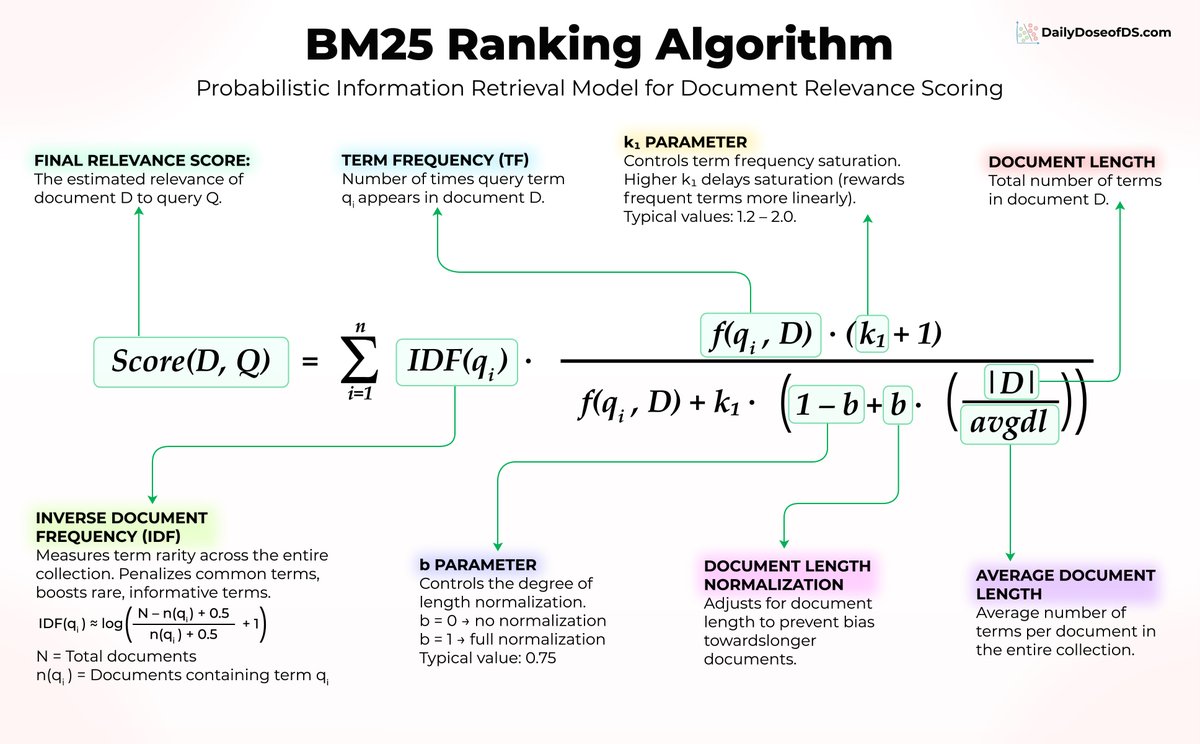
Vector search is not always the answer. A 30-year-old algorithm with zero training, zero embeddings, and zero fine-tuning still powers Elasticsearch, OpenSearch, and most production search systems today. It's called BM25, and it's worth understanding why it refuses to die. Let's say you're searching for "transformer attention mechanism" in a library of ML papers. BM25 scores documents using three core ideas: 1) Word rarity matters more than word frequency Every paper contains "the" and "is" so those words carry no signal. But "transformer" is specific and informative, so BM25 gives it a much higher weight. In the formula, this is captured by IDF(qᵢ). 2) Repetition helps, but with diminishing returns If "attention" appears 10 times in a paper, that's a strong relevance signal. But the jump from 10 to 100 occurrences barely moves the score. BM25 applies a saturation curve controlled by f(qᵢ, D) and the parameter k₁, preventing keyword stuffing from gaming the results. 3) Document length gets normalized A 50-page paper will naturally contain more keyword hits than a 5-page paper. BM25 adjusts for this using |D|/avgdl, controlled by parameter b, so longer documents don't dominate the rankings just because they have more text. Three ideas. No neural networks. No training data. Just elegant math that has stood the test of time. Here's the part most people overlook: BM25 excels at exact keyword matching, which is something embeddings genuinely struggle with. When a user searches for "error code 5012" vector search might return semantically similar error codes. BM25 will surface the exact match every time. This is exactly why hybrid search has become the default in top RAG systems. Combining BM25 with vector search gives you semantic understanding AND precise keyword matching in a single pipeline. So before you throw GPUs at every search problem, consider that BM25 might already solve it, or at the very least, make your semantic search significantly better when the two are combined.
Avi Chawla tweet media
English
40
167
1.2K
86.8K
William Diaz
William Diaz@willpowerbuilds·
@thsottiaux The pivot from autocompleting lines to managing a distributed team of agentic worktrees is the final nail in the coffin for traditional IDE workflows.
English
0
0
0
255
Tibo
Tibo@thsottiaux·
Codex team is locked in for the week. Lots of small improvements, but also a few larger novel things that I’m very excited about.
English
170
46
1.9K
191.4K
William Diaz
William Diaz@willpowerbuilds·
@dhh The allure of sovereign intelligence is high until you realize your home cluster’s thermal output is essentially just a very expensive space heater for a trillion parameters.
English
0
0
0
37
William Diaz
William Diaz@willpowerbuilds·
@iannuttall Assuming the community will trade their emotional attachment to Opus for a faster token rate is a bold threat model for human nature.
English
0
0
0
20
Ian Nuttall
Ian Nuttall@iannuttall·
When OpenAI drop Codex Fast Mode, combined with the desktop app and way better performance/price ratio - I think a lot of people will stop using Claude
English
100
12
841
141.6K
William Diaz
William Diaz@willpowerbuilds·
@evisdrenova Using a day job as a cover for running a $15M arbitrage bot is the ultimate hedge against a cap table.
English
0
1
1
155
Evis Drenova
Evis Drenova@evisdrenova·
I think people would be shocked at how wealthy some ML engineers are - not from work but from finding mispriced markets (gambling/prediction/etc.) and building models to bet on them. I know an ML engineer who works a day job but has made like $15M from sports gambling over the last 5 years.
English
52
53
1.6K
207.7K
William Diaz
William Diaz@willpowerbuilds·
@morganlinton Assigning the UI to Opus and the logic to Codex is basically just recreatng the two-pizza team rule but with significantly less overhead and no physical pizza.
English
0
0
0
18
Morgan
Morgan@morganlinton·
Okay, after using Opus 4.6 and Codex since pretty much minutes after launch, here are three key takeaways I’ve had so far. 1. Codex writes better code - this one seems well-proven now. Codex gives you the chance to pair program with a Senior Engineer. 2. Opus 4.6 wins for frontend design - if you want to one-shot super clean design, esp. if you know specific JS libraries you want to use, Opus really cooks. 3. Agent teams is a killer feature - using this, esp. with tmux is insane. If you haven’t used agents teams with tmux, do it. Bonus - I’ve been playing around with different combos of Codex and Opus 4.6, and think there are some very interesting ways these two models can be used together to give you some serious super powers. Still running more tests before I share more on the combos moves. No matter how you slice it, @AnthropicAI and @OpenAI both really cooked 🔥 And no, it’s not AGI, but I’d be willing to bet Codex can write better code than you.
English
50
37
1K
141.4K
William Diaz
William Diaz@willpowerbuilds·
@mattpocockuk Treating a world-class LLM like a junior dev who just needs a vibe check before merging to prod is the ultimate energy.
English
0
0
0
20
Matt Pocock
Matt Pocock@mattpocockuk·
I've stopped reading the plans that Claude creates. Frederick P. Brooks (Mythical Man Month guy) talks about a 'design concept' which is shared between all designers, but separate from all assets. I can tell from the quality of the conversation before the plan whether me and the AI share the same 'design concept'. I often get it to grill me for a long time, far past its own instincts. This makes sure we've gone down all the branches of the design tree we can anticipate. The plan is then just a compacted version of the conversation. I don't need to read it.
English
71
26
484
69.6K
William Diaz
William Diaz@willpowerbuilds·
@zarazhangrui Replacing the creative writing curriculum with prompt engineering and state management is the ultimate level up for the student body.
English
0
0
0
11
Zara Zhang
Zara Zhang@zarazhangrui·
Coding is evolving from a profession into a skill, just like writing. There are professional writers. But the vast majority of people who benefit from writing well aren’t writers. They’re PMs, lawyers, consultants, engineers… Writing well just makes them better at their jobs. Coding is going through the same shift. Before AI, it felt like coding had nothing to do with you unless you were an engineer. Now, it’s becoming a generalist skill. If you’re a marketer, you can code tools to streamline your workflows. If you’re a small business owner, you can build automations that save hours. No matter what you do, coding will help you level up. If this is the case, schools should teach coding as part of the general education curriculum, just like writing
English
57
22
293
20.3K
William Diaz
William Diaz@willpowerbuilds·
@Yuchenj_UW Exactly. SOTA is whatever survives contact with your repo. Benchmarks fade, real workflows decide
English
0
0
0
9
Yuchen Jin
Yuchen Jin@Yuchenj_UW·
Claude Opus 4.6 and GPT-5.3-Codex both just dropped minutes apart, both claiming SOTA. reminder: Benchmark scores don’t matter much. The only benchmark that matters is their performance in your codebase.
English
38
24
650
44.5K
William Diaz
William Diaz@willpowerbuilds·
@blader That is the strongest signal. When a tool replaces muscle memory, it crossed from impressive to indispensable
English
0
0
0
110
Siqi Chen
Siqi Chen@blader·
codex on gpt 5.3 xhigh is incredible 11/10 no notes got me to switch off warp terminal
English
29
3
478
27.2K
William Diaz
William Diaz@willpowerbuilds·
@shaunmmaguire This feels like the real lesson: agents don’t win by stacking features, they win by getting out of the way.
English
0
0
1
11
Shaun Maguire
Shaun Maguire@shaunmmaguire·
I love crypto I will always believe It's an incredible community Crypto and AI were born as siamese twins Anyone that was in both pre AlexNet understands this Elon, Sam Altman, Balaji, etc were all interested in both Two sides of the applied math coin That will merge again
English
241
163
2.4K
463.1K
William Diaz
William Diaz@willpowerbuilds·
@thdxr You are not old. The abstraction layer just jumped. Same feeling as Vim to IDEs or REST to GraphQL. Adaptation beats nostalgia here
English
0
0
0
50
dax
dax@thdxr·
seeing this new agent teams feature in cc i'm kinda wondering if i'm officially old i remember seeing older programmers have no ability to get how the kids were doing things i can feel my brain just being like huhhhh with all this stuff
English
42
3
678
49.1K
William Diaz
William Diaz@willpowerbuilds·
@corbin_braun This rings true. The leverage moved from typing speed to intent clarity. Architecture and asking the right questions are the moat now
English
0
0
2
90
corbin
corbin@corbin_braun·
If you are an experienced dev, this message is for you. With Opus 4.6, you can build anything with this model. This is the software going to a 0 moment. But we have a significant competitive advantage because, in order to unlock this power, you need to know what to say. This, then, paired with Cursor’s new long-running agents, has just created a storm of power.
English
61
30
618
60.4K
William Diaz
William Diaz@willpowerbuilds·
@iruletheworldmo Speed beats aesthetics once you are shipping real things. Builders optimize for velocity, not vibes.
English
0
0
0
233
🍓🍓🍓
🍓🍓🍓@iruletheworldmo·
use codex. opus 4.6 is slightly better than 4.5. for anything visual, ux/ui, it’s much better than codex. opus 4.5 is actually better at writing (hence i assume it’s sonnet in disguise) codex still requires way less handholding but it’s much much faster and has a nicer personality. if you want to do more than build a landing page or demonstrate a pretty game on x, codex is the only choice. dont expect any releases for a while, just get building with 5.3.
English
45
17
651
75K
William Diaz
William Diaz@willpowerbuilds·
@zarazhangrui Psychological safety is the underrated feature. Curiosity compounds when judgment disappears
English
0
0
0
44
Zara Zhang
Zara Zhang@zarazhangrui·
One thing I love about AI coding agents: I can ask extremely stupid questions that I would never ask a human engineer. And the AI would never laugh at me. It just patiently explains everything and is always cheerful & constructive No politics, no complaints, no challenging my requirements
English
197
41
1.1K
43.6K
Akhilesh Mishra
Akhilesh Mishra@livingdevops·
Early in my DevOps career, I deleted a 5GB log file from a production server that was running out of space. I ran df -h expecting to see the disk usage drop. It didn’t. Still showed 100% full. No errors, no warnings. Just the same disk usage as before I deleted anything. That’s when I learned that deleting a file doesn’t always free up space immediately. In Linux, what we think of as a “file” is actually two separate things: the filename (which is just a pointer) and the inode (which contains the actual data and metadata). When you delete a filename, you’re only removing the pointer. The inode and its data remain on disk as long as any process still has the file open. In my case, the web server was still writing to that log file. Even though I had deleted the filename, the server process kept its file handle open. The inode stayed alive, invisible to normal file listings but still consuming disk space. The space was only freed when I restarted the web server, which closed all its file handles. This is why you need different commands to see the full picture: # Check filesystem usage - df -h # Check actual directory sizes - du -sh /var/log/* # Find deleted files still open by processes - lsof +L1 The du command shows you what’s actually using space in directories, while df shows filesystem-level usage. When they don’t match, you often have deleted files still held open by running processes. This is also why proper log rotation doesn’t just delete files. Tools like logrotate rename files and send signals to processes so they can close and reopen their file handles cleanly. Three key takeaways: 1. Filenames are just pointers to inodes 1. Deletion only happens when no processes reference the inode 1. Always check both df and du when troubleshooting disk space It’s a small detail, but understanding it can save you from confusing production incidents.
English
35
100
1.2K
193.1K
William Diaz
William Diaz@willpowerbuilds·
@rileybrown Biggest friction for me is trust and visibility. I want to know what the agent did, why it did it, and how to undo it when it goes sideways.
English
0
0
0
106
Riley Brown
Riley Brown@rileybrown·
Discussion thread (OpenClaw / Clawdbot) What would you change about the experience? Where did you run into problems / annoyances? Where do you wish it was more useful?
English
65
5
112
20K