Sabitlenmiş Tweet

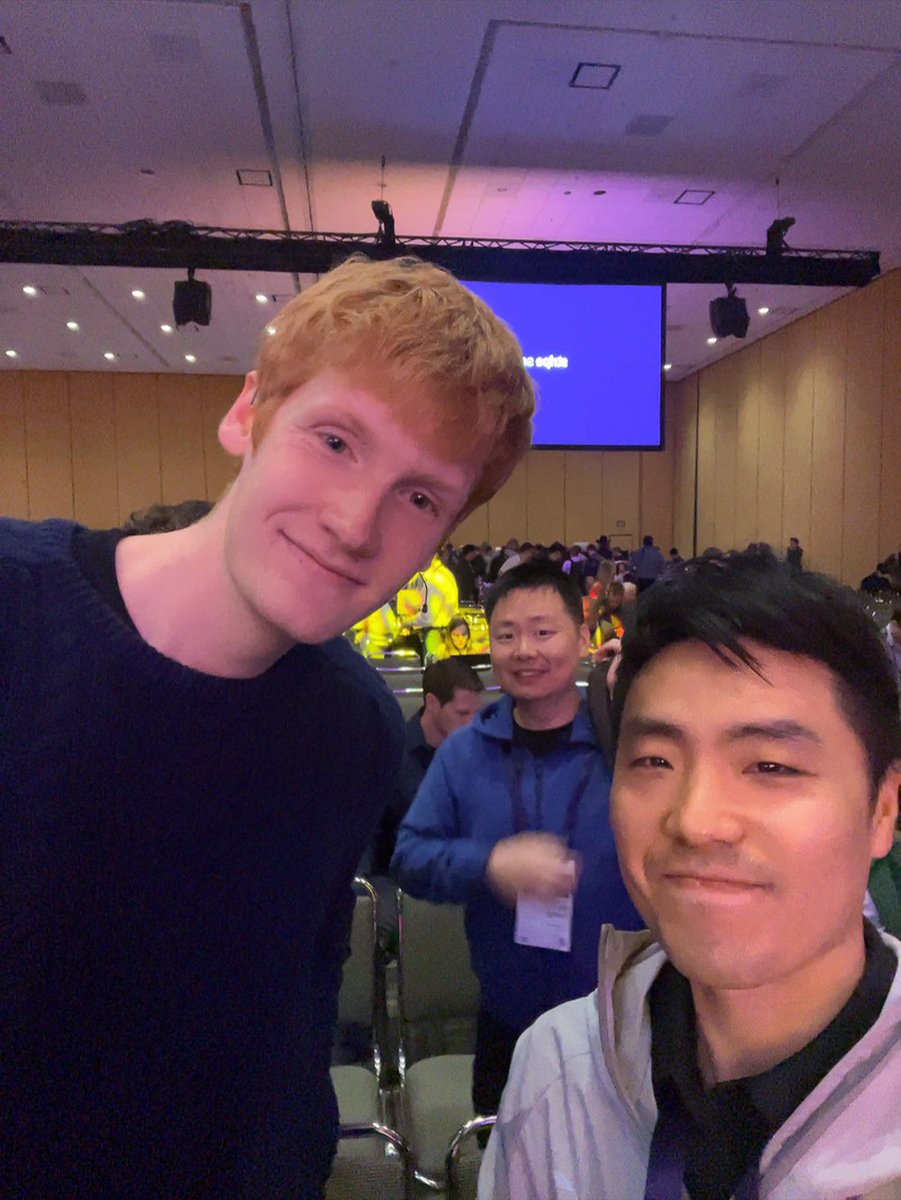
I met Michael, the CEO of Cursor (@cursor_ai) at the Stripe(@stripe) Sessions and his insights were great. 🙌

English
wonick.eth⚡️in New York🗽
722 posts

@wonick_park
Head of Planet New York @TheMiilkInc🥛 | ex-Silicon Valley Correspondent @ChosunBiz🇰🇷 | Tech & Business Journalist👨🏻💻 | AI & Web3 Explorer🗺


Love this project: nanoGPT -> recursive self-improvement benchmark. Good old nanoGPT keeps on giving and surprising :) - First I wrote it as a small little repo to teach people the basics of training GPTs. - Then it became a target and baseline for my port to direct C/CUDA re-implementation in llm.c. - Then that was modded (by @kellerjordan0 et al.) into a (small-scale) LLM research harness. People iteratively optimized the training so that e.g. reproducing GPT-2 (124M) performance takes not 45 min (original) but now only 3 min! - Now the idea is to use this process of optimizing the code as a benchmark for LLM coding agents. If humans can speed up LLM training from 45 to 3 minutes, how well do LLM Agents do, under different kinds of settings (e.g. with or without hints etc.)? (spoiler: in this paper, as a baseline and right now not that well, even with strong hints). The idea of recursive self-improvement has of course been around for a long time. My usual rant on it is that it's not going to be this thing that didn't exist and then suddenly exists. Recursive self-improvement has already begun a long time ago and is under-way today in a smooth, incremental way. First, even basic software tools (e.g. coding IDEs) fall into the category because they speed up programmers in building the N+1 version. Any of our existing software infrastructure that speeds up development (google search, git, ...) qualifies. And then if you insist on AI as a special and distinct, most programmers now already routinely use LLM code completion or code diffs in their own programming workflows, collaborating in increasingly larger chunks of functionality and experimentation. This amount of collaboration will continue to grow. It's worth also pointing out that nanoGPT is a super simple, tiny educational codebase (~750 lines of code) and for only the pretraining stage of building LLMs. Production-grade code bases are *significantly* (100-1000X?) bigger and more complex. But for the current level of AI capability, it is imo an excellent, interesting, tractable benchmark that I look forward to following.
Nice - my AI startup school talk is now up! Chapters: 0:00 Imo fair to say that software is changing quite fundamentally again. LLMs are a new kind of computer, and you program them *in English*. Hence I think they are well deserving of a major version upgrade in terms of software. 6:06 LLMs have properties of utilities, of fabs, and of operating systems => New LLM OS, fabbed by labs, and distributed like utilities (for now). Many historical analogies apply - imo we are computing circa ~1960s. 14:39 LLM psychology: LLMs = "people spirits", stochastic simulations of people, where the simulator is an autoregressive Transformer. Since they are trained on human data, they have a kind of emergent psychology, and are simultaneously superhuman in some ways, but also fallible in many others. Given this, how do we productively work with them hand in hand? Switching gears to opportunities... 18:16 LLMs are "people spirits" => can build partially autonomous products. 29:05 LLMs are programmed in English => make software highly accessible! (yes, vibe coding) 33:36 LLMs are new primary consumer/manipulator of digital information (adding to GUIs/humans and APIs/programs) => Build for agents! Thank you again for the invite @ycombinator and congrats again on an awesome events! I'll post some links/references in the reply.
Today is the start of a new era of natively multimodal AI innovation. Today, we’re introducing the first Llama 4 models: Llama 4 Scout and Llama 4 Maverick — our most advanced models yet and the best in their class for multimodality. Llama 4 Scout • 17B-active-parameter model with 16 experts. • Industry-leading context window of 10M tokens. • Outperforms Gemma 3, Gemini 2.0 Flash-Lite and Mistral 3.1 across a broad range of widely accepted benchmarks. Llama 4 Maverick • 17B-active-parameter model with 128 experts. • Best-in-class image grounding with the ability to align user prompts with relevant visual concepts and anchor model responses to regions in the image. • Outperforms GPT-4o and Gemini 2.0 Flash across a broad range of widely accepted benchmarks. • Achieves comparable results to DeepSeek v3 on reasoning and coding — at half the active parameters. • Unparalleled performance-to-cost ratio with a chat version scoring ELO of 1417 on LMArena. These models are our best yet thanks to distillation from Llama 4 Behemoth, our most powerful model yet. Llama 4 Behemoth is still in training and is currently seeing results that outperform GPT-4.5, Claude Sonnet 3.7, and Gemini 2.0 Pro on STEM-focused benchmarks. We’re excited to share more details about it even while it’s still in flight. Read more about the first Llama 4 models, including training and benchmarks ➡️ go.fb.me/gmjohs Download Llama 4 ➡️ go.fb.me/bwwhe9

"Move 37" is the word-of-day - it's when an AI, trained via the trial-and-error process of reinforcement learning, discovers actions that are new, surprising, and secretly brilliant even to expert humans. It is a magical, just slightly unnerving, emergent phenomenon only achievable by large-scale reinforcement learning. You can't get there by expert imitation. It's when AlphaGo played move 37 in Game 2 against Lee Sedol, a weird move that was estimated to only have 1 in 10,000 chance to be played by a human, but one that was creative and brilliant in retrospect, leading to a win in that game. We've seen Move 37 in a closed, game-like environment like Go, but with the latest crop of "thinking" LLM models (e.g. OpenAI-o1, DeepSeek-R1, Gemini 2.0 Flash Thinking), we are seeing the first very early glimmers of things like it in open world domains. The models discover, in the process of trying to solve many diverse math/code/etc. problems, strategies that resemble the internal monologue of humans, which are very hard (/impossible) to directly program into the models. I call these "cognitive strategies" - things like approaching a problem from different angles, trying out different ideas, finding analogies, backtracking, re-examining, etc. Weird as it sounds, it's plausible that LLMs can discover better ways of thinking, of solving problems, of connecting ideas across disciplines, and do so in a way we will find surprising, puzzling, but creative and brilliant in retrospect. It could get plenty weirder too - it's plausible (even likely, if it's done well) that the optimization invents its own language that is inscrutable to us, but that is more efficient or effective at problem solving. The weirdness of reinforcement learning is in principle unbounded. I don't think we've seen equivalents of Move 37 yet. I don't know what it will look like. I think we're still quite early and that there is a lot of work ahead, both engineering and research. But the technology feels on track to find them. youtube.com/watch?v=HT-UZk…
Introducing NVIDIA Cosmos, an open-source, open-weight Video World Model. It's trained on 20M hours of videos and weighs from 4B to 14B. Cosmos offers two flavors: diffusion (continuous tokens) and autoregressive (discrete tokens); and two generation modes: text->video and text+video->video. Physical AI has a big data problem. Synthetic data to the rescue! We apply Cosmos to large-scale synthetic data generation for robotics and autonomous driving, and now you can too! It's all yours to finetune. Check it out: github.com/NVIDIA/Cosmos