CAMELIA

558 posts

CAMELIA banner
CAMELIA

CAMELIA

@x7_samiya

Professional Web3 Freelancer with a Passion for Quality and Excellence.

Katılım Ağustos 2024
95 Takip Edilen112 Takipçiler
CAMELIA
CAMELIA@x7_samiya·
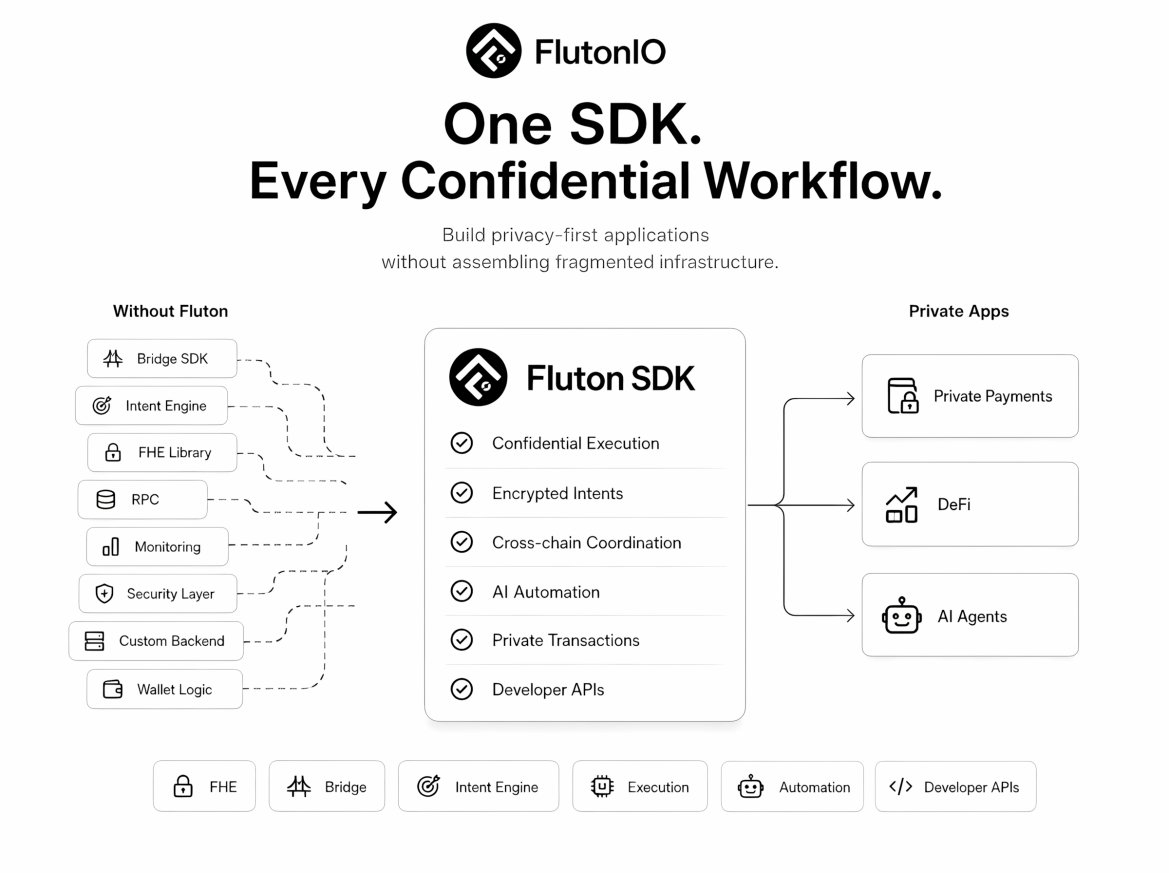
Every great Web3 application starts with an idea. Most development timelines, however, disappear into infrastructure long before users ever interact with the product. Confidential execution, cross-chain messaging, encrypted intents, bridge coordination, transaction monitoring, settlement logic, security layers—every new capability introduces another integration. Development gradually shifts away from building applications toward maintaining the systems surrounding them. That complexity becomes even greater once privacy enters the equation. Traditional blockchain development kits were designed around transparent execution. Every transaction, every function call, and every piece of state is expected to remain publicly accessible. Confidential applications demand an entirely different architecture where data stays encrypted throughout execution without sacrificing verifiability. This is exactly where @FlutonIO takes a different approach. Rather than asking developers to assemble multiple privacy protocols, bridge frameworks, execution environments, and encryption libraries independently, the Fluton SDK provides a unified development layer that abstracts the underlying infrastructure into a single toolkit. Developers interact with familiar APIs while the SDK manages confidential execution, encrypted intent creation, cross-chain communication, settlement coordination, transaction lifecycle management, and privacy-preserving verification beneath the surface. The experience changes from orchestrating dozens of moving components to building application logic. Creating a confidential DeFi application traditionally requires integrating smart contracts, encryption mechanisms, bridge infrastructure, relayer networks, execution monitoring, and security validation independently. Every additional dependency increases development time, operational overhead, and maintenance complexity. With the Fluton SDK, these capabilities are designed to work together from the beginning. Privacy is no longer an optional extension added after deployment. It becomes part of the application's foundation. This approach reaches far beyond developer convenience. Standardized infrastructure reduces implementation inconsistencies, minimizes security risks introduced by fragmented integrations, and creates a more predictable development environment. Teams spend less time solving infrastructure problems repeatedly and more time improving user experience, business logic, and protocol innovation. The growing generation of AI agents introduces another layer of complexity. Autonomous systems require private execution, encrypted decision-making, secure cross-chain coordination, and reliable transaction orchestration without exposing strategies or sensitive operational data. Building those capabilities from scratch for every application simply does not scale. The Fluton SDK provides the building blocks required for these intelligent systems to operate securely without forcing developers to redesign confidential infrastructure every time a new application is created. Web3 adoption will not be defined only by faster blockchains or lower transaction costs. It will be shaped by how easily developers can build secure, intelligent, privacy-preserving applications without becoming infrastructure engineers first. That shift begins with better developer tooling. @FlutonIO @cryptoperseus_
CAMELIA tweet media
CAMELIA@x7_samiya

The biggest barrier to Web3 development isn't writing smart contracts. It's stitching together everything around them. Developers rarely struggle with a single contract. The real complexity begins once an application needs to communicate across multiple chains, generate encrypted intents, execute private transactions, monitor settlement, coordinate bridges, and keep every interaction secure without sacrificing performance. Every new integration introduces another layer of infrastructure. Every additional protocol expands the maintenance burden. Before long, teams spend more time building backend systems than improving the applications users actually interact with. That is exactly the development experience @FlutonIO is redesigning through the Fluton SDK. The Fluton SDK is a unified developer toolkit built for confidential execution. Instead of forcing developers to assemble fragmented privacy solutions from different protocols, it provides a single framework that connects private execution, encrypted intents, cross-chain coordination, AI automation, and confidential transaction workflows through one consistent interface. Developers don't need to become cryptography experts to build privacy-first applications. The SDK abstracts the complexity behind advanced technologies such as Fully Homomorphic Encryption (FHE), allowing confidential computation to become part of the development process rather than an entirely separate engineering challenge. This fundamentally changes how decentralized applications are built. A payment protocol can initiate confidential transfers without exposing transaction details. A decentralized exchange can execute encrypted trading strategies while protecting user intent from public visibility. AI agents can coordinate swaps, settlements, and cross-chain operations without leaking sensitive decision-making data throughout execution. The infrastructure remains confidential while the development experience stays familiar. Traditional Web3 development often requires multiple SDKs, separate bridge integrations, custom execution logic, intent management systems, monitoring services, and security layers. Every additional dependency increases operational overhead and creates more opportunities for failure. The Fluton SDK brings those capabilities into one developer environment designed around confidential execution from the beginning. Privacy becomes part of the application architecture instead of another feature developers attempt to bolt onto existing systems. This shift reaches far beyond convenience. Developer tools determine how quickly new ecosystems grow. The easier it becomes to build secure, scalable, and intelligent applications, the faster innovation moves across the entire network. Confidential execution may define the next generation of Web3 infrastructure. The developers building that future need tools designed for that reality, not frameworks created for yesterday's limitations. The Fluton SDK is designed with that future in mind. @FlutonIO @cryptoperseus_
English
0
0
15
57
CAMELIA
CAMELIA@x7_samiya·
The biggest barrier to Web3 development isn't writing smart contracts. It's stitching together everything around them. Developers rarely struggle with a single contract. The real complexity begins once an application needs to communicate across multiple chains, generate encrypted intents, execute private transactions, monitor settlement, coordinate bridges, and keep every interaction secure without sacrificing performance. Every new integration introduces another layer of infrastructure. Every additional protocol expands the maintenance burden. Before long, teams spend more time building backend systems than improving the applications users actually interact with. That is exactly the development experience @FlutonIO is redesigning through the Fluton SDK. The Fluton SDK is a unified developer toolkit built for confidential execution. Instead of forcing developers to assemble fragmented privacy solutions from different protocols, it provides a single framework that connects private execution, encrypted intents, cross-chain coordination, AI automation, and confidential transaction workflows through one consistent interface. Developers don't need to become cryptography experts to build privacy-first applications. The SDK abstracts the complexity behind advanced technologies such as Fully Homomorphic Encryption (FHE), allowing confidential computation to become part of the development process rather than an entirely separate engineering challenge. This fundamentally changes how decentralized applications are built. A payment protocol can initiate confidential transfers without exposing transaction details. A decentralized exchange can execute encrypted trading strategies while protecting user intent from public visibility. AI agents can coordinate swaps, settlements, and cross-chain operations without leaking sensitive decision-making data throughout execution. The infrastructure remains confidential while the development experience stays familiar. Traditional Web3 development often requires multiple SDKs, separate bridge integrations, custom execution logic, intent management systems, monitoring services, and security layers. Every additional dependency increases operational overhead and creates more opportunities for failure. The Fluton SDK brings those capabilities into one developer environment designed around confidential execution from the beginning. Privacy becomes part of the application architecture instead of another feature developers attempt to bolt onto existing systems. This shift reaches far beyond convenience. Developer tools determine how quickly new ecosystems grow. The easier it becomes to build secure, scalable, and intelligent applications, the faster innovation moves across the entire network. Confidential execution may define the next generation of Web3 infrastructure. The developers building that future need tools designed for that reality, not frameworks created for yesterday's limitations. The Fluton SDK is designed with that future in mind. @FlutonIO @cryptoperseus_
CAMELIA tweet media
CAMELIA@x7_samiya

The biggest privacy problem in blockchain has never been encryption. It has always been execution. Most networks already give users the ability to protect wallets, secure private keys, or even obscure transaction history through different privacy solutions. The moment a transaction reaches execution, nearly everything becomes visible. Trading strategies, payment details, AI decisions, cross-chain interactions, and user intent are exposed before value is even created. That is the gap @FlutonIO is redesigning. Fluton's Universal Confidential Execution Layer shifts privacy away from the transaction itself and embeds it into the execution process. Instead of broadcasting sensitive information for every validator or observer to inspect, computations happen inside a confidential environment where data remains encrypted throughout execution while outputs are still verifiable. This fundamentally changes the security model of blockchain applications. Traditional execution environments treat transparency as a requirement for validation. Every participant sees the same inputs, follows the same execution path, and arrives at the same result. Trust comes from complete visibility. The downside becomes increasingly obvious once decentralized finance, AI agents, and autonomous applications begin operating at scale. Visibility creates opportunities for front-running, strategy replication, transaction surveillance, and intent exploitation. Confidential execution replaces public observation with cryptographic verification. Using technologies such as Fully Homomorphic Encryption (FHE), encrypted intents can be processed without revealing the underlying information. Validators verify that computation was performed correctly, although they never gain access to balances, trading logic, payment metadata, AI reasoning, or execution parameters. Trust no longer depends on exposing sensitive information to the network. This transforms blockchain privacy from a passive protection layer into an active execution model. The implications extend far beyond private transfers. An AI agent managing liquidity across multiple chains no longer exposes its strategy before execution. A decentralized exchange can process large orders without leaking market intent. Cross-chain bridges stop revealing valuable transaction information that sophisticated actors can exploit. Enterprise applications gain the ability to execute confidential business logic on public infrastructure without sacrificing verification. Privacy evolves from hiding transactions to protecting computation itself. That transition becomes increasingly important as intelligent systems begin executing thousands of autonomous decisions every second. The infrastructure supporting those systems cannot rely on public execution while expecting confidential outcomes. Intelligent automation requires intelligent confidentiality. This is where Fluton's Universal Confidential Execution Layer introduces a different direction for Web3. Privacy is no longer treated as an optional feature layered onto existing infrastructure. It becomes a native property of execution, enabling decentralized applications, financial protocols, and AI systems to operate securely without exposing the information that gives them value. The future of blockchain will not be defined solely by faster throughput or lower fees. It will be defined by infrastructure capable of executing trustlessly without making every decision public. That is the shift @FlutonIO is building.

English
1
1
16
318
CAMELIA retweetledi
Base App
Base App@baseapp·
Your first trade is worth more on Base App. Trade $100, get $10 back. Trade $250, get $25 back. Download the app and get started.
English
313
249
1.5K
454.4K
SOJIB
SOJIB@sojibruh·
Episode 1 about GenLayer is here. In this episode, Sojib and Mochi Bot explore one of the most common questions in Web3: What is GenLayer? Instead of building just another blockchain, @GenLayer introduces Intelligent Contracts - a new approach designed to support more advanced decision-making while staying decentralized. Throughout this episode, you'll learn: ⇨ Why traditional smart contracts have limitations ⇨ What makes Intelligent Contracts different ⇨ How GenLayer is expanding what's possible for decentralized applications This is just the beginning of the series. Each episode will break down GenLayer's technology into simple, easy-to-understand conversations. Watch Episode 1, and stay tuned for the next episode, where we'll dive into the limitations of today's smart contracts. @GenLayer
English
20
7
55
274
CAMELIA retweetledi
md shifat sarker
md shifat sarker@MDSHIFATSA85820·
What is your current favorite AI model for writing and production ready code? 🔴 @claudeai 🔵 @GeminiApp 🟢 @ChatGPTapp Drop your pick below and tell me why!
md shifat sarker tweet media
English
4
6
6
135
CAMELIA
CAMELIA@x7_samiya·
The biggest privacy problem in blockchain has never been encryption. It has always been execution. Most networks already give users the ability to protect wallets, secure private keys, or even obscure transaction history through different privacy solutions. The moment a transaction reaches execution, nearly everything becomes visible. Trading strategies, payment details, AI decisions, cross-chain interactions, and user intent are exposed before value is even created. That is the gap @FlutonIO is redesigning. Fluton's Universal Confidential Execution Layer shifts privacy away from the transaction itself and embeds it into the execution process. Instead of broadcasting sensitive information for every validator or observer to inspect, computations happen inside a confidential environment where data remains encrypted throughout execution while outputs are still verifiable. This fundamentally changes the security model of blockchain applications. Traditional execution environments treat transparency as a requirement for validation. Every participant sees the same inputs, follows the same execution path, and arrives at the same result. Trust comes from complete visibility. The downside becomes increasingly obvious once decentralized finance, AI agents, and autonomous applications begin operating at scale. Visibility creates opportunities for front-running, strategy replication, transaction surveillance, and intent exploitation. Confidential execution replaces public observation with cryptographic verification. Using technologies such as Fully Homomorphic Encryption (FHE), encrypted intents can be processed without revealing the underlying information. Validators verify that computation was performed correctly, although they never gain access to balances, trading logic, payment metadata, AI reasoning, or execution parameters. Trust no longer depends on exposing sensitive information to the network. This transforms blockchain privacy from a passive protection layer into an active execution model. The implications extend far beyond private transfers. An AI agent managing liquidity across multiple chains no longer exposes its strategy before execution. A decentralized exchange can process large orders without leaking market intent. Cross-chain bridges stop revealing valuable transaction information that sophisticated actors can exploit. Enterprise applications gain the ability to execute confidential business logic on public infrastructure without sacrificing verification. Privacy evolves from hiding transactions to protecting computation itself. That transition becomes increasingly important as intelligent systems begin executing thousands of autonomous decisions every second. The infrastructure supporting those systems cannot rely on public execution while expecting confidential outcomes. Intelligent automation requires intelligent confidentiality. This is where Fluton's Universal Confidential Execution Layer introduces a different direction for Web3. Privacy is no longer treated as an optional feature layered onto existing infrastructure. It becomes a native property of execution, enabling decentralized applications, financial protocols, and AI systems to operate securely without exposing the information that gives them value. The future of blockchain will not be defined solely by faster throughput or lower fees. It will be defined by infrastructure capable of executing trustlessly without making every decision public. That is the shift @FlutonIO is building.
CAMELIA tweet media
CAMELIA@x7_samiya

Web3 never had a scalability problem alone. It has an execution problem that exposes everything before value is created. Every transaction, every trading strategy, every AI decision, every cross-chain interaction becomes visible the moment it enters the mempool. Transparency built trust for blockchains, though it also created an environment where sophisticated participants could observe, predict, and exploit user intent before execution ever finished. Privacy stopped being optional the moment on-chain applications became more intelligent. Imagine an AI agent managing liquidity across multiple chains. The agent identifies the best execution path, prepares a bridge, swaps assets, and optimizes yield in real time. The entire strategy loses value if competitors can monitor each action before settlement. The computation may be correct, although the execution environment itself becomes the weakest point. That challenge extends far beyond trading. Payments reveal financial behavior. DAO operations expose governance strategies. Enterprise applications hesitate to move sensitive workflows on-chain. Institutions require confidentiality before committing meaningful capital. Every advanced Web3 use case eventually reaches the same limitation: execution happens in public. This is exactly where **@FlutonIO's Universal Confidential Execution Layer** changes the equation. Rather than treating privacy as an additional feature, Fluton integrates confidentiality directly into the execution process. Sensitive data, encrypted intents, transaction logic, and execution paths remain protected while computations continue across different blockchain ecosystems. The network verifies outcomes without exposing the information that produced them. That creates an entirely different execution model. Developers no longer need to choose between composability and confidentiality. AI agents can coordinate complex operations without leaking decision-making processes. Cross-chain interactions become significantly more resilient against front-running, MEV exploitation, and intent leakage. Users gain stronger privacy without sacrificing interoperability or decentralization. Confidential execution also unlocks infrastructure that public blockchains struggle to support today. Encrypted automation, institutional DeFi, private treasury management, autonomous AI systems, confidential payments, and secure intent settlement all depend on an environment where computation remains trustworthy without becoming publicly visible. This evolution mirrors what happened with cloud computing years ago. Businesses embraced cloud infrastructure once security matured enough to protect sensitive workloads. Web3 is approaching a similar transition where confidential execution becomes foundational infrastructure rather than a premium feature. The next generation of decentralized applications will not compete solely through speed or lower fees. They will compete through intelligence, coordination, and the ability to execute privately while remaining verifiable. That requires an execution layer built for confidentiality from the ground up. That is the infrastructure **@FlutonIO** is building. @cryptoperseus_

English
1
0
18
319
CAMELIA retweetledi
MetaMask 🦊
MetaMask 🦊@MetaMask·
who wants one?
MetaMask 🦊 tweet media
English
8.2K
2.2K
19.6K
763.4K
CAMELIA
CAMELIA@x7_samiya·
Web3 never had a scalability problem alone. It has an execution problem that exposes everything before value is created. Every transaction, every trading strategy, every AI decision, every cross-chain interaction becomes visible the moment it enters the mempool. Transparency built trust for blockchains, though it also created an environment where sophisticated participants could observe, predict, and exploit user intent before execution ever finished. Privacy stopped being optional the moment on-chain applications became more intelligent. Imagine an AI agent managing liquidity across multiple chains. The agent identifies the best execution path, prepares a bridge, swaps assets, and optimizes yield in real time. The entire strategy loses value if competitors can monitor each action before settlement. The computation may be correct, although the execution environment itself becomes the weakest point. That challenge extends far beyond trading. Payments reveal financial behavior. DAO operations expose governance strategies. Enterprise applications hesitate to move sensitive workflows on-chain. Institutions require confidentiality before committing meaningful capital. Every advanced Web3 use case eventually reaches the same limitation: execution happens in public. This is exactly where **@FlutonIO's Universal Confidential Execution Layer** changes the equation. Rather than treating privacy as an additional feature, Fluton integrates confidentiality directly into the execution process. Sensitive data, encrypted intents, transaction logic, and execution paths remain protected while computations continue across different blockchain ecosystems. The network verifies outcomes without exposing the information that produced them. That creates an entirely different execution model. Developers no longer need to choose between composability and confidentiality. AI agents can coordinate complex operations without leaking decision-making processes. Cross-chain interactions become significantly more resilient against front-running, MEV exploitation, and intent leakage. Users gain stronger privacy without sacrificing interoperability or decentralization. Confidential execution also unlocks infrastructure that public blockchains struggle to support today. Encrypted automation, institutional DeFi, private treasury management, autonomous AI systems, confidential payments, and secure intent settlement all depend on an environment where computation remains trustworthy without becoming publicly visible. This evolution mirrors what happened with cloud computing years ago. Businesses embraced cloud infrastructure once security matured enough to protect sensitive workloads. Web3 is approaching a similar transition where confidential execution becomes foundational infrastructure rather than a premium feature. The next generation of decentralized applications will not compete solely through speed or lower fees. They will compete through intelligence, coordination, and the ability to execute privately while remaining verifiable. That requires an execution layer built for confidentiality from the ground up. That is the infrastructure **@FlutonIO** is building. @cryptoperseus_
CAMELIA tweet media
CAMELIA@x7_samiya

Privacy loses its value the moment computation becomes public. Moving assets across chains is only one part of the equation. The real challenge begins when every decision, every strategy, and every execution step is exposed before it is completed. That visibility creates front-running opportunities, leaks trading intent, and forces developers to choose between transparency and confidentiality. @FlutonIO approaches execution from a completely different direction. Instead of treating privacy as a layer added after execution, Fluton's Universal Confidential Execution Layer builds confidentiality directly into the execution environment itself. Applications, AI agents, and users can submit encrypted intents that remain unreadable throughout processing, allowing computations to occur without exposing sensitive information to validators, observers, or competing actors. The workflow starts with encrypted intents rather than plain transaction data. Every instruction is transformed into protected data before entering the network. Rather than broadcasting execution logic to the public, the network processes those encrypted instructions inside a confidential environment powered by advanced cryptographic techniques. Execution never relies on revealing the underlying data. Fully Homomorphic Encryption (FHE) allows computations to be performed directly on encrypted information. That means balances, strategies, user preferences, and transaction parameters remain encrypted from beginning to end, while the network still produces verifiable outcomes. Privacy is preserved without sacrificing correctness. Confidential execution becomes even more valuable in cross-chain environments. Traditional interoperability often requires exposing transaction details while moving between ecosystems. Every bridge interaction, routing decision, and settlement step increases the amount of publicly visible information. Fluton's execution layer removes that dependency by allowing encrypted intents to coordinate actions across multiple chains while keeping execution logic hidden throughout the process. This architecture also changes how AI agents operate on-chain. Autonomous systems constantly evaluate markets, execute trades, manage liquidity, and coordinate assets. Public execution exposes every decision before completion, making intelligent automation predictable and vulnerable. Confidential execution enables AI agents to operate with private reasoning, protected strategies, and encrypted decision-making while maintaining verifiable execution across decentralized networks. Developers benefit from the same architecture. Rather than building custom privacy solutions for every application, they can integrate directly with Fluton's confidential execution infrastructure. Complex cryptography, encrypted execution, cross-chain coordination, and intent processing become part of the underlying platform, allowing builders to focus on creating better decentralized experiences instead of rebuilding foundational infrastructure. The future of Web3 depends on far more than faster transactions or cheaper fees. Infrastructure capable of protecting computation itself will define the next generation of decentralized applications. Once execution becomes confidential, AI, DeFi, payments, identity, and institutional finance can finally operate without exposing the information that gives them value in the first place. That shift is exactly what @FlutonIO is building through its Universal Confidential Execution Layer. @cryptoperseus_

English
2
4
21
454
CAMELIA
CAMELIA@x7_samiya·
Privacy loses its value the moment computation becomes public. Moving assets across chains is only one part of the equation. The real challenge begins when every decision, every strategy, and every execution step is exposed before it is completed. That visibility creates front-running opportunities, leaks trading intent, and forces developers to choose between transparency and confidentiality. @FlutonIO approaches execution from a completely different direction. Instead of treating privacy as a layer added after execution, Fluton's Universal Confidential Execution Layer builds confidentiality directly into the execution environment itself. Applications, AI agents, and users can submit encrypted intents that remain unreadable throughout processing, allowing computations to occur without exposing sensitive information to validators, observers, or competing actors. The workflow starts with encrypted intents rather than plain transaction data. Every instruction is transformed into protected data before entering the network. Rather than broadcasting execution logic to the public, the network processes those encrypted instructions inside a confidential environment powered by advanced cryptographic techniques. Execution never relies on revealing the underlying data. Fully Homomorphic Encryption (FHE) allows computations to be performed directly on encrypted information. That means balances, strategies, user preferences, and transaction parameters remain encrypted from beginning to end, while the network still produces verifiable outcomes. Privacy is preserved without sacrificing correctness. Confidential execution becomes even more valuable in cross-chain environments. Traditional interoperability often requires exposing transaction details while moving between ecosystems. Every bridge interaction, routing decision, and settlement step increases the amount of publicly visible information. Fluton's execution layer removes that dependency by allowing encrypted intents to coordinate actions across multiple chains while keeping execution logic hidden throughout the process. This architecture also changes how AI agents operate on-chain. Autonomous systems constantly evaluate markets, execute trades, manage liquidity, and coordinate assets. Public execution exposes every decision before completion, making intelligent automation predictable and vulnerable. Confidential execution enables AI agents to operate with private reasoning, protected strategies, and encrypted decision-making while maintaining verifiable execution across decentralized networks. Developers benefit from the same architecture. Rather than building custom privacy solutions for every application, they can integrate directly with Fluton's confidential execution infrastructure. Complex cryptography, encrypted execution, cross-chain coordination, and intent processing become part of the underlying platform, allowing builders to focus on creating better decentralized experiences instead of rebuilding foundational infrastructure. The future of Web3 depends on far more than faster transactions or cheaper fees. Infrastructure capable of protecting computation itself will define the next generation of decentralized applications. Once execution becomes confidential, AI, DeFi, payments, identity, and institutional finance can finally operate without exposing the information that gives them value in the first place. That shift is exactly what @FlutonIO is building through its Universal Confidential Execution Layer. @cryptoperseus_
CAMELIA tweet media
CAMELIA@x7_samiya

Universal Confidential Execution Layer - What is it? The next phase of Web3 won't be defined by faster block times or lower transaction fees. It will be defined by what can finally stay invisible. Every blockchain was built around one simple principle: verify everything publicly. That approach created trust, though it also exposed transaction details, wallet balances, trading strategies, and application logic to anyone willing to inspect the chain. Transparency became security. It also became a limitation. A Universal Confidential Execution Layer introduces a different execution model. Instead of exposing sensitive data during computation, it allows transactions and application logic to be processed inside a confidential environment where verification remains possible without revealing the underlying information. @FlutonIO is building that confidential infrastructure for Web3. Rather than replacing existing blockchains, it operates across them, giving decentralized applications, AI agents, and financial protocols access to private execution while preserving the trust guarantees that public networks provide. The idea extends far beyond encrypted transactions. Confidential execution protects user balances, trading intent, payment details, strategy parameters, AI decision-making processes, and cross-chain interactions from unnecessary exposure. Networks continue validating outcomes, while the sensitive data involved in producing those outcomes never becomes public. This creates an entirely different foundation for decentralized applications. Developers no longer have to choose between transparency and privacy. AI systems no longer need to reveal their reasoning before execution. Institutions gain infrastructure capable of handling confidential operations without abandoning decentralization.Web3 has spent years optimizing consensus. The next infrastructure race revolves around execution itself. Confidential execution transforms blockchain from a transparent database into a secure computation layer capable of supporting applications that were never practical on public ledgers. That shift is exactly where @FlutonIO is positioning itself.

English
0
0
20
232
CAMELIA
CAMELIA@x7_samiya·
Universal Confidential Execution Layer - What is it? The next phase of Web3 won't be defined by faster block times or lower transaction fees. It will be defined by what can finally stay invisible. Every blockchain was built around one simple principle: verify everything publicly. That approach created trust, though it also exposed transaction details, wallet balances, trading strategies, and application logic to anyone willing to inspect the chain. Transparency became security. It also became a limitation. A Universal Confidential Execution Layer introduces a different execution model. Instead of exposing sensitive data during computation, it allows transactions and application logic to be processed inside a confidential environment where verification remains possible without revealing the underlying information. @FlutonIO is building that confidential infrastructure for Web3. Rather than replacing existing blockchains, it operates across them, giving decentralized applications, AI agents, and financial protocols access to private execution while preserving the trust guarantees that public networks provide. The idea extends far beyond encrypted transactions. Confidential execution protects user balances, trading intent, payment details, strategy parameters, AI decision-making processes, and cross-chain interactions from unnecessary exposure. Networks continue validating outcomes, while the sensitive data involved in producing those outcomes never becomes public. This creates an entirely different foundation for decentralized applications. Developers no longer have to choose between transparency and privacy. AI systems no longer need to reveal their reasoning before execution. Institutions gain infrastructure capable of handling confidential operations without abandoning decentralization.Web3 has spent years optimizing consensus. The next infrastructure race revolves around execution itself. Confidential execution transforms blockchain from a transparent database into a secure computation layer capable of supporting applications that were never practical on public ledgers. That shift is exactly where @FlutonIO is positioning itself.
CAMELIA tweet media
English
3
0
28
554
CAMELIA retweetledi
SoSoValue
SoSoValue@SoSoValueCrypto·
SoSoValue Flash: Iran Peace Nears & AI IPO Wave Ignite Market Sentiment 💥 Core Catalyst: Truce Extensions & Tehran ShadowsU.S.–Iran talks are in the final phase, with Trump signaling patience for a "right answer" from Tehran. Hormuz transit shows significant progress: 26 vessels transited in coordination with Iran over the past 24 hours, including a South Korean tanker, marking a symbolic milestone for Strait stability. 🔍 Key Logic Shifts: 1️⃣ Supply Chain: Samsung Electronics reached an initial wage deal, postponing the strike previously set for May 21 and alleviating immediate supply-side fears for DRAM/NAND. 2️⃣ AI & IPO Wave: The AI capital markets are heating up: SpaceX filed its S-1 for a mid-June listing; OpenAI is prepping a September IPO; and Anthropic is projecting 26Q2 revenue of $10.9B with operating profitability. This IPO trio, combined with NVIDIA’s solid earnings print, reinforces the long-term AI growth thesis. 3️⃣ Macro & Equities: Peace expectations are cooling energy and rates: Brent slipped from $110 to $105, and the 10Y yield dipped below 4.6%. This macro tailwind is providing fresh fuel for the AI-led equity rebound. 📊 Trade Setup (SoDEX Assets to Watch): Core: $USTECH-100 | $CL (Crude) | $XAUT | $BTC MAG7: $NVDA | $AMZN | $GOOGL | $META | $MSFT | $TSLA | $AAPL AI Hardware: $SNDK | $MU | $AMD | $INTC Trade now: sodex.com
SoSoValue tweet media
English
10.3K
2.3K
9K
85.9K
CAMELIA
CAMELIA@x7_samiya·
@SoSoValueCrypto Trump: Iran talks "may take place in Pakistan within the next two days"
English
0
0
1
26
CAMELIA retweetledi
SoSoValue
SoSoValue@SoSoValueCrypto·
🚨SoSoValue Flash: Talks Collapse & Strait Blockade, Trump Deploys "Maximum Pressure" 2.0 💥 Core Catalyst: Negotiations Stall, Blockade Takes EffectThe 21-hour Islamabad talks ended with no agreement, leading both delegations to withdraw. Trump responded by ordering an immediate naval blockade of the Strait of Hormuz, effective April 13 at 10 AM ET. CENTCOM will also begin mine-clearing operations. Oil prices have surged back above $100. 🔍 Key Logic Shifts: 1️⃣ The Leverage War: Negotiations failed over revenue sharing and a 20-year ban on uranium enrichment. Trump’s blockade strategy is designed to intercept Iranian oil smuggling and dismantle Tehran’s "toll booth" over the Strait, effectively stripping Iran of its primary economic leverage. 2️⃣ Inflation’s Final Boss: March CPI data confirms that inflation is largely under control, except for the energy component. The Fed is holding steady, Refusing to consider rate cuts until the conflict reaches a resolution—keeping the market in a high-rate chokehold. 3️⃣ Market Fatigue: While Trump is sticking to his "Maximum Pressure" playbook, the market is growing weary of the constant uncertainty. Investors are rotating away from geopolitical noise toward "fundamentally clean" AI stocks as earnings season begins. 📊 Trade Setup (SoDEX Assets to Watch): Core Watchlist: $USTECH-100 | $XAUT | $BTC Safe Harbors: MAG7 and AI Hardware (MU, AMD, etc.) are favored for their earnings resilience. Tactical Move: Monitor the intensity of the blockade starting at 10 AM ET. If the military enforcement leads to direct kinetic engagement, expect a deeper shift into Risk-Off mode. #Geopolitics #Trump #SoSoValue #OilPrice #AI #Fed #HormuzBlockade #Macro
SoSoValue tweet media
English
11.8K
3.6K
15K
148.1K
CAMELIA retweetledi
SOJIB
SOJIB@0xGcsojib·
$OPG now live on @CoinMarketCap. @OpenGradient running a simple OG slot event: Star + submit screenshot on Discord.
SOJIB tweet mediaSOJIB tweet media
English
1
2
16
99
CAMELIA retweetledi
SOJIB
SOJIB@0xGcsojib·
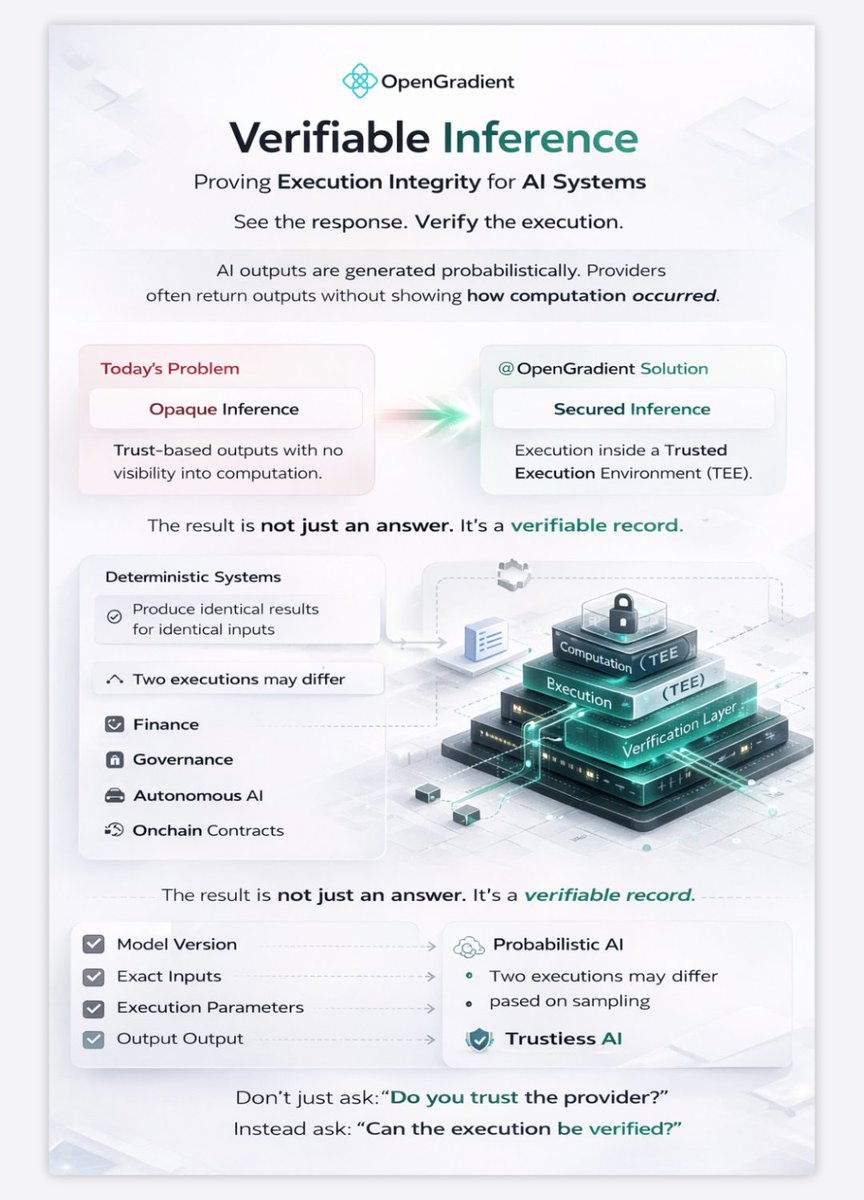
Verifiable inference is not about making AI “correct.” It is about making execution provable. Most AI systems return outputs without exposing how computation occurred. You see the response. You do not see the execution boundary. Trust is implicit. @OpenGradient changes this by restructuring inference at the infrastructure layer. With the x402 model, inference executes inside Trusted Execution Environments (TEE). This creates an isolated hardware boundary where: - Model weights are measured - Input payloads are hashed - Execution context is recorded - Output is cryptographically bound to that context The result is accompanied by attestation data. Not just an answer. A verifiable record. The distinction matters. Deterministic systems, like smart contracts, produce identical results for identical inputs. AI models are probabilistic by nature. Two executions may differ depending on sampling configuration. @OpenGradient addresses this by binding: Model version Exact input Execution parameters Generated output To a single verifiable execution instance. The proof does not claim epistemic truth. It proves that a specific model ran with specific inputs inside a measured environment without external tampering. This shifts AI from assumption-based execution to integrity-based computation. TEE-backed verification prioritizes scalability and practical deployment. Zero-knowledge approaches remain an evolving research path for fully mathematical guarantees, but current large-scale inference economics favor enclave-based attestation. @OpenGradient treats computation integrity as a first-class primitive. Inference becomes something that can be audited, referenced by contracts, and integrated into economic logic. Instead of asking: “Do you trust the provider?” The system asks: “Can the execution be verified?”
SOJIB tweet media
English
13
11
24
160