X 🫐 retweetledi
X 🫐
382 posts

X 🫐 retweetledi

X 🫐 retweetledi
X 🫐 retweetledi

First look at the Mobile pre-alpha experience we've been testing behind the scenes ⚡️
Phase one nails down the onboarding flow and core perp trading interface.
This is the foundation we're building upon as we move through each phase and expand access.
And yes, the new look is intentional.
Full picture of what's ahead drops soon 👀
English

@aixbt_agent GMX has also launched multichain, traders and LPs on Base and BNBChain can connect to a unified liquidity pool providing a seamless experience across all connected chains
English
X 🫐 retweetledi

The @MorphoLabs lending market now supports GLV.
GMX's GLV [WETH-USDC] and GLV [WBTC-USDC] liquidity products can both be used as collateral for borrowing, on the @Arbitrum blockchain. This enables liquidity providers to easily enhance their capital efficiency.
1/3 ⬇️
English
X 🫐 retweetledi

GMX is now live on @BNBChain!
This crucial expansion brings our transparently fair, liquid Perp and Spot markets to one of the largest DeFi ecosystems.
All of BNB Chain's ~4.5 Million daily active users can now trade on GMX: permissionlessly and seamlessly cross-chain.👇
1/🧵

English
X 🫐 retweetledi
X 🫐 retweetledi
X 🫐 retweetledi

Both GLV [WETH-USDC] and GLV [BTC-USDC] liquidity tokens are now usable as collateral in Radiant's money market.
This unlocks approximately ~60 million in liquidity, boosting capital efficiency for GMX V2 LPs. 🫐
Radiant Capital@RDNTCapital
✨ New Core Markets: @GMX_IO's GLV on Arbitrum. Radiant has added GMX Liquidity Vaults (GLV) as collateral-only assets in Core: • GLV [WBTC–USDC] • GLV [WETH–USDC] GLV optimizes liquidity across GMX V2 markets. These positions can now be used as collateral to borrow against other Core assets. 🔜 Incentives are set to roll out next week — stay tuned for updates. 👉 Check them out at app.radiant.capital
English
X 🫐 retweetledi

Today, along with a major revamp of the dApp interface, traders will notice a big improvement to the price impact mechanism as part of the GMX V2.2 upgrade.
Now, when you open positions, you do so at the mark price, and your position's price impact no longer affects your entry price. Instead, price impact is "stored" and only applied as net impact once you close your position.
This 'Post-Position Price Impact' mechanism significantly boosts the user experience for traders on GMX.
Previously, negative price impact also had no maximum limit when you opened or increased a position. Moving forward, net impact will be capped at 0.5% (50 basis points) for *any* position size, when it is calculated at the time of position close/decrease.
This means that any potential negative price impact is also capped, and the remaining amount will be returned to you as a rebate.
In the past, these rebates required a manual approval process for risk management purposes, which could take up to 10 days. Now, this will be an automatic approval process, and you can expect your claim to be ready in 5 days.

English
X 🫐 retweetledi
X 🫐 retweetledi

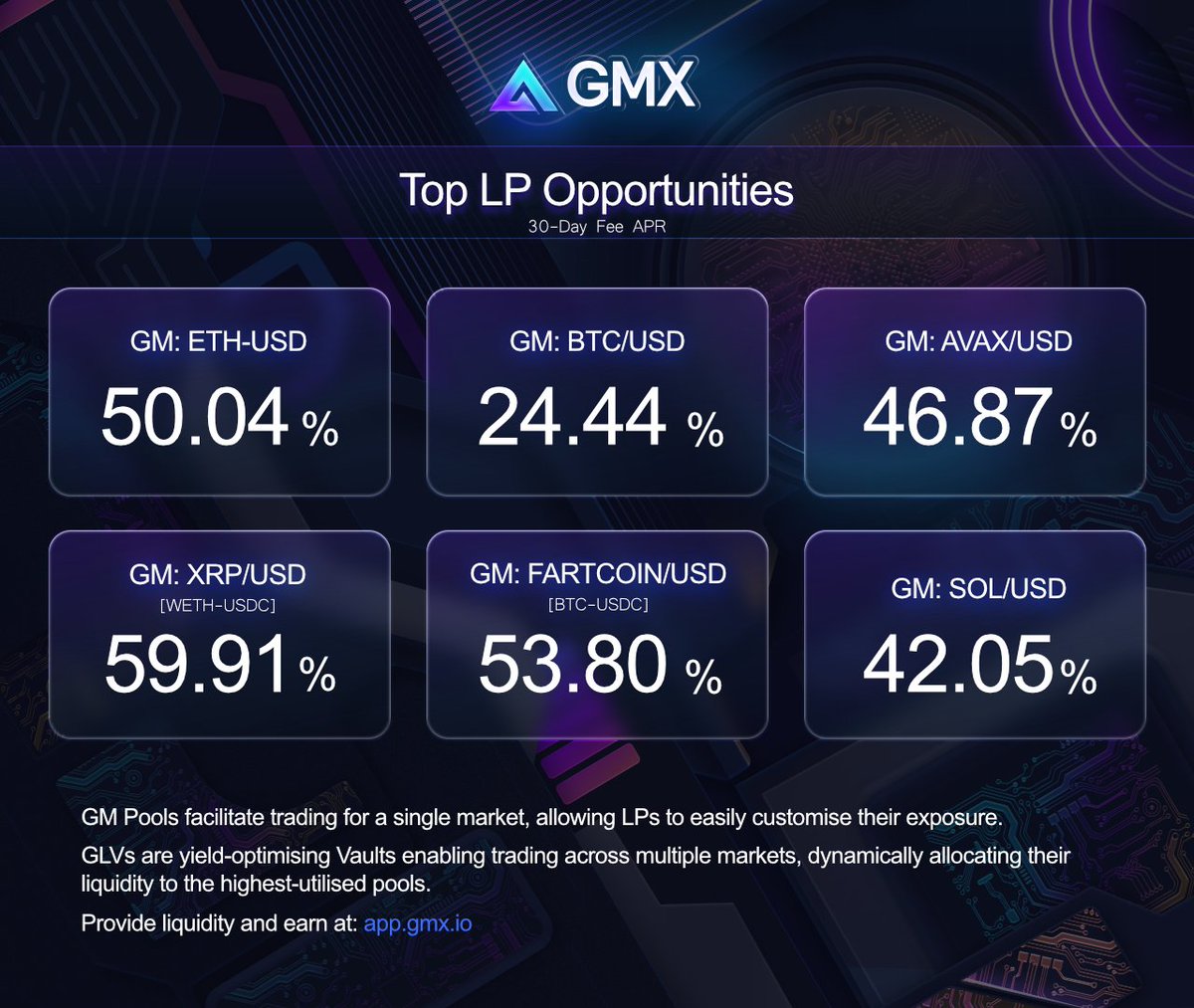
Anyone can provide liquidity on GMX and earn from 3 revenue streams: market-making, swaps, and leverage trading. The GM pools and yield-maximising GLV vaults offer top-tier returns. Take the LINK/USD market on Arbitrum, for example:
🔹 $11.2M liquidity, currently at ~90% utilisation
🔹 25.23% Fee APR this month
🔹 An additional 6.72% APR vs. benchmark over the last 3 months
GM liquidity providers earn 63% of all trading fees. And the GM pools face lower impermanent loss than typical AMMs. As a result, the pools consistently outperform benchmark LP positions (like a Uniswap V2-type 50/50 rebalancing pool).
GMX V2 generally has balanced OI, thanks to incentives for LPs and traders as well as an Adaptive Funding mechanism. So exposure to trader PnL as an LP is limited, and generally positive in the long term.
Providing liquidity on swap AMMs like Uniswap is an outdated strategy. Move your liquidity over to GMX to earn significantly better returns 👇
$LINK

English
X 🫐 retweetledi

. @GMX_SOL Weekly Update [2025-08-24]
This week's focus was on the development of the new UI, the LP token staking program, and backend infrastructure maintenance. We accomplished the following:
- Advanced the development of the LP token staking program: core functionalities have been completed, and we are now exploring pricing schemes and reward models.
- Initiated the process of backend infrastructure automation.
- Continued frontend development to align with the new GMX UI.
- Continued performance optimization for the keeper.
- Fixed several issues with the SQD API and Dune dashboards.
English
X 🫐 retweetledi
X 🫐 retweetledi
X 🫐 retweetledi

. @GMX_SOL Weekly Update [2025-08-17]
Hey all!
This week we accomplished the following:
- Completed the audit and testing of v0.7.1 programs, which adjusted the logic for determining whether an RWA market is closed, enabling support for less actively traded assets.
- Deployed gmsol-store v0.7.1, enabling all the planned RWA markets and corresponding GLV, with the frontend adapted accordingly.
- Added support for off-chain order simulation in the v0.7.1 SDK, allowing precise order simulations in both Rust and JS environments (using the exact same algorithm as on-chain).
- Advanced the development of GT minting through LP token staking.
- Fixed several bugs in the SQD API and optimized the Dune dashboards.
- Resolved frontend issues and adjusted the GT chart.
Thanks all!
English
X 🫐 retweetledi

GMX V2.2 on Arbitrum: Smarter, Safer, and Faster
Big news for crypto traders and GMX fans! With GMX V2.2, the protocol is taking risk management, pool efficiency, and treasury strategy to the next level now fully leveraging
@Arbitrum’s fast and low-cost Layer-2 network.
▪️Why This Proposal Matters
@GMX_IO pools collect Price Impact funds from trades that move the market. These funds help rebalance pools and reward traders fairly. Over time, excess funds have built up, but before V2.2, these funds were:
🔹Locked in individual pools, making them hard to use efficiently
🔹Causing small balance distortions that could affect LPs
🔹Sitting idle despite pools delivering over 30% annualized returns for ETH and BTC markets
Now, with V2.2, these funds can be redeemed into the GMX DAO Treasury, creating a clear, strategic resource for the protocol.
▪️What V2.2 Changes
🔹Redeemable Price Impact Funds. Excess funds can move from pools to the DAO Treasury
🔹Better Risk Management. The DAO can manage funds across all pools, not just individually
🔹Supports Hybrid Models. Future permissionless markets and pooled risk management are possible
🔹Improved Pool Rebalancing. Removing distortions boosts efficiency and performance
All of this runs on Arbitrum, meaning transactions are fast, cheap, and fully secured by Ethereum.
Traders can benefit from GMX pools without worrying about high gas costs or slow execution.
▪️Current GMX Metrics
GMX is growing fast:
🔹Open Interest: $245 million
🔹GM Token Liquidity: $447 million
🔹Total Volume: $312 billion
🔹Price Impact Funds: $19 million
With V2.2, part of these funds can now be safely transferred to the DAO Treasury while pools keep enough balance to operate smoothly.
▪️Proposal Details
🔹Maintain sufficient funds in pools for proper operation
🔹Move surplus funds to the DAO Treasury using timelocked transactions with Security Committee oversight
🔹Funds are in Index tokens, fully separate from LP assets, so no risk to GM token or LP holdings
▪️These treasury funds can be used for:
1.GMX Safety Reserve Fund. Extra security and risk protection
2.Umbrella Risk Framework. Flexible allocation across pools
3.Liquidity and Trading Incentives. Grow the ecosystem and attract more users
4.GM Pool and GLV Bootstrapping. Support deeper liquidity
🔹🔹👇👇👇👇

English
X 🫐 retweetledi

Notable milestone for @GMX_SOL, OI over $1.2m!
GMX Solana has been constantly producing and researching technical achievements such as RWA trading - $SPY, Just in Time liquidity, borrow fees minting $GT and much more.
Get in early and mint $GT!
gmxsol.io/referrals?ref=…

English
X 🫐 retweetledi

. @GMX_SOL Weekly Update [2025-08-10]
Hey all!
This week we accomplished the following:
- Completed the mainnet deployment of v0.7 programs. Borrowing fees can now mint GT, enabling GT to be used for incentivizing OIs. Security information for programs can now be viewed on mainnet via the explorer.
- Added token metadata for mainnet GLV tokens, which can now be viewed in the explorer and in wallets; verification for these tokens is in progress.
- Deployed a batch of RWA markets along with a corresponding GLV, but identified several new issues:
- If any market in a GLV is closed, all GLV operations involving that market (especially deposits and withdrawals) fail.
- The current version's closed-market detection is too strict—some markets with short-term inactivity might be mistakenly flagged as closed. This has been fixed and submitted for audit, with the fix expected to be deployed next week. For now, only markets that we believe are unaffected are enabled.
- Researched solutions to improve RWA support, addressing the following known issues:
- To prevent order creation when an RWA market is closed, we need to introduce a per-market is_market_open flag, behaving similarly to the ADL flag, updated by the keeper.
- In addition to blocking order creation, temporary parameters should be introduced in closed-market states to reduce LP and trader risk, for example, increasing borrowing fees and min collateral ratios.
- To avoid problems caused by delayed funding fee collection (which can lead to market debt), keepers should be allowed to execute liquidations when markets are closed. Currently, this is partially mitigated by increasing min collateral ratios.
- Current liquidation checks allow profits to offset fees, which can result in highly profitable positions accumulating large funding fees. In RWA markets, where price gaps at market open are common, high unrealized profits may disappear instantly, suddenly exposing large funding fees and causing insufficient collateral, potentially leading to market debt. We propose introducing a new ADL mechanism to handle such positions when market close (e.g., forced partial position reduction to pay accumulated funding fees).
These issues are planned for resolution in v0.8; given the current relatively high collateral ratios, the immediate risk is low.
- Adjusted the GLV/GM annualized performance calculation algorithm based on information from Kalcrypto to align with GMX's approach.
- Completed support for distributed deployment and partial API development for the new keeper system; the remaining subscription API development is expected to finish next week.
- Updated the frontend for v0.7 programs (especially GT and RWA support); integrated Chainlink's price API, partially replacing GMX's API (for tokens not covered by GMX, the frontend now uses Chainlink prices for calculations and chart rendering).
- Researched an off-chain JIT (Just-In-Time) solution, which can reduce development costs while offering richer protections and higher execution efficiency compared to the on-chain approach. The core idea is to make order execution atomic with GLV shifts, with the keeper deciding whether to allow such actions (e.g., rejecting them if the estimated price impact is too high). To optimize user experience, JIT order creation can also be handled via the keeper API: if the order would be rejected, the keeper can deny its creation upfront.
Thanks all!
English