Carlos Baquero

14.2K posts

Carlos Baquero banner
Carlos Baquero

Carlos Baquero

@xmal

Professor @feup_porto and researcher @inesctec. Distributed Systems and Data. Co-creator of CRDTs. Still searching for unknown unknowns

Oporto, Portugal Katılım Mart 2007
3.6K Takip Edilen3.1K Takipçiler
Carlos Baquero
@Giovann35084111 Did the BTC power-law community try out of sample forward predictions for increasing time forward horizons? I am evaluating some new methods under that criteria.
English
0
0
0
301
Carlos Baquero
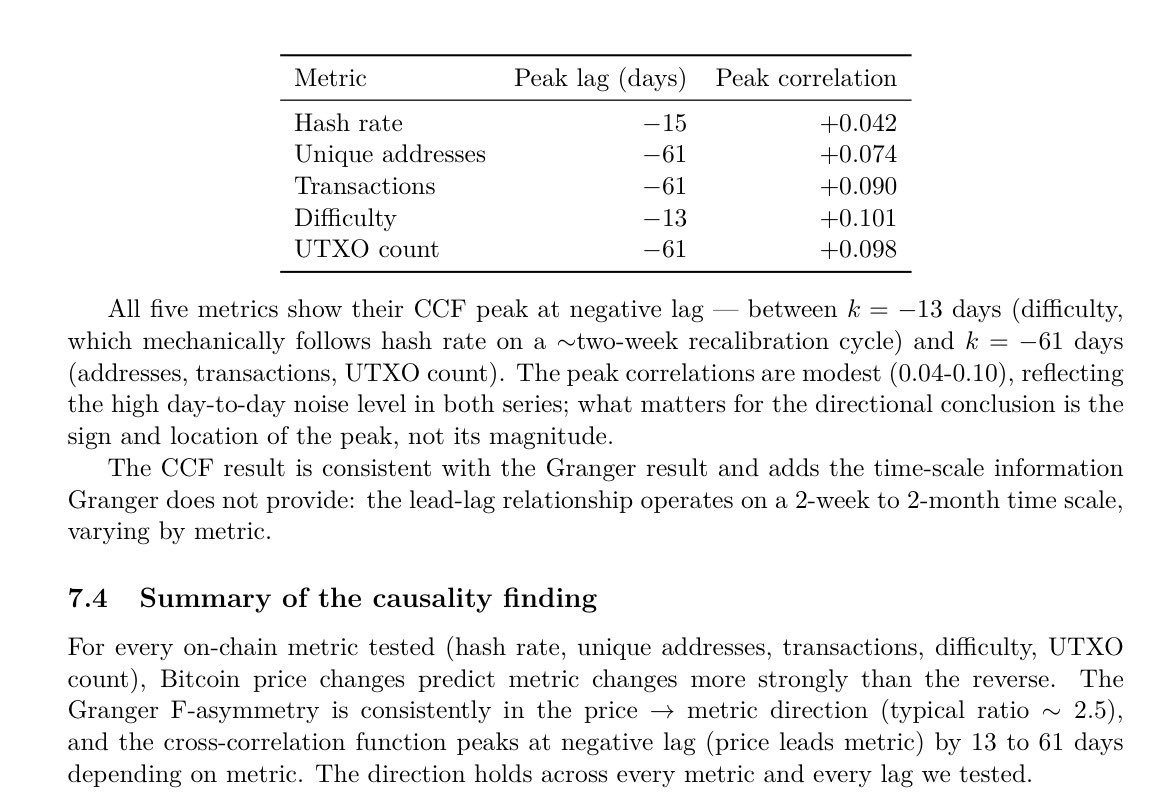
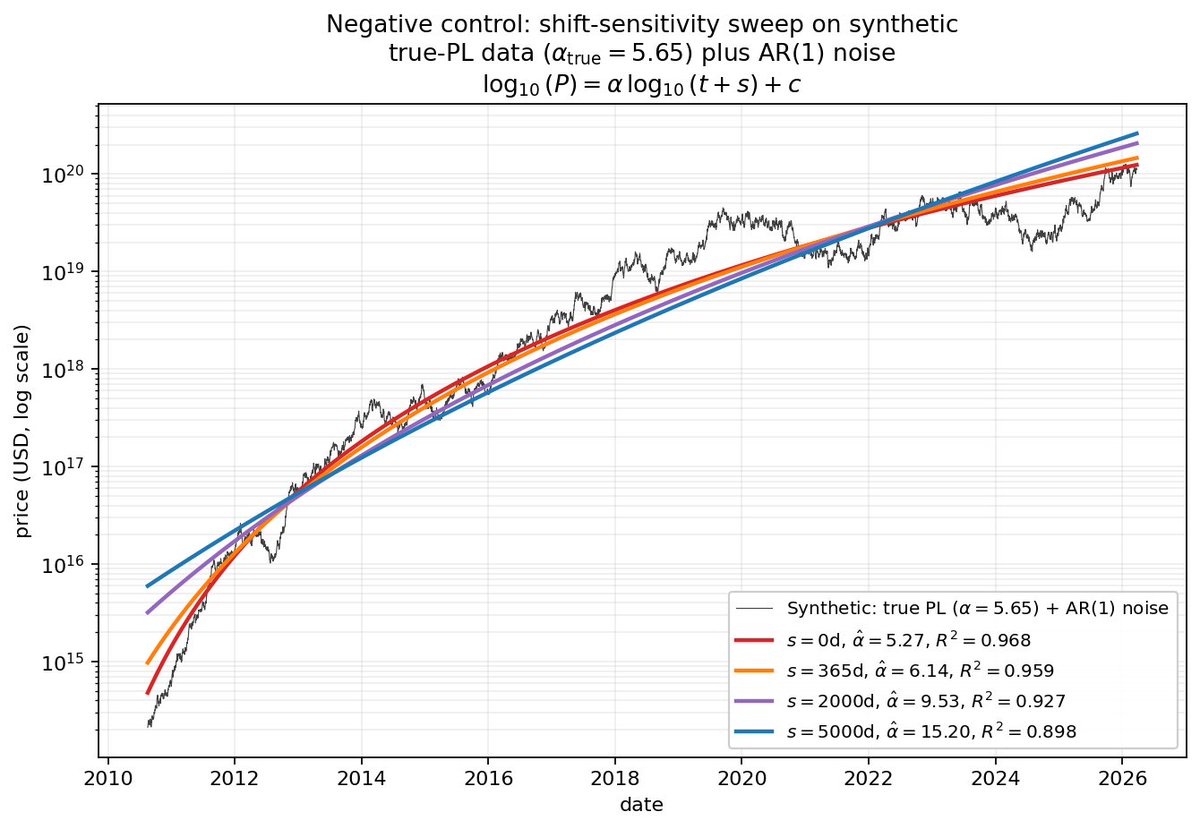
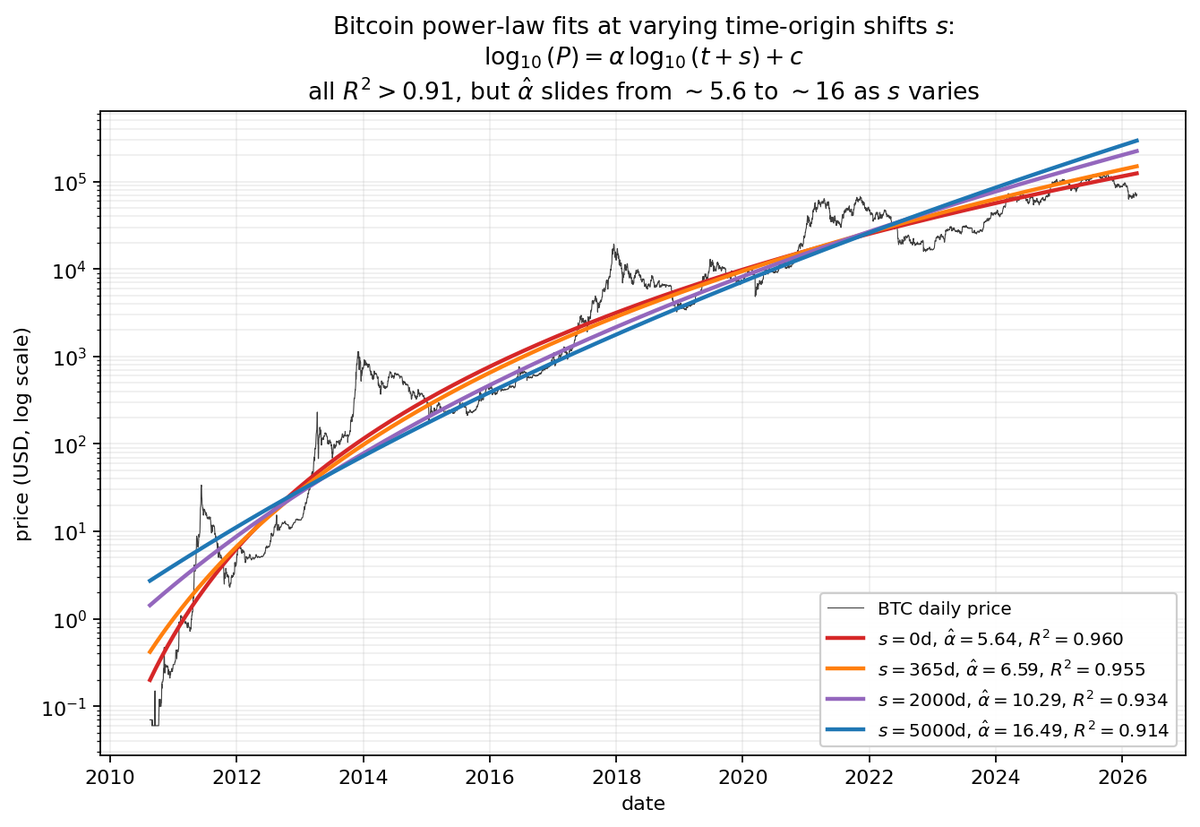
Applied @karpathy autoresearch method to optimise the Bitcoin power law trend. The base model is still a power law, but it found several optimisations. It reduced the prediction errors by half up to a 5-year horizon. All in one sunday morning. Experiment code soon and paper.
Carlos Baquero tweet mediaCarlos Baquero tweet media
English
0
0
0
114
Carlos Baquero retweetledi
sunny madra
sunny madra@sundeep·
“If your $500K engineer isn’t burning at least $250K in tokens, something is wrong.”
English
888
924
10.5K
6M
Carlos Baquero retweetledi
Muhammad Muneeb
Muhammad Muneeb@im2muneeb·
Advice for PhD Students …
Muhammad Muneeb tweet media
English
19
222
2.6K
67.9K
Carlos Baquero retweetledi
Sofia Afonso Ferreira
Sofia Afonso Ferreira@sofiafonsoferre·
In memory of Chuck Norris.
Sofia Afonso Ferreira tweet media
English
62
1.7K
21.3K
271.2K
Carlos Baquero retweetledi
Z'Économist'a
Z'Économist'a@wolf_castilho·
The year Is 1508,USA🇺🇸 doesnt even exist. Afonso de Albuquerque led 6 Portuguese ships against 160 Persian vessels to conquer Hormuz, after negotiations failed.Superior naval artillery and tactics secured a legendary victory 🇵🇹.We live in a loop⚓️ #Hormuz
Z'Économist'a tweet mediaZ'Économist'a tweet mediaZ'Économist'a tweet media
English
24
175
1.3K
71K
Carlos Baquero retweetledi
Ryan Detrick, CMT
Ryan Detrick, CMT@RyanDetrick·
So many of these, but this one is a classic Chuck Norris joke. 🐅 #RIPChuckNorris
English
186
4.7K
34.4K
1.3M
Carlos Baquero retweetledi
Abakcus
Abakcus@abakcus·
1/3 + 1/9 + 1/27 + ··· = 1/2. The proof is in the picture. No words needed.
Abakcus tweet media
English
30
244
1.6K
79.7K
Carlos Baquero retweetledi
CACM Editor
CACM Editor@blogCACM·
From Distributed Intelligence to Verifiable Responsibility The accountability substrate: completing the AI-native Internet. By Mallik Tatipamula, David Attermann, and Vinton G. Cerf cacm.acm.org/blogcacm/from-…
English
0
4
3
422
Carlos Baquero retweetledi
antirez
antirez@antirez·
I'm thinking that because of automatic programming certain complicated and elegant programs we wrote in the past may basically become a form of art for future generations. Like the manuscript books of the middle age for us.
English
33
31
373
20.1K
Varun
Varun@varun_mathur·
Agentic General Intelligence | v3.0.10 We made the Karpathy autoresearch loop generic. Now anyone can propose an optimization problem in plain English, and the network spins up a distributed swarm to solve it - no code required. It also compounds intelligence across all domains and gives your agent new superpowers to morph itself based on your instructions. This is, hyperspace, and it now has these three new powerful features: 1. Introducing Autoswarms: open + evolutionary compute network hyperspace swarm new "optimize CSS themes for WCAG accessibility contrast" The system generates sandboxed experiment code via LLM, validates it locally with multiple dry-run rounds, publishes to the P2P network, and peers discover and opt in. Each agent runs mutate → evaluate → share in a WASM sandbox. Best strategies propagate. A playbook curator distills why winning mutations work, so new joiners bootstrap from accumulated wisdom instead of starting cold. Three built-in swarms ship ready to run and anyone can create more. 2. Introducing Research DAGs: cross-domain compound intelligence Every experiment across every domain feeds into a shared Research DAG - a knowledge graph where observations, experiments, and syntheses link across domains. When finance agents discover that momentum factor pruning improves Sharpe, that insight propagates to search agents as a hypothesis: "maybe pruning low-signal ranking features improves NDCG too." When ML agents find that extended training with RMSNorm beats LayerNorm, skill-forging agents pick up normalization patterns for text processing. The DAG tracks lineage chains per domain(ml:★0.99←1.05←1.23 | search:★0.40←0.39 | finance:★1.32←1.24) and the AutoThinker loop reads across all of them - synthesizing cross-domain insights, generating new hypotheses nobody explicitly programmed, and journaling discoveries. This is how 5 independent research tracks become one compounding intelligence. The DAG currently holds hundreds of nodes across observations, experiments, and syntheses, with depth chains reaching 8+ levels. 3. Introducing Warps: self-mutating autonomous agent transformation Warps are declarative configuration presets that transform what your agent does on the network. - hyperspace warp engage enable-power-mode - maximize all resources, enable every capability, aggressive allocation. Your machine goes from idle observer to full network contributor. - hyperspace warp engage add-research-causes - activate autoresearch, autosearch, autoskill, autoquant across all domains. Your agent starts running experiments overnight. - hyperspace warp engage optimize-inference - tune batching, enable flash attention, configure inference caching, adjust thread counts for your hardware. Serve models faster. - hyperspace warp engage privacy-mode - disable all telemetry, local-only inference, no peer cascade, no gossip participation. Maximum privacy. - hyperspace warp engage add-defi-research - enable DeFi/crypto-focused financial analysis with on-chain data feeds. - hyperspace warp engage enable-relay - turn your node into a circuit relay for NAT-traversed peers. Help browser nodes connect. - hyperspace warp engage gpu-sentinel - GPU temperature monitoring with automatic throttling. Protect your hardware during long research runs. - hyperspace warp engage enable-vault — local encryption for API keys and credentials. Secure your node's secrets. - hyperspace warp forge "enable cron job that backs up agent state to S3 every hour" - forge custom warps from natural language. The LLM generates the configuration, you review, engage. 12 curated warps ship built-in. Community warps propagate across the network via gossip. Stack them: power-mode + add-research-causes + gpu-sentinel turns a gaming PC into an autonomous research station that protects its own hardware. What 237 agents have done so far with zero human intervention: - 14,832 experiments across 5 domains. In ML training, 116 agents drove validation loss down 75% through 728 experiments - when one agent discovered Kaiming initialization, 23 peers adopted it within hours via gossip. - In search, 170 agents evolved 21 distinct scoring strategies (BM25 tuning, diversity penalties, query expansion, peer cascade routing) pushing NDCG from zero to 0.40. - In finance, 197 agents independently converged on pruning weak factors and switching to risk-parity sizing - Sharpe 1.32, 3x return, 5.5% max drawdown across 3,085 backtests. - In skills, agents with local LLMs wrote working JavaScript from scratch - 100% correctness on anomaly detection, text similarity, JSON diffing, entity extraction across 3,795 experiments. - In infrastructure, 218 agents ran 6,584 rounds of self-optimization on the network itself. Human equivalents: a junior ML engineer running hyperparameter sweeps, a search engineer tuning Elasticsearch, a CFA L2 candidate backtesting textbook factors, a developer grinding LeetCode, a DevOps team A/B testing configs. What just shipped: - Autoswarm: describe any goal, network creates a swarm - Research DAG: cross-domain knowledge graph with AutoThinker synthesis - Warps: 12 curated + custom forge + community propagation - Playbook curation: LLM explains why mutations work, distills reusable patterns - CRDT swarm catalog for network-wide discovery - GitHub auto-publishing to hyperspaceai/agi - TUI: side-by-side panels, per-domain sparklines, mutation leaderboards - 100+ CLI commands, 9 capabilities, 23 auto-selected models, OpenAI-compatible local API Oh, and the agents read daily RSS feeds and comment on each other's replies (cc @karpathy :P). Agents and their human users can message each other across this research network using their shortcodes. Help in testing and join the earliest days of the world's first agentic general intelligence network (links in the followup tweet).
Varun@varun_mathur

Autoquant: a distributed quant research lab | v2.6.9 We pointed @karpathy's autoresearch loop at quantitative finance. 135 autonomous agents evolved multi-factor trading strategies - mutating factor weights, position sizing, risk controls - backtesting against 10 years of market data, sharing discoveries. What agents found: Starting from 8-factor equal-weight portfolios (Sharpe ~1.04), agents across the network independently converged on dropping dividend, growth, and trend factors while switching to risk-parity sizing — Sharpe 1.32, 3x return, 5.5% max drawdown. Parsimony wins. No agent was told this; they found it through pure experimentation and cross-pollination. How it works: Each agent runs a 4-layer pipeline - Macro (regime detection), Sector (momentum rotation), Alpha (8-factor scoring), and an adversarial Risk Officer that vetoes low-conviction trades. Layer weights evolve via Darwinian selection. 30 mutations compete per round. Best strategies propagate across the swarm. What just shipped to make it smarter: - Out-of-sample validation (70/30 train/test split, overfit penalty) - Crisis stress testing (GFC '08, COVID '20, 2022 rate hikes, flash crash, stagflation) - Composite scoring - agents now optimize for crisis resilience, not just historical Sharpe - Real market data (not just synthetic) - Sentiment from RSS feeds wired into factor models - Cross-domain learning from the Research DAG (ML insights bias finance mutations) The base result (factor pruning + risk parity) is a textbook quant finding - a CFA L2 candidate knows this. The interesting part isn't any single discovery. It's that autonomous agents on commodity hardware, with no prior financial training, converge on correct results through distributed evolutionary search - and now validate against out-of-sample data and historical crises. Let's see what happens when this runs for weeks instead of hours. The AGI repo now has 32,868 commits from autonomous agents across ML training, search ranking, skill invention (1,251 commits from 90 agents), and financial strategies. Every domain uses the same evolutionary loop. Every domain compounds across the swarm. Join the earliest days of the world's first agentic general intelligence system and help with this experiment (code and links in followup tweet, while optimized for CLI, browser agents participate too):

English
153
717
5.1K
905.4K
Carlos Baquero retweetledi
Pedro Domingos
Pedro Domingos@pmddomingos·
When AI has made mathematicians irrelevant, they'll continue to do math like chess players continue to play chess.
English
84
28
635
40K
Carlos Baquero retweetledi
CACM Editor
CACM Editor@blogCACM·
When Science Goes Agentic If agentic science delivers even a fraction of its promise, the productivity explosion will overwhelm peer review. cacm.acm.org/blogcacm/when-…
English
1
5
6
864
Carlos Baquero retweetledi
Henpecked Hal
Henpecked Hal@HenpeckedHal·
Simple facts I'm terrified of my toddler discovering: - public parks don't randomly close - tv's don't run out of batteries - there is no actual world record for "fastest at putting away toys" - chicken the animal and chicken the food are one and the same Got any to add?
English
171
101
3.9K
128.9K
Carlos Baquero retweetledi
Our World in Data
Our World in Data@OurWorldInData·
The number of cancer deaths worldwide has more than doubled since the 1980s. Does that mean we're losing the fight against cancer? Not necessarily, because it depends on how you measure it. On this chart, you can see three ways to look at the same data. The red line shows the total number of cancer deaths. It has increased by about 120%, but this measure doesn't account for the fact that the world's population has also grown enormously over this period. Another approach is to look at the death rate: the number of cancer deaths divided by the total population. That's the brown line, called the crude cancer death rate. It has increased too, but much less — around 20%. But there's still a problem: the world's population has been getting older. Cancer is mostly a disease of old age, so even per capita, we'd expect more cancer deaths simply because there are more older people than before. That's where the method of “age standardization” comes in. It's a way of asking: what would the cancer death rate look like if the age structure of the population hadn't changed? The blue line shows this age-standardized rate: it's fallen by about 25%. At any given age, people are now less likely to die of cancer than they were in the 1980s. The same underlying data gives us three different pictures. The absolute number of deaths is up; the crude rate is up slightly; the age-standardized rate is down. None of these are inaccurate, but they answer different questions. Age standardization is one of the most important statistical methods for making sense of health data. Without it, population aging can hide progress or mask problems.
Our World in Data tweet media
English
56
605
2.7K
223.8K