Sabitlenmiş Tweet

@btstarchitect @vaguelym @queenvictoria @MichaelWarbur17 @mtizard Spiral Jetty, Sun Tunnels, City, Double Negative, Meow Wolf Las Vegas.

English
Zina
2.4K posts

@zinak
Inhabiting virtual worlds since λ🐮 ⚖️Boards 🔬Tech + Commercialisation 🦋 Art+Science 📃 🪴Philanthropy💧Bias +Innovation🍸 Waters rising so keep dancing 👨🎤

I built an app that lets you talk to statues. Naturally, I took it for a spin at the British Museum. Full conversations in the thread.

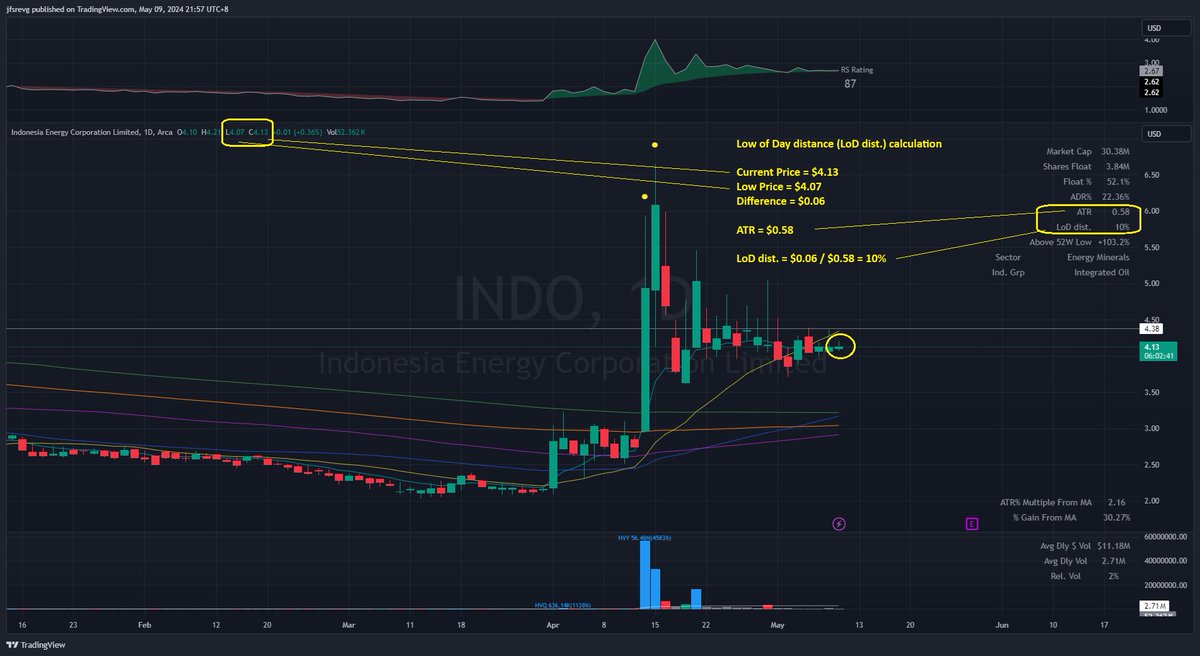

I love this sharing, I totally relate to this. If you're precise and efficient with your entries—ensuring entries are always below 50/60% from the LoD stop based on ATR nature of the securities volatility—then taking a 0.15% risk to your net liquidation value can easily scale up to 15-20% position size. Sometimes, I’ve gone even as high as 30% with a 0.15% risk; that happened with trades in $KOLD and $UCO earlier this year. The downside of designing trades with a tight stop loss is that you might hit your stop way more frequently than with a fixed %-based stop, especially during intraday. However, when it comes to the period that you rightly aligned your positions with the market's key turning points, you're setting yourself up for a few trades that can significantly pay off. These successful trades can quickly offset a prolonged drawdown, turning your performance positive and even making your year. You can be profitable even at 28% win rate on such circumstance because your profit factor for such traders are extremely high (as much as 4x 5x on average month, providing you scale down losses even before they hit the predetermined stop.) By the rule of the thumb, a low win rate but high profit factor strategy has way more lucrative potential to exploit further possibility and potential for equity growth because of its mathematical robustness. Try running a free Monte Carlo simulations for risk of ruin, and you will know what i mean. It's important to remember that the beauty of this represents just a <0.15% risk to your equity per opportunity. At the end of the day, you have control over your decisions, so any potential or unexpected drawdown can be kept in check if you know when to ease off when the market is already running hot. An edge in trading only comes to life when the person executing the strategy can make sound and pragmatic discretionary decisions.

CURRENT VIEW ON $BTC Controversial take, but curious what people think… Given the price action in $BTC, I wonder two things: 1. Has $BTC topped shorter-term? 2. How compressed will prospective return be over the coming years? We had an absolutely beautiful setup in Bitcoin. Great consolidation. All-time highs. Tons of bullshit treasury purchases to fuel the fire. Positive regulatory news. Every trader I know (including me for the idiots that think I’m a permabear) was leveraged long to the hilt. And yet we could only get two real days of price expansion. At this point, who is the marginal buyer? Who isn’t long on a setup like that? Structurally, I’ve felt $BTC will go higher but that the massive returns are gone. As an asset reaches mass adoption, realized vol compresses as do returns. There is less price discovery to occur. It’s just basic market structure theory. Every cycle in $BTC, the returns have been about a magnitude less. And the failure of this breakout makes me think $BTC is largely approaching the era of market returns (market single-year returns/vol can be far higher than most think though). It didn’t take much imagination to see a quick move to $130k, $140k, $150k (the people who think $1m is around the corner are high on hopium IMO). Yet here we are. I always then end up wondering the second deriv… if returns compress and approach market returns, how many people would still hold bitcoin? The data doesn’t lie. Most holders of $BTC are in it solely for speculative purposes. People are looking for 1000%+ returns or even 100% returns. What happens to the average holder if we experience years of traditional market returns? What happens to the average holder if all of a sudden $ETH or some other coin starts to offer higher prospective returns? I have zero idea the future. Not a forecast. But certainly questions worth thinking about. @TheFlowHorse @skyquake_1 @TedHZhang


Wow, art won. I would not have guessed. Okay. Here is one of my favorite pieces in my collection, Ossip by Emil Schumacher (1958). The subject matter is how it feels to be short uncapped variance in a market crash
TestFlight1 — Liftoff 🚀 Today, Eris became the first #AustralianMade orbital rocket to launch from Australian soil — ~14s of flight, 23s engine burn. Big step for 🇦🇺 launch capability. Team safe, data in hand, eyes on TestFlight 2. (More pics and vids to come from the media.)



we have greatly improved memory in chatgpt--it can now reference all your past conversations! this is a surprisingly great feature imo, and it points at something we are excited about: ai systems that get to know you over your life, and become extremely useful and personalized.