Kent Harris

474 posts

Kent Harris banner
Kent Harris

Kent Harris

@FUPD666

Fighting Young Onset Parkinson’s Disease/ middle school teacher/genetic type of Parkinson’s/ patient council person at NysnoBio/advocate for genetic testing

Washington, DC Entrou em Aralık 2022
481 Seguindo392 Seguidores
Tweet fixado
Kent Harris
Kent Harris@FUPD666·
@JCThr33 Jimmy Choi has accepted my race challenge. To my 12 followers, I want to emphasize how big this is.
English
4
1
22
1.8K
togetherforsharon
togetherforsharon@togetherforsha1·
Last night was a very scary experience. I couldn’t sleep for several hours, and when I finally fell asleep, I woke up with a severe migraine and intense nausea that sent me to the hospital. I’m home resting now, but it was a terrible night. I’ve battled migraines for years
togetherforsharon tweet media
English
2
0
1
46
Kent Harris
Kent Harris@FUPD666·
@purposeful_pd Basketball is great to help walk. My dad, who was diagnosed with PD last September, has done this. When I do it, I cross everyone up and they end up falling. lol. Love seeing your posts
English
1
0
1
34
Gavin Mogan
Gavin Mogan@purposeful_pd·
If I looked into a crystal ball 18 years ago and saw this day, I would be so, so grateful. It’s challenging, but I expected far worse. I’ve lost some bodily control, but never felt more in control.
English
2
0
17
440
Michael Okun
Michael Okun@MichaelOkun·
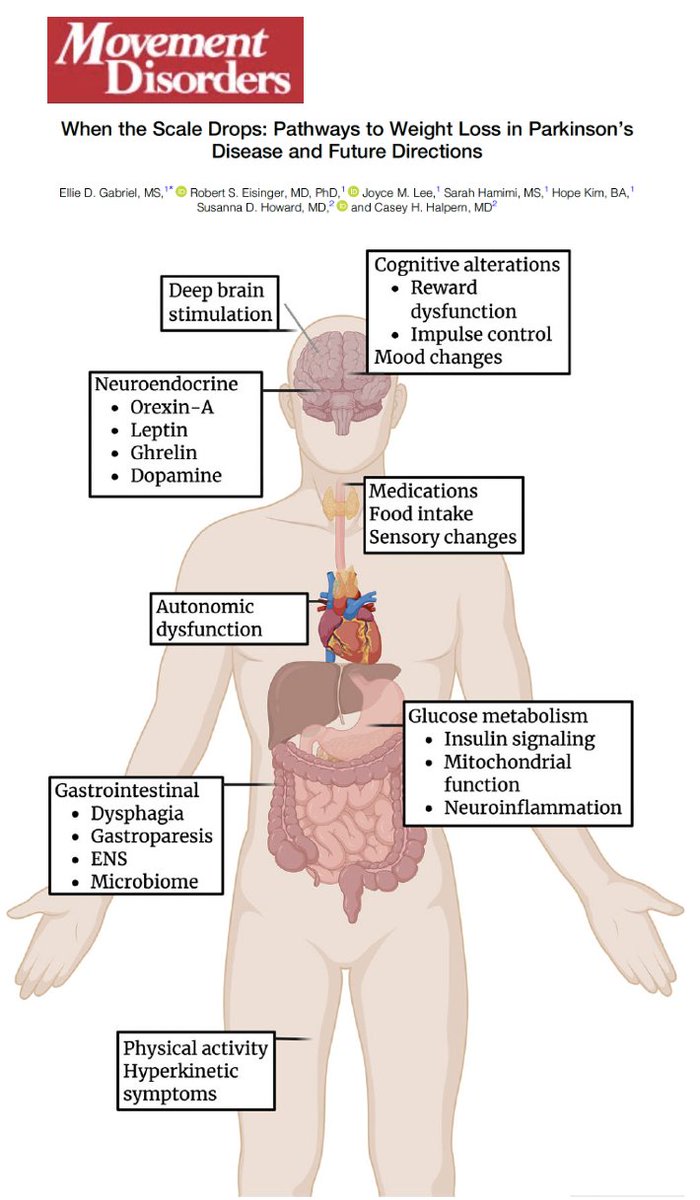
Why do many folks lose weight with Parkinson’s disease? The biology is more complex than eating less. Metabolism is how the body converts food into energy and regulates fuel use across organs including the brain. Gabriel and colleagues describe in a new paper in Movement Disorders how multiple biological pathways combine to drive weight loss in Parkinson’s disease. The review highlights how metabolism, gastrointestinal function, brain signaling and treatment effects all interact to shape weight trajectories across the disease course. Key Points: - Weight loss in Parkinson’s disease frequently begins years before diagnosis and can exceed 5 percent of baseline weight as the disease progresses. - Disruptions in metabolism, neuroendocrine signaling, gastrointestinal function and brain reward circuits can alter appetite, digestion and energy balance. - Weight loss is linked to frailty, cognitive decline and worse quality of life, making early monitoring and nutritional strategies important for care. My take: Weight loss in Parkinson’s disease is not a simple story of eating less. It reflects a systems level disruption affecting metabolism including the gut, hormones and brain circuits that regulate hunger and reward. Understanding these pathways will help health care providers better recognize weight changes earlier and to intervene before frailty develops. Here are 5 points that resonated w/ me: 1- Weight loss can begin years before motor symptoms, suggesting it may be an early biological signal of Parkinson’s disease. 2- Gastrointestinal changes such as dysphagia, gastroparesis and constipation can reduce nutrient absorption and appetite. 3- Brain changes affecting smell, motivation and reward can blunt the drive to eat even when food is available. 4- Metabolic and hormonal disruptions including ghrelin, leptin and glucose signaling can create a perceived low energy state in the body. 5- Monitoring body weight at routine visits and involving nutrition specialists may help protect quality of life and reduce frailty in Parkinson’s disease. …mentdisorders.onlinelibrary.wiley.com/doi/10.1002/md… @MDJ_Journal @ParkinsonDotOrg #parkinson
Michael Okun tweet media
English
2
26
86
4.5K
Barbara Salsberg Mathews
Barbara Salsberg Mathews@SalsbergMathews·
“I take great joy throwing a tennis ball for Luna, my black labrador.” Matt Eagles is from Cheshire in the UK diagnosed in 1975, at age 8. How do you harvest JOY? Please DM me or email info@parkinsonseurope.org We’re creating a new book & invite your submissions. @MattEagles
Barbara Salsberg Mathews tweet media
English
1
1
10
286
Michael Okun
Michael Okun@MichaelOkun·
Could smell be a window into understanding Parkinson’s symptoms and predicting outcome? Olfaction refers to the brain’s ability to identify and process smells. In a new paper in the European Journal of Neurology, Yeeun Sun and colleagues describe how smell loss can reveal important clues about the many symptoms of Parkinson's. Key Points: - Olfactory dysfunction tracks w/ many non-motor issues as folks w/ worse smell showed more mood symptoms, more cognitive changes and more dysautonomia. - Limbic and caudate changes seem to emerge early as reduced dopamine transporter availability in the caudate as well as atrophy in limbic regions of brain were linked to smell loss. - Anosmia may predict worse outcomes as folks w/ complete smell loss had higher risk of freezing of gait and higher risk of future dementia. My take: The nose is the gateway to the brain. The olfactory system is like 'two train tracks' connecting the outside world to the brain. It is fascinating to think about how important this system may be in Parkinson's. Here are 5 points that resonated w/ me: 1- Smell matters more than most realize as losing it early can be a window into how Parkinson's may unfold across motor and non-motor symptoms. 2- Smell loss frequently travels w/ other symptoms including sleep changes, gastrointestinal issues and mood shifts. 3- Smell testing provides helpful clues since it may highlight changes in memory and thinking that can be tied to limbic system involvement. 4- Anosmia can forecast risk as complete smell loss may signal higher chances of freezing of gait and later cognitive difficulties. 5- Smell may one day guide care conversations as understanding olfaction could trigger personalized monitoring and prevention strategies. onlinelibrary.wiley.com/doi/10.1111/en… #parkinson @ParkinsonDotOrg @FixelInstitute @SfNtweets @PdAvengers
Michael Okun tweet media
English
6
44
141
22.9K
Michael Okun
Michael Okun@MichaelOkun·
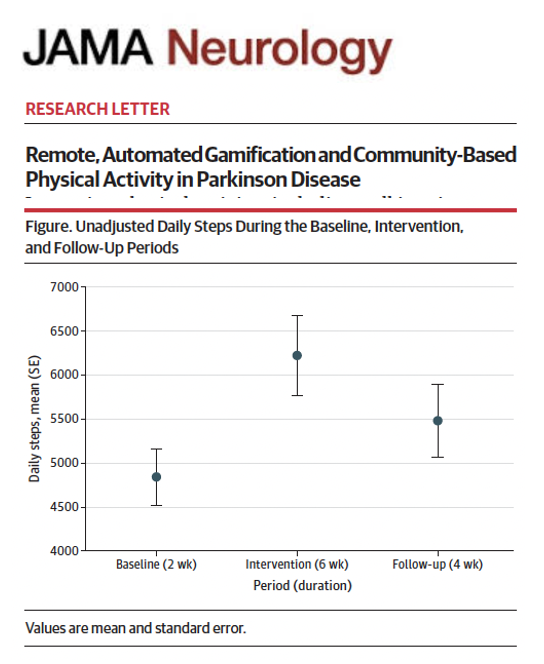
Can you level up your movement in Parkinson's by playing video games 'remotely?' Gamification refers to using game-like elements to motivate real-world behavior change, such as increasing your daily steps. Waddell, Morley and colleagues describe in a new research letter in JAMA Neurology how a remote and automated gamification program helped veterans living w/ Parkinson’s increase their daily steps. Key Points: - Physical activity is a powerful therapy for Parkinson’s. - Gamification may be one more creative tool to keep folks moving and motivated. - Gamification increased daily steps by more than 1200 during the intervention period. - Improvements persisted beyond the program w/ a sustained step increase during follow-up. - Remote design facilitated participation from rural veterans and it reduced staffing needs. My take: You may be surprised to learn the increasing number of papers showing video games and gamification can be used to treat disease. Here are 5 points that resonated w/ me: 1- Gamification can help keep folks moving and motivated in their everyday life. 2- Small step increases add up over time and may support better mobility and quality of life. 3- Remote programs can expand access to exercise support. 4- Behavior change strategies frequently matter as much as the exercise plan itself. 5- This early work is promising, but of course we will need more trials to define the dose and also the type of gamification to prescribe. cutt.ly/ZtqrfOs5 @JAMANeuro @ParkinsonDotOrg @SfNtweets @movedisorder #parkinson @PdAvengers @JAMA_current
Michael Okun tweet media
English
3
3
10
1.3K
Gavin Mogan
Gavin Mogan@purposeful_pd·
@Coachgarz2 I talked my girlfriend into moving down here from New Jersey. She also has Parkinson’s. We’ll work on our skills! Julio’s video is far superior to mine😆
English
3
0
4
93
Kent Harris
Kent Harris@FUPD666·
@purposeful_pd I’d love to play, but I need my disability retirement to be approved first. I am currently appealing and hope to have an answer soon. In the denial, the doctor used my exercise program as evidence against me. Very frustrating!
English
1
0
1
20
Gavin Mogan
Gavin Mogan@purposeful_pd·
@FUPD666 Parkinson’s Ballers are meeting up in Indianapolis in November. Can you make it?
English
1
0
1
24
Gavin Mogan
Gavin Mogan@purposeful_pd·
Surely you won’t let this old guy with Parkinson’s beat you to the basket will you? Care to wager? You may win some $, but you’ll also have to hear about living life with untreated Parkinson’s.
English
2
1
5
255
togetherforsharon
togetherforsharon@togetherforsha1·
Still trying to make it to DC. 6 pm flight turned to three gate changes and six delays and now an announcement on Jet Blue they cannot find a pilot. It continues on…..it is 930 and no further info provided at this time. A long night ahead.
English
1
0
2
112
Kent Harris
Kent Harris@FUPD666·
@MichaelOkun Thanks to them all. I hope many decide to help people with movement disorders.
English
0
0
1
36
Michael Okun
Michael Okun@MichaelOkun·
The 19th year of the Vanderbilt Focus on common movement disorders course is in the books(if you count the planning meeting). One resident from each neurology residency attends and we work hard to inspire them to pursue Parkinson’s disease and movement disorders. We have a critical shortage of specialists with only 40-50 a year matching into post residency training. It is part of our pdplan.org to meet the needs of the exploding population of those needing care. @fixelinstitute @ufhealth @VanderbiltU @parkinsondotorg
Michael Okun tweet media
English
1
1
17
1.9K
Kent Harris
Kent Harris@FUPD666·
@MichaelOkun I have found more steps is better for fighting my PD. If you can’t do 7000 yet, do less. Make a smart goal, one that you can eventually obtain. I have yet to find an amount of steps that doesn’t benefit me. Steps equal medicine
English
0
0
3
108
Michael Okun
Michael Okun@MichaelOkun·
Why 7000 steps is the right number for Parkinson’s and beyond. What do I tell the folks in my clinic? The 3 D's: Death, Dementia and Depression. For years people have asked me how many steps they should aim for each day. New evidence offers us a refined answer: 7000 steps or their equivalent is enough to drive real health benefits. Ding, Nguyen and colleagues nail it in their meta-analysis just published in Lancet Public Health. Key Points: - 7000 steps per day is linked to a 47% lower risk of DEATH, 25% lower risk of cardiovascular disease, 37% lower cancer mortality, 38% lower DEMENTIA risk, and 22% lower DEPRESSION risk. - Health benefits keep improving w/ more steps, however the biggest bang for your buck comes between 5000 and 7000 steps per day. - Even modest step counts matter. Going from 2000 to 4000 steps reduces mortality risk by over one-third. My take: Think about the 3 D's for achieving meaningful benefits in Parkinson's and beyond: death, dementia and depression. I tell folks in my clinic to shoot for 3-4 20 minute walks and to take a friend, especially if there are any balance issues. If they can't walk, I encourage 1-1.5 hours of indoor recumbent biking a day that is performed in 10-20 minute intervals (spread over the course of the waking day). Here are 5 points that resonated w/ me about this article. 1- Every step counts and small increases make a big difference. 2- 7000 steps is realistic and achievable for many, including those living w/ Parkinson’s. 3- Steps do not need to be consecutive. Accumulated movement through the day matters. 4- Beyond 7000 steps, benefits continue however gains become smaller. 5- Movement is medicine. A daily walking habit is one of the most powerful tools we have to fight Parkinson’s and other chronic diseases. Do you have an exercise plan? pdplan.org thelancet.com/journals/lanpu… @TheLancet @LancetGH @TheLancetNeuro @ParkinsonDotOrg @FixelInstitute @SfNtweets
Michael Okun tweet media
English
1
22
61
4.6K
Michael Okun
Michael Okun@MichaelOkun·
The Parkinson’s Plan is now a New York Times Bestseller. As exciting as this news is, we are calling on you to join the movement. Every copy sold benefits Parkinson's. It is time. Just as the world rallied around polio, HIV and breast cancer, the moment has arrived for Parkinson’s disease. We cannot stand by as the fastest growing neurodegenerative disorder continues its rapid rise. Cases are rising faster than Alzheimer's. We have proposed a bold strategy: level the increase of the disease to 0. Preventable exposures to toxins and pollutants must be employed. We call for a 10 fold increase in research funding. We must move the needle. We call for 100 percent access to levodopa for everyone, everywhere. The 0-10-100 goals give us a clear target. However movements are not built on goals alone, they are built on action. That is why we created the Parkinson’s 25: A comprehensive list of things each of us can do right now, whether or not you have Parkinson’s. This is not just about medicine, it is about people, families and communities uniting. The time has come for Parkinson’s. Let’s create a movement. nytimes.com/books/best-sel… @nytimes @Oprah @OprahDaily @ParkinsonDotOrg @FixelInstitute @movedisorder @AANmember @SfNtweets @Bilirakis @RepPaulTonko @RepWexton #parkinson #TheParkinsonsPlan #Parkinsons #NYTimesBestseller #Parkinsons25
Michael Okun tweet media
English
11
42
145
17.9K