Matt Bio 🍒
708 posts
Matt Bio 🍒
@MattPBio
Web3 | Longevity | Systems biology | Cognitive science
Entrou em Mayıs 2018
148 Seguindo49 Seguidores

@MattPBio @BojanPozar @JJansaSDS @vladaRS Grok med ostalim pravi:
....As of March 2026, it's still mostly in pilot, experimental, or limited-use stages...
Hard to perfectly hide voter identity while allowing individual checks....
English

Zanimivo soočenje Goloba in @JJansaSDS na podcastu Klemna Selakovića, saj predvsem drugačno od drugih. Janša, ki na podcaste prihaja v puloverjih, pravi, da bo kmalu sestavljal @vladaRS, vendar oni ne bodo “čistili golobistov”, kot je Golob čistil janšiste. Golob pa poudari, on, Golob, je v politiki zato, da navdihuje ljudi. Čeprav v nekem trenutku vidno izgubi živce ter prizna, da se je v politiko vrnil, ker naj bi mu Janševa vlada odvzela sanje in življenje na vrhu Gen-I.

Slovenščina
@BojanPozar @JJansaSDS @vladaRS Vsebinsko je Golob razpredal o težavah e-glasovanja kot srednješilec. Problem ni v idetifikaciji, problem je v manipulaciji oddane glasovnice, ki jo zaradi tajnega glasovanja moraš ločiri od volilca. Prakrično ni moč dobiti ustrezega algoritma, ki bi to lahko 100% ščitil.
Slovenščina
@JMacarolV A brez teh bedasto zacudenih fac v coverju res ne gre?
Slovenščina

🥛 Kaj je rekel Lavrov po 4 vodkah?! To je 1. napovednik pogovora z Anžetom Logarjem, ki bo na spletu objavljen 15. 2. 2026 v jutranjih urah na spodaj navedenih kanalih. Anže je bil izjemno »političen« sogovornik, ki pa sem ga lupil kot čebulo, da mi je na koncu vseeno povedal nekaj več kot drugim.
Cenim vaš follow in všeček – to je tisto, kar pravzaprav poganja vsebino in moje ustvarjanje.
Spored - Epizoda 001 //
15.2.2026 - ob 6:30 am / na x.com/JmacarolV
15.2.2026 - ob 7:30 am / na Jan Macarol FB ... facebook.com/janmacarol
15.2.2026 - ob 7:55 am / na @janmacarol" target="_blank" rel="nofollow noopener">youtube.com/@janmacarol
15.2.2026 - ob 00:01 am / Apple Podcast / Spotify / Soundcloud / - podcast platforme.
15.2.2026 - ob 9:00 pm / namesto Berganta na TV
Slovenščina
@ElonTrades The capital won't return until the mighty correlation continues to push back the market enabling speculation. Canton won't be any different.
English

When capital returns to crypto after a prolonged alt winter, it won 't spread evenly across 15,000 tokens again.
It'll concentrate into whatever has demonstrable traction. The 2020 recovery didn't lift the 2017 dead, it created entirely new winners.
This cycle's version of that is probably even more brutal because the market is more sophisticated at identifying what's real.
That's why when capital rotates back in again, Canton will be well positioned to take the lion's share.
$CC
English
@SasoDolenc A tega ne storimo zato, ker bi nas nekdo premagal z argumenti, temveč zato, ker nam je nekdo pokazal, da resnica ne pomeni izgube dostojanstva.
💯
Slovenščina

Zakaj pametni ljudje verjamejo neumnostim?
Predstavljajte si, da ste pred težko dilemo: ali sprejmete neprijetno resnico in tvegate izgubo prijateljev ali pa zamižite pred očitnimi dejstvi in ohranite dobre odnose. Če bi nas o tem vprašali zgolj teoretično, bi verjetno vsi zatrdili, da se nam zdi resnica pomembnejša od priljubljenosti. A v resničnem življenju se zgodi nekaj nenavadnega.
Naši možgani namesto hladne logike vklopijo obrambni mehanizem. Začnejo nam šepetati, da dokazi morda le niso tako trdni in da resnica ni nujno črno-bela. Tako se nam nenadoma zdi strinjanje z očitno zmoto povsem sprejemljivo. Vendar pri tem ne gre za znak nerazumnosti, ampak za neizogiben del naše človečnosti, ki dobre odnose pogosto ceni bolj kot resnico. In ta naša človeška narava ima v rokavu še en trik, ki nas pogosto zavede.
Leta 2002 sta psiholog Leonid Rozenblit in kognitivni znanstvenik Frank Keil izvedla preprost, a zgovoren eksperiment. Ljudi sta vprašala, kako dobro razumejo delovanje povsem vsakdanjih predmetov, kot so zadrge, stranišča ali šivalni stroji. Udeleženci so bili sprva samozavestni in so svoje znanje ocenili visoko. Ko pa sta jih raziskovalca prosila, naj dejansko opišejo, kako ti predmeti delujejo korak za korakom, se je samozavest hitro razblinila. Ocene znanja so strmo padle, saj so udeleženci spoznali, da so bili prepričani o razumevanju, ki ga v resnici sploh niso imeli.
Pojav, ki sta ga poimenovala »iluzija razlagalne globine«, pojasnjuje marsikaj o našem odnosu do kompleksnih vprašanj, od gospodarstva do podnebnih sprememb. Ko slišimo preprosto razlago – »elite nas izkoriščajo« ali »sistem je pokvarjen« – se nam zdi, da zadeve razumemo. Preprost vzrok, jasna posledica in smiselna povezava v možganih sprožijo prijeten občutek: »Aha, tako je to!« Ko pa nam nekdo predstavi dobro preverjeno in utemeljeno razlago, ki vključuje zapleten preplet številnih dejavnikov, ta občutek jasnosti izgine. Resnična razlaga se nam paradoksalno zdi manj pravilna od poenostavljene laži – preprosto zato, ker nam ne zagotavlja tistega udobnega občutka, da razumemo svet okoli sebe.
Naši možgani namreč niso zgrajeni kot detektivi, ki iščejo resnico, ampak kot pripovedovalci, ki gradijo smiselno zgodbo. Ko opazimo zaporedje dogodkov, avtomatsko iščemo vzorec, ki bi nam sosledje pojasnil. Ko vidimo nesrečo, iščemo krivca. Težava pa je, da resničnost pogosto nima strukture zgodbe, ki bi nas zadovoljila. Gospodarske krize niso nujno plod zarot, ampak rezultat nepreglednih sistemskih dinamik. Naravne katastrofe so pogosto le kruta naključja. A za naše možgane je takšna neurejenost neznosna. Če gredo stvari narobe, mora obstajati razlog. Če se počutimo ogrožene, mora nekdo za tem stati.
Tukaj vstopijo teorije zarote in ideologije. Privlačne so zato, ker zapleten svet preoblikujejo v jasno zgodbo. Ponujajo očitne zlikovce in nedolžne žrtve. V njihovem svetu so vzroki vedno sorazmerni s posledicami. Elite nenadoma niso več kompleksna mreža akterjev z navzkrižnimi interesi, ampak usklajeni zarotniki. Politični nasprotniki niso ljudje z drugačnimi vrednotami, ampak sovražniki z zlimi nameni. To so dobre, napete zgodbe. In ker so zanimive, se nam zdijo resnične – čeprav to niso.
Vendar pa poglavitni razlog za naše zavračanje dejstev morda sploh ni kognitivni, temveč socialni. Ljudje smo se razvili kot plemenska bitja; v naši davni preteklosti je izobčenje iz skupine pomenilo smrt. Ta prastrah je še vedno globoko v nas. Hormon oksitocin, ki ga ljubkovalno imenujemo »hormon ljubezni«, ima tudi svojo temno plat: medtem ko krepi vezi z našimi bližnjimi, hkrati povečuje nezaupanje do tistih, ki ne pripadajo »našim«. Ko nekdo zagovarja določeno politično stališče, s tem pogosto ne izraža svojega mnenja o dejstvih, temveč maha z zastavo pripadnosti. Zavračanje znanosti o podnebnih spremembah ali cepivih tako ni nujno zavračanje podatkov, ampak zavračanje »nasprotnega plemena«, ki te podatke uporablja.
To potrjujejo tudi ugotovitve psihologa Dana Kahana, ki je odkril nekaj na videz protislovnega: višja znanstvena pismenost ne zmanjša nujno polarizacije – lahko jo celo poveča. Izkazalo se je namreč, da inteligentnejši ljudje niso imuni za pristranskost; so le spretnejši pri iskanju argumentov, ki potrjujejo prepričanja njihove skupine. Inteligenca tako ni ščit pred zmoto, temveč pogosto le orodje za njeno utrjevanje. To pojasni, zakaj dve izobraženi osebi lahko gledata iste podatke in vidita povsem različno sliko. Čeprav se tega ne zavedata, ne presojata le točnosti grafov, temveč tudi, kaj bi sprejetje teh podatkov pomenilo za njuno identiteto in status v skupnosti.
Če torej gola dejstva ne delujejo, kaj nam sploh preostane? Prvi korak je verjetno zavedanje, da se ne borimo proti neznanju, temveč tekmujemo z zgodbami in s potrebo po pripadnosti. Če nekomu vzamemo njegovo razlago sveta, ne da bi mu ponudili novo, prepričljivo zgodbo, pustimo za seboj nevarno praznino. Še pomembneje pa je razumeti, da sta posmehovanje in vzvišenost strup za dialog, saj ljudi le potisneta globlje v njihove okope. Najuspešnejši so zato tisti sogovorniki, ki s svojo publiko delijo iste skrbi in vrednote.
Sprememba miselnosti je mogoča, a zahteva potrpežljivost. Ljudje smo sposobni sprejeti nova spoznanja, tudi če ta porušijo naš ustaljeni svet. A tega ne storimo zato, ker bi nas nekdo premagal z argumenti, temveč zato, ker nam je nekdo pokazal, da resnica ne pomeni izgube dostojanstva. Da lahko spremenimo mnenje, ne da bi pri tem izgubili svojo skupnost. To je počasno delo, ki zahteva več poslušanja kot govorjenja in več gradnje mostov kot dokazovanja svojega prav. A na koncu je to verjetno edini pristop, ki resnično deluje.
kvarkadabra.net/2026/01/zakaj-…
delo.si/mnenja/kolumne…

Slovenščina
@jdorman81 Yep. The toxic correlation and putting everything in the same basket is killing the whole industry.
English

This asset class has killed common sense.
A cheap asset with a declining P/E in the fastest growing sector of the market is what investors dream about.
In crypto this asset is highly correlated and has the same downside returns as a memecoin.
HYPEconomist | Theo Arc@HYPEconomist
$HYPE trades at the exact same price as it did on this day one year ago users: 300K ➤ 1.4M (+367%) open interest: $4B ➤ $9B (+123%) trading pairs: 150 ➤ 266 (+77%) ➤ hyperliquid native stablecoin (USDH) ➤ a billion worth of buybacks ➤ multiple HIP-3 markets ➤ 30+ builder codes/apps ➤ $1B+ TVL on hyperEVM ➤ portfolio margin i've never felt more comfortable buying $HYPE than right now
English




Major win for real creators today.
Let me explain why this matters.
For months, I've criticized InfoFi reward farming.
The response? Backlash. Lots of it.
But here's the truth nobody wanted to hear:
InfoFi doesn't solve real problems.
In fact, it creates them.
The peaq Kaito campaign showed exactly how:
Content created purely for rewards feels totally fake.
No real conviction.
No genuine curiosity.
Just chasing incentives.
When rewards drive behavior, value dies and noise wins.
I see three types of creators here:
→ Engagement fakers
→ Undisclosed pump & dumpers
→ Authentic, selective voices
InfoFi amplifies the first two.
This space desperately needs more of the third.
Less reward farming.
More genuine contributions.
More people who actually care about the tech and communities.
That's how we build something real.
Nikita Bier@nikitabier
We are revising our developer API policies: We will no longer allow apps that reward users for posting on X (aka “infofi”). This has led to a tremendous amount of AI slop & reply spam on the platform. We have revoked API access from these apps, so your X experience should start improving soon (once the bots realize they’re not getting paid anymore). If your developer account was terminated, please reach out and we will assist in transitioning your business to Threads and Bluesky.
English

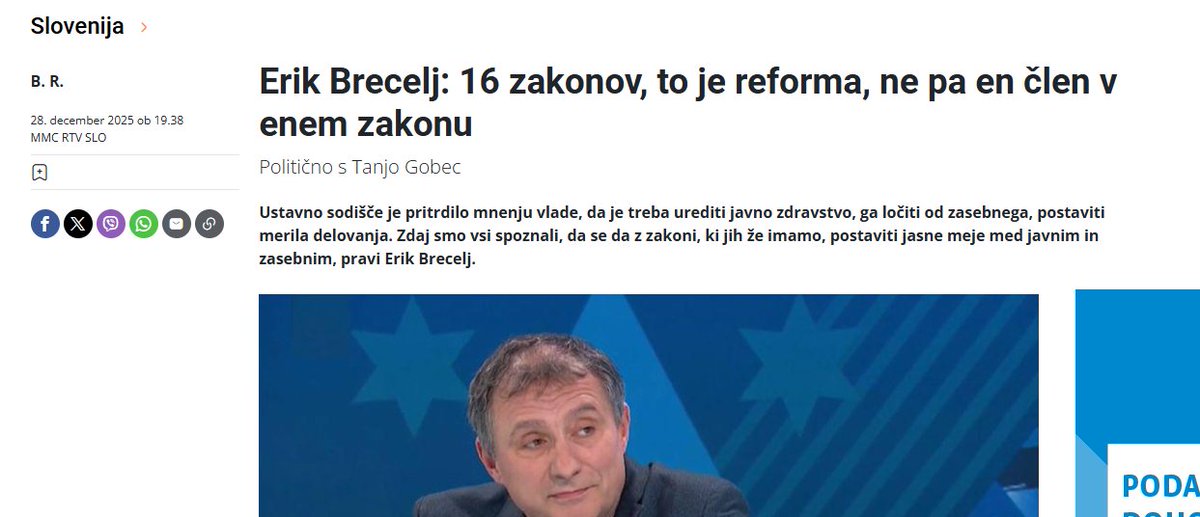
Povedal je nekaj zelo pomenljivega: "Se pravi, 16 zakonov, ki jih je ministrica pripravila, speljala do konca, žal ZZVZZ (zakon o ZZZS op. a.) so zablokirali zaradi finančnih interesov."
Ne pomaga 1600 zakonov, če ne urediš ključnega in nujnega - financiranje javnega zdravstva in upravljanje s 7 milijardami evrov v blagajni ZZZS. Ustrezna spremembe tega zakona je NUJNI, a seveda ne ZADOSTNI predpogoj za kakršnokoli reformo v zdravstvu.
Vse ostalo, kar se vam zdi problematično v zdravstvu, so samo posledice tega in ne vzroki težav. Želja po upravljanju tega denarja vpliva na politično upravljanje javnih zavodov, biznisiranju z javnimi razpisi, vpitje "ulice"...
Slovenščina

@ChainLinkGod @OneOpenSea Missed this debate but the critique is justified. As long as tokenholders don't have any control over the token, LINK is a company-backed, security-like token (except tokenholders have no rights like in tradfi), and not an ownership token.
See this:
blog.variant.fund/tokens-versus-…
English

It’s all supply and demand at the end of the day, for any token, the Reserve creates a supply sink through on-market buybacks, similar to what many other projects are doing now with their revenue and tokens
But Chainlink takes it a step further as it is the first project to use offchain revenue from enterprise deals to buyback a network’s native token
No it’s not 1:1 like equity buybacks because tokens aren’t stock, that’s just a regularity reality of all tokens today, I was making an analogy in terms of economic impact
The Reserve specifically supports the network’s long term sustainability, given there is no inflationary block reward mechanism like most networks (i.e., token is capped supply), which supports launch of new revenue- generating oracle networks
And token release != token sale, your comment lacks any and all nuance on this topic and is now just fear mongering
Fishy Catfish@CatfishFishy
Thread👇 Since I've seen the topic of LINK token releases come up often, I wanted to a short thread to clear up some misconceptions around them. 1) Token unlocks are *NOT* the same thing as token sales. 70M LINK is released to the team per year regardless if they’re actually sold or not. In fact, if you look at the supply of LINK on exchanges (cryptoquant.com/asset/link/cha…), it's closing in on a 3 year low, despite the total number of token unlocks we've had being at an all time high (because that's a cumulative number) It's actually at the lowest level as far back as this tracking tool even goes, but I don't want to overstate it if we can't see it. 2) Unlike other projects, LINK token releases don’t just fund the team, but also fund staking rewards and node oracle rewards, and other forms of network incentives. Because Chainlink is not a blockchain, it doesn't have programmatic block rewards by which to distribute inflation. Furthermore, because Chainlink is comprised of hundreds of oracle networks, it cannot have a "one size fits all" block reward because different networks have wildly varying costs due to chain gas cost and node count. Therefore, the manual token unlocks allow Chainlink Labs to use a scalpel to distribute rewards in a fine-tuned way to not overpay for node operations. 3) There is **NO** negative correlation between price and token release. Price has actually gone up after token releases historically + the period of time when LINK perfomed the worst, there was zero token releases happening. You will see my Lookonchain tweet in my thread with evidence: "Before this, Chainlink had unlocked 10 times in total, and 9 of them saw price increases 30 days after unlocking." 4) LINK is capped at 1B max supply, so token releases are finite and have an end date (with lowering inflation each year), whereas reserve buybacks will only grow in size tied to network adoption and will continue far beyond when token releases end.
English
Yet another example of the token vs equity conflict of interest problem plaguing crypto
Dev team behind a protocol get successfully acquired, tokenholders who funded that team get nothing
"continue to operate independently under community governance" = dev team rugging you for greener pastures
This is the #1 issue our industry needs to solve if we want to attract serious capital

Circle@circle
We have entered into an agreement to bring the @interop_labs team – initial developers of @axelar, a leading interoperability stack – into Circle to accelerate the next chapter of multichain infrastructure with @Arc and CCTP, and we are excited to welcome new team members to the Circle family as soon as the deal closes. The Axelar Network, Foundation and AXL token are not part of this acquisition and will continue to operate independently under community governance, with @CommonPrefix leading network development. More here: circle.com/blog/circle-si…
English
@kantianum @MetaDAOProject Yeah, absolutely. It's just funny how no one has thought that this might be a serious problem even a month ago, and now everyone is talking about it. Kinda scary to think what else may be in the aquisition pipeline but public isn't aware of..
English

because industry is maturing. Now that many apps are hitting PMF and legal is becoming more favorable, you can be sure that many acquisitions are in the pipeline.
Also previous cycles were quite complacent to all long tail assets.
Things have changed and holders need to be more cautious and more exigeant. 5 years ago, no one cares about revenues, FDV, unlocks etc.
Now things are different.
English
There is an ownership crisis.
In just a few weeks, we saw lots of free marketing for @MetaDAOProject and the ownership narrative.
➝ Padre Terminal got acquired by Pump Fun: PADRE holders got nothing and the chart nuked.
➝ Vector Fun got acquired by Coinbase: Tensor holders got nothing out of the operation. Chart nuked.
➝ Axelar team (Interop Labs) got acquired by Circle: AXL token holders didn't get any benefit out of it and the token got obliterated.
➝ AAVE is having an existential crisis after Aave Labs made it clear that it has zero intention of giving more ownership to Aave DAO (hence AAVE holders).
We're holding tokens that represent zero sense of ownership.
The current system gives tokenholders zero protection.
And more acquisitions should be expected. Increasing revenues, more adoption and capital, better legal clarity...many such cases will occur again in the future.
Imagine holding a token of a good business and still getting fully rekt because of an acquisition.
MetaDAO addresses this concern.
Projects that raise on the MetaDAO launchpad see their business operations tied to onchain governance through a legal entity: IP, treasury, and strategic decisions can all be fully controlled by the DAO and onchain governance.
Not saying MetaDAO is perfect.
There will probably be more iterations and issues to address as time goes on, but it's one of the few projects in the space that tries to innovate on this front.
Study MetaDAO.

English

ethereum will outperform in 2026.
it completely dominates the big 3 metas for the next year: tokenization, stablecoin, and defi.
smart money has full conviction in ETH. block out the noise.
English

Maple products continue to grow within the yield-bearing dollar sector, even while already ranking among the largest by TVL.
The syrup is sticking.
stablewatch@stablewatchHQ
Stablewatch Weekly Trending Yield Bearing Tokens by TVL: 1. @Neutrl – sNUSD 2. @reservoir_xyz – srUSD 3. @maplefinance – syrupUSDT 4. @ResolvLabs – stUSR 5. @SkyEcosystem – sUSDS
English
@hosseeb You're saying eth's moat is it's future growth. Does future growth entail rev growth as a necessary condition for eth's value?
English

The problem with this analysis is that "revenue" is a tricky word when you are applying it to a L1.
"Revenue" is price x quantity sold. It ignores expenses. On the other hand, profit subtracts expenses to get your actual net income.
So if you look at transaction fees on Ethereum, the naive view is that this is the revenue. In this view, the revenue is embarrassingly low, especially compared to something like Amazon. This is Santi's view.
Another way to understand the transaction fees is that these are not the revenue, but the profit of Ethereum, because Ethereum has no expenses. Amazon grew their revenue dramatically, but not their profit. Amazon continually kept their profit low to reinvest in growth. In 2013, Amazon had a P/E ratio of over 600x—this was because they didn't care about capturing profits yet.
Transaction fees that users would be willing to pay but are not charged are counterfactual profit that Ethereum has elected not to charge. By not charging these fees (by, for example, limiting block space, or even just raising the minimum gas fee a la EIP-7918), Ethereum has chosen to forgo profit in favor of future growth.
This is a weird way to explain it, which is why I think it's better to analogize Ethereum as a city. If you consider Ethereum is a city has a low tax rate on commerce, it becomes immediately unmysterious what it's doing.
Ethereum could raise those taxes if it so chose. Tron has decided to raise its taxes, jacking up fees on the L1 (perhaps detecting that the days of its Tether monopoly are numbered, being threatened by Plasma, Tempo, Arc, etc.), and so monetizing whatever you can now is the rational response. But this aggressive monetization will accelerate the end of the Tron Tether monopoly. One recalls Bezos's maxim: your margin is my opportunity.
It also explains why Tron is trading at a lower P/E multiple than Ethereum. The market agrees on weaker prospects of future growth. It's the same reason why Western Union trades at a low P/E multiple in the face of challenges by stablecoin remittance companies.
If Ethereum were to raise taxes today, it'd do so at the expense of future growth. And Ethereans—and the market—believe that future growth is coming.
Santiago R Santos@santiagoroel
Amazon is a network and arguably one of the most successful networks ever built. Which is why comparisons are uncomfortable: when you line Ethereum up next to real, scaled networks like Amazon or Facebook, the valuation gap becomes impossible to ignore. Ethereum at a ~$380B valuation generates roughly ~$1B in annual revenue → 380x sales. When Amazon carried a similar valuation, it produced $136B in revenue and $2.4B in net income → 2.6x sales. That means ETH holders today are paying ~146x more per dollar of revenue than Amazon investors did. The claim that “Amazon is a company, Ethereum is a network” doesn’t resolve the discrepancy: Networks are priced on the economics they produce: revenue and cash flows. Amazon’s network effects were real, scaled, and monetizable. And the market valued them on fundamentals, not hypotheticals. TVL and “assets secured” are not revenue. Settlement volume is not revenue. TAM is not revenue. At some point, you have to put up numbers on the dashboard to support the big narrative talk
English
@rravnikarNOV25 @MladiZdravniki Katerih predsodkov? Seveda sem vedel, večina ljudi pač ne bere zakona. In še enkrat, da bo jasno, zakona v tej obliki ne podpiram. Vztrajam pa pri svojem, da je bilo to namerno zavajanje s strani stroke.
Slovenščina
Ja, seveda, ker vam ne potrjuje vaših predsodkov. Ste vedeli, da je velika večina podpornikov verjela, da je zakon za bolnike v zadnjih tednih bolezni, čeprav terminalnih bolnikov zakon sploh ni omenjal? Kot eno od "romantičnih predstav". Ne da se vam več, čeprav so bila stališča, ki smo jih zdravniki predstavljali v javnosti ena redkih, če ne celo edina podkrepljena z dejanskimi citiranimi viri. Tudi tistih 450 tablet. Ampak ja, "laži, zavajanja in manipulacije. lp
Slovenščina