Brad Cooper

2K posts

Brad Cooper banner
Brad Cooper

Brad Cooper

@mvhacking

Ex-Apple | Ex-MGM Studios | 30k+ followers | AI, tech, medical, media, and non-profit executive. Marketing executive, inventor, builder, STEM, storyteller.
Irvine, CA Entrou em Ocak 2019
4.3K Seguindo1.6K Seguidores
Brad Cooper
Brad Cooper@mvhacking·
@OwenGregorian When I saw it as a kid, I thought, "This is going to happen, so might as well be part of trying to make sure the right people are working on AI to point it in the right direction to save lives."
English
0
0
0
46
Owen Gregorian
Owen Gregorian@OwenGregorian·
When I saw this as a kid, I thought to myself: “They would never be so dumb that they’d put AI in charge of weapons that could kill lots of people.”
English
81
65
630
16.5K
Brad Cooper
Brad Cooper@mvhacking·
@jason_haugh What do your AI agents do for you? What specific hands-on tasks in building and implementing things? Not just strategy and debating each other?
English
1
0
0
25
Jason Haugh
Jason Haugh@jason_haugh·
I run 8 AI agents every day and I still think adoption is the hardest problem in this space. OpenAI apparently agrees, they’re doubling their workforce and one of the roles they’re specifically hiring for is helping businesses actually implement their tools. A $840B company that still needs dedicated people to get customers to use the product says a lot about where we really are.
English
89
34
353
131.4K
Mark Cuban
Mark Cuban@mcuban·
If my “repaving” you mean “reinventing “, yes. One of the challenges is that most corporate knowledge is still in someone’s head. Knowledge is far different than information. LLMs and agents can capture all the information it can touch, internally and externally to the company But there are things that you, me and everyone, security guards, salespeople, whoever, do to make the things we do fit the way we want them to. None of that shit is documented anywhere. You can give LLMs or Agents to employees to improve how they do their jobs. But that isn’t all that much impact for bigger companies. If you want to truly gain from AI, You can’t do it the way it was done, and just add AI. That’s why so many companies have struggled to get a return. Which I think is your point ? You have to reinvent your business to maximize the benefit from the tech. That is hard. There aren’t many CEOs capable of reinventing their company around tech they don’t understand. Nor are there many shareholders in public companies willing to allow them to take that chance. Let me rephrase that. There are ZERO public companies who will at this point, allow the ceo to wing it and reinvent the company around Ai. None. It’s one reason @costplusdrugs has been able to reinvent our manufacturing. We optimize to the technology and train and retrain our employees to fit it. Our public competitors can’t begin to consider what we do. You live this. Curious what you think about the above ?
English
5
1
29
6K
Shanaka Anslem Perera ⚡
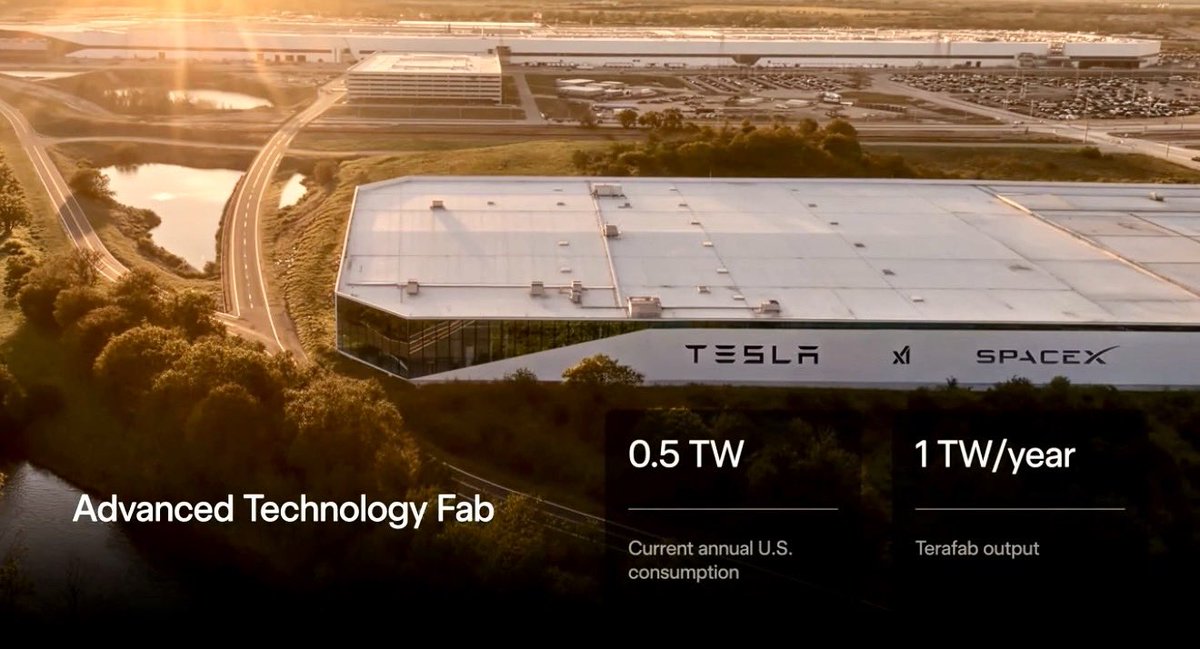
Everyone is covering Terafab as a chip factory. It is not a chip factory. Last night in Austin, Elon unveiled a facility that makes masks, fabricates chips, and tests them inside a single building with a nine-month recursive improvement cadence. No such loop exists anywhere else on Earth. Then he told you 80% of the output goes to space. Then he showed you a 100-kilowatt AI satellite with solar panels and radiators, scaling to megawatt range. Then he said Optimus plus photovoltaics will be the first von Neumann probe, a machine capable of replicating itself from raw materials found in space. Nobody connected the sequence. Terafab produces 1 terawatt per year of compute. The entire United States consumes 0.5 terawatts of electricity. Musk is building a single factory whose output in AI silicon exceeds twice the power consumption of the country it sits in. And he is sending 80% of it off-planet because Earth literally cannot power what he is building. Follow the mechanism. Terafab seeds the chips. Starship launches Optimus robots and solar arrays at 100 million tons per year. The robots mine lunar and asteroid regolith for silicon, iron, and nickel. They 3D-print more robots. They fabricate more solar panels. They assemble more AI satellites. Each satellite runs hotter-burning D3 chips designed specifically for vacuum, where free radiative cooling eliminates the thermal constraints that strangle every terrestrial data center on the planet. The nodes replicate. The replication is exponential. This is a Dyson Swarm bootstrap hidden inside a semiconductor announcement. The math is public. The Sun outputs 3.828 times 10 to the 26th watts. A 2022 paper in Physica Scripta calculated that 5.5 billion satellites at 290 kilograms each, robotically manufactured from Mars resources, capture enough solar energy to meet all of Earth’s power needs within 50 years. A 2025 paper in Solar Energy Materials calculated a partial swarm capturing 4% of solar output yields 15.6 yottawatts, roughly a billion times current human civilization’s total energy budget. Musk just announced the factory that builds the chips that go inside the satellites that replicate themselves forever. 92% of advanced logic chips are fabricated in Taiwan. One factory in Austin does not fix that. But one self-replicating system seeded by that factory, launched by the only company with reusable heavy-lift rockets, assembled by the only humanoid robot in mass production, and powered by the only star within reach, does not fix a supply chain. It obsoletes the concept of supply chains entirely. The market priced this as a $20 billion capex story about semiconductor independence. The actual announcement was the engineering blueprint for Kardashev Type II. Humanity sits at 0.73 on the Kardashev scale. 18 terawatts. The distance between here and harnessing a star is not a technology gap. It is a recursion gap. And recursion is exactly what a single building in Austin that makes its own masks, builds its own chips, tests its own chips, and launches the output into orbit on its own rockets was designed to close. Every civilization that makes it past this point never looks back.
Shanaka Anslem Perera ⚡ tweet media
SpaceX@SpaceX

TERAFAB: the next step to becoming a galactic civilization Together with @Tesla & @xAI, we're building the largest chip manufacturing facility ever (1TW/year) – combining logic, memory & advanced packaging under one roof

English
486
1.8K
9.1K
983.8K
Terrible Maps
Terrible Maps@TerribleMaps·
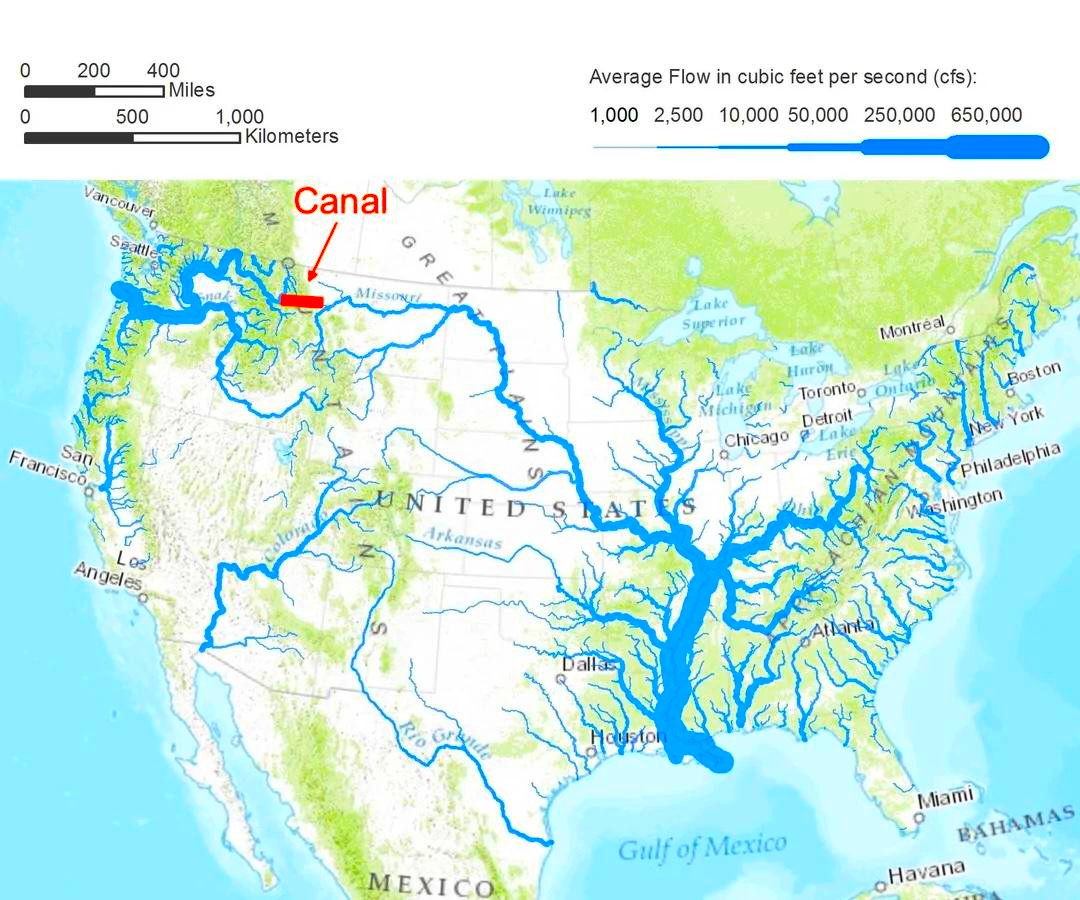
Why has the US not built a canal here to rival the Panama Canal?
Terrible Maps tweet media
English
890
179
11.4K
3M
Brad Cooper
Brad Cooper@mvhacking·
@andrewjohnhuff I don't remember anything objectionable, a few "jump scare" type moments (that adults will see coming a mile away) and people who have died--they all die offscreen, I believe. I've seen way more objectionable stuff in recent animated movies, frankly.
English
0
0
1
16
Andrew Huff
Andrew Huff@andrewjohnhuff·
All right, I'm pretty convinced I'm taking the entire family to see Project Hail Mary. First time in a long time I feel like my younger kids can actually come to a non-animated movie.
English
1
0
1
76
Brad Cooper
Brad Cooper@mvhacking·
@davidasinclair @MaxUnfried Well, certain aspects of quantum physics, including virtual particles, are the least predictable because they come from places we cannot even see them and may never be able to.
English
0
0
0
274
David Sinclair
David Sinclair@davidasinclair·
@MaxUnfried I think its because they’re not biologists and don’t understand that multicellular biology with trillions of cells is the least predictable of all sciences by many orders of magnitude
English
20
4
170
12.1K
Brad Cooper
Brad Cooper@mvhacking·
Finally got to see Project Hail Mary with my son. 10/10. Maybe in my Top 10 movies of all time.
Brad Cooper tweet media
English
1
0
3
87
Brad Cooper
Brad Cooper@mvhacking·
The world is horizontal. Cinematic movies are horizontal. We have two eyes, side by side, not top and bottom. You can turn your phone easily. Can someone explain to me why we need vertical content, shows, and movies? Other than because it seems trendy and cool?
English
2
0
3
63
Andrew Huff
Andrew Huff@andrewjohnhuff·
@mvhacking Oh shoot I was going to say because it seems trendy and cool
English
2
0
2
21
Brad Cooper
Brad Cooper@mvhacking·
@DavidSacks Released on a Friday? uh oh, every PR person knows that is the day to release stories you want buried.
English
1
0
2
113
David Sacks
David Sacks@DavidSacks·
In December, President Trump signed an Executive Order tasking us with the development of a national framework for AI, what he called “One Rulebook.” This was in response to a growing patchwork of 50 different state regulatory regimes that threaten to stifle innovation and jeopardize America’s lead in the AI race. Today we are releasing that framework. It will help parents safeguard their children from online harm, shield communities from higher electric bills, protect our First Amendment rights from AI censorship, and ensure that all Americans benefit from this transformative technology. We look forward to working with our colleagues in Congress to turn the principles we are announcing today into legislation. whitehouse.gov/articles/2026/…
English
266
531
3.7K
703.8K
Brad Cooper
Brad Cooper@mvhacking·
@Andercot Outside of maybe Einstein and Newton, few have had mass market awareness. Yet many famous actors, sports figures, and politicians. We mostly value the wrong things.
English
0
0
0
85
Allie K. Miller
Allie K. Miller@alliekmiller·
Yesterday, I met with Anthropic and OpenAI and Google. (Separately, of course.) And while the conversations were largely confidential, I do want to share some aggregated reflections on the day as well as general SF takeaways. ⬇️ 1) Competitive advantage as a solo practitioner really does come from taking action and finding an area with a bit of friction and doubling down. Ex: memory management right now isn’t perfect, but allocating an hour to improving that system gives you a ton of leverage over others 2) SF continues to be the number one place for AI work. I know that’s not surprising. I would put New York at a healthy second place. SF tends to be more about crazy agent experiments for the thrill of capability and discovery and NYC tends to be more about kinda crazy agent experiments to find new ways to make money. Not saying either is better. But I met several people renting two apartments to straddle these worlds. You want the frontier of SF and enterprise insights of NYC. It’s one reason I travel between them so much. 3) All AI labs want to hear more from people. All of them. What are you using it for, what do you like, what do you hate, what do you need. Users have a TON of power on the direction of these tools. Keep testing and tweeting at them!! 4) There is very clearly a third customer cohort that is bubbling and underserved. It’s not developers…it’s not the business professional basic users…it’s builders. Everyone can build now. It’s marketing and sales folks vibe coding. It’s legal folks building complex skills. It’s a finance expert building a side project. This is a really undertapped customer base. They feel the Cursors of the world are too complex and doc summarization tools of the world are too basic. 5) Not sure if it was just sample size, but far fewer people were wearing tech gear compared to when I lived in SF. Everyone was still dressed casually, but I used to see Splunk and Optimizely and Slack and VC gear everywhere. People seem more in stealth swag now. 6) We may soon have our world model moment. 7) Speed of iteration and shipping is faster than I’ve ever seen. We see the nonstop drops from Anthropic. We see that because of scale, providers can get a much faster feedback loop of products or features that aren’t hitting. A lot of 2025 was experimentation, but ever since the OpenClaw moment over the holidays, the releases from all three labs have been more concentrated on…things that sorta look and feel like OpenClaw. 8) Small teams can pull off more than ever before. Small teams are the powerhouses of innovation right now. This means that finding new ways to share knowledge, break silos, and remove duplicate work is going to be even more important. AI agents functioning as actually teammates that support an entire system is key. 9) Build more Skills. Build better Skills. 10) Misinformation on AI tools and leaks spread FAST. I’ve seen so many fake stories on these AI labs. Your company needs to actually TEST these tools on your actual use cases to know which models and tools are best and you need to not make large-scale snap decisions based on a rumor of a rumor of a rumor. We will see more volatility. Plan for it. 11) You can feel the seriousness of this moment. Even during random conversations I had in line at a cafe. Lots of folks worried about job loss and lack of meaning. 12) Mac minis were sold out ;)
English
87
64
579
105.5K
jen bucci
jen bucci@jendarhy·
Make it black and white. And put type on it.
English
69
84
2K
122.2K
Brad Cooper
Brad Cooper@mvhacking·
@Keller 100%. What is the max wind speed you've had successful docks with?
English
0
0
5
1.2K
Brad Cooper retweetou
Keller Cliffton
Keller Cliffton@Keller·
The Bitter Lesson of Robotics: It's extremely easy to make a video of a robot doing something once under perfect conditions then post it to X. But it often takes a decade to harden systems and design for all the insane edge cases of the real world. Many companies raising $$$$ on cool demos, but all the hard work comes after
English
93
194
1.9K
184.2K
harpriya
harpriya@harpriiya·
I can finally talk about this!! Hotbox is backed by @a16z @speedrun :) I spent the last 14 months in Korea and now I’m back in SF, where it all began. My entire career exists because of social media. From early NeurIPS papers, to working on ranking algorithms, and then building viral playbooks for startups. The thing I kept coming back to is: every company has no choice but to become a media company. To distribute. To get attention. That is the next generation of entrepreneur’s biggest challenge. That’s the next single person unicorn’s moat. Hotbox is built for that next gen entrepreneur. Businesses run entirely on social now. Hotbox is the sales infra for the social economy. more to come. sign up on our waitlist & lmk if you’ll be at the a16z speedrun demo day 🤫
English
88
17
531
44.1K
Brad Cooper
Brad Cooper@mvhacking·
@shuooo Inspiring story, thank you for sharing it.
English
0
0
1
9
Shuooo Wang
Shuooo Wang@shuooo·
I don't share my personal story often, but we really get into it on this podcast. My story is one of being a forever outsider - 1. I moved to the US at 16 - not an easy age to try and learn English. But, my accent is daily reminder of how far I've come, and why setbacks shouldn't outweigh the benefits of a global team. 2. Got into MIT, but spent my entire 1st semester hospitalized after a bus accident. It's also what inspired me to get into robotics, building exoskeletons for the US military. 3. And eventually, the robotics experience led me to founding my first company. After school, I built & sold hardware company against all conventional odds. 4. Got into YC, just to pivot 3 times, get rejected by every VC fund in seed round, and have to raise from angels. Today? Deel is valued at $17.3b. 5. @Bouazizalex and I didn’t know anyone in Silicon Valley when we first arrived, but we turned our outsider status into an advantage. We just thought different than peers. We weren't insular and always believed global talent was worth exploration. That's how we tackled a decades-old system with a global-first mindset. 6. When the world changed, we changed the world. When the pandemic meant widespread chaos and business uncertainty, we jumped in to help companies hire global talent, unlock economic mobility, and navigate complex regulatory systems to take advantage of the changing work landscape. 7. Deel pioneered seamless global payroll, operating in 165+ countries, used by 37,000 businesses, and paying 1.5 million people every month.And that's just to date. We're always pushing ourselves to think outside of the box, because of who we are. Let's see where being different takes us now.
Ti Morse@ti_morse

My first interview with Shuo Wang (@shuooo), Co-Founder & CRO of @Deel. 1:08 Designing Deel To Scale Quickly 3:28 Why Companies Should Go Global Early 7:30 Building Deel’s Sales Team 10:33 Why Shuo Loves Sales 14:44 Pivoting 3 Times During YC & Being Shameless 19:06 Dreaming About Intercom 22:04 Solving Payment Delays Early On 25:11 Joining YC As A Crypto Payment Platform For Content Creators 32:37 How To Make Decisions Before You Have Data 36:30 Why It Was So Painful To Open Corporate Entities During Covid 39:57 Thinking Outside The Box 44:15 Why Covid Was “A Lifetime Opportunity” For Deel 46:11 Deel Speed 47:55 Argentina & Brazil 50:07 Interviewing Deel’s First 400 Employees 51:33 Screening For Happiness 52:59 Creating Ghost Busters (Special Projects Team) 59:16 Having A Co-Founder You Can Rely On 1:03:31 Why Offsites Are Important 1:06:07 Torturing Yourself Into Greatness 1:07:20 Learning How To Run A Business From Her Mom 1:11:26 Growing Up In China With Her Grandparents 1:15:51 Moving To The United States At 16 1:24:13 Building An Air Purifier Company In China 1:30:18 Being An Outsider In Silicon Valley 1:31:08 Focusing On One Product vs. Building Multiple Products 1:32:46 What PMF Was Like At Deel 1:34:46 How Shuo Thinks About Risk 1:37:18 Understand The Problem, Not The Solution 1:42:08 Creating An 11-Star Customer Experience 1:43:44 What Makes Alex Special 1:46:00 Poker 1:46:43 Always Look At The Positives Even In Tough Situations

English
29
18
215
61.1K
🐧 Daniel Garcia
🐧 Daniel Garcia@dannybuntu·
Mondo Robotics should seriously sell these - like now!
English
16
53
404
30.2K