

Puneet Singh
601 posts

Puneet Singh
@xhawkCEO
CEO at XHawk. Building solutions to amplify human creation, curiosity, and insight.
California, USA Entrou em Haziran 2019
2K Seguindo1.4K Seguidores

Everyone is measuring the wrong thing. The biggest impact of AI isn’t that experts become more productive. That's a small outcome in the grand scheme of things.
It’s that millions of ordinary workers gain capabilities that previously required years of specialized learning and education. AI is not just a productivity tool. It’s an amplifier of human capability!
AI isn’t just helping people do their jobs better. It’s helping people do jobs they couldn’t do before.

English
Puneet Singh retweetou


Introducing 30 days of AI.
For the next 30 weekdays, I’m going to share one observation per day from the frontlines of AI.
I have the privilege of co-running an enterprise AI transformation firm, where I experience the edges of this technology, see the biggest challenges the biggest companies are facing, and have deep relationships with companies on the frontier (Anthropic, OpenAI, Lovable, Cursor, Perplexity, Vercel).
I get to live in the future for free, and I want to bring that future to those trying to disrupt themselves before they get disrupted.
There’s just two rules:
1) Each observation is actionable & understandable to the non-technical leader.
2) I can’t miss a day.
Post 1 coming soon.
English
Memory is not a second brain. That’s like calling a database company a CRM because it can store data and run logic on top of it.
To be considered a true second-brain platform, a company should own the full stack: ingestion, curation, and query/retrieval. Storing information alone doesn’t make it a brain. IMHO.
English

It’s hard to categorize or evaluate second-brain systems because there’s no single right answer.
But I found one useful lens every second brain should be evaluated through: the lifecycle of your data.
Collect -> Organize -> Evolve -> Use -> Govern
So I made a curated comparison of the existing second brain, AI memory, and knowledge systems, from @claudeai’s memory to @garrytan’s GBrain.
It focuses on the full lifecycle:
- how scattered context gets collected
- how it turns into durable knowledge
- how it stays fresh over time
- how people and AI tools use it in real work
- how users can inspect, correct, delete, export, and trust it
If you want AI to understand your personal context, team knowledge, and working history, this might help.
PRs welcome, especially from heavy users who’ve actually tried building and maintaining a real second brain.
github.com/aristoapp/awes…

English
Puneet Singh retweetou
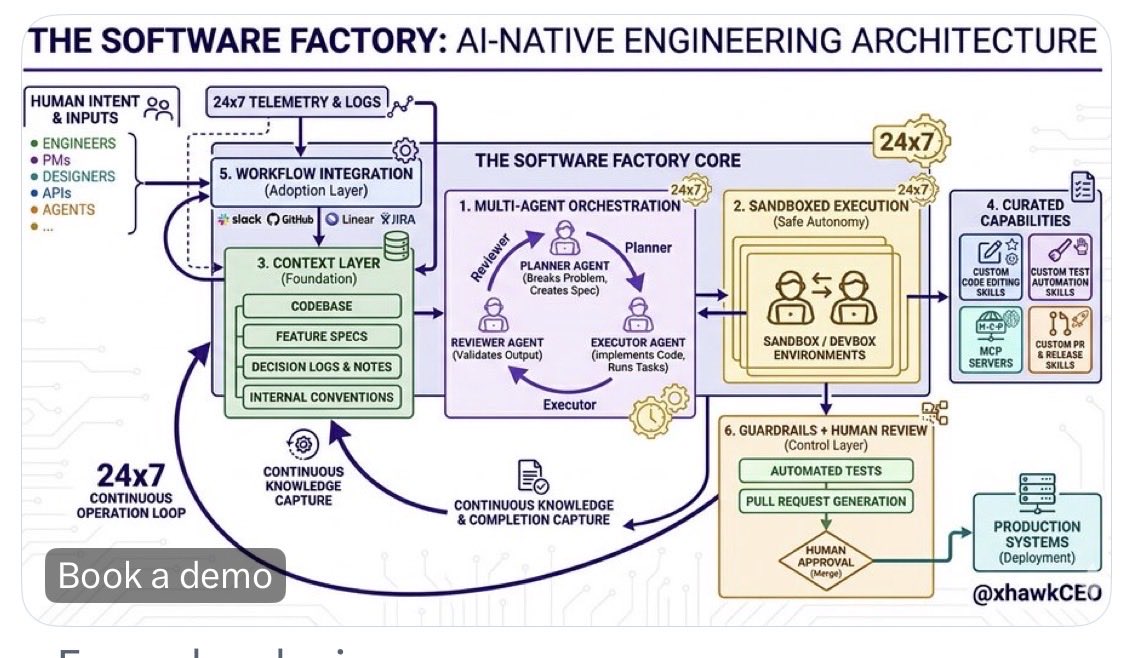
What if every company also had a knowledge filesystem: a software factory that captures how work gets done?
English
@jatingargiitk @ericosiu It’s a naive idea to build on your own. It’s like saying we will build our own database because we need to store data in tables.
English

@ericosiu shipped a company brain across the org this month. the capture and retrieval boxes were the easy half. the source truth box is where it becomes a permanent maintenance job, not a one-time architecture. nobody talks about who owns that.
English

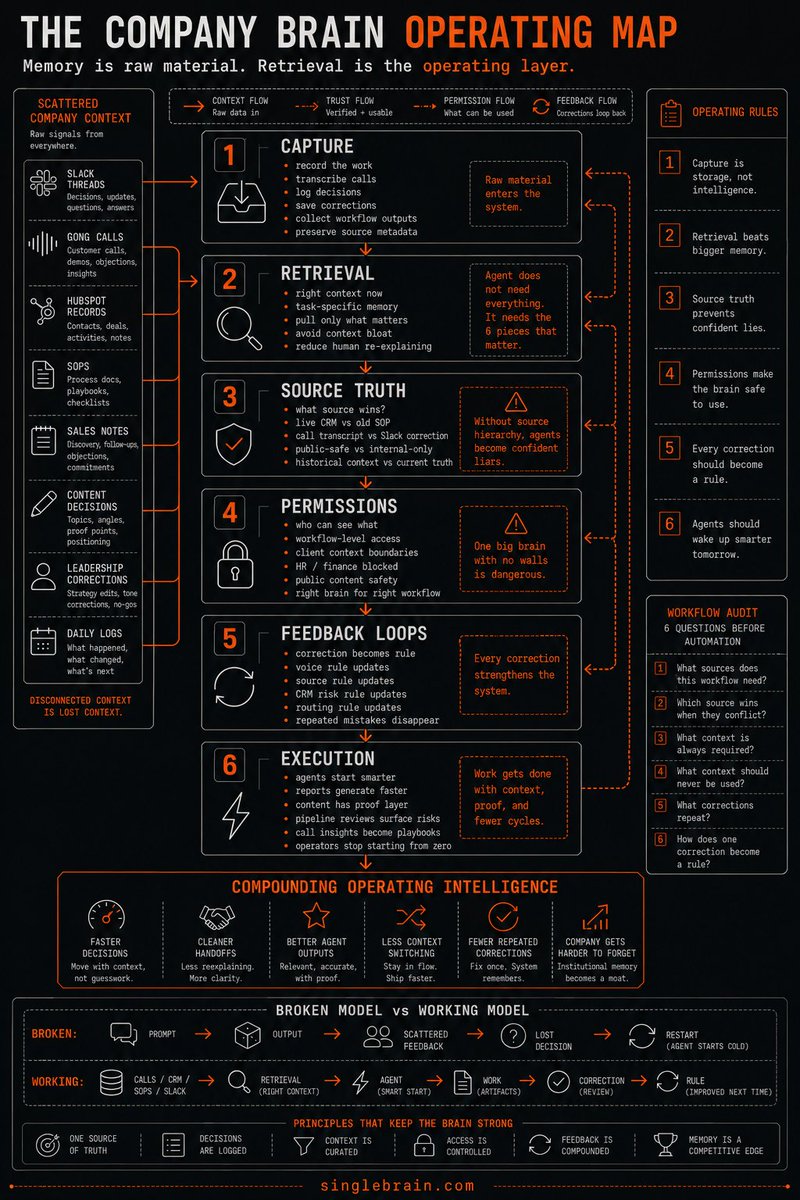
Every company is missing the same layer:
A company brain.
Right now, the memory of the business is scattered across calls, docs, Slack threads, dashboards, SOPs, and people's heads.
That's the part people miss when they talk about a company brain.
The value isn't a giant folder of company knowledge. Every company already has that.
The real advantage is the intelligence layer that sits between all that context and the work your team needs done.
This is the layer every AI-native company will need:
ericosiu@ericosiu
English
@kieranklaassen Most teams lack discipline. That’s why process becomes increasingly valuable as an organization scales.
English

I see all these Kanban boards, linear, trackers on X, but what I'm trying to do is skip that step entirely. If there is something that you want to file in a tracker, just go fix it immediately. Isn't that way better? No backlog, just fixes.
English
Puneet Singh retweetou

New podcast, new format. Three founders join us.
Waste Tokens, Save Time
00:00 Three Frontier Founders
01:27 AI Software Factories
04:15 Waste Tokens, Save Time
05:47 Models Instructing Humans
09:30 Is Pure Software Dead?
12:04 You Don't Get Stuck Anymore
With @rauchg, @maxhodak_, and @bscholl.
English
@nbaschez All “company brain” products become “Enterprise Search”. Sad Reality. The situation has not changed in the last decade.
English

Thing that should exist but (i think?) doesn't:
- Shared company brain that you connect to any agent
- Nice UI for viewing pages
- Permissions / suggest changes mode
- Versioning
- Works with company SSO / RBAC
- Also bundles connectors to tools
Is this a thing?
English


I've been complaining about AI-bros and their "20 agents working overnight" for a couple of weeks now.
That's getting old. So I thought I'd do the more productive thing and propose what I think is the Right Way™ to develop software with AI.
And I did that by stealing from the iconic agile manifesto.
ronanberder.com/ai-manifesto/
English
Puneet Singh retweetou

Puneet Singh retweetou

1/5
I'm a cardiologist. I have spent twenty years watching cholesterol destroy arteries, trigger heart attacks, and kill people I care about.
Today, Eli Lilly presented data that may begin to end that era.
VERVE-102. A single infusion. One dose. It uses base editing to permanently turn off the PCSK9 gene in your liver.
Presented today at the European Atherosclerosis Society Congress:
88% reduction in PCSK9.
62% reduction in LDL cholesterol.
Sustained up to 18 months.
No treatment-related serious adverse events.
One infusion. Not daily pills you forget to take. Not monthly injections. One dose — and your cholesterol may stay low for the rest of your life.
English
Puneet Singh retweetou

My biggest takeaways from @danshipper:
1. The future of work will happen inside Codex or Claude Code. Instead of putting AI into your SaaS tool, you’ll use your SaaS tools inside your favorite AI agents' in-app browser. Dan spends all his time in Codex now—writing documents, managing email, doing research, everything. He's using Google Docs, PostHog, and everything he needs within the agent's in-app browser. The agent can see what he’s doing, and has all of his context, so he and his agent collaborate quickly and super effectively.
2. Automation is a lie—every automation needs a human. Dan's company doubled in size this year despite being incredibly AI-forward. Why? Because in order to make automation work well, you need humans making sure everything keeps working. This is why benchmarks are misleading—they measure AI on problems we’ve already framed and can score, but there’s always a higher frame.
3. PMs will win the AI era. Marcus, a former PM who previously ran Axios’s writing product, joined Every after getting super AI-pilled. Now he runs their product Spiral, and ships faster than anyone on the team. He pairs technical knowledge with spiky product sense, deep user empathy, and an eye for what matters. Dan thinks any PM who gets really AI-native will be incredibly dangerous because the building is done for you—what matters is figuring out what to build and if it’s great.
4. Full-stack designers are becoming superheroes. Designers used to make beautiful interactions that engineers didn’t want to build or couldn’t execute properly. Now designers don’t need to hand things off; they can build it themselves. Designers are naturally creative people, and AI is the perfect tool for them because it lets them bring their vision to life without the traditional bottlenecks.
5. SaaS is not dead. In fact, Dan is bullish on SaaS stocks. When users bring their own AI (via Codex or Claude Code) to use SaaS products, the user—not the SaaS company—pays for tokens. This saves SaaS company’s margins. Since the agents need their own seats, Dan predicts that agents will create massive new demand for SaaS because there will be tons of agents using these products at high volume.
6. Every company will have one “super-agent” inside their Slack that every employee will use. Dan initially thought every employee would have their personal work agent, like a shadow AI org chart, but he’s completely flipped his view. He realized agents need humans who care about them. When someone gets tired of maintaining their personal agent, it becomes useless. The winning model is one forward-deployed engineer or AI-savvy person who maintains a company-wide agent (like Shopify’s River or Viktor), and then it trickles down to more specialized team agents as models improve and become less fiddly.
7. The AI job apocalypse is not happening, but you do need to evolve to stay relevant. Models make yesterday’s human competence cheap. But because everyone uses the same models, it all looks the same if you use it the default way; it becomes commoditized slop. Humans then take that frozen competence and use it to make something new and interesting for their specific situation. The key: “ride the models”—use them for everything you do, try new models when they drop, keep turning over rocks.
8. We will read way more AI-generated writing, and we will like it. Human writing is incredibly important for things that matter, but for internal docs, planning, and email, AI-generated is often better because most people are bad at writing strategy documents.
9. Build software for humans and agents to use together. The current model is building a CLI that an agent uses independently. Instead, you and your agent should be using the app together. This creates new design challenges—agents can make a billion requests in three seconds, so you need approval flows, inboxes that summarize what happened, logs, and easy rollback.
10. Forward-deployed engineers are the new most essential role. The big model companies have teams of people managing their internal agents, and those teams aren’t going away. It’s different from traditional software building, and certain engineers love it. As models get better, this role will evolve—you’ll be managing more agents doing more things.
Lenny Rachitsky@lennysan
Automation is a lie. CLIs are over. The SaaSpocalypse is dumb. A year ago @danshipper came on the podcast to predict where AI was heading. He was remarkably right—including the call that everyone was sleeping on Claude Code. Dan has a unique lens into where things are going because his team at @every is possibly the most AI-pilled group of people in tech. I always learn a ton talking to Dan. So I brought him back for round two. We'll score these in exactly a year: 🔸 Every company will have one “super-agent” in Slack. 🔸 Codex and Claude Code will become the new operating system for knowledge work. 🔸 The AI job apocalypse is not happening. 🔸 PMs and designers will thrive. 🔸 We will read way more AI-generated writing and we will like it. 🔸 "I would buy SaaS stocks right now." Listen now 👇 youtube.com/watch?v=4D3hDm…
English
@shashank_kr @Razorpay x.com/xhawkceo/statu…
Companies interested in building their own Slash versions, please reach out to us! This is the future of software companies.
Puneet Singh@xhawkCEO
Why are all big tech companies building software factories?
English

We recently built an AI assistant inside @Razorpay called Slash.
It reads our entire codebase, debugs production incidents, reviews specs, writes code, reviews every single PR, answer tech queries and also raises PRs for small features.
It's easily accessible through Slack. We can tag it in any Slack thread, describe the problem in English, and it gets to work.
Six weeks ago, Slash handled 122 tasks in its first week. Last week it handled 14000+. Queries, analysis, bug fixes, PR reviews, test runs and work that earlier lived across scattered tools and teams can now be done with Slash right within Slack. 1000+ people used it in a single week because it got their work done faster. The whole adoption has been completely organic.
The numbers from last week have been very encouraging - 14,854 tasks completed. 2,150 PRs raised, 1,152 merged, 45% of those PRs shipped with zero human rework.
A payout gets stuck mid-retry during a live incident, an engineer tags Slash and within seconds, it cross-references logs with code and pinpoints a state machine bug blocking the retry-to-failed state transition. Tells the team exactly which logs to check and how to resolve the incident.
With its K8s analyzer skill, Slash scanned a single namespace, right-sized all 11 workers using 48-hour P95 pod metrics, and raised the PR. One run saved $560/month.
A marketing banner bug was fixed with few prompt iterations with a PR raised, merged to prod and deployed in minutes. No front-end developer touched the code.
Security teams ran static security testing and remediation through Slash at org scale. Thousands of findings were purged and many more got validated autonomously.
But Slash isn't just an engineering tool.
Account managers now trace stuck customer payments and integration failures through Slash instead of pinging engineers on Slack. L2 product support tickets get triaged by Slash before they reach engineering.
250+ non-engineers ran thousands of sessions last week. PMs used it for research on our payments infra, customer interviews and product features sometimes raising PRs of their own. Analytics teams built SQL pipelines. 11% of all sessions came from people outside tech and product.
On our company bakkar (watercooler) Slack thread, someone asked Slash jokingly to assign tasks to everyone and it responded in the same tone. It seamlessly started participating in inside jokes and conversations.
The quality compounds with use. Engineers who shipped 11+ Slash PRs averaged a 63% merge rate without rework. First-timers averaged 37%. Across the org, human review comments per PR have dropped more than 40% with Slash starting to do in-depth review of every single change.
We're still early. Large cross-repo refactors, fully agentic sdlc and plan mode are next. But Slash has already changed how people at Razorpay build, debug, and ship every day.


English
Puneet Singh retweetou

Puneet Singh retweetou

The best apprenticeship model was always the shop floor.
Now the shop floor has an AI teammate.
@tobi doing tobi things 👌
tobi lutke@tobi
English