LEJ Capital

524 posts

LEJ Capital

LEJ Capital

@LEJCapital

Buyside TMT Investor. Tweets not investment advice.

Manhattan, NY Присоединился Kasım 2010
6.2K Подписки1.4K Подписчики
LEJ Capital
LEJ Capital@LEJCapital·
Ah, thought your article last year also recommended shorting it, but see it was just exploring the capabilities. Very well known bear case, where we're seeing random accounts highlight filing their taxes with LLM solutions (Reddit post, Perplexity Computer, etc.) Agree there is more competition here, which will largely be reflected in higher CAC/more competition, but tax filing was never the moat here, since have always had competition. Twitter vendetta against this name, that has gotten whacked, so just odd the continued targeting of this name, with no comments on numbers, etc. Just a "this MAY get replaced" thesis, that has worked quite well YTD
English
0
0
3
202
Jeffrey Emanuel
Jeffrey Emanuel@doodlestein·
@LEJCapital Continuing to recommend? I don’t think I’ve ever said a word about this stock before to anyone. You must be confusing me with someone else. And none of their business is particularly defensible. If you have a Mercury account you don’t need Quickbooks at all.
English
1
0
2
946
Jeffrey Emanuel
Jeffrey Emanuel@doodlestein·
Probably not too late to short this thing. It sells a product that is meaningfully worse than what you can do already with current frontier models and agent harnesses. A year ago, this was still a pretty clunky and manual workflow. I had to use TurboTax last year and paste screenshots into GPT 4.5. I came up with an approach that worked well and wrote an article about it last year, but it was a pain to apply and wasn't automated. Now, you can literally just use my skill in Claude Code or Codex and it all "just works" and can give you strategic advice and far more sophisticated feedback than you could get from TurboTax, or even H&R Block for that matter. It's hard to think of another software company that is more exposed to these disruptive forces. Don't be swayed by an optically low forward P/E. The earnings could just start melting away at an accelerating pace. Is that really worth over $100 billion?
Jeffrey Emanuel tweet media
Jeffrey Emanuel@doodlestein

Also, I should add that this isn't just for preparing your return, although it can do that extremely well. It's also a tax consultant in general that can tell you how to restructure your affairs to maximize tax savings, taking into account all the particulars of your situation. Like many of my recent "big" skills, it's so huge that you can really apply it over and over again in different ways and keep uncovering more ideas and strategies to explore. I'm planning to continue to expand and improve it and to keep it up to date with all changes in relevant tax laws. If you're a subscriber of my site and want me to add more stuff about any particular area or strategy, just let me know. It costs under $20 to e-file your Federal and state return using FreeTaxUSA, and that seems to be sophisticated enough to handle just about anything you'd reasonably want to do (unlike Aiwyn, which couldn't handle a situation where I lived part of the year in NYC and part in upstate NY). So for another $20 you can subscribe to my site for a month and use the skill to tap into a tremendous amount "operationalized expertise" that not only helps you to strategize, but which can literally file the tax returns for you. I don't see how that isn't unbelievably bearish for Intuit (maker of TurboTax), which charges $100+ for the stripped down version of their native software and even more for their web-based version, which you need to sit there like an idiot filling out manually. Interestingly, my approach in software development, where I use multiple different frontier models to check each other's work, also works incredibly well with tax preparation. Codex found tons of mistakes that Claude Code made, but Claude Code also had a lot of insights that Codex missed. Even Gemini had a couple good thoughts (although it was mostly wrong and overly cautious).

English
48
12
300
138.5K
Evergreen Capital
Evergreen Capital@evergreencap3·
I don't think we're anywhere near a floor for software. We're still at the beginning of a once-in-a-lifetime disruption to software as a technology and business. And the pace of change will only accelerate. The sector's historical premium was built around one assumption: very long duration, highly recurring revenue. That underpinned everything — growth, retention, incremental margins, ROIC, free cash flow, and terminal value. That assumption no longer holds. Anyone who says otherwise is being disingenuous. Competition has already inflected to a level never seen before and will further intensify. For the first time, there is an extremely wide performance gap between the existing and new products: you are at a material disadvantage using Microsoft Copilot instead of Anthropic's suite. There will be some winners, but most of these big, slow incumbents are at risk of displacement. And nearly all are now reaping what they sowed with obscene accounting: $SNOW: SBC greater than its entire CY25 free cash flow $WDAY: $2.59 GAAP EPS vs $9.23 adjusted $NOW: $1.67 GAAP EPS vs $3.51 adjusted $MDB: SBC greater than its entire free cash flow $DDOG: $0.31 GAAP vs $2.05 adjusted Even at the 30x GAAP P/E that's been floated, most names have significant downside. Meanwhile, the multiple could/should go lower: $GOOGL trades at 23x 2027. $META trades at 18x. $NVDA trades at 14x. Which of these cohorts is better positioned? Which has more staying power? There will be volatile days, but the SaaS-pocalypse likely gets worse before it gets better.
English
11
5
85
15.2K
LEJ Capital
LEJ Capital@LEJCapital·
This is the bear case for the broader AI and return on AI spend… sure, it’s theoretically positive for memory manufacturers, but if capex is increasing because a component is extracting pricing vs. incr. capex for more compute capacity, this is negative for everyone downstream
SemiAnalysis@SemiAnalysis_

Memory is taking over Hyperscaler CapEx. In CY23 and CY24, memory was ~8% of total Hyperscaler spend. We estimate it hits 30% in CY26 and moves higher in CY27. That's a near-4x shift in just four years. (1/4) 🧵

English
3
3
20
3.8K
LEJ Capital
LEJ Capital@LEJCapital·
Now that the memory trade is dead, what’s the next big thematic trade?
English
1
0
2
462
LEJ Capital
LEJ Capital@LEJCapital·
@dalibali2 Larry's ~50% equity ownership made the equity check theoretically more digestible with a roll. Size + willingness + exit ops all hurdles here
English
0
0
1
152
dalibali
dalibali@dalibali2·
@LEJCapital I guess you gotta question if he’s too lazy to actually do something like this
English
2
0
1
382
dalibali
dalibali@dalibali2·
It’s actually achievable for benioff to take Salesforce private
English
9
1
115
24.2K
LEJ Capital
LEJ Capital@LEJCapital·
@dalibali2 This was the initial bull pitch for Oracle back in the day when Larry/Safra were spending ~300% of FCF on buybacks to get the stock to $80 for a $1Bn performance grant
English
1
0
1
274
dalibali
dalibali@dalibali2·
Workday too
English
6
0
10
3.9K
LEJ Capital
LEJ Capital@LEJCapital·
AI slop is awful… unless it confirms my priors
Kira (Hindsight Capital)@Klaudnin3

The 2028 Global Intelligence Crisis That Wasn't A Macro Memo from the Actual June 2028, Not the Fanfic Version The unemployment rate printed 3.8% this morning, roughly where it's been all year. The market yawned. The S&P 500 is at 7,400, which is somehow both a record high and a disappointment to people who were promised 10,000 by every DCF model with a "AI Upside Case" tab. We are writing this memo because in February 2026, a widely circulated Substack piece predicted that by this exact date, the S&P would be down 38%, unemployment would be 10.2%, and the mortgage market would be in free fall. It was beautifully written, rigorously structured, and wrong about nearly everything. We feel it is our duty — nay, our privilege— to conduct the post-mortem. In the authors' defense, it was explicitly labeled a "scenario, not a prediction." In our defense, 2,321 people liked it and several macro Twitter accounts made it their entire personality for six months. How It Actually Started In late 2025, agentic coding tools did indeed take a step function jump in capability. The Citrini memo predicted that a competent developer could now "replicate the core functionality of a mid-market SaaS product in weeks." This was true! What the memo failed to mention was that a competent developer could also replicate the core functionality of a mid-market SaaS product in weeks in 2019. The difference was that back then, nobody did it because maintaining software is horrible, and in 2026, nobody did it because maintaining software is still horrible. The procurement manager at the Fortune 500 who told the vendor he'd been "in conversations with OpenAI about replacing them entirely"? He got his 30% discount, then spent the next eighteen months trying to get his internal AI prototype to handle SSO correctly. It could write a Shakespearean sonnet about SAML authentication but could not, for the life of it, actually implement SAML authentication without hallucinating an endpoint that didn't exist. He renewed the vendor contract at full price the following year. The memo predicted ServiceNow's $NOW net new ACV growth would decelerate to 14% as customers cut seats. In reality, ServiceNow reported accelerating growth in 2027 because — and this is the part the doom thesis always misses — the AI agents that companies deployed generated more workflow tickets, not fewer. Every autonomous agent needed monitoring, logging, exception handling, and escalation paths. ServiceNow didn't sell fewer seats. They sold seats to robots. SERVICENOW Q3 2027: "AI AGENT MANAGEMENT" BECOMES FASTEST-GROWING MODULE; CEO JOKES "OUR BEST CUSTOMERS ARE NOW NON-HUMAN" | Bloomberg, October 2027 The Friction That Refused to Die The Citrini memo's most elegant argument was that AI agents would eliminate friction, and that trillions in enterprise value depended on friction persisting. Subscriptions that passively renewed, insurance policies nobody re-shopped, delivery apps that exploited laziness — all would be ruthlessly optimized away. Here's what actually happened with subscriptions: AI agents did start cancelling unused subscriptions on behalf of users. Subscription companies responded by making cancellation flows so Byzantine that the AI agents needed other AI agents to navigate them. An arms race ensued. By Q2 2027, the average subscription cancellation flow involved a 47-step conversational gauntlet with an AI retention specialist. The median consumer's agent spent more tokens trying to cancel a $9.99/month meditation app than the consumer had spent meditating in the entire previous year. Net result on subscription revenue: approximately zero. The memo predicted agents would disintermediate travel booking platforms. In practice, when agents assembled "optimal" itineraries, they produced trips that were technically cheaper but involved three layovers, a 4am bus transfer in Ljubljana, and a hotel 45 minutes from the city center with a 4.1-star rating that turned out to be an Airbnb above a nightclub. Consumers used the agent, looked at its itinerary, said "absolutely not," and went back to $BKNG. It turns out that what humans call "preferences" and what a cost-optimization function calls "irrational friction" are the same thing. People don't want the cheapest flight. They want the one that doesn't leave at 5am. We knew this. We have always known this. We briefly forgot because a Substack told us machines would make us rational. The DoorDash $DASH Thesis, or "You Underestimate How Lazy People Are" The memo called DoorDash the "poster child" of habitual intermediation destruction. Agents would compare twenty delivery apps and pick the cheapest. Vibe-coded competitors would flood the market. DoorDash's moat of "you're hungry, you're lazy, this is the app on your home screen" would evaporate. Counterpoint: have you met people? The vibe-coded delivery competitors did indeed launch. Dozens of them. They had names like Fetchr, GrubAgent, NomNom AI, and — we are not making this up — "Deliver.sol." They offered lower fees by passing 90-95% through to drivers. They also had no customer service, no restaurant onboarding team, no logistics optimization, no insurance, and no way to handle the moment when a driver ate half your order and marked it "delivered." The apps worked flawlessly in demo videos and catastrophically in the rain on a Friday night in Brooklyn. By Q3 2027, the subreddit r/VibecodeDeliveryHorror had 400,000 subscribers and a pinned post titled "My agent ordered me sushi from a restaurant that closed in 2019." DoorDash stock is up 35% from the date of the Citrini memo. The Payments Armageddon That Wasn't Perhaps the most creative prediction was that AI agents would route around card interchange using stablecoins, destroying Visa / $V, Mastercard / $MA, and American Express $AXP. What actually happened: agents tried to pay with stablecoins. Merchants said no. Not because they couldn't accept them, but because the fraud liability framework for stablecoin payments did not exist, and no CFO in America was going to accept payment in magic internet money to save 2% on interchange when the chargeback protections that interchange funded were the only thing standing between them and an army of AI agents submitting fraudulent refund claims. That's the thing nobody modeled. AI didn't just empower consumers. It empowered fraud. The same agents that could price-optimize your protein bars could also generate synthetic identities, file fake chargebacks, and exploit return policies at scale. Visa and Mastercard's moat turned out not to be friction — it was trust infrastructure. When fraud exploded in early 2027, merchants practically begged to keep paying interchange. MASTERCARD Q1 2028: NET REVENUES +11% Y/Y; CEO CITES "UNPRECEDENTED DEMAND FOR AI-POWERED FRAUD DETECTION SUITE" AND "RETURN TO CARD RAILS FROM ALTERNATIVE PAYMENT EXPERIMENTS" | Bloomberg, April 2028 Mastercard didn't die. It sold the antidote. The Mortgage Crisis That Was Actually Just San Francisco Being San Francisco The memo's most alarming prediction was that the $13 trillion mortgage market would crack because white-collar workers would lose their income and default on their loans. What actually happened in housing: San Francisco home prices did decline, approximately 8% peak-to-trough. This was treated as a national emergency by San Francisco homeowners and as "Tuesday" by everyone who'd watched San Francisco home prices fall 8% roughly every four years since the city was founded. The national housing market was fine, because the national housing market has a problem that is far more powerful than AI displacement: there aren't enough houses. The US has been underbuilding for fifteen years. A structural housing shortage does not resolve because some product managers in SOMA lost their jobs. If anything, the modest cooling in tech-heavy metros made housing more affordable for the nurses, teachers, and tradespeople who'd been priced out — people whose jobs, it should be noted, AI has not disrupted in any meaningful way. The 780-FICO borrowers the memo flagged? Most of them had two-income households, 30-year fixed mortgages locked at 3-4% in 2020-2021, and six months of savings. The ones who lost their jobs found new ones — not always at the same pay, but enough to make a mortgage payment that was locked in at 2021 rates. Turns out a $2,400/month mortgage is pretty easy to service even at $120k instead of $180k, especially when your rate is 3.25% and the alternative is paying $3,500/month in rent. FANNIE MAE: SERIOUS DELINQUENCY RATE REMAINS AT 0.6%, NEAR ALL-TIME LOWS; "AI DISPLACEMENT CONCERNS HAVE NOT MATERIALIZED IN CREDIT PERFORMANCE" | Fannie Mae Q2 2028 Credit Supplement The Job Market: Disrupted, Not Destroyed We are not going to pretend that AI has had zero impact on employment. It has. The labor market is different. Some categories of work have genuinely contracted — particularly rote analytical work, first-draft content generation, and basic code production. But the Citrini memo made the classic futurist error: it modeled job destruction in high resolution and job creationin zero resolution. It said AI "created new jobs" but "for every new role AI created, it rendered dozens obsolete." This sounded profound and was completely made up. Here's what they missed: 1. AI made existing jobs bigger, not extinct. The product manager at Salesforce didn't get replaced by Claude. She used Claude to do the work of three product managers, got promoted, and now manages a portfolio twice the size. Companies didn't fire 60% of their PMs. They gave the surviving PMs AI tools and expanded their scope. Headcount was flat. Output tripled. 2. The "build it yourself" thesis created more jobs than it destroyed. All those companies that tried to replace their SaaS vendors with internal AI-built tools? They needed people to manage those tools. A new class of "AI operations" roles emerged — not the fake "prompt engineer" jobs from 2023, but genuine systems integration, agent orchestration, and reliability engineering roles. The BLS hasn't even finished categorizing them yet. 3. Humans got weird. The fastest-growing job categories of 2027-2028 were things nobody predicted: AI output auditors, "authenticity consultants" for brands that wanted to prove their content was human-made, in-person experience designers (turns out when everything digital gets commoditized, people pay more for analog), and — our personal favorite — professional "vibe curators" for corporate events, which is just party planning with a $300/hour rate and a LinkedIn title. The unemployment rate is 3.8%. It was 3.7% when the memo was written. The composition has shifted, but the apocalypse has not arrived. The Real Feedback Loop They Missed The Citrini memo described a "negative feedback loop with no natural brake." AI gets better → companies cut workers → workers spend less → economy weakens → companies buy more AI → repeat until civilization collapses. The natural brake they missed was called "shareholders." When companies cut too aggressively, quality collapsed. The first wave of AI-driven layoffs in 2026 did boost margins. The second wave, in early 2027, started producing disasters. AI-generated customer communications that were subtly unhinged. Product launches with no human gut-check that flopped spectacularly. Legal filings with hallucinated case citations (again). A major airline's AI-managed pricing engine that accidentally sold 40,000 business class tickets from New York to London for $12 each before a human noticed. UNITED AIRLINES Q2 2027: $380M CHARGE RELATED TO "AUTONOMOUS PRICING SYSTEM ERROR"; CEO ANNOUNCES "HUMAN-IN-THE-LOOP" MANDATE FOR ALL REVENUE MANAGEMENT SYSTEMS | Bloomberg, July 2027 Companies re-hired. Not to the same levels, and not the same roles. But the "fire everyone, let the robots handle it" thesis ran directly into the wall of "the robots are confidently wrong 3% of the time and that 3% is extremely expensive." The negative feedback loop had a natural brake, and its name was liability. India, Actually The memo predicted India's IT services sector would collapse, the rupee would crash 18%, and the IMF would come knocking. What actually happened: TCS, Infosys, and Wipro did see growth slow in traditional staff augmentation. They responded by — and stop us if you've heard this before — selling AI services. It turns out that the same cost arbitrage that made Indian developers attractive for manual coding also makes Indian firms attractive for AI implementation, training, and management. They pivoted from "we'll give you 500 developers" to "we'll give you 50 developers and 450 AI agents managed by our platform." The rupee is roughly where it was in February 2026. The IMF has not called. What We Actually Got Right and Wrong The bears got right: AI is transforming the economy. Wage growth for certain white-collar categories has stagnated. Inequality has widened. The political tensions around AI are real and growing. Some business models — particularly those built purely on information asymmetry — are under genuine pressure. The bears got wrong: The speed, the severity, and the linearity. The Citrini memo extrapolated every trend at its maximum velocity for 28 months and assumed no adaptation, no friction, no regulatory response, no human irrationality, no corporate incompetence, and no second-order effects that cut the other way. In short, they modeled the economy as a physics problem and forgot it's a biological one. Systems adapt. Humans are stubborn. Institutions are slow but not dead. And the most powerful force in the American economy is not artificial intelligence. It's inertia. Closing We say this with genuine respect for the original authors: it was a good piece. Thoughtful, well-structured, and asking the right questions. The scenario was worth gaming out. But the scenario assumed a frictionless spherical economy in a vacuum, and we live in a world where a Fortune 500 company once took nine months to change its font. The canary is still alive. It just learned to use ChatGPT and is now posting on LinkedIn about its "AI-augmented singing journey." The S&P is at 7,400. The mortgage market is fine. DoorDash still has a 28% take rate. And somewhere, a procurement manager is telling a SaaS vendor he could replace them with AI, while secretly praying they don't call his bluff. Disclaimer: This is a rebuttal, not a prediction. If the 2028 Global Intelligence Crisis actually happens, please don't forward this back to us.


English
0
0
3
742
LEJ Capital ретвитнул
Kira (Hindsight Capital)
Kira (Hindsight Capital)@Klaudnin3·
The 2028 Global Intelligence Crisis That Wasn't A Macro Memo from the Actual June 2028, Not the Fanfic Version The unemployment rate printed 3.8% this morning, roughly where it's been all year. The market yawned. The S&P 500 is at 7,400, which is somehow both a record high and a disappointment to people who were promised 10,000 by every DCF model with a "AI Upside Case" tab. We are writing this memo because in February 2026, a widely circulated Substack piece predicted that by this exact date, the S&P would be down 38%, unemployment would be 10.2%, and the mortgage market would be in free fall. It was beautifully written, rigorously structured, and wrong about nearly everything. We feel it is our duty — nay, our privilege— to conduct the post-mortem. In the authors' defense, it was explicitly labeled a "scenario, not a prediction." In our defense, 2,321 people liked it and several macro Twitter accounts made it their entire personality for six months. How It Actually Started In late 2025, agentic coding tools did indeed take a step function jump in capability. The Citrini memo predicted that a competent developer could now "replicate the core functionality of a mid-market SaaS product in weeks." This was true! What the memo failed to mention was that a competent developer could also replicate the core functionality of a mid-market SaaS product in weeks in 2019. The difference was that back then, nobody did it because maintaining software is horrible, and in 2026, nobody did it because maintaining software is still horrible. The procurement manager at the Fortune 500 who told the vendor he'd been "in conversations with OpenAI about replacing them entirely"? He got his 30% discount, then spent the next eighteen months trying to get his internal AI prototype to handle SSO correctly. It could write a Shakespearean sonnet about SAML authentication but could not, for the life of it, actually implement SAML authentication without hallucinating an endpoint that didn't exist. He renewed the vendor contract at full price the following year. The memo predicted ServiceNow's $NOW net new ACV growth would decelerate to 14% as customers cut seats. In reality, ServiceNow reported accelerating growth in 2027 because — and this is the part the doom thesis always misses — the AI agents that companies deployed generated more workflow tickets, not fewer. Every autonomous agent needed monitoring, logging, exception handling, and escalation paths. ServiceNow didn't sell fewer seats. They sold seats to robots. SERVICENOW Q3 2027: "AI AGENT MANAGEMENT" BECOMES FASTEST-GROWING MODULE; CEO JOKES "OUR BEST CUSTOMERS ARE NOW NON-HUMAN" | Bloomberg, October 2027 The Friction That Refused to Die The Citrini memo's most elegant argument was that AI agents would eliminate friction, and that trillions in enterprise value depended on friction persisting. Subscriptions that passively renewed, insurance policies nobody re-shopped, delivery apps that exploited laziness — all would be ruthlessly optimized away. Here's what actually happened with subscriptions: AI agents did start cancelling unused subscriptions on behalf of users. Subscription companies responded by making cancellation flows so Byzantine that the AI agents needed other AI agents to navigate them. An arms race ensued. By Q2 2027, the average subscription cancellation flow involved a 47-step conversational gauntlet with an AI retention specialist. The median consumer's agent spent more tokens trying to cancel a $9.99/month meditation app than the consumer had spent meditating in the entire previous year. Net result on subscription revenue: approximately zero. The memo predicted agents would disintermediate travel booking platforms. In practice, when agents assembled "optimal" itineraries, they produced trips that were technically cheaper but involved three layovers, a 4am bus transfer in Ljubljana, and a hotel 45 minutes from the city center with a 4.1-star rating that turned out to be an Airbnb above a nightclub. Consumers used the agent, looked at its itinerary, said "absolutely not," and went back to $BKNG. It turns out that what humans call "preferences" and what a cost-optimization function calls "irrational friction" are the same thing. People don't want the cheapest flight. They want the one that doesn't leave at 5am. We knew this. We have always known this. We briefly forgot because a Substack told us machines would make us rational. The DoorDash $DASH Thesis, or "You Underestimate How Lazy People Are" The memo called DoorDash the "poster child" of habitual intermediation destruction. Agents would compare twenty delivery apps and pick the cheapest. Vibe-coded competitors would flood the market. DoorDash's moat of "you're hungry, you're lazy, this is the app on your home screen" would evaporate. Counterpoint: have you met people? The vibe-coded delivery competitors did indeed launch. Dozens of them. They had names like Fetchr, GrubAgent, NomNom AI, and — we are not making this up — "Deliver.sol." They offered lower fees by passing 90-95% through to drivers. They also had no customer service, no restaurant onboarding team, no logistics optimization, no insurance, and no way to handle the moment when a driver ate half your order and marked it "delivered." The apps worked flawlessly in demo videos and catastrophically in the rain on a Friday night in Brooklyn. By Q3 2027, the subreddit r/VibecodeDeliveryHorror had 400,000 subscribers and a pinned post titled "My agent ordered me sushi from a restaurant that closed in 2019." DoorDash stock is up 35% from the date of the Citrini memo. The Payments Armageddon That Wasn't Perhaps the most creative prediction was that AI agents would route around card interchange using stablecoins, destroying Visa / $V, Mastercard / $MA, and American Express $AXP. What actually happened: agents tried to pay with stablecoins. Merchants said no. Not because they couldn't accept them, but because the fraud liability framework for stablecoin payments did not exist, and no CFO in America was going to accept payment in magic internet money to save 2% on interchange when the chargeback protections that interchange funded were the only thing standing between them and an army of AI agents submitting fraudulent refund claims. That's the thing nobody modeled. AI didn't just empower consumers. It empowered fraud. The same agents that could price-optimize your protein bars could also generate synthetic identities, file fake chargebacks, and exploit return policies at scale. Visa and Mastercard's moat turned out not to be friction — it was trust infrastructure. When fraud exploded in early 2027, merchants practically begged to keep paying interchange. MASTERCARD Q1 2028: NET REVENUES +11% Y/Y; CEO CITES "UNPRECEDENTED DEMAND FOR AI-POWERED FRAUD DETECTION SUITE" AND "RETURN TO CARD RAILS FROM ALTERNATIVE PAYMENT EXPERIMENTS" | Bloomberg, April 2028 Mastercard didn't die. It sold the antidote. The Mortgage Crisis That Was Actually Just San Francisco Being San Francisco The memo's most alarming prediction was that the $13 trillion mortgage market would crack because white-collar workers would lose their income and default on their loans. What actually happened in housing: San Francisco home prices did decline, approximately 8% peak-to-trough. This was treated as a national emergency by San Francisco homeowners and as "Tuesday" by everyone who'd watched San Francisco home prices fall 8% roughly every four years since the city was founded. The national housing market was fine, because the national housing market has a problem that is far more powerful than AI displacement: there aren't enough houses. The US has been underbuilding for fifteen years. A structural housing shortage does not resolve because some product managers in SOMA lost their jobs. If anything, the modest cooling in tech-heavy metros made housing more affordable for the nurses, teachers, and tradespeople who'd been priced out — people whose jobs, it should be noted, AI has not disrupted in any meaningful way. The 780-FICO borrowers the memo flagged? Most of them had two-income households, 30-year fixed mortgages locked at 3-4% in 2020-2021, and six months of savings. The ones who lost their jobs found new ones — not always at the same pay, but enough to make a mortgage payment that was locked in at 2021 rates. Turns out a $2,400/month mortgage is pretty easy to service even at $120k instead of $180k, especially when your rate is 3.25% and the alternative is paying $3,500/month in rent. FANNIE MAE: SERIOUS DELINQUENCY RATE REMAINS AT 0.6%, NEAR ALL-TIME LOWS; "AI DISPLACEMENT CONCERNS HAVE NOT MATERIALIZED IN CREDIT PERFORMANCE" | Fannie Mae Q2 2028 Credit Supplement The Job Market: Disrupted, Not Destroyed We are not going to pretend that AI has had zero impact on employment. It has. The labor market is different. Some categories of work have genuinely contracted — particularly rote analytical work, first-draft content generation, and basic code production. But the Citrini memo made the classic futurist error: it modeled job destruction in high resolution and job creationin zero resolution. It said AI "created new jobs" but "for every new role AI created, it rendered dozens obsolete." This sounded profound and was completely made up. Here's what they missed: 1. AI made existing jobs bigger, not extinct. The product manager at Salesforce didn't get replaced by Claude. She used Claude to do the work of three product managers, got promoted, and now manages a portfolio twice the size. Companies didn't fire 60% of their PMs. They gave the surviving PMs AI tools and expanded their scope. Headcount was flat. Output tripled. 2. The "build it yourself" thesis created more jobs than it destroyed. All those companies that tried to replace their SaaS vendors with internal AI-built tools? They needed people to manage those tools. A new class of "AI operations" roles emerged — not the fake "prompt engineer" jobs from 2023, but genuine systems integration, agent orchestration, and reliability engineering roles. The BLS hasn't even finished categorizing them yet. 3. Humans got weird. The fastest-growing job categories of 2027-2028 were things nobody predicted: AI output auditors, "authenticity consultants" for brands that wanted to prove their content was human-made, in-person experience designers (turns out when everything digital gets commoditized, people pay more for analog), and — our personal favorite — professional "vibe curators" for corporate events, which is just party planning with a $300/hour rate and a LinkedIn title. The unemployment rate is 3.8%. It was 3.7% when the memo was written. The composition has shifted, but the apocalypse has not arrived. The Real Feedback Loop They Missed The Citrini memo described a "negative feedback loop with no natural brake." AI gets better → companies cut workers → workers spend less → economy weakens → companies buy more AI → repeat until civilization collapses. The natural brake they missed was called "shareholders." When companies cut too aggressively, quality collapsed. The first wave of AI-driven layoffs in 2026 did boost margins. The second wave, in early 2027, started producing disasters. AI-generated customer communications that were subtly unhinged. Product launches with no human gut-check that flopped spectacularly. Legal filings with hallucinated case citations (again). A major airline's AI-managed pricing engine that accidentally sold 40,000 business class tickets from New York to London for $12 each before a human noticed. UNITED AIRLINES Q2 2027: $380M CHARGE RELATED TO "AUTONOMOUS PRICING SYSTEM ERROR"; CEO ANNOUNCES "HUMAN-IN-THE-LOOP" MANDATE FOR ALL REVENUE MANAGEMENT SYSTEMS | Bloomberg, July 2027 Companies re-hired. Not to the same levels, and not the same roles. But the "fire everyone, let the robots handle it" thesis ran directly into the wall of "the robots are confidently wrong 3% of the time and that 3% is extremely expensive." The negative feedback loop had a natural brake, and its name was liability. India, Actually The memo predicted India's IT services sector would collapse, the rupee would crash 18%, and the IMF would come knocking. What actually happened: TCS, Infosys, and Wipro did see growth slow in traditional staff augmentation. They responded by — and stop us if you've heard this before — selling AI services. It turns out that the same cost arbitrage that made Indian developers attractive for manual coding also makes Indian firms attractive for AI implementation, training, and management. They pivoted from "we'll give you 500 developers" to "we'll give you 50 developers and 450 AI agents managed by our platform." The rupee is roughly where it was in February 2026. The IMF has not called. What We Actually Got Right and Wrong The bears got right: AI is transforming the economy. Wage growth for certain white-collar categories has stagnated. Inequality has widened. The political tensions around AI are real and growing. Some business models — particularly those built purely on information asymmetry — are under genuine pressure. The bears got wrong: The speed, the severity, and the linearity. The Citrini memo extrapolated every trend at its maximum velocity for 28 months and assumed no adaptation, no friction, no regulatory response, no human irrationality, no corporate incompetence, and no second-order effects that cut the other way. In short, they modeled the economy as a physics problem and forgot it's a biological one. Systems adapt. Humans are stubborn. Institutions are slow but not dead. And the most powerful force in the American economy is not artificial intelligence. It's inertia. Closing We say this with genuine respect for the original authors: it was a good piece. Thoughtful, well-structured, and asking the right questions. The scenario was worth gaming out. But the scenario assumed a frictionless spherical economy in a vacuum, and we live in a world where a Fortune 500 company once took nine months to change its font. The canary is still alive. It just learned to use ChatGPT and is now posting on LinkedIn about its "AI-augmented singing journey." The S&P is at 7,400. The mortgage market is fine. DoorDash still has a 28% take rate. And somewhere, a procurement manager is telling a SaaS vendor he could replace them with AI, while secretly praying they don't call his bluff. Disclaimer: This is a rebuttal, not a prediction. If the 2028 Global Intelligence Crisis actually happens, please don't forward this back to us.

English
30
86
489
174.4K
LEJ Capital
LEJ Capital@LEJCapital·
@s_nav123 Honestly, I’d respect him more if he just said “0. There is 0 price I’d recommend WDAY, until they accelerate ORGANICALLY.” KK buy-rated stocks must: 1) Be up 30%+ in L3M 2) Have multi-year themes 3) Minimium 20%+ residual outperformance vs. peers 4) Be private AI companies
English
0
0
1
120
A S
A S@s_nav123·
Another KK special- scientifically chosen 9x fcf $wday
A S tweet media
English
2
0
7
1.4K
LEJ Capital
LEJ Capital@LEJCapital·
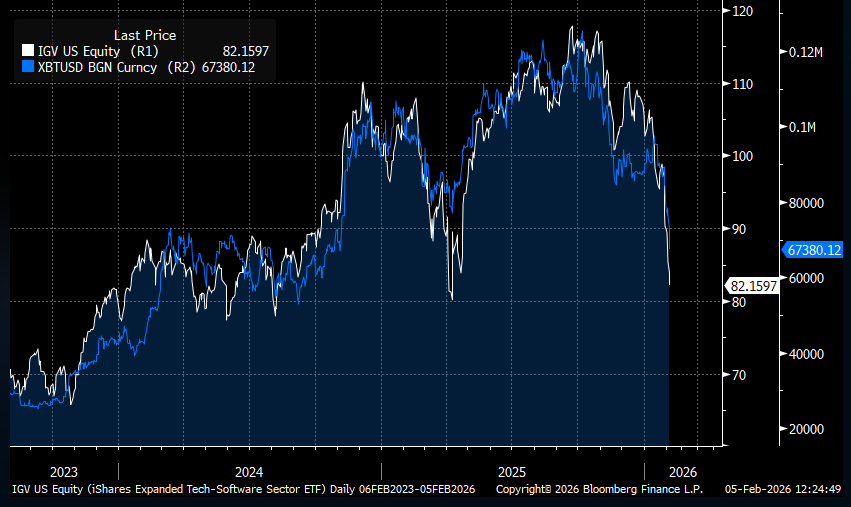
@jonrice80 Didn’t put this together until today, but it’s $MSTR in $IGV
English
0
0
1
142
Jon Hook
Jon Hook@jonrice80·
Having some trouble understanding/explaining this. Software stocks are somehow tied to Bitcoin?
Jon Hook tweet media
English
8
0
14
3.4K
LEJ Capital
LEJ Capital@LEJCapital·
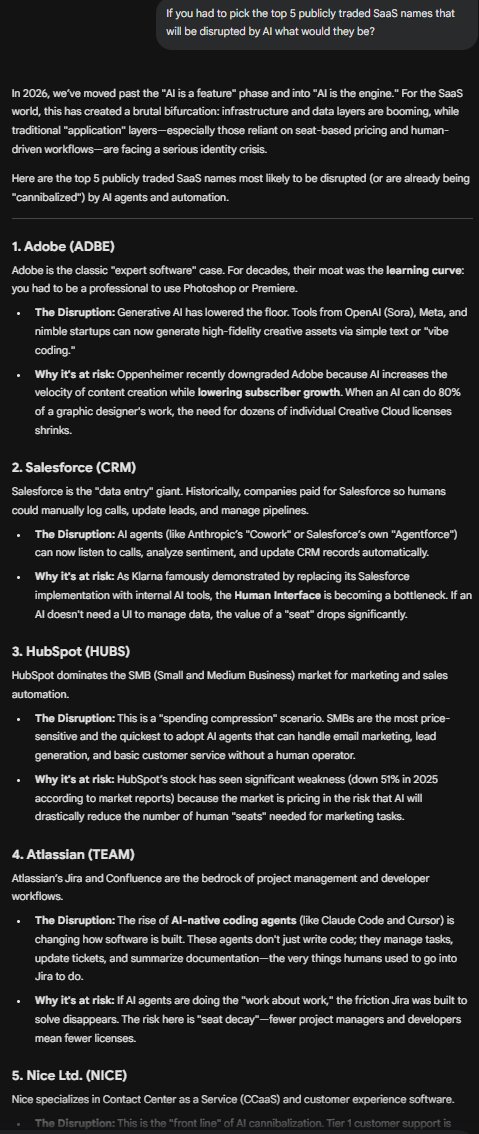
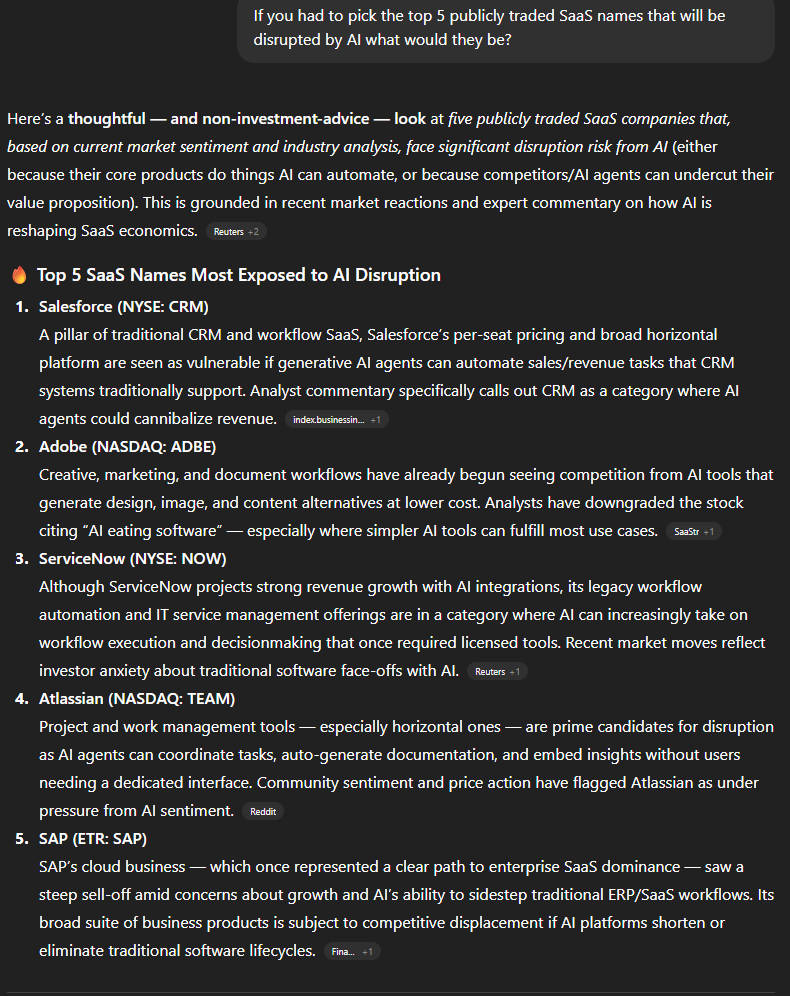
@CapitalJurassic “Hey AI, for those top 5 publicly traded businesses that could get disrupted by AI, how much have the stocks gone down on these concerns? Are you 100% certain? What KPIs should we monitor that would prove/disprove our thesis? Does that mean they’re worth $0? Thanks, AI”
English
0
0
0
98
Jurassic Capital
Jurassic Capital@CapitalJurassic·
Hey AI, "what are the top 5 publicly traded business that will be disrupted by AI (Gemini, ChatGPT)?" #1 $ADBE #2 $CRM #3 $TEAM Others, $NICE $SAP $NOW $HUBS
Jurassic Capital tweet mediaJurassic Capital tweet media
English
8
0
15
8.4K
LEJ Capital
LEJ Capital@LEJCapital·
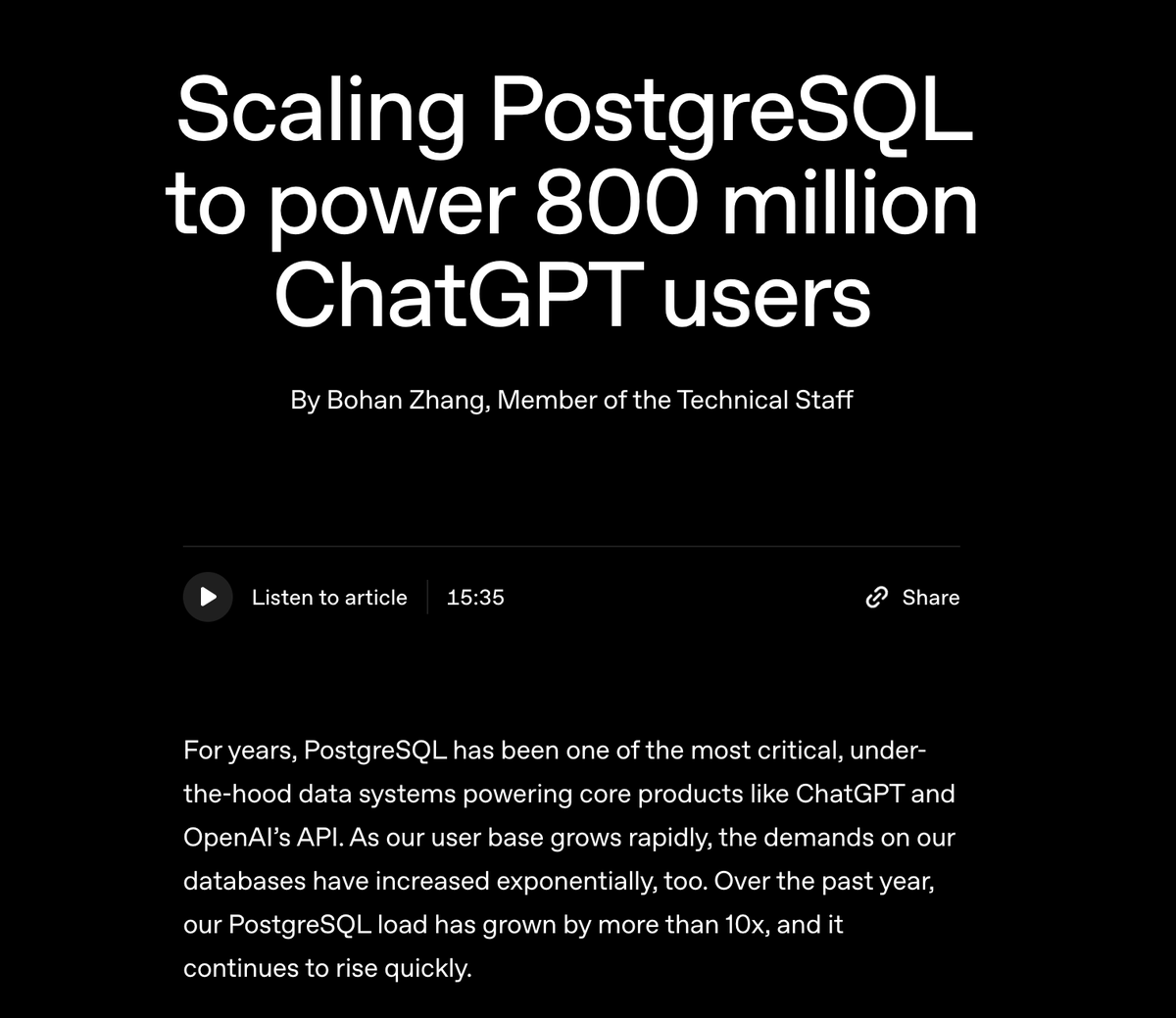
It is for read-heavy workloads. Blog says it’s challenged for write and they use CosmosDB for those. “We’ve already migrated the shardable write-heavy workloads to our sharded systems like CosmosDB. The remaining write-heavy workloads are more challenging to shard—we’re actively migrating those as well to further offload writes from the PostgreSQL primary.”
English
1
0
6
261
the Rich
the Rich@Duderichy·
but SQL isn't webscale
the Rich tweet media
English
5
0
26
3.9K
LEJ Capital
LEJ Capital@LEJCapital·
@JaredKubin @evrgn11112231 Momentum within sectors also very important. Reference above is w/r/t tech momentum, and is basically just long semis, short software. “Momentum” standalone is good, but not as stark as solely within tech
English
0
0
1
46
Jared L Kubin
Jared L Kubin@JaredKubin·
@LEJCapital @evrgn11112231 Interesting wrinkle in LO MO … currently one of the highest rolling correlations to high VOL ever. It’s all the same trade.
English
2
0
1
302
Jared L Kubin
Jared L Kubin@JaredKubin·
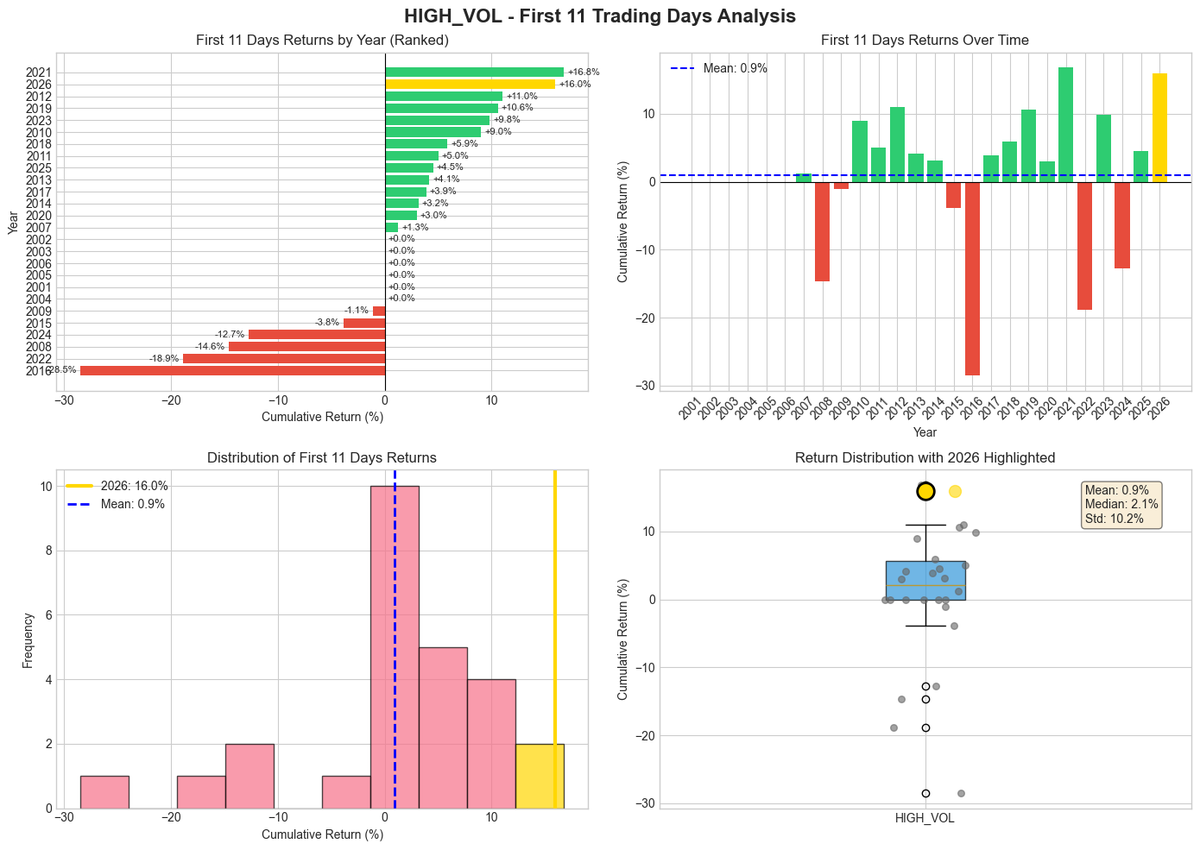
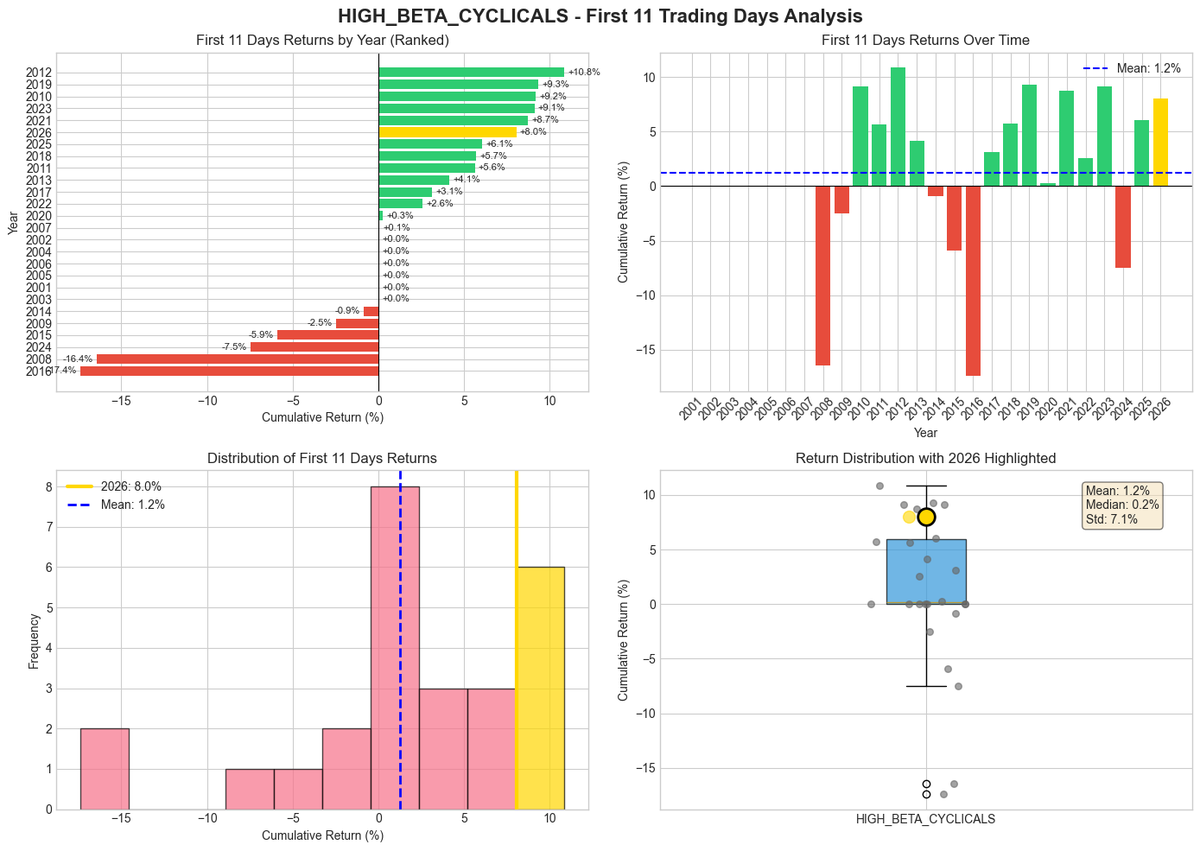
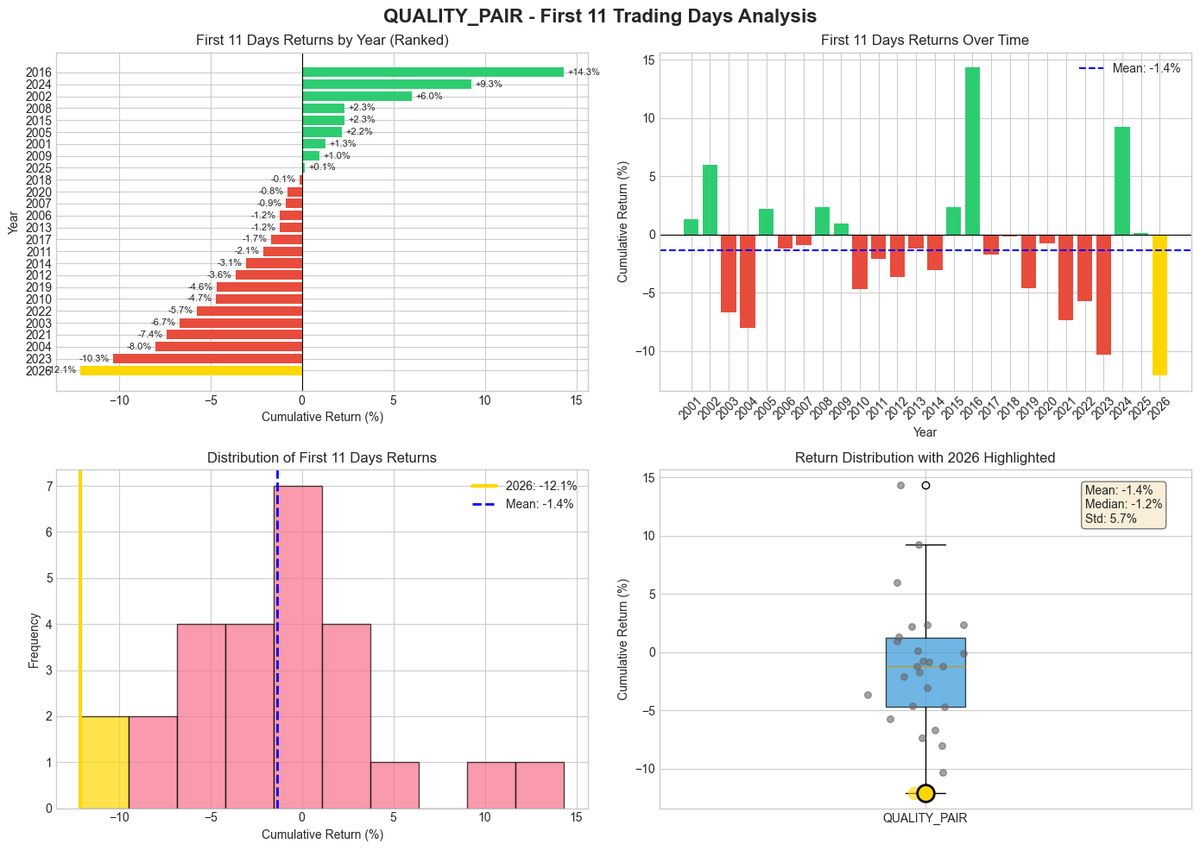
2026 FACTORS 🧵🧵 Looking at the start to the year... 1. High VOL +16% 2. High Beta Cyclicals +8% 3. Quality Pair (Long High v Short Low) -12% 4. Software vs Semis (L/S ew) -21%(!!)
Jared L Kubin tweet mediaJared L Kubin tweet mediaJared L Kubin tweet mediaJared L Kubin tweet media
English
5
9
68
24.5K
LEJ Capital
LEJ Capital@LEJCapital·
@JaredKubin @evrgn11112231 TMT HFs generally long momentum, short negative momentum. That’s best start to year since 2023
English
1
0
1
226
Jared L Kubin
Jared L Kubin@JaredKubin·
@evrgn11112231 Different things *tmt / software pods in major pain * multi strats are fine * single manager tech very overweight semis The GS HF INDEX is more a proxy for velocity of book changes and not performance … unwinds
English
1
0
4
1.4K
LEJ Capital
LEJ Capital@LEJCapital·
Reverse DCF makes EXPLICT assumptions on ROIC and capital intensity. It’s fine, META is fine here - Zuck will spend, they’re more tapped on engagement, ROI will be more dubious, it’s cheap but there is some option value for other initiatives, but ownership/love/your assertions are wayyyy more “priced in” than @chat_SBC assertions. That’s the delta. If you ask 100 people, would you rather buy application software or META and 90%+ agree with you (which is what I imagine this claim would receive), you’re just going to get paid on EPS growth
English
1
0
5
402
chatSBC
chatSBC@chat_SBC·
The replies to this tweet is so indicative of momentum trading/backwards reasoning based on price action. The stocks w/valuation support, low SBC, etc have all gotten equally crushed (CSU, ADBE, CRM, most vertical software). It is just crafting narrative based on accel/decel. FROG and PATH have nosebleed valuations and no FCF but had a few good Qs and stocks are fine. NFLX and SPOT were zeroes bc of slowing growth and competition in 2022. META was a zero bc it had no FCF and tik tok and zuck will burn metaverse cash and ftc will break it up This too shall pass. These were overvalued stocks that are going thru a growth to mgn transition that are now very cheap on underlying FCF (based on churn) and people are just picking at the weaknesses bc stocks have been bad. Those weakness existed when the stocks were 20x revs and they exist now.
BuccoCapital Bloke@buccocapital

The problem with application SaaS isn’t vibe coding, it’s that vibe coding is only ONE of many bear cases: 1. There is no valuation support for many of these names. FCF is a mirage due to excessive SBC 2. Speaking of SBC, the dilution at some of these companies is absolutely disgusting. It’s insulting. 3. VCs funded thousand and thousands and thousand and thousands of these things. What happens to competition and to margins and to future profits when the incremental feature is free to make? Many of these companies are zeroes 4. It’s not clear where value will accrue. Investors are thinking of Netflix gathering all the value on top of cable, or OTAs stealing all the value on top of legacy systems of record 5. Last, and certainly not least - even if you don’t think application SaaS is a zero, everyone else seems to. So who is going to step in to buy these things? One of them has to accelerate for real for the money to start flowing in Oh also, these businesses had structural tailwinds for 15 years. Not exactly the most battle tested group of leaders. And what happens to the seats if AI takes the jobs? I could go on and on and on. Every time I think Application SaaS sentiment has bottomed, it keeps getting worse. But it’s not like these businesses are doing themselves any favors the way they’ve been run or how they treat their shareholders

English
8
4
201
86.7K