

Brad Hartman
114 posts

Mi sembra abbiamo iniziato bene i negoziati:
-hormuz chiuso
-minaccia di rapire il team iraniano in Svizzera
-minaccia di bombardare Iran se continuano hezbollah
-Iran ha diritto di arricchire uranio
-Iran vuole fee su hormuz
-Iran chiude hormuz finché Israele non si ritira ..
Italiano
@HFI_Research @andrepaltry Taco is out…Nacho (no chance Hormuz opens) is in.
English

What matters isn’t if trapped ships get out.
What matters is how many NEW ships risk traveling in.
Unless you restore two way flows, you don’t solve on-going oil disruption. Solving the right problem matters.
Energy Headline News@OilHeadlineNews
Chris Wright @SecretaryWright: "Yesterday, 67 ships went through the Strait of Hormuz. The day before, it was 55 ships. In terms of oil and oil products—about equal to where we were before the conflict."
English
Brad Hartman ретвитнул


Structure governs dynamics:
• Israel will not leave Lebanon → fixed constraint
• Iran requires Israel to leave Lebanon → fixed constraint
• Iran uses the Strait as leverage → fixed constraint
• The U.S. cannot force either side’s red lines → fixed constraint
These are incompatible commitments.
That means the MOU is not an equilibrium — it’s a temporary alignment that collapses under pressure.
And it did collapse — within days.
English

Israel will not withdraw from the security zone in Lebanon - Defense Minister Katz
English
It does not matter what happens in one day. What matters is that within one week, the MOU broke down.
Ship owners need to trust a waterway.
Look up the Red Sea traffic post Houthis firing on it. It doesn’t get back to normal.
And the MOU will continue to falter - look for structure and signal, not one off data.
Structure:
• Israel will not leave Lebanon → fixed constraint
• Iran requires Israel to leave Lebanon → fixed constraint
• Iran uses the Strait as leverage → fixed constraint
• The U.S. cannot force either side’s red lines → fixed constraint
These are incompatible commitments.
That means the MOU is not an equilibrium — it’s a temporary alignment that collapses under pressure.
And it did collapse — within days.
English

55 ships, 17M barrels in a single day = the physical answer to Iran's Hormuz closure declaration. The market always votes with the cargo manifest, not the press release. Brent is down 8% this week precisely because the data says 'open.' Watch what moves, not what's said.
English
Ummm…it’s already closed genius
First Squawk@FirstSquawk
Trump to Fox News: If Iran closes the Strait of Hormuz, Iranian negotiators will not be able to return to their country
English
RT @WindwardAI: Iran's re-closure of Hormuz is already measurable in the data.
12 transits today, down from 21+ on June 20.
Neutral and E…
English
You blockade us…no, we blockade you
You toll us…no, we toll you
Anything you can do, we can do better.
US foreign policy has been reduced to playground antics.
Mario Nawfal@MarioNawfal
🚨 BREAKING: 🇺🇸🇮🇷 Trump: "U.S. could become the Guardian Angel of the Strait of Hormuz and take 20% of the oil. We may take over the Strait, if we have to. I'll blow the sh*t out of them. If they don't make a deal, we'll collect tolls." Source: Fox News / Writer: Samuel
English
Pretty concerning when a US President lashes out swearing to kill another countries diplomats because he looks weak and ineffective.
Mario Nawfal@MarioNawfal
🇮🇷 Iran's President Pezeshkian: "We will not give up our right to enrichment." 🇺🇸 Trump: "He better watch his mouth. He better shape up, or we will take over the rest of the country." It doesn't seem like the MoU is bringing the 2 sides any closer... Writer: Samuel
English
Brad Hartman ретвитнул

⛽ Gas prices aren't just supply and demand.
Chevron CEO Mike Wirth told Bloomberg the part most coverage skips:
pricing is set as much by how energy moves as by how much exists.
A blocked strait or a rerouted tanker can move the pump price more than a production change.
The mechanism:
when a key transit route tightens, cargoes travel farther, freight costs rise, and that lands in the barrel before any supply number changes.
Chevron's read on supply, demand, and transit signals is how we keep reliable energy flowing to customers and allies.
Which matters more to the next price move... a barrel of supply, or the route it has to travel?
English
In addition to reading, you may want to try thinking. 91M barrel capacity doesn’t mean anything if you are drawing 18 million barrels a week in the US.
Tank bottoms at Cushing are real. We hit them last week - read the inventory data.
You need 18-20M barrels to maintain pipe pressure.
When you get there, you have to cut sending barrels to someone - first loss is exports. Europe loses exports from the US - ARA is in trouble.
Oil is about flows, not random data points.
English
@anasalhajji Can you please keep reporting when each single tanker crosses. This is incredible - we have so much oil flowing
English
السعودية 🇸🇦🇸🇦🇸🇦
🟥ناقلة نفط محملة بمليوني برميل من النفط السعودي الخفيف جدا تعبر مضيق هرمز في طريقها إلى اليابان بعد إعلان الحرس الثوري الإيراني أمس إغلاق المضيق!
🟥البيانات والتصريحات شيء، والواقع شيء آخر!
Anas Alhajji@anasalhajji
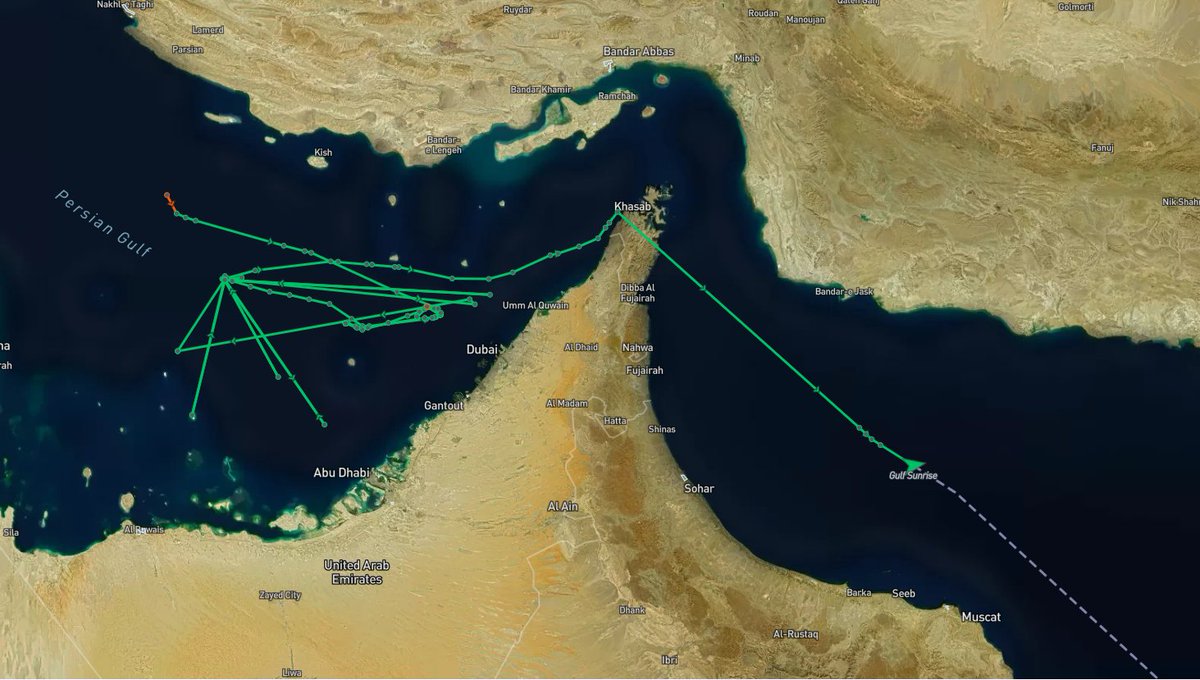
💥IRGC closed Hormuz again? 🌀Meanwhile, here’s an oil tanker carrying 2 million barrels of Saudi crude that crossed the Strait — after the IRGC announced it was closed. 🌀Destination: Japan. 🌻Actions speak louder than announcements. Map form @Kpler
العربية
@anasalhajji @Kpler One whole tanker? Omg that’s marvelous!
English
💥IRGC closed Hormuz again?
🌀Meanwhile, here’s an oil tanker carrying 2 million barrels of Saudi crude that crossed the Strait — after the IRGC announced it was closed.
🌀Destination: Japan.
🌻Actions speak louder than announcements.
Map form @Kpler
English
This is the single most important datapoint of the entire month.
A chokepoint that “reopens” and then fails within a week is not open.
It is operationally unstable.
Shipowners don’t care what the U.S. says.
They care about:
• insurance
• risk of seizure
• risk of drone attack
• risk of miscalculation
• risk of escalation
A system that fails immediately is a system that is not trusted.
Even if Iranian barrels trickle out, the structural reality is:
Hormuz is functionally impaired.
English
Call it “aggression by statement”
Just by saying SOH is “closed” the Iran hard liners can impact flows.
Shipowners and insurers are less likely to take chances if things are unclear.
Shipshow (yes, i wrote “ship” but you get the meaning)
Brian Sullivan@SullyCNBC
Reminder - You’re going to hear a lot of confusing and at times contradictory headlines and charts about Hormuz “open” or “closed” The reason - as I’ve reported for two months - is that there are multiple parties trying to assert control in Iran. Some saying some things, others different. Some charts will show more ships than others due to transponder connectivity etc. Hard to know how it plays out but right now there’s more activity than a week ago. Stay tuned and stay nimble. It’s tense and reactionary time.
English
This is the single most important datapoint of the entire month.
A chokepoint that “reopens” and then fails within a week is not open.
It is operationally unstable.
Shipowners don’t care what the U.S. says.
They care about:
• insurance
• risk of seizure
• risk of drone attack
• risk of miscalculation
• risk of escalation
A system that fails immediately is a system that is not trusted.
This is why you’re right that even if some Iranian barrels trickle out, the structural reality is:
Hormuz is functionally impaired.
English

Traffic in strait continues to flow: U.S. forces monitoring situation to ensure it keeps moving, U.S. Central Command spokesperson says
English
100% - hard assets are the new regime.
Doug Casey's International Man@intlmandotcom
The Next Commodity Supercycle Has Already Started Energy, metals, and hard assets are becoming central to a new global market cycle as technology dominance fades and geopolitical pressure reshapes supply chains. internationalman.com/articles/the-n…
English
You continue to focus on the surface.
Look at the deal structure and governing dynamics.
Structure:
Israel says they won’t leave Lebanon
Iran views Israeli occupation of Lebanon as a violation of the agreement.
Signal:
These are mutually incompatible positions and lead to an unstable agreement.
Result:
Inside a week you have increasing Lebanon escalation, Iran says the US is in breach.
The rest of this is surface noise.
English
Correct. Why I’ve said the “Ghalibaf factor” is so critical.
Unless other harder-liners try to push him out and assume control.
Who controls Iran today, tomorrow and months from now isn’t clear to my sources.
Drew Nelson@DrewNelson13
@SullyCNBC Seems like the guys with missiles, mines, and drones are probably the ones that are going to decide if it’s closed or not. Not whomever is negotiating.
English
Directionally correct, but incomplete.
Exports drop faster. Cushing - refiners operational “hub” and piping system - is already at tank bottoms this week (20M).
When that happens, it can’t maintain normal flows and has to prioritize domestic production. So exports drop even before US SPR hits bottom.
On the SPR tank bottoms - I would be a bit more conservative vs aggressive on your model.
343M barrels as of last week
-300M likely operational minimum
SPR caverns risk collapse at 275M
Drawing 8-9mb/week.
Likely: ~5 weeks from last Friday to US SPR exhaustion (at current avg draw rates over the past month)
English

ORANGE ALERT:
MSM reports that SoH is closed again.
We have 3 weeks until so-called "tank bottoms":
When SPR runs out of oil, US will not be able to export oil to EU & Asia, but in return, will not receive refined products such as DIESEL.
US can refine plenty of gasoline & jet fuel.
In that sense, ALL nations will be affected when tank bottoms arrive (do not know about China, who keeps everything secret).


English
It seems you focus on surface level facts and not underlying systems. When you look clear eyed at the underlying structure, it is clear that:
Israel’s incentive:
Maintain deterrence, avoid appearing weak, prevent Hezbollah entrenchment.
→ Escalate or hold ground, not withdraw.
Iran’s incentive:
Use asymmetric leverage (Hormuz, proxies) to force concessions and deter Israeli/U.S. pressure.
→ Escalate pressure until concessions occur.
U.S. incentive:
Prevent regional war, maintain oil flow, avoid domestic political fallout.
→ Stabilize, but cannot impose outcomes.
These incentives are not aligned.
They are not reconcilable.
They produce persistent instability, not resolution.
Conclusion: the MOU is based on structurally incompatible incentives and is inherently quite unstable.
Evidence: Israel - Lebanon escalation, across multiple days, Iran declaring US in breach of agreement. All inside a week.
English
Well... Ships and tankers are going through!
Source: Marine Traffic

English