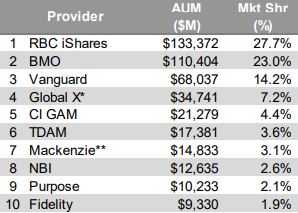
It's AMAZING to see the continued adoption of ETFs by Canadian Investors! 🇨🇦
Since there are still a lot of CDNS not yet benefiting here's an easy list of Canada's Top 10 ETF Providers (by AUM) to share & bookmark with family, friends & followers...
Links to each 👇👇 in 🧵
@BoomerDivvies I pulled the plug at my number. But it certainly wasn’t at $1M.
Just as fun coming home from pickleball and seeing that markets still ‘paid’ you. 🤷♂️👍
I don’t believe what you people say on FinX.
I’m not talking portfolio size, I think people are honest there.
I’m talking about people saying they’re done when they hit their “enough” number.
Making money is fun and addictive.
You won’t stop at $1M, who are you kidding??
47% of total Canadian payroll sits in jobs that are highly exposed to AI.
This weekend, @karpathy published an AI exposure analysis for the US job market.
I adapted it to Canadian jobs data. Full heatmap + dashboard link below.
3 things that stood out:
1) The higher you're paid, the more exposed you are. Workers earning $100K+ have an average AI exposure of 6.7/10. Those marking under $35K? Just 3.4/10. AI is coming fast for knowledge work, not manual labour.
2) Education amplifies exposure. University-educated workers face the highest AI exposure. Those with no formal education face the least.
3) 7.9M Canadian workers are in high-exposure occupations (score 6+). That's 39% of the workforce.
Check out the heatmap across 500+ job categories:
reuven-rgb.github.io/canadian-ai-jo…@KirkLubimov@danielfoch
I'm seeing a lot of calls for stagflation lately, which naturally leads to 2022 comparisons, which makes sense with foreign conflict, energy shock, inflation fears, growth headwinds from AI.
But the Fed is in a meaningfully different position. They don't have to start from zero. Even 100 bps of hikes from the current level creates a much smaller variance shock than the 0-to-500 journey in 21-22.
Mag7 down 40-60%? Hard to make that case unless the Fed is forced to hike hard into a weakening labor market. That's the tail risk. We're not there. But the ingredients are on the counter.
This is the most SHAMELESS structural manipulation of a major index I've ever seen.
SpaceX is preparing what could be the largest IPO in history.
Target valuation: $1.75 trillion.
That would make it the sixth-largest company in America on day one.
And Nasdaq wants the listing so badly they're literally CHANGING how the Nasdaq-100 works.
In February, Nasdaq published a "consultation" proposing sweeping changes to how companies enter the index. The timing is pure coincidence, of course.
Just like it's pure coincidence that SpaceX has reportedly made fast index inclusion a CONDITION of listing on Nasdaq.
Here's what they're proposing:
A new "Fast Entry" rule would let any newly listed company whose market cap ranks in the top 40 of current Nasdaq-100 members get added to the index after just 15 trading days.
No seasoning period. No liquidity requirements. Completely exempt from the standards every other company had to meet.
Currently, new public companies typically wait up to a year before they're eligible for major index inclusion.
That waiting period exists for a reason. It lets the market establish real price discovery. It protects passive investors from being forced into untested, illiquid stocks.
And Nasdaq wants to throw all of that out. For ONE listing.
But the Fast Entry rule isn't even the worst part...
The real scandal is the 5x float multiplier.
Right now, the S&P 500 uses a free-float adjusted methodology. If only 5% of a company's shares are available for public trading, the index weights you at 5% of total market cap.
That's common sense. You weight a company based on what investors can actually buy.
Nasdaq's current methodology already uses total market cap rather than free-float for weighting. But for very low-float stocks, they at least had a 10% minimum float threshold.
Under the new proposal, that threshold DISAPPEARS entirely.
Instead, any stock with less than 20% free float gets weighted at FIVE TIMES its actual float percentage, capped at 100%.
Do the math on SpaceX:
If SpaceX IPOs at $1.75 trillion and floats 5% of its shares, there would be roughly $87.5 billion worth of stock available for public trading.
Under Nasdaq's proposed 5x multiplier, the index would weight SpaceX at 25% of its total market cap. That means passive funds would be forced to buy as if SpaceX were a $437.5 billion company.
But only $87.5 billion of stock actually exists in the market.
You are forcing hundreds of billions in passive buying into a $87.5 billion float.
QQQ alone manages nearly $400 billion. The total Nasdaq-100 ecosystem represents over $1.4 trillion in exposure across ETFs, mutual funds, structured notes, and derivatives.
Every single passive vehicle tracking this index would be REQUIRED to buy SpaceX at whatever price the market dictates.
On Day 15.
With zero price discovery. Zero track record as a public company. And a float so thin you could read through it.
So what this actually does is it creates a structural wealth transfer mechanism.
The passive bid from index funds pushes the stock price higher. That higher price benefits exactly one group of people: the insiders and early investors who own the other 95% of the shares.
And when lock-up periods expire 90 to 180 days later? Those insiders sell into the artificially inflated passive bid. Your 401(k) is the exit liquidity.
This is the fundamental corruption of indexing.
Indexing used to be brilliant. Low cost. Efficient. You were free-riding on the price discovery done by active managers. The index reflected the market.
Now the index IS the market. Trillions of dollars flow blindly into whatever the index tells them to buy. And the people who control the index methodology are changing the rules to serve the interests of a single IPO candidate.
The S&P 500 requires companies to have at least…
Veering into mutually assured destruction now…
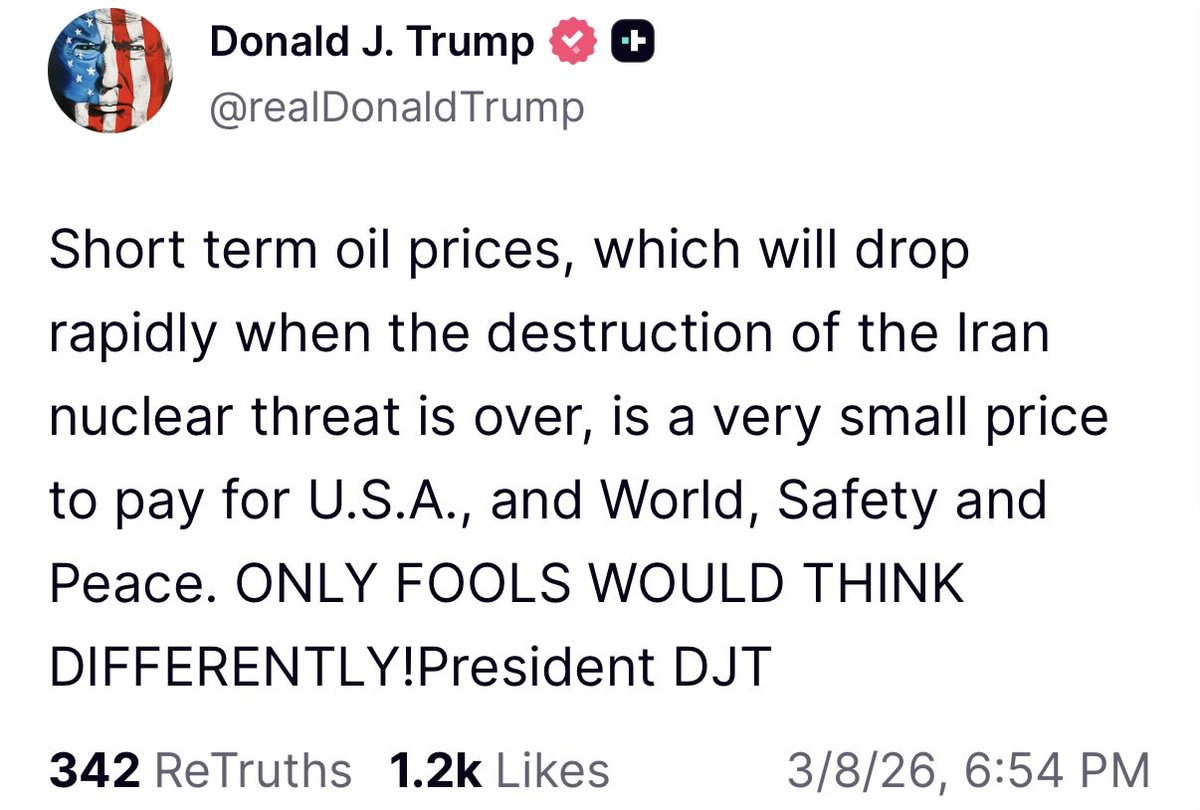
Iranians are going after the Saudi east-west pipeline (6mbd) and Trump is threatening to go after Kharg island if boats aren’t moving (Iran’s main oil export hub).
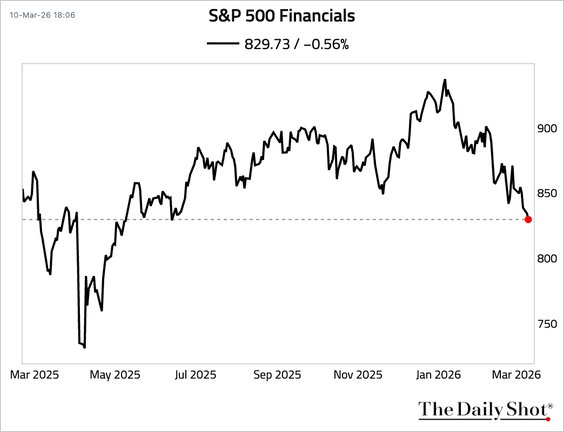
This market can not rally significantly until Financials and Technology regain traction. The combined market-capitalization of Utilities, Staples, Energy, Industrials, and Materials is smaller than Technology alone.
My buddy just got his annual bonus
$40k which was $26k after tax
Works in corporate finance in NYC
Mid-30s & married with a 2 year old
Has zero debt & happily rents
Hates his job & wants to retire young
Hasn’t vacationed as a family yet
What should he do with the bonus? 💰
@BoomerDivvies Surest way to a wealthy life is to go out and work for it.
It’s not everyone - but I see a lot of people hoping markets will make them rich.
Working and saving makes you rich. Investing (hopefully) just makes you richer. 👍
Boomers bought houses, raised families, lived through recessions and built businesses without:
- complaining online
- blaming previous generations
- needing a podcast about it
They gained wealth slowly and didn’t expect to be rich at a young age.
There’s a lesson in that.
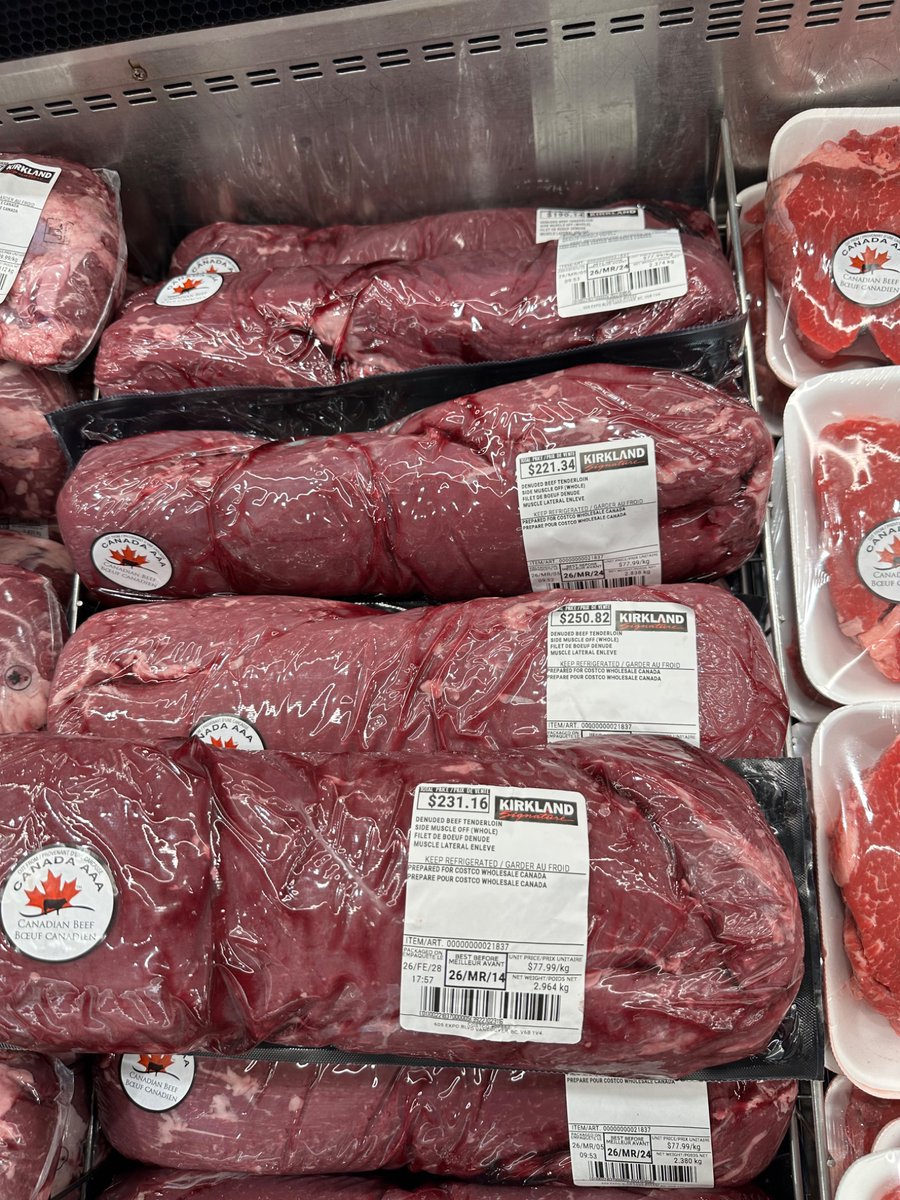
@BoomerDivvies We’ve done this for years. Typically get 12-14 cuts.
Used to cost $90-$100. Trimmed.
Now we have to slum it and do our own trimming. 🤷♂️😂
Have you ever bought a full beef tenderloin from Costco?
Thinking about doing it this summer at some point.
Pretty pricey, but steaks are expensive everywhere these days.
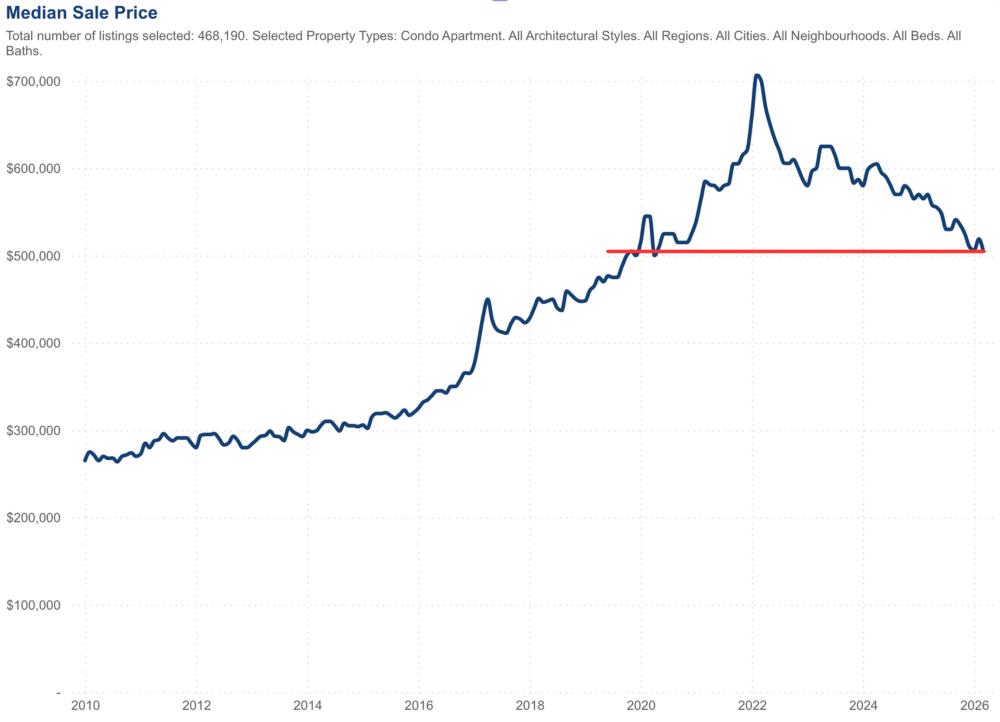
@ShaziGoalie Pre 2017 spike is where affordability and value live.
Any new buyers should base their offers on these prices.
Sellers ASK prices are irrelevant and either based on greed, dreams or their own past mistakes.
Buyers OFFER price is the only price that matters. 👍
Toronto home prices just dropped another 7% YoY.
Average price now $1.009M.
The entire 2021–2022 housing boom has been erased.
Down 24% from the peak.
Detached homes down.
Condos down.
Townhouses down.
The GTA housing chart now looks like a full boom-and-bust cycle. 📉
@danielfoch GTA stopped being reasonable in 2017 so wake me up when we get to 2016 levels. 👍
Every buyers offer price should be based on 2016 levels. All prices after were detached from actual value and affordability. 🤷♂️