Austin Meyer

3K posts

Austin Meyer banner
Austin Meyer

Austin Meyer

@austingmeyer

w/ @b_ritt23 • MD/PhD/MS/MPH/MS • data scientist • virus modeler • IM/Peds Hospitalist @bswhealth • I 💛 infections, jazz, data, ☕️
Austin, TX Присоединился Mart 2009
994 Подписки585 Подписчики
Eric Topol
Eric Topol@EricTopol·
A single dose of antibiotics can have lasting effects on your gut microbiome, with changes that last well beyond 4 years. Three types of antibiotics stood out for their long term disruptive impact (3 at left, Figure) @NatureMedicine nature.com/articles/s4159…
Eric Topol tweet media
English
44
303
1.1K
140.1K
Austin Meyer
Austin Meyer@austingmeyer·
@BradSpellberg @ABsteward Isn't the real issue here (sort of like the ProACT), that physicians on average just won't use inflammatory biomarkers when they conflict with their clinical gestalt? It just seems like we're studying clinician behavior more than the utility of clinical tests.
English
1
0
2
196
Antibiotic Steward Bassam Ghanem 🅱️C🆔🅿️🌟
🆕⚡🟢PRUDENCE RCT A pragmatic, randomised controlled clinical trial in 13 countries Point-of-care testing strategy versus usual care to safely reduce antibiotic prescribing for acute respiratory tract infections in primary care A point-of-care testing strategy for respiratory tract infection, which included testing for CRP, group A streptococcus, and influenza, did not reduce antibiotic prescribing when clinicians were considering prescribing or had planned to prescribe an antibiotic. Point-of-care testing is unlikely to be effective as a standalone solution in antimicrobial stewardship. @BradSpellberg Thanks @Inox94 thelancet.com/journals/lanpr…
English
1
9
24
3.8K
Austin Meyer
Austin Meyer@austingmeyer·
You realize this same nonsensical argument could be deployed for soldiers who experience PTSD despite signing up to be soldiers? "Would you find it strange if professional soldiers experienced PTSD after being asked to fight in a battle?" No, I would not find it strange, actually. I was housestaff during the pandemic and it was terrible. Lots of months-long ventilator patients, lots of goals of care, lots of death. Lots of attending subspecialists who more or less refused to see patients in the hospital.
English
0
0
8
174
Joseph Marine
Joseph Marine@DrJMarine·
HFNC = high flow nasal cannulae? I suggest you try looking at this from how an objective person outside health care would. Total volume of patients was actually below normal, but a higher proportion had a new disease called covid. Even with a higher than normal mortality rates, some people would find it difficult to understand why doctors and nurses who signed up to be critical care health care professionals would be traumatized taking care of sick patients. Would you find it strange if professional firefighters publicly complained about having to fight fires? Even after the challenging wildfires you have had in CA, I do not think I have ever seen that.
English
18
0
4
3.4K
Joseph Marine
Joseph Marine@DrJMarine·
The myth of "overwhelmed hospitals" throughout the USA during the pandemic is a lie that refuses to die. It was perpetuated as the most effective way to keep the public cowed and compliant with the covid authoritarianism and to silence critics. It also had enormous collateral damage.
Joseph Marine@DrJMarine

Not so. When the pandemic started, I was president of my state ACC chapter and was chair-elect of the BOG. I went to my hospital almost every day. My office was 50 feet from our main covid ICU and was across the hall from where the doctors would hang out. As others did, I volunteered for every crisis staffing pool and worked as a hospitalist and for over a week as an ICU intern. I had a front-row seat to the pandemic in my hospital and was in touch with cardiologists throughout the state and the country. My 900-bed hospital was as empty as it has ever been in the spring of 2020. The peak census of covid patients was 150. Everyone noticed the dearth of patients presenting with CV symptoms. I had one patient present very late with AV block who developed renal failure. I asked him why he waited and he admitted he was terrified to come to the ER because of all the images on TV. Many colleagues have related similar stories of patients who were injured or died from delayed care. My health system had to lay off many HCW because they had nothing to do. The experience of CV leaders in my state and around the country was similar. I created an ACC campaign called #HeartCareCantWait to try to overcome public fear of going to ERs. I encouraged my hospital to communicate to the public that we were not overwhelmed, had plenty of beds, and was a safe place to receive care. In late April, I wrote to the governor of the state asking him to end the insanity and restore normal health care operations. I did not hear any colleagues complain about losing money. There was concern about practice viability and how they were going to pay staff without having to lay them off. I did hear a lot of frustration at being sidelined, having nothing to do, and not being able to take care of their patients. The medical shutdown of spring 2020 was a disastrous mistake and overreaction. Those who made these bad decisions will never acknowledge it.

English
156
29
177
255.2K
Benjamin Mazer
Benjamin Mazer@BenMazer·
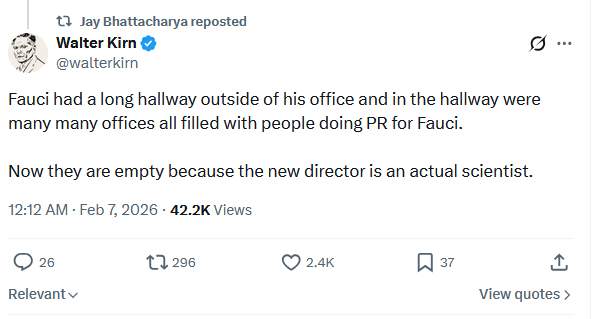
Amazing repost by our insecure NIH director @DrJBhattacharya. Fauci, whatever you think of him, was a prolific and established scientist as well as a practicing physician. Besides, Jay didn't replace Fauci. Were Bertagnolli, Tabak, and Collins not scientists? lol
Benjamin Mazer tweet media
English
11
18
136
15.5K
Austin Meyer
Austin Meyer@austingmeyer·
For what it's worth, states recover millions and millions through 340B rebates to ADAPs. Basically, a state ADAP can buy health insurance for a patient. When the state pays the premium+deductible/copay for the patient, by federal policy the state ADAP becomes entitled to the 340B rebate from the full cost of the drug even though the insurance company paid for it. So if the ADAP pays $200/month for insurance and gets a rebate of $1000/month on Biktarvy, they net a ton.
English
0
0
1
164
Mark Cuban
Mark Cuban@mcuban·
Can someone correct me if I’m wrong. State Medicaid has to pay full RETAIL price for scripts filled under 340B , but the contracted pharmacy makes a significant premium and the prescribing 340b Covered Entity (the hospital typically) gets to keep all the profit they didn’t go to the pharmacy they contracted with and often own Yes ? No ? I ask because State Medicaid Programs are getting crushed.
English
99
42
423
131K
Austin Meyer
Austin Meyer@austingmeyer·
@AdamRodmanMD Though of course the models could achieve mastery in many more fields than a single human, and could do things much faster, but in terms of expanding the universe of knowledge, I'm not sure.
English
1
0
1
16
Austin Meyer
Austin Meyer@austingmeyer·
Honestly, from a philosophical perspective, I have a hard time understanding how LLMs could go much beyond peak human capabilities in any particular field. Ultimately, the training data is human generated/labeled and it is hard to see how LLMs wouldn't be bounded by that contraint.
English
1
0
1
24
Adam Rodman
Adam Rodman@AdamRodmanMD·
Not the intention of this cartoon, but unironically a good explanation of how reward systems breakdown as LLMs reach "superhuman" performance (since our current rewards rely on expert labeling)
Eric Topol@EricTopol

Eminence-based medicine ;-)

English
1
1
16
1.8K
Austin Meyer
Austin Meyer@austingmeyer·
I think you're neglecting the risk of false positives and the subsequent cascade of care thereafter. Even if the tests were free, that wouldn't mean we should do all of them. Data is not neutral in this domain. For every test that is itself not risky, there are a series of secondary and tertiary risks from findings that require further invasive testing or over-treatment.
English
0
0
0
89
Méritaux
Méritaux@Ankisucks·
I get the whole argument. It goes against everything we as medical professionals are trained. Dont order extra tests if they wont affect your decision making. But what many fail to understand is that the main REASON from first principles why you dont order the extra test is financial cost compared to expected benefit. It actually never hurts to have more data, even if the data is useless or goes against your decision. If money was not an issue, then yes, MRI's for all would catch some extra conditions. But it would also cost trillions in doctors and medical professionals and patients time in tracking down false positives. At some point, we will be able to afford that. Especially with the advent of AI to help doctors. But we certainly cannot yet.
English
12
0
48
7K
Dr. Glaucomflecken
Dr. Glaucomflecken@DGlaucomflecken·
I have logistical questions for the full body MRI + AI interpretation crowd. What do you do with that report? Take it directly to a surgeon? Expect them to operate without a radiologist interpretation? Will the hospitals allow it? Who pays for it? Gonna need ironclad research to convince surgeons, hospitals, and payors to take on that liability.
Elon Musk@elonmusk

@PalmerLuckey Widespread MRI usage done at least annually with AI reviewing the data would greatly improve wellbeing and mortality

English
182
52
810
134.6K
Austin Meyer
Austin Meyer@austingmeyer·
This is silly. You are too under-educated on this to have a serious conversation. Hopefully, you can have some further conversations with the experts you know personally to get a better sense of public health reality. Also, you have now mentioned the nirvana fallacy twice. It isn’t a useful position to hold.
English
1
0
0
24
Phillip Cem Cezayirli
Phillip Cem Cezayirli@DrPhilCez·
Firstly, regarding sewage and clean drinking water, I have been referring to the history of its modern development and adoption in the US, which occurred over 100 years ago prior to federal government mandates. Secondly, mandating something, no matter how effective it is statistically, and one person having a negative side effect or still getting sick and dying may still show statistically it worked and was “worth it,” but that is not how the patient or family feels. The lives saved aren’t seen because it is preventative. Even lowering severity of disease isn’t seen because it’s preventative. So now you’ve mandated something where one person and their family only experienced the failure. The mandate creates a problem because you’ve paternalistically forced others to take a vaccine where they had no choice and they had one of the negative effects. A mandate doesn’t include a real informed consent because there isn’t a choice. People aren’t statistics. The statistics don’t matter for that one family. So the goal should be 100% effectiveness and 0% risks. That should be the goal.
Phillip Cem Cezayirli tweet media
English
1
0
1
24
Mark Cuban
Mark Cuban@mcuban·
That doesn't answer the question. What about contagious diseases ? How much risk is someone allowed to create for another person ?
Ge Bai@GeBaiDC

@mcuban Vaccines available for folks who want them

English
2.9K
153
1.7K
578K
Austin Meyer
Austin Meyer@austingmeyer·
Sure, I’ll go read more to make sure I understand the topics in my courses. That’s a silly proposition. It is just blatantly incorrect to suggest that wastewater systems are not mandated. They are. Please take an environmental health course or speak with an environmental attorney. Being pro-vaccine is great and non-communicable diseases matter, but that doesn’t change the incorrectness of your opinion about the goodness or badness of a vaccine or your lack of understanding of vaccines as public health infrastructure or the misunderstanding regarding the differences between communicable and non-communicable diseases management at the population level or the various other misunderstandings in your posts. Just to reiterate this, whether or not we agree on the liability issue is irrelevant to the fact that your initial post was incoherent and betrayed a serious misunderstanding about what makes a good vaccine. We should just acknowledge that fact. There certainly can be a good vaccine that requires high population adherence. That is just true and you claimed otherwise.
English
1
0
0
32
Phillip Cem Cezayirli
Phillip Cem Cezayirli@DrPhilCez·
I suggest you read your history. That is not at all how sewage systems and clean drinking water systems propagated in the US. Again, I’m very much pro vaccine. And medications or even diet and lifestyle are great examples to compare to vaccines because preventable diseases are the most common drivers of hospitalizations and healthcare dollars used in the US. Non adherence to medications and preventative lifestyle drive up healthcare costs, which affects me much greater than if someone has the flu shot or tetanus shot. Even obesity has a much greater effect on our health system in the US than vaccines. So my real issue with mandates are the slippery slope. And the fact that vaccine manufacturers are protected from litigation. The fear of litigation and not being guaranteed mandated revenue sources would actually drive innovation and improvement.
English
1
0
0
31
Austin Meyer
Austin Meyer@austingmeyer·
1. That question doesn't make sense. Ebola is not endemic to the US. Moreover, while the infection is similar to what I described the logistics of the situation are not. Again, I'm not sure how to be more clear about this... a purely medical definition of "good" is the same misunderstanding you exposed in the original post. There are a lot of other issues at stake to determine if something is a "good" vaccine. The logistics of vaccine administer in Ebola endemic countries is far less trivial than my description. But in DRC, if the logistics were as trivial as I suggested, then yeah, everyone should be vaccinated... obviously. 2. You're still misunderstanding vaccines. Your blood pressure does not affect my blood pressure in any causal manner. Vaccines have a dual purpose of preventing disease in an individual person to some extent and reducing the spread of the disease in the population; the second is much more important than the first. Thus, you having an infectious does have a causal impact on other people. When an individual's choices can affect other people's health, it is common to legislate it. Whatever the liability structure of vaccine products has nothing to do with the wrongness of your earlier opinion or your misunderstanding about the dual purpose of vaccines. Even if we both agreed vaccine liability law is dumb, that has nothing to do with whether ‘if others need to be vaccinated, it’s a bad vaccine’ is a coherent statement. It isn’t, for exactly the same reason your safe sewage system needs neighbors to use it. 3. This is just completely incorrect. There are all kinds of laws about septic systems. Where you can use them, how they must be constructed, and how they are maintained. In virtually all areas of the US there are laws about how close they can be to water reservoirs. It is illegal to defecate in public in most places in the US. These are mandates to isolate and clean wastewater in various important ways. Whether they are federal, state, or local mandates, they are mandates. If it were not a mandate, the local municipality would say, "We strongly recommend not piping your home wastewater directly into the reservoir lake, but we don't require anything in particular in that regard."
English
1
0
0
23
Phillip Cem Cezayirli
Phillip Cem Cezayirli@DrPhilCez·
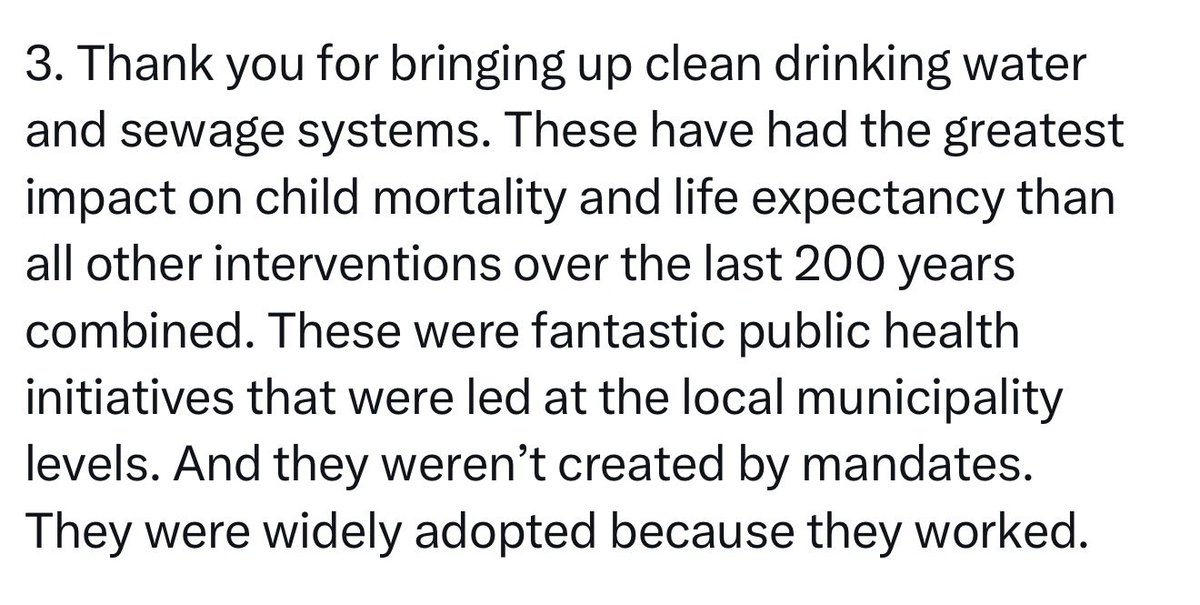
1. You just described Ebola. So you think we should mandate the Ebola vaccine for every American? 2. As I’ve said, I’m pro vaccine. But vaccines are preventative. Should we force everyone with hypertension to take their blood pressure medicine? The NNT is similar to the NNV for most of the vaccines we have. Difference is a faulty medication can result in damages agonist the producer, but not with vaccines: this is absolutely insane. 3. Thank you for bringing up clean drinking water and sewage systems. These have had the greatest impact on child mortality and life expectancy than all other interventions over the last 200 years combined. These were fantastic public health initiatives that were led at the local municipality levels. And they weren’t created by mandates. They were widely adopted because they worked.
English
1
0
0
24
Ge Bai
Ge Bai@GeBaiDC·
@mcuban No federal mandate under any circumstances. If the vaccines are so great, people aren’t dumb — no mandates are needed.
English
25
4
96
2.8K
Austin Meyer
Austin Meyer@austingmeyer·
This, “If a vaccine requires everyone around me to be vaccinated, then it isn’t a very good vaccine”, is just a completely wrong perspective. Maybe stick to opinions about neurosurgery and ask your ID/Epi colleagues about this topic. Let’s just say you wanted to quantify “good” here, it would be some balance between risks and benefits. Assessing that would require some complex analysis regarding the efficacy of the vaccine immediately and in perpetuity for all possible outcomes of the infection, the morbidity/mortality of the infection, the harms of the vaccine, logistics of administration, cost of the vaccine, and myriad other factors. It would be very easy to envision a situation where your statement above is completely wrong. Imagine a virus with 50% mortality and devastating morbidity. It has a R0 of 1.3. We have a vaccine with no known harms after three decades of use, it costs a penny, can be stored at room temp, and can be administered orally. The vaccine is 30% effective at inducing permanent immunity to morbidity and mortality the day after it is administered. So about 77% of people need to be vaccinated to eliminate the disease. That’s a great vaccine. It would make no sense to develop a better one. You only need 77% for herd immunity. The virus is capable of exponential growth with that R0 and will kill a lot of people but it isn’t particularly contagious. The issue here is you and many (probably most) people think of vaccines in terms of personal preventive care. That is wrong thinking. Vaccines, properly construed, are population interventions to reduce the morbidity and mortality of the population. It is literally protective infrastructure. Think of it this way, if a sewage system is 99% effective, but requires 100% of neighbors to connect to it to prevent cholera from seeping into the groundwater, one would not say, "If a sewage system requires my neighbor to use it to keep me safe, it's not a very good sewage system." It is a collective infrastructure project where the efficacy is emergent from the network, not the individual.
English
1
0
0
35
Phillip Cem Cezayirli
Phillip Cem Cezayirli@DrPhilCez·
The goal of any intervention is to reach your goal 100% of the time. Perfection is the goal. So we strive for 100% good outcomes, 0% unnecessary interventions, and 0% bad outcomes. As of right now, I don’t know of any interventions that have these outcomes. I don’t know of anyone nor anything that can predict future events 100% of the time. An effective vaccine would protect me 100% of the time and have zero downside. No intervention has 100% certainty, which is why we provide informed consent, risks, benefits, and alternatives. Mandates don’t do this. To then shield the manufacturers from risks is a bit absurd. I’m vaccinated. I’m pro vaccines. And I know the vaccines I have protect me (and protect others by me not spreading a disease). If a vaccine requires everyone else I’m around to have the vaccine for it to be effective, then it isn’t a very good vaccine. This is the same for any other intervention. Vaccines are really preventive care. It’s like eating healthy, living a healthy lifestyle, and living a safe life. I’m not sure if there’s a good way to mandate preventive care of one’s self.
English
1
0
1
273
Austin Meyer
Austin Meyer@austingmeyer·
@DrCihakovaD @lunarcycling @mbeisen To be clear, this is the convention in biology and medicine. Other fields have other conventions. Some fields of physics do alphabetical, for example.
English
0
0
0
30
Michael Eisen
Michael Eisen@mbeisen·
The metricization of science is the death of science. Any scientist "welcomes this initiative" should be permanently disbarred. nature.com/articles/d4158…
Michael Eisen tweet media
English
38
62
520
180.8K
Austin Meyer
Austin Meyer@austingmeyer·
With the release of HealthBench by @OpenAI, I am legitimately surprised at the number of trainees involved in creating a benchmark that is supposed to serve as a gold standard. By my count, perhaps a third of the "physician contributors" from US institutions are either currently trainees, probably were when the work was done, or possibly a few appear to have never finished training.
English
0
0
0
153
Austin Meyer
Austin Meyer@austingmeyer·
It seems like we might be getting carried away. Also, Biochemistry as math intensive? I think there were no required math courses during my PhD in Biochemistry.
David Shapiro (L/0)@DaveShapi

AI has *solved* math. OpenAI did it with o4 Not "is close to solving math" Not "is competitive at math" *SOLVED* This is far bigger than anyone realizes. Let me explain why. First, you need to understand some historical context. Typically, with AI/ML you know that you're getting *close* to fully generalizing a problem space when you get into the 70% and 80% solution range. However, as we often see, "reality is in the edge cases" meaning that the last mile jump from 80% to 99% is often far harder. But OpenAI did that not in years, but months. Remember, o1 and o3 were announced in September of last year. It's been just over 8 calendar months and they closed the gap. Just from a research and development perspective, this is a remarkable velocity. But I'm not talking about benchmarks. I'm talking about real world implications. This puts a World Class mathematician in every pocket, on every team. Do you know what math underpins? Pretty much everything. The first order consequence of a semi-agentic AI system that has conquered math is pretty obvious: anything that requires math, it can likely solve on its own, or with very little redirection. For example, a good friend of mine is in CFD (computational fluid dynamics), which is used for oceanography and meteorology extensively. He's been using reasoning models since they came out and they were helpful to him, but still needed his expert guiding hand. These new models might nuke that. Second order consequences (downstream impacts) from this are difficult to predict, but not difficult to overstate. Let's put second order consequences in practical terms: This will accelerate AI research itself. AI research is, among other things, math. It's also code. Guess what these models crushed? Math and code. Beyond that, they are semi-autonomous i.e. "partially agentic" - they require less human direction, correction, and oversight. In practical terms, it means they can use more tools without help, work on larger, longer problems without supervision, and are less likely to make mistakes around user intent. Guess what else is math intensive? Biochemistry Robotics Spaceflight Cryptography Nuclear physics Blockchain Now, to make this even more impressive, these models did this with ONE TOOL: Python. Not series of tools. Not MatLab. Not supercomputers. Now let me underscore what this means in the long run: your smartphone will be a math genius before too long. And a coding genius. And a linguistics genius. And... and... Third, fourth, and fifth order consequences of this one technology alone are impossible to overstate, and this technology will only get better. You know that scene where Tony Stark is figuring out time travel in his kitchen? Yeah, that's the level of AI math we're talking about in just one or two more generations. If warp drive is possible, these machines will help us figure it out.

English
0
0
0
121
Austin Meyer
Austin Meyer@austingmeyer·
There is something broken about this summary. Neither of these things is necessarily true. Also it seems to be simultaneously narrowing and broadening the definition of algorithm. Either way, 2 is definitely false. Many algorithms are not black boxes (eg gradient descent) and causal inference is an entire subfield of statistics. There can be a trade off between predictive accuracy and explanatory power but to suggest models (which it seems is the word that should replace “algorithm” in the OP) can never provide any explanation is just wrong.
English
0
0
1
193
Harvard Business Review
Harvard Business Review@HarvardBiz·
When designing algorithms, managers need to recognize two major limitations: 1. Algorithms do exactly what they're told, and may be acting without the common sense of a human. 2. Algorithms are black boxes — they can predict the future, but not what causes it. s.hbr.org/2LX6JfF
English
2
20
56
23.9K
Austin Meyer
Austin Meyer@austingmeyer·
For what it's worth, it also implicitly discourages transitioning between fields from undergrad to grad school. The expectations for minimum contribution, frequency of publication, and even worthy venue varies widely between Computer Science, Physics, and Molecular Biology, for example.
English
0
0
0
35
Austin Meyer
Austin Meyer@austingmeyer·
@EricLevitz So it seems like it is fair to compare that sort of investment to the kind of time and energy put in to attain other high paying positions like at big consulting firms or investment banks or big tech when making decisions about compensation.
English
0
0
1
14
Austin Meyer
Austin Meyer@austingmeyer·
@EricLevitz It seems like balancing the scales for those people who put in that investment should happen first, then we can reduce that investment for new trainees moving forward, and then we can reduce compensation.
English
1
0
1
21
Eric Levitz
Eric Levitz@EricLevitz·
A remarkable number of folks believe that leftism requires opposing the idea, "People in the top 2 percent of the income distribution -- who currently earn nearly 8 times the median salary -- should make a bit less money, so their services are more affordable for working people"
Eric Levitz tweet mediaEric Levitz tweet mediaEric Levitz tweet media
English
14
12
128
26.5K