Guy
383 posts


Caught up with @karpathy for a new @NoPriorsPod: on the phase shift in engineering, AI psychosis, claws, AutoResearch, the opportunity for a SETI-at-Home like movement in AI, the model landscape, and second order effects 02:55 - What Capability Limits Remain? 06:15 - What Mastery of Coding Agents Looks Like 11:16 - Second Order Effects of Coding Agents 15:51 - Why AutoResearch 22:45 - Relevant Skills in the AI Era 28:25 - Model Speciation 32:30 - Collaboration Surfaces for Humans and AI 37:28 - Analysis of Jobs Market Data 48:25 - Open vs. Closed Source Models 53:51 - Autonomous Robotics and Atoms 1:00:59 - MicroGPT and Agentic Education 1:05:40 - End Thoughts

This is a man who has been haunted since childhood and built a billion dollar company as a side effect of trying to make the haunting stop.

Thrilled to welcome Jas Sekhon to @GoogleDeepMind as Chief Strategy Officer! The path to AGI requires exceptional thoughtfulness and foresight - Jas’ incredible experience as former Chief Scientist & Head of AI at Bridgewater makes him uniquely suited to advise us on the mission


Some professional news: I'm joining Anthropic's editorial team! I'll be leading the team's work on economics and policy, and working closely with the Anthropic Institute (about which more here: x.com/AnthropicAI/st…). Dramatic AI progress is coming in the next two years, and researchers+policymakers+the public alike will need the best information available about that shift. It's a big new challenge, and I can’t wait to get started. [Some important housekeeping: I’ll keep running Statecraft at @IFP as a Nonresident Senior Fellow! And will remain on the board at Recoding America/ as a journalist-in-residence at @johnshopkins School of Government and Policy. I start at Anthropic in a few weeks.] The move from frontier think tank to frontier lab is bittersweet. I’ve been at IFP for three years, and it’s been the most formative professional experience of my life. In a short period of time, IFP has become one of the most effective institutions in DC, generating a truly shocking amount of counterfactual policy impact (not all of it public). Being on this team has permanently raised my ambitions. I'm very grateful.




I don't consider myself an AI optimist or pessimist particularly. I've gone through different phases relative to consensus. But the "stochastic parrots" people are basically telling the Wright Brothers that their "flying machines" will never work. Just a total embarrassment.
You can now schedule recurring cloud-based tasks on Claude Code. Set a repo (or repos), a schedule, and a prompt. Claude runs it via cloud infra on your schedule, so you don’t need to keep Claude Code running on your local machine.


Terence Tao responding to a question on what advice he would give someone considering a career in math in 2026: 'Yeah, so we live in a time of change. It is, as I said, we live in a particularly unpredictable era. And I think things that we've taken for granted for centuries may not hold anymore. So, yeah, the way we... do everything, not just mathematics, will change. In many ways, I would prefer the much more boring, quiet era where things are much the same as they were 10 years ago, 20 years ago. But I think one just has to embrace that there's going to be a lot of change and that, you know, the things that you study, some of them may become obsolete or revolutionized, but some things will be retained. There'll be a lot of opportunities for things that you wouldn't be able to do before. So, I mean, in math, you previously had to basically go through years and years of education to be a math PhD before you could contribute to the frontier of math research. But now it's quite possible at the high school level or whatever, that you could get involved in a math project and actually make a real contribution because of all these AI tools and lean and everything else. So there'll be a lot of non-traditional opportunities to learn. So you need a very adaptable mindset. There'll be one for pursuing things just for curiosity, for playing around. And I mean, you still need to get your credentials. I mean, I think for a while it would still be important to sort of still go through traditional education and learn math and science and so forth the old-fashioned way for a while. Yeah, but you should also be open to very, very different ways of doing science, some of which don't exist yet. Yeah, so it's a scary time, but also very exciting.'

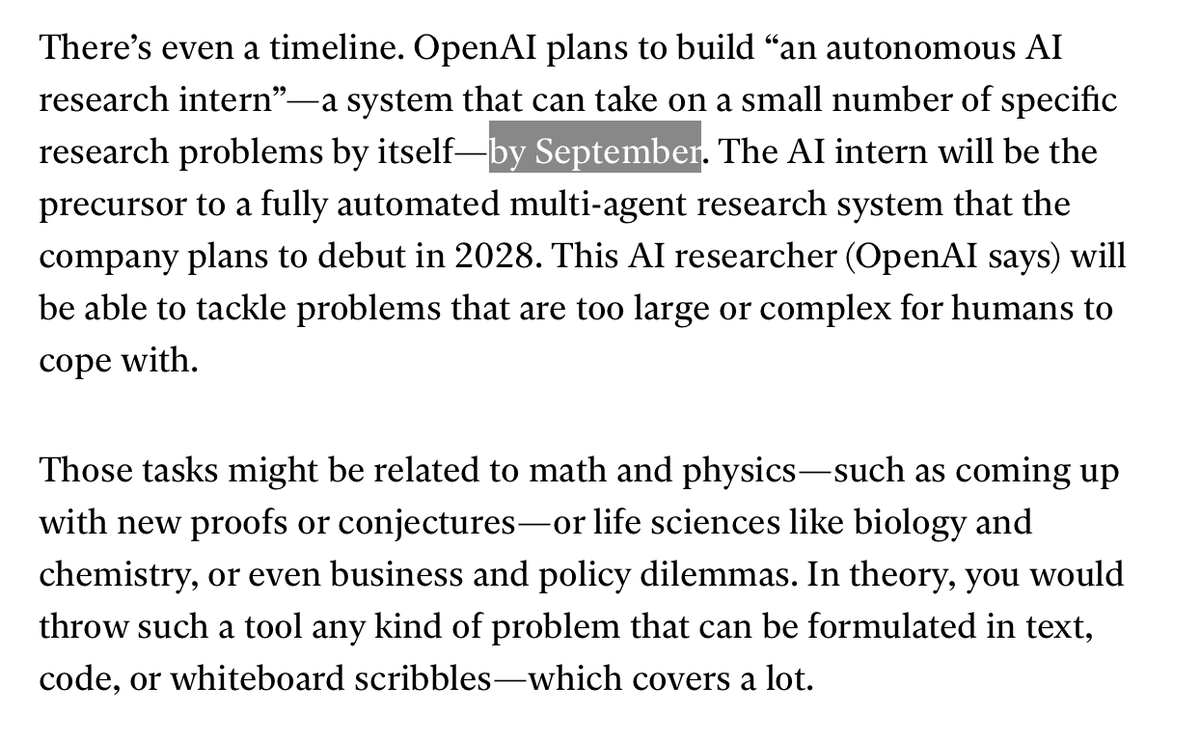
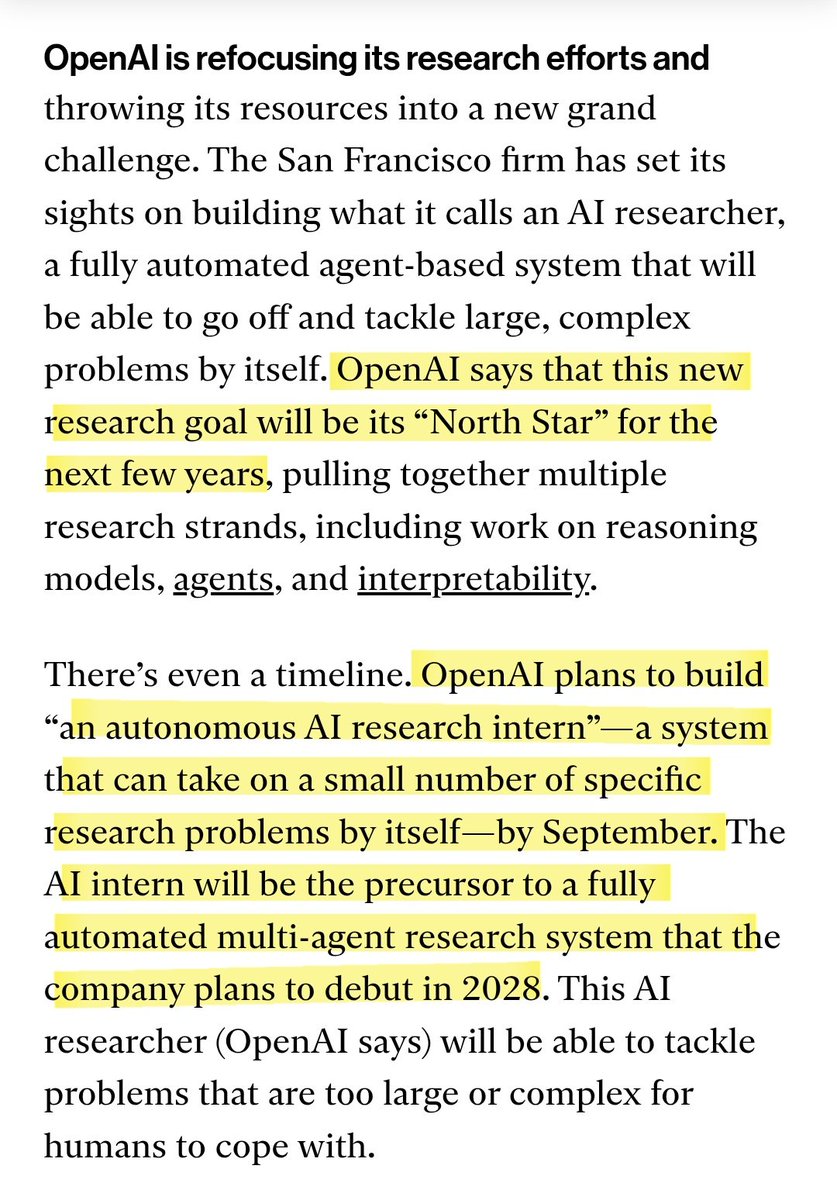
An exclusive conversation with OpenAI’s chief scientist Jakub Pachocki about his firm's new grand challenge and the future of AI. trib.al/2Lr8Kfh