g023
5K posts

Закреплённый твит

So I optimized the model, i optimized the harness, now I'm optimizing the endpoint by making an openai api to deepseek endpoint proxy that has some context compression features automatically integrated to attempt to save $$$ (works well with copilot):
gist.github.com/g023/c2bb7b540…
English

@merlinaudio_ I prefer it for remembering what was done where, but still like to make excuses to burn my opus rips.
English

@n3r4 @vineerpasam Yep. They pointed at a mazak and said can you program this, and I was like yup and bam I got that job. Modern problems = modern solutions and all.
English

that's a dumb interviewer.
As a machinist/fabricator for 30+ years. we dont ask ppl to recite the machinery handbook, or specifics on weld amperage/wire speeds or pen depth.. or all of gd&t or cad/cam post processors.
Even the most skilled 'engineers' cant answer them on the spot.
bottom line is.. can they use their tools.
id fire the interviewer. find someone that knows how to find talent.
English

My vibe coder friend built multiple AI apps over the past year. He went into an interview yesterday thinking the company would be impressed by his project showcase.
The interviewer asked him the difference between Git merge and Git rebase.
My friend has never even pushed code without Claude Code's help 😭
English


@RoyShilkrot ... also a lot less reading to see what it messed around with.
English

@RoyShilkrot it truly does help to isolate and work on the problem as a component, rather than the whole, for speed and token efficiency. Especially when dealing with smaller models for tasks.
English

@antirez @ivanfioravanti I have little faith in those benchmarks. Real life is the best test.
English

@ivanfioravanti No, if it misrepresents models in random ways, how is it good? Only because 5.5 happens to be on top?
English

@lmrankhan depending on the task, cleaving out the subagents altogether gives some surprisingly good results.
English

A lot of people are talking about running tons of agents, parallel workflows, skills, and orchestration layers.
Honestly, for building an app, I've found two coding agents running in async works perfectly fine, Codex for backend and Opus/Claude Code for frontend.
Haven't had to use more than that, skills, or complex workflows. The bottleneck is usually figuring out what to build, not how many agents you're running or using any of the advanced workflows.
I'm sure there are more advanced things people are doing, but for most MVPs or early stage products, simplicity works
English

at tencent (china’s largest internet company), the token reimbursement quota is dynamic.
the more you use, the more you get when it refreshes next month.
so… it kinda looks like you’re incentivized to build side projects at work? 😂😂
Zack Korman@ZackKorman
Companies are like "we are spending all this money on AI but we don't know what the devs are even doing with it." Let me answer that for you: They're working on their personal side projects.
English

@RoguePoma I share a lot of my things in public, and yes sometimes they are pretty raw but useful to me. Always like to learn from others too.
English

@shyamalanadkat I think what would qualify as AGI would be a session that is always on, has infinite history that doesn't need to be cleared, and carries out its business on its own, either seeding itself with roles, or being directed to a role as a seed role.
English

@rajyaligar @smhanov try using deepseek as a subagent and opus as orchestrator to stretch out the window
English
g023 ретвитнул

@antoniolupetti I'm working on a concept: an agent that maintains a large, external, sparse key-value memory (not vector database, but differentiable memory like a sparse Transformer memory layer) that is updated during a single long session compressing past into mem tkns & retrieve w/attention
English

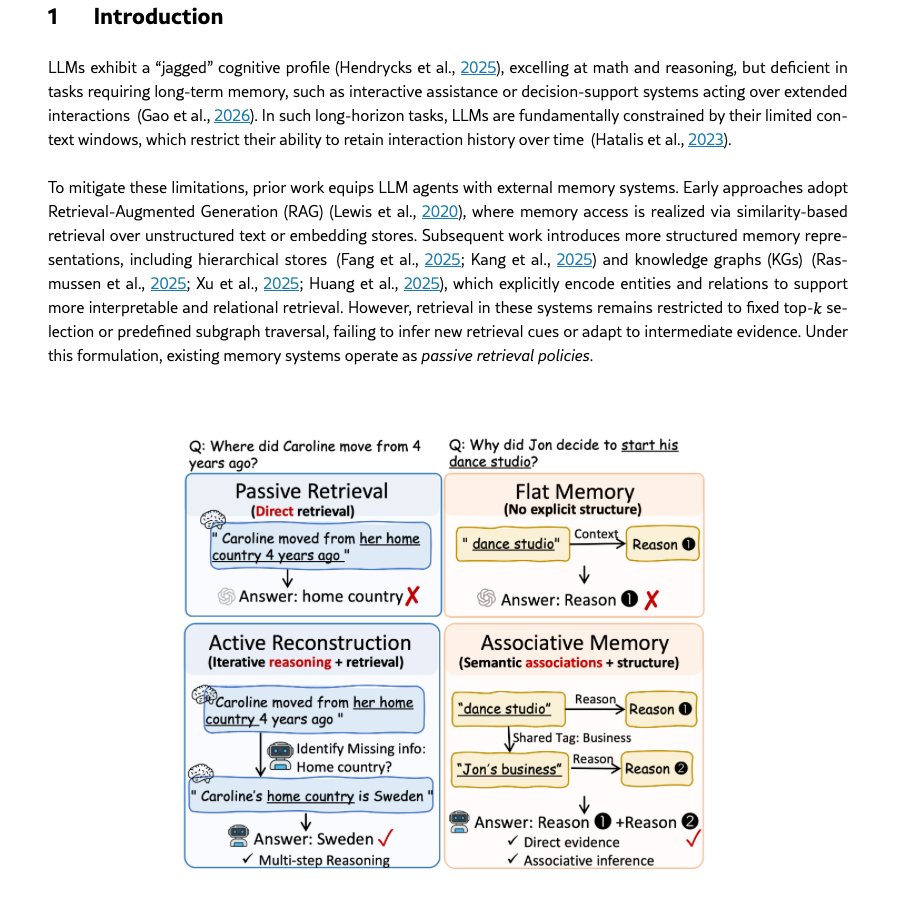
"Graph Memory for LLM Agents" is a recent paper that explores an idea that I find quite interesting. Most AI memory systems treat remembering as a retrieval problem (the model searches its memory, retrieves relevant information, and then reasons about it).
This paper argues that the process may be more dynamic than that and, instead of simply retrieving memories, an AI agent could reconstruct them during reasoning, following clues, associations, and intermediate evidence as they emerge.
What I find interesting is the possibility that memory and reasoning may not be separate processes at all, but that remembering itself could be part of reasoning.
arxiv.org/abs/2606.06036

English