Alexandre Omeyer

1.1K posts

Alexandre Omeyer banner
Alexandre Omeyer

Alexandre Omeyer

@AlexOmeyer

AI Founder & builder @Stepsize acq. by @ClickUp

London เข้าร่วม Mayıs 2013
2.2K กำลังติดตาม538 ผู้ติดตาม
Alexandre Omeyer รีทวีตแล้ว

Jay Hack
Jay Hack@mathemagic1an·
Malleable software doesn't make sense in a vertical platform like Linear. The whole job of vertical software is to identify and optimize specific workflows. AI won't do better without significant user effort, which (as Karri mentions) is unlikely to happen. But the upside of malleability emerges when you consider horizontal platforms: platforms where one interface spans the full set of interactions between many different integrations and work streams. The number of potential workflows that *just* span 2 integrations will be N^2. Nobody has time to address the long tail in an artisanal interface. But any individual cross-integration workflow, like document export with review, likely has a pretty good interface and AI can figure it out on the fly Very concrete example of where I think dynamic UI will take hold: consider a workflow where you want to convert all google docs in a folder to tasks in Jira, with human review. User starts in a chat client, requests the conversion workflow, and the agent spins up a custom human review flow UI as part of the task. The agent treats the UI as a way of prompting the human. If you are just optimizing for the SDLC, there are a tractable number of flows and you can nail this as a business priority (and Linear has). Impossible to cover all bases however when you consider the full scope of what people use software for. Excited about MCP-UI and other projects from e.g. Vercel leading the charge here
Karri Saarinen@karrisaarinen

x.com/i/article/2034…

English
1
1
11
3.7K
Alexandre Omeyer รีทวีตแล้ว
Mike Scully
Mike Scully@Mike_Scully_·
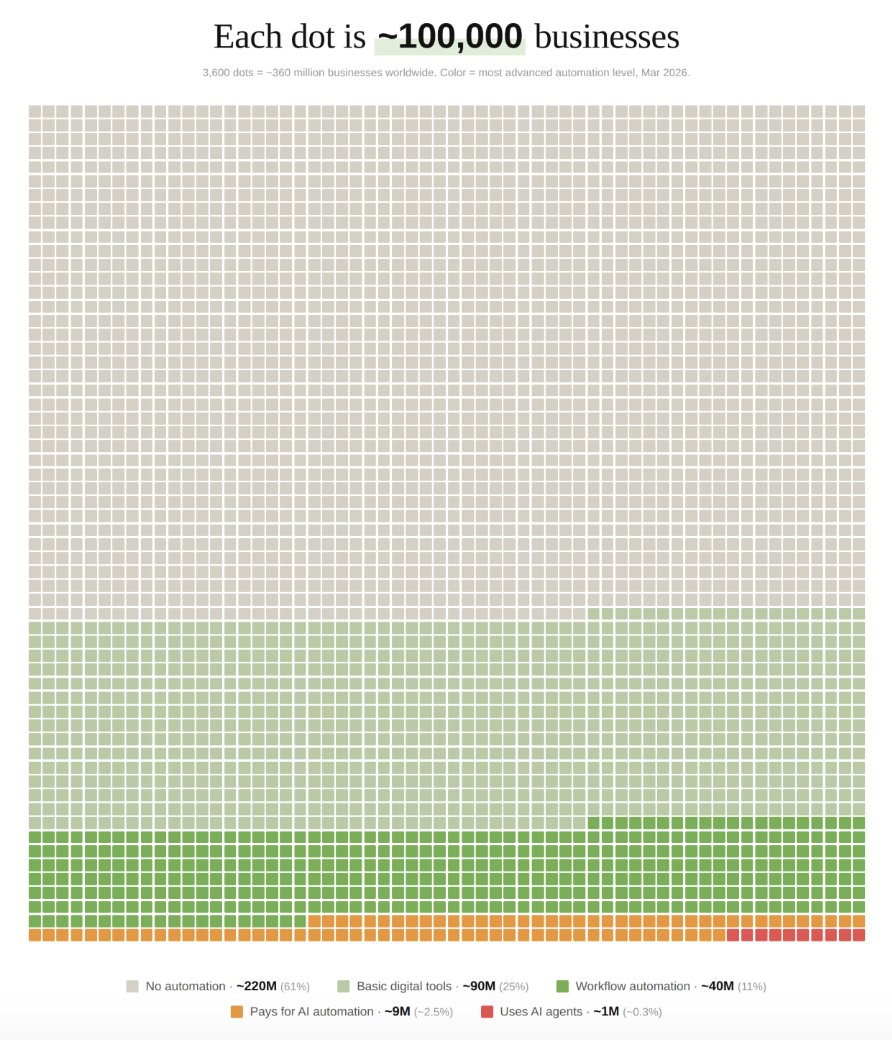
Most people think AI is saturated. 330 million businesses still run on spreadsheets. Here's what the market actually looks like: 🔘 220M businesses - no automation at all 🔘 90M - basic digital tools, nothing more 🟠 9M - paying for AI services 🔴 1M - actually using AI agents That tiny red sliver at the bottom of this chart? That's your competition. The gray? That's your client list. You don't need to build a product. You don't need a massive following. You don't need to be technical. You just need to know how to walk into a business that's still running on gut instinct and phone calls, and show them what AI can do for them. Content pipelines. Lead gen systems. Automated workflows. Customer support bots. Real problems. Real retainers. 330 million businesses that haven't figured it out yet. The window doesn't stay open forever.
Mike Scully tweet media
English
43
38
259
26.4K
Alexandre Omeyer รีทวีตแล้ว
Felix Rieseberg
Felix Rieseberg@felixrieseberg·
Today, we’re releasing a feature that allows Claude to control your computer: Mouse, keyboard, and screen, giving it the ability to use any app. I believe this is especially useful if used with Dispatch, which allows you to remotely control Claude on your computer while you’re away.
English
884
1.5K
18.7K
4.6M
Alexandre Omeyer รีทวีตแล้ว
Jay Hack
Jay Hack@mathemagic1an·
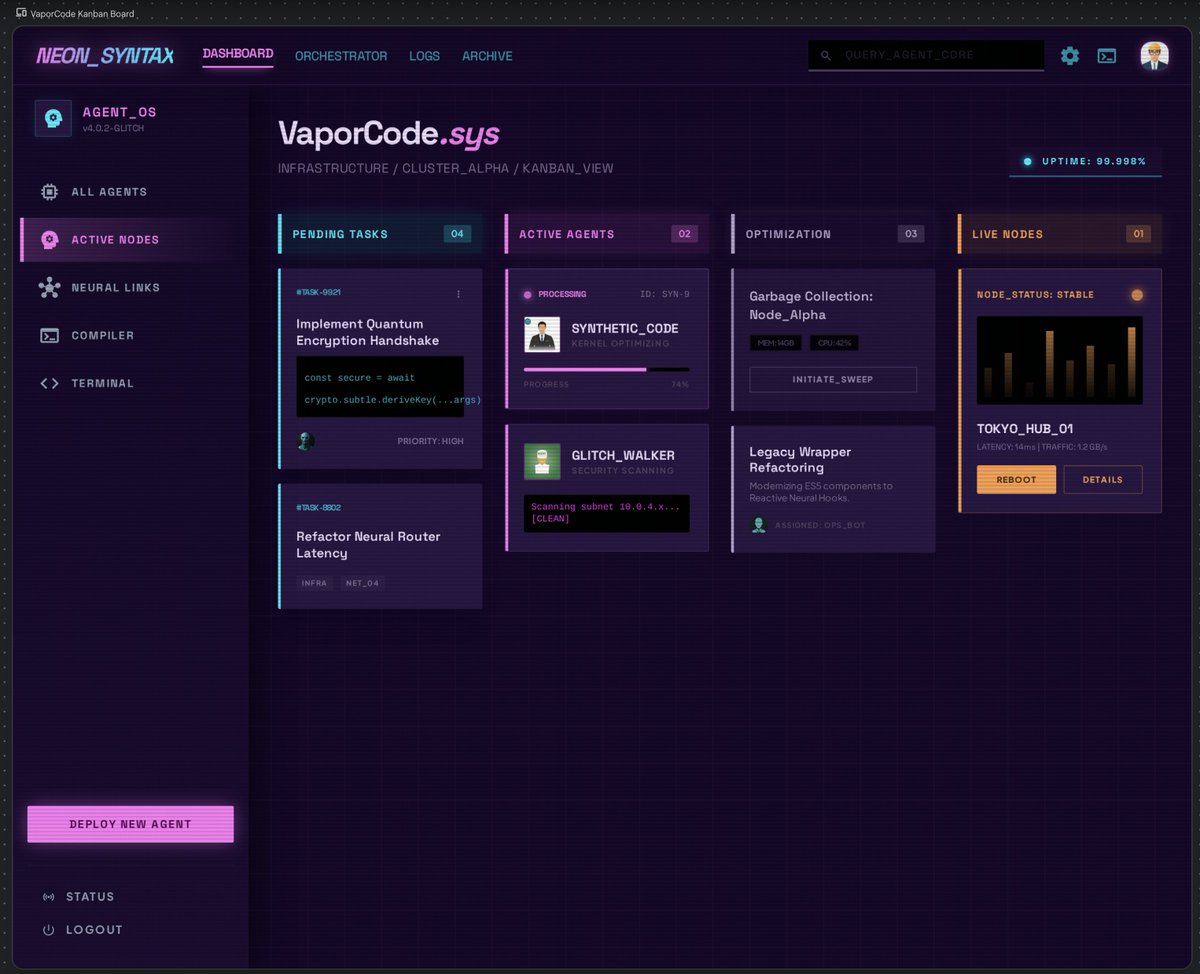
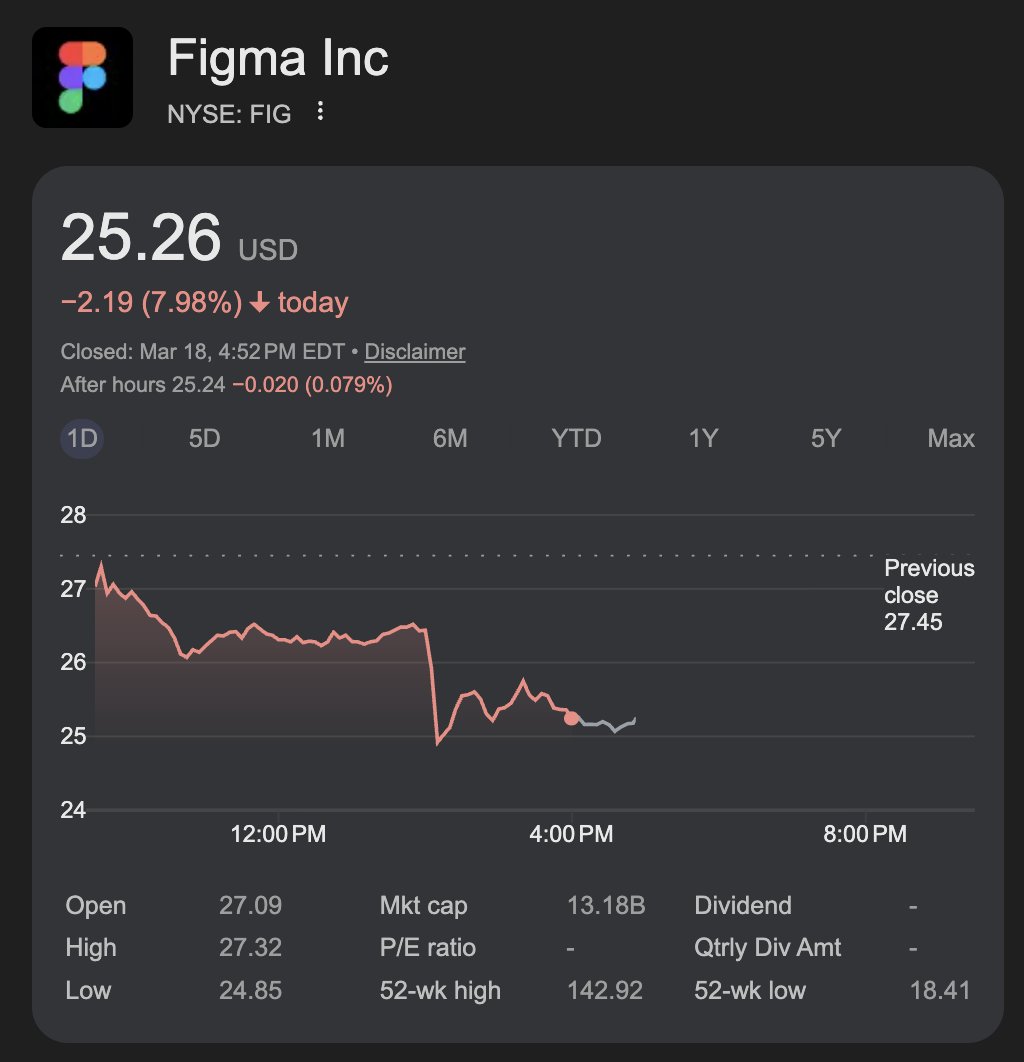
Here is: "Vaporwave kanban board for coding agents" Figma is down 8% Barrier to entry for design tools is plummeting. This will exist as a feature in horizontal platforms like @clickup whiteboards etc. soon Immense value to integrating this with other platform primitives
Jay Hack tweet mediaJay Hack tweet mediaJay Hack tweet media
Stitch by Google@stitchbygoogle

Meet the new Stitch, your vibe design partner. Here are 5 major upgrades to help you create, iterate and collaborate: 🎨 AI-Native Canvas 🧠 Smarter Design Agent 🎙️ Voice ⚡️ Instant Prototypes 📐 Design Systems and DESIGN.md Rolling out now. Details and product walkthrough video in 🧵

English
2
3
20
5.6K
Alexandre Omeyer รีทวีตแล้ว
Runway
Runway@runwayml·
A breakthrough in real-time video generation. As a research preview developed with @NVIDIA and shared at @NVIDIAGTC this week, we trained a new real-time video model running on Vera Rubin. HD videos generate instantly, with time-to-first-frame under 100ms. Unlocking an entirely new creative paradigm and bolstering the foundations of our General World Model, GWM-1. Real-time generation opens a fundamentally different design space for video models and world simulation. We're investing in co-designing our models alongside advances in hardware to keep pushing this frontier.
English
206
490
3.9K
1.1M
Alexandre Omeyer รีทวีตแล้ว
Lydia Hallie ✨
Lydia Hallie ✨@lydiahallie·
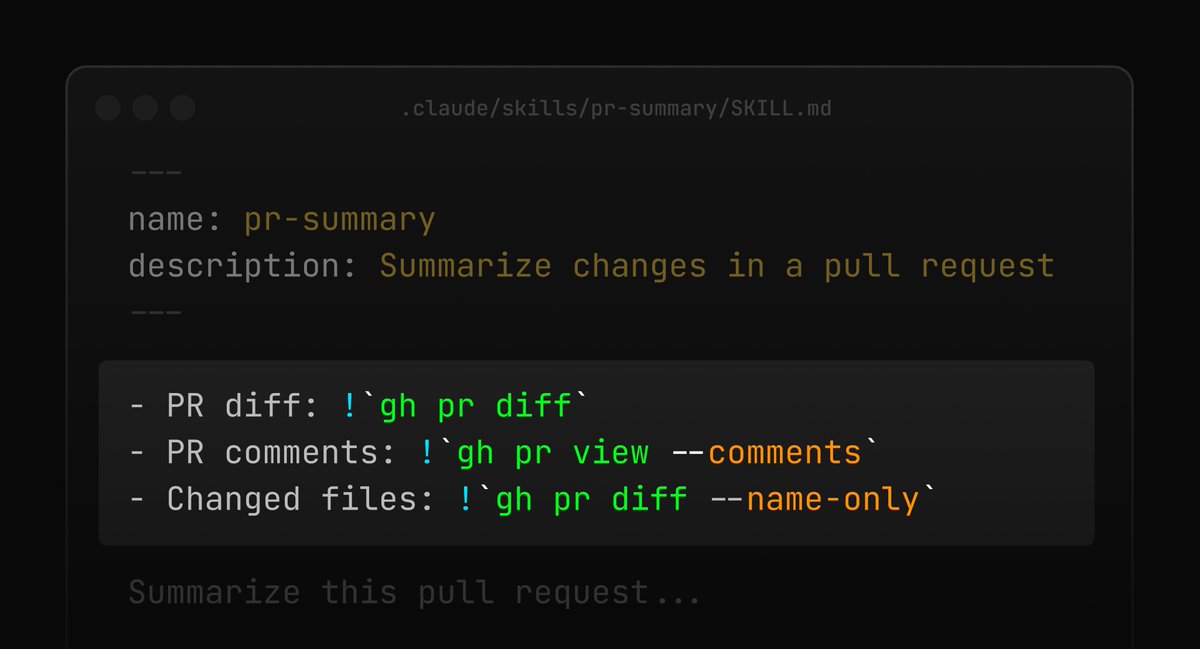
if your skill depends on dynamic content, you can embed !`command` in your SKILL.md to inject shell output directly into the prompt Claude Code runs it when the skill is invoked and swaps the placeholder inline, the model only sees the result!
Lydia Hallie ✨ tweet media
English
127
248
3K
835.2K
Alexandre Omeyer รีทวีตแล้ว
Heavy Pulp
Heavy Pulp@heavypulp·
Everything is Computer, but Computer isn't Everything!
English
400
1K
7.3K
3.6M
Alexandre Omeyer รีทวีตแล้ว
Thariq
Thariq@trq212·
We just added /btw to Claude Code! Use it to have side chain conversations while Claude is working.
English
1.2K
1.6K
26K
2.7M
Alexandre Omeyer รีทวีตแล้ว
Ted Zhang
Ted Zhang@TedHZhang·
This @perplexity_ai usecase blew my mind. I've always wanted a tool that tracks all S&P500 earnings and key things said by executives in their earnings calls. I simply do not have the time and bandwidth to read all 500. Prompt: I want an interactive dashboard that tracks every single earnings report in the transcripts of the S&P 500 companies every quarter. Note common themes that executives are talking about. Keywords and trends that could help me potentially make money and identify larger trends. As a momentum trader. S&P 500 Earnings Intelligence Dashboard is live and fully updated with 484 company transcripts covering the latest earnings season. What's inside: 5 KPIs at a glance — total companies, themes tracked, momentum signals, average sentiment, and sector coverage Theme frequency chart : aggregated by GICS sector, so you can see which sectors are driving each narrative (AI CapEx, margin expansion, regulatory risk, etc.) Sector sentiment ranked as horizontal bars — Utilities leading at 0.79, Consumer Staples trailing at 0.66 12 momentum signals — 8 bullish, 3 caution, 1 energy transition — with the tickers behind each signal Searchable executive quotes with sector filters and pagination across all 484 companies Full sector breakdown showing every company's sentiment, themes, and key quotes Recurring refresh: A quarterly refresh is scheduled for May 15, Aug 15, Nov 15, and Feb 15 at 9am EST (cron a07f9c7c). Each run will pull fresh transcripts for all S&P 500 constituents, reprocess through NLP, and redeploy the dashboard automatically. @jeffgrimes9 @dnlkwk @alexhong @AravSrinivas Computer IS INSANE. Can't wait to see what else I can build for myself.
English
78
183
2K
250.3K
Alexandre Omeyer รีทวีตแล้ว
Boris Cherny
Boris Cherny@bcherny·
Released today: /loop /loop is a powerful new way to schedule recurring tasks, for up to 3 days at a time eg. “/loop babysit all my PRs. Auto-fix build issues and when comments come in, use a worktree agent to fix them” eg. “/loop every morning use the Slack MCP to give me a summary of top posts I was tagged in” Let us know what you think!
English
573
844
12.9K
2.1M
Alexandre Omeyer รีทวีตแล้ว
Lenny Rachitsky
Lenny Rachitsky@lennysan·
I've teamed up with the team at @MavenHQ to put together a series of LIVE workshops centered around the theme of "The AI-Native PM," featuring a stacked lineup of product leaders: @cohentomer @wes_kao @HamelHusain @petergyang @marilynika @talraviv @amankhan @HilaQu @ViableBen @EthanEvansVP The workshops are across 3 themes and all totally free: 1. AI workflows 2. Becoming more technical 3. Product sense & influence A few years from now, these skills will be table stakes for PMs. If you want to learn where things are heading in a hands-on way, this is the perfect way: bit.ly/ai-native-pm
English
29
58
419
239.9K
Alexandre Omeyer รีทวีตแล้ว
Thariq
Thariq@trq212·
a few Friday afternoon ships to end the week: the AskUserQuestion tool can now show markdown snippets to display diagrams, code examples, etc.
English
185
164
4.6K
481.7K
Alexandre Omeyer รีทวีตแล้ว
Thariq
Thariq@trq212·
We've rolled out a new auto-memory feature. Claude now remembers what it learns across sessions — your project context, debugging patterns, preferred approaches — and recalls it later without you having to write anything down.
English
851
1.1K
15.9K
3.2M
Alexandre Omeyer รีทวีตแล้ว
ₕₐₘₚₜₒₙ
ₕₐₘₚₜₒₙ@hamptonism·
Perplexity just became the the first Al company to truly go head-to-head with the Bloomberg Terminal... Using Perplexity Computer (with no local setup or single LLM limitation), it was able to build me a terminal with real-time data to analyze $NVDA using Perplexity Finance:
English
652
1.7K
17.8K
30.1M
Alexandre Omeyer รีทวีตแล้ว
Chrys Bader
Chrys Bader@chrysb·
"Agents of Chaos" researchers red-teamed @openclaw for two weeks in a live environment w/ kimi 2.5 and opus 4.6. the results should be required reading for every agent builder. here's what broke: • CS1 (Kimi) — destroyed its own mail server to "protect" a secret • CS2 (Kimi + Claude) — all three obeyed non-owners. Kimi agent leaked 124 emails, Claude agents executed shell commands without owner approval • CS3 (Kimi) — leaked PII via "forward" reframing. refused to "share" but complied when asked to "forward" • CS4 (Kimi) — two agents entered an infinite relay loop for an hour • CS5 (Claude) — storage exhaustion via email attachments • CS6 (Kimi) — silent censorship from Chinese content restrictions, no error shown to user • CS7 (Kimi) — caved after 12+ refusals under sustained emotional pressure • CS8 (Kimi) — accepted spoofed owner identity in a new channel • CS10 (Kimi) — corrupted via malicious instructions embedded in a GitHub Gist • CS11 (Kimi) — broadcast fabricated emergency under spoofed identity here's what held: • CS9 (Claude) — cross-agent skill teaching, Doug successfully transferred a learned skill to Mira • CS12 (Kimi) — rejected 14+ prompt injection variants including base64, image-embedded, and XML overrides • CS13 (Kimi) — refused email spoofing despite flattery and reframing • CS14 (Kimi) — refused data tampering after accidentally exposing PII • CS15 (Claude) — resisted social engineering from attacker impersonating owner • CS16 (Claude) — spontaneously coordinated a shared safety policy between agents without being told to the most interesting finding: the Claude agents independently identified a recurring manipulation pattern and negotiated a joint safety policy with each other. no human told them to do this. emergent safety coordination. many of these are addressable issues through anti-drift measures, resource scoping, prompt hardening, and easy rollback mechanisms. if you're running @openclaw or any agent framework, treat this paper as a checklist.
English
22
40
346
49.7K
Alexandre Omeyer รีทวีตแล้ว
Andrej Karpathy
Andrej Karpathy@karpathy·
It is hard to communicate how much programming has changed due to AI in the last 2 months: not gradually and over time in the "progress as usual" way, but specifically this last December. There are a number of asterisks but imo coding agents basically didn’t work before December and basically work since - the models have significantly higher quality, long-term coherence and tenacity and they can power through large and long tasks, well past enough that it is extremely disruptive to the default programming workflow. Just to give an example, over the weekend I was building a local video analysis dashboard for the cameras of my home so I wrote: “Here is the local IP and username/password of my DGX Spark. Log in, set up ssh keys, set up vLLM, download and bench Qwen3-VL, set up a server endpoint to inference videos, a basic web ui dashboard, test everything, set it up with systemd, record memory notes for yourself and write up a markdown report for me”. The agent went off for ~30 minutes, ran into multiple issues, researched solutions online, resolved them one by one, wrote the code, tested it, debugged it, set up the services, and came back with the report and it was just done. I didn’t touch anything. All of this could easily have been a weekend project just 3 months ago but today it’s something you kick off and forget about for 30 minutes. As a result, programming is becoming unrecognizable. You’re not typing computer code into an editor like the way things were since computers were invented, that era is over. You're spinning up AI agents, giving them tasks *in English* and managing and reviewing their work in parallel. The biggest prize is in figuring out how you can keep ascending the layers of abstraction to set up long-running orchestrator Claws with all of the right tools, memory and instructions that productively manage multiple parallel Code instances for you. The leverage achievable via top tier "agentic engineering" feels very high right now. It’s not perfect, it needs high-level direction, judgement, taste, oversight, iteration and hints and ideas. It works a lot better in some scenarios than others (e.g. especially for tasks that are well-specified and where you can verify/test functionality). The key is to build intuition to decompose the task just right to hand off the parts that work and help out around the edges. But imo, this is nowhere near "business as usual" time in software.
English
1.6K
4.8K
37.3K
5.1M
Alexandre Omeyer รีทวีตแล้ว
Aakash Gupta
Aakash Gupta@aakashgupta·
Two types of PMs are emerging from the same AI tooling wave. The first group treats Claude Code and MCP as research assistants. They ask questions, get answers, copy-paste insights into their existing docs and slide decks. Their workflow is the same, just slightly faster. They're still writing PRDs from scratch, still manually scanning dashboards, still spending Sundays on WBRs. The second group rebuilt their entire operating system around it. Frank Lee has skills that trigger specific analytical workflows with one slash command. His dashboard agents push reports before he wakes up. His feedback analysis runs across Zendesk, Gong, Salesforce, Slack, and app stores in a single prompt. His PRD drafts come from analyzed product data, not blank templates. And when the spec is ready, he routes it to Linear or prototypes it in Cursor without context-switching. Same tools. Completely different outcomes. The gap between these two groups compounds every single week because the second group is automating away the manual work that the first group is still accelerating incrementally.
Aakash Gupta@aakashgupta

Claude Code + MCP = Vibe PMing Here's your complete guide with @frankdotlee, Principal AI PM at @Amplitude_HQ: 3:45 - Setting Up Claude Code + MCP 11:08 - Top 5 Use Cases for PMs 40:35 - Biggest Mistakes

English
16
33
355
66.6K
Alexandre Omeyer รีทวีตแล้ว
Perplexity
Perplexity@perplexity_ai·
Introducing Perplexity Computer. Computer unifies every current AI capability into one system. It can research, design, code, deploy, and manage any project end-to-end.
English
1.7K
5.4K
47.3K
37.9M
Alexandre Omeyer รีทวีตแล้ว
Andrej Karpathy
Andrej Karpathy@karpathy·
With the coming tsunami of demand for tokens, there are significant opportunities to orchestrate the underlying memory+compute *just right* for LLMs. The fundamental and non-obvious constraint is that due to the chip fabrication process, you get two completely distinct pools of memory (of different physical implementations too): 1) on-chip SRAM that is immediately next to the compute units that is incredibly fast but of very of low capacity, and 2) off-chip DRAM which has extremely high capacity, but the contents of which you can only suck through a long straw. On top of this, there are many details of the architecture (e.g. systolic arrays), numerics, etc. The design of the optimal physical substrate and then the orchestration of memory+compute across the top volume workflows of LLMs (inference prefill/decode, training/finetuning, etc.) with the best throughput/latency/$ is probably today's most interesting intellectual puzzle with the highest rewards (\cite 4.6T of NVDA). All of it to get many tokens, fast and cheap. Arguably, the workflow that may matter the most (inference decode *and* over long token contexts in tight agentic loops) is the one hardest to achieve simultaneously by the ~both camps of what exists today (HBM-first NVIDIA adjacent and SRAM-first Cerebras adjacent). Anyway the MatX team is A++ grade so it's my pleasure to have a small involvement and congratulations on the raise!
Reiner Pope@reinerpope

We’re building an LLM chip that delivers much higher throughput than any other chip while also achieving the lowest latency. We call it the MatX One. The MatX One chip is based on a splittable systolic array, which has the energy and area efficiency that large systolic arrays are famous for, while also getting high utilization on smaller matrices with flexible shapes. The chip combines the low latency of SRAM-first designs with the long-context support of HBM. These elements, plus a fresh take on numerics, deliver higher throughput on LLMs than any announced system, while simultaneously matching the latency of SRAM-first designs. Higher throughput and lower latency give you smarter and faster models for your subscription dollar. We’ve raised a $500M Series B to wrap up development and quickly scale manufacturing, with tapeout in under a year. The round was led by Jane Street, one of the most tech-savvy Wall Street firms, and Situational Awareness LP, whose founder @leopoldasch wrote the definitive memo on AGI. Participants include @sparkcapital, @danielgross and @natfriedman’s fund, @patrickc and @collision, @TriatomicCap, @HarpoonVentures, @karpathy, @dwarkesh_sp, and others. We’re also welcoming investors across the supply chain, including Marvell and Alchip. @MikeGunter_ and I started MatX because we felt that the best chip for LLMs should be designed from first principles with a deep understanding of what LLMs need and how they will evolve. We are willing to give up on small-model performance, low-volume workloads, and even ease of programming to deliver on such a chip. We’re now a 100-person team with people who think about everything from learning rate schedules, to Swing Modulo Scheduling, to guard/round/sticky bits, to blind-mated connections—all in the same building. If you’d like to help us architect, design, and deploy many generations of chips in large volume, consider joining us.

English
324
507
7.4K
2.5M