Nicki Win(gate)field Almquist

538 posts

Nicki Win(gate)field Almquist banner
Nicki Win(gate)field Almquist

Nicki Win(gate)field Almquist

@AlmquistNicki

Post Doc at University of Copenhagen, Department of Nutrition, Exercise and Sports. Focusing on Improving performance in elite athletes

Denmark, Copenhagen เข้าร่วม Ağustos 2017
296 กำลังติดตาม2.4K ผู้ติดตาม
Nicki Win(gate)field Almquist รีทวีตแล้ว

Øyvind Skattebo
Øyvind Skattebo@Skattebo_Oyvind·
Our latest review explores the key physiological factors limiting VO₂max and endurance performance 🚴‍♀️🏃 From oxygen delivery to muscle metabolism, we unpack what sets the upper limits of human performance 🚴‍♀️🏃 Read more: onlinelibrary.wiley.com/doi/epdf/10.11…
English
2
38
129
6.8K
Nicki Win(gate)field Almquist
Nicki Win(gate)field Almquist@AlmquistNicki·
@JornTrommelen Honestly, I am quite convinced that it has hypertrophic effects. And maybe not so modest as one might think. I saw indications of it signallingwise in my sprint studies and we saw a similar tendancy for CSA in our recent meta analysis (Mølmen et al. 2024). Please investigate Jorn
English
0
0
1
47
Jorn Trommelen, PhD
Jorn Trommelen, PhD@JornTrommelen·
@AlmquistNicki Thank you, Nicki. Not sure to be honest. Sprint training may have a hypertrophic effect, but if so, it seems likely to be smaller than many people expect. I would like to see more high-quality studies on SIT specifically. What is your view?
English
1
0
0
66
Jorn Trommelen, PhD
Jorn Trommelen, PhD@JornTrommelen·
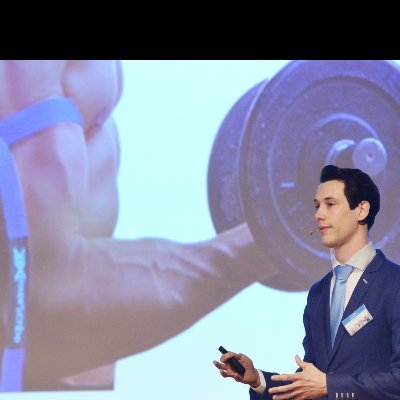
Does interval training boost muscle protein synthesis more than continuous exercise? HIIT vs MICT ✅ Within-participant design ✅ Unilateral cycling model ✅ MPS over 2 weeks International collab including: @mackingprof @gibalam Let’s break it down (1/10)
Jorn Trommelen, PhD tweet media
English
1
6
15
2.5K
Nicki Win(gate)field Almquist
Nicki Win(gate)field Almquist@AlmquistNicki·
As always, very relevant research questions and gold-standard methods used by @JornTrommelen et al. Interesting to see whether sprint training is any different with regards to stimulating MPS as previously speculated.
Jorn Trommelen, PhD@JornTrommelen

Does interval training boost muscle protein synthesis more than continuous exercise? HIIT vs MICT ✅ Within-participant design ✅ Unilateral cycling model ✅ MPS over 2 weeks International collab including: @mackingprof @gibalam Let’s break it down (1/10)

English
0
0
1
463
Nicki Win(gate)field Almquist
Nicki Win(gate)field Almquist@AlmquistNicki·
@JornTrommelen As always Jorn, fantastic use of methods and very interesting research questions. Considering the picture used and recent indications related to sprint training leading to a hypertrophic response - any considerations there? Do you believe sprint training is stimulus for mps?
English
1
0
1
59
Jorn Trommelen, PhD
Jorn Trommelen, PhD@JornTrommelen·
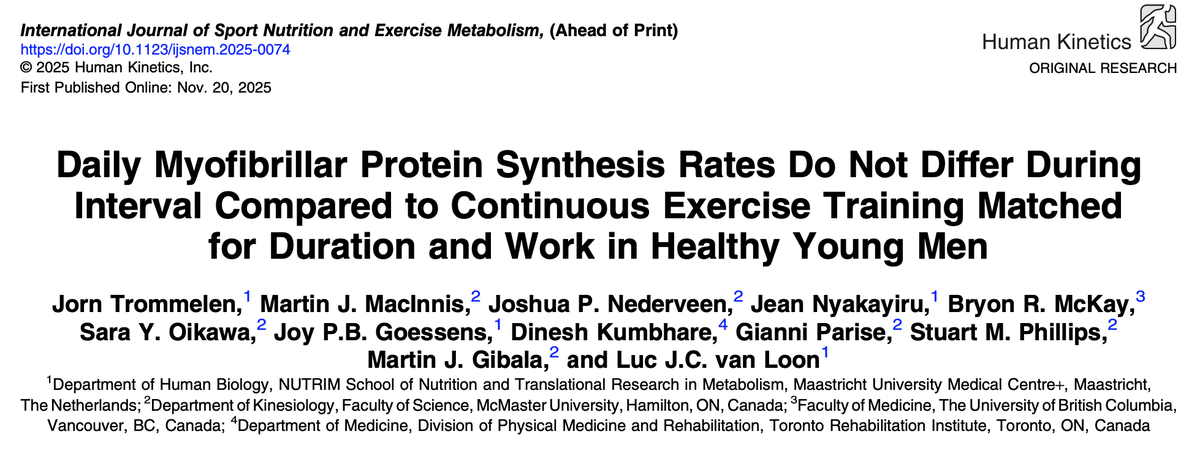
In conclusion, high-intensity interval training does not enhance myofibrillar protein synthesis rates when compared to volume- and duration-matched moderate intensity continuous exercise. Open-access link: journals.humankinetics.com/view/journals/… 9/10
Jorn Trommelen, PhD tweet media
English
2
2
5
708
Nicki Win(gate)field Almquist
Nicki Win(gate)field Almquist@AlmquistNicki·
“Males are more fit than females” or what? Have a look at this well designed study in highly trained athletes on the sex differences in VO2max, O2 extraction and cardiac output during strenuous exercise. The supreme peak of physiological invasive methods provided by @Skattebo
Øyvind Skattebo@Skattebo_Oyvind

Curious how cardiac output, leg blood flow, O₂ delivery & O₂ extraction differ between highly-trained females and males in limiting VO₂max? And impacts of normalizing for muscle mass? We examined this using thermodilution & blood gas analyses: physoc.onlinelibrary.wiley.com/doi/10.1113/JP… 1/8🧵

English
1
0
19
1.8K
Nicki Win(gate)field Almquist
Nicki Win(gate)field Almquist@AlmquistNicki·
Great post about recovery for trained cyclists. Co-ingestion of PRO and CHO «maximises» aminoacid availability without compromising resynthesis of liver glycogen. However, whether this translates to improved performance the next day or over time is still questionable IMO?
Javier Gonzalez@Gonzalez_JT

Co-ingesting whey protein with carbohydrates enhances post-exercise amino acid availability without compromising liver glycogen resynthesis Great work @sophie_hannon65 @Hearris @JamesyMorton @nathanhodson5 Read on for why this needed to be done... doi.org/10.1113/JP2884…

English
0
1
9
1.2K
Steve Magness
Steve Magness@stevemagness·
You've probably seen headlines: High-Intensity Training is superior to easy aerobic running. But dig deeper and you'll notice a pattern: most of these studies are short: just 4 to 8 weeks. A recent review tells a fuller story. In the early weeks, HIT and Sprint Interval Training outperform easy endurance training (ET). But over the long haul… the story changes
Steve Magness tweet media
English
30
97
631
264.6K
Nicki Win(gate)field Almquist
Nicki Win(gate)field Almquist@AlmquistNicki·
@stevemagness Thanks for sharing our meta: link.springer.com/article/10.100… Given the discussion in your feed I add som clarity. We did compare the effects of ET HIT and SIT when adjusting for time spent INCLUDING warm up, recovery and cool down. We also compared effects in different fitness levels.
Nicki Win(gate)field Almquist@AlmquistNicki

When normalizing %change in VO2max to total hours of exercise SIT was on average ~ 2.9 times more efficient than HIT and~4.9 times more efficient than ET, while HIT was ~ 1.7 times more efficient than ET. This trend SIT>HIT>ET was consistent across initial fitness levels.

English
0
1
15
1.2K
Nicki Win(gate)field Almquist
Nicki Win(gate)field Almquist@AlmquistNicki·
@novezain Are you suggesting that performing higher intensity training in the general population increases the risk of cardiovascular incidences? Many studies find it to be quite beneficial in prevention and treatment of that so wouldnt expect so.
English
0
0
0
28
Nicki Win(gate)field Almquist รีทวีตแล้ว
MYRA Center for Athlete Development
Many athletes think they fuel well. But self-reported “nutrition awareness” doesn’t match reality. Our new article dives into: 🧠 The knowledge gap ⚡️ What carbs actually do 📉 Why low-carb training often backfires open.substack.com/pub/myranorge/… A short thread👇
English
1
2
10
976
Nicki Win(gate)field Almquist
Nicki Win(gate)field Almquist@AlmquistNicki·
Do you remember to warm up properly? Warming up in the heavy intensity domain «postpones fatigue development» during exhaustive cycling. This is possibly related to a reduction in metabolite accumulation and altered sarcolemmal excitability. journals.lww.com/acsm-msse/abst…
English
1
14
78
6.4K
Nicki Win(gate)field Almquist รีทวีตแล้ว
Jem Arnold
Jem Arnold@jem_arnold·
Carb intakes are increasing, but there is a wide uncertainty range in how much we actually expend, dependent on absolute workload, relative intensity, and gross metabolic efficiency Which factor has the biggest influence depends on where we are on the map
Jem Arnold tweet media
English
3
27
118
18.2K
Nicki Win(gate)field Almquist
Nicki Win(gate)field Almquist@AlmquistNicki·
Does PRO+CHO enhance endurance performance? There remains no compelling evidence that co-ingesting PRO+CHO before/during exercise confer any advantage, nor facilitates the resynthesis of liver or muscle glycogen during REC when CHO recommendations are met link.springer.com/article/10.100…
English
0
7
39
1.8K
Nicki Win(gate)field Almquist
Nicki Win(gate)field Almquist@AlmquistNicki·
@dwrowland Highly depends on when the hyperhydration is in use and how the athletes are able to drink during a race. Hot and flat lead-in to a climb would hypothetically be beneficial.
English
0
0
0
101
Daniel Rowland
Daniel Rowland@dwrowland·
@AlmquistNicki Are you suggesting that there would be no benefit from this sort of hydration strategy? I would have thought that the weight could be significant for an uphill TT for example. But perhaps at the end of a mountain stage they would be in a better condition to perform?
English
1
0
1
189
Daniel Rowland
Daniel Rowland@dwrowland·
In female endurance athletes, sodium hyperhydration improved cycling performance in the heat without increasing heart rate or core temperature. The effect was strongest during the high-progesterone phase of the menstrual cycle. pubmed.ncbi.nlm.nih.gov/39591960/
English
1
1
24
1.7K
Nicki Win(gate)field Almquist
Nicki Win(gate)field Almquist@AlmquistNicki·
@dwrowland So one would expect that they gained weight and eventually that would potentially affect their up-hill performance negatively or be of no significans.
English
1
0
0
190
Daniel Rowland
Daniel Rowland@dwrowland·
@AlmquistNicki They did look at body mass (BM), and noted that "our findings suggest that acute BM gains from sodium-induced fluid retention do not impair female cyclists’ performance in controlled laboratory conditions". They didn't specifically look at W/kg as far as I could see.
English
1
0
1
158