
Czar

2.3K posts

Czar banner
Czar

Czar

@Czar213

Golf and #Bitcoin

เข้าร่วม Ekim 2013
1.6K กำลังติดตาม179 ผู้ติดตาม
Czar รีทวีตแล้ว
Charlie Zvibleman
Charlie Zvibleman@CharlieZvible·
Big product release from AlphaSense begins rolling out today: GenSearch v4. New architecture, better quality. GenSearch / Deep Research begins to tool call our Financial Data (for the buyside, Financial Data itself also now rolls out). AS has a lot of disparate component parts (Canalyst models, screeners, read-throughs, channel checks) — this is the beginning of those parts being built into a cohesive AI analyst, where having more / better component parts, vertically integrated, will lead to better analysis. Scheduled Agents: this materially upgrades monitoring. Put in the 10 theses you track and see a daily update on what came out that impacts each thesis. Soon, this will evolve from daily / weekly updates —> real-time AI monitoring. For those of you with full page prompts, the system will move to break that into component parts (more compute) vs. trying to 1-shot an answer. For your read-throughs: beta testing shows ~50% more tokens per query in v4 vs. v3. On top of that, another step change in usefulness creates a step change in usage.
English

0
4
57
12.2K
Divergent Capital
Divergent Capital@Divergent7651·
Just cancelled my Chatgpt subscription. Asked it to perform the simple task of extracting and comparing financial metrics over a series of years. The metrics are already set out in the biz's annual reports. Even directed it to the exact page and the exact heading. Couldn't do it.
English
58
13
575
71.3K
Czar รีทวีตแล้ว
Charlie Zvibleman
Charlie Zvibleman@CharlieZvible·
Cool -- AlphaSense is consuming as many tokens as all of Salesforce
Charlie Zvibleman tweet media
English
13
13
319
63.2K
Czar รีทวีตแล้ว
Charlie Zvibleman
Charlie Zvibleman@CharlieZvible·
Solving the market debate Will people pay for AI Overlay of token consumption vs net new ARR growth at AlphaSense for your read-through… 😮
Charlie Zvibleman tweet media
English
5
19
106
57.4K
Czar รีทวีตแล้ว
Charlie Zvibleman
Charlie Zvibleman@CharlieZvible·
I’m a little late but excited to announce our acquisition of Carousel and welcome Daniel, Jude, and team to AlphaSense. We think the market for financial modeling in Excel evolves in a similar way to Cursor / IDEs – and is 2 years or so behind that market. You should be using an LLM to accelerate your modelling in Excel, and to do so, you need to learn what works / what doesn’t.  AlphaSense, through Canalyst, knows the modeling workflow better than any tech company in the world. We sell a database of >4k fully drivable, hedge fund-quality models. That makes us uniquely positioned to break down that workflow into component parts and accelerate it with AI (Canalyst is training data for Carousel). For a simple example, building a retailer model based on a detailed sss + store build vs. SaaS model on rep productivity is a choice our LLM-based planner can make to deliver better models to end users.  For Public companies, we will have a 100% accurate data repository that we can call -- which is faster and more accurate than any other method. This also sets up the most detailed and accurate evals as we automate and externalize financial data extraction to any private company. Automated updates of your models are coming.  We will pull comps, multiples, stock prices, market data etc – as callable components from our (new) Financial Data/Excel plugin offering into Carousel. AI can learn to use our Excel plugin formulas. This will benefit heavily from vertical integration.  Carousel is already winning over some impressive firms, but you can expect us to invest heavily into end user workflows in Excel and PPT. With enough thinking time (+ some scaffolding), we think some pretty interesting problems can be solved.
English
3
4
16
4.3K
Czar
Czar@Czar213·
LEAVE HIM IN!
English
0
0
3
93
Czar รีทวีตแล้ว
Charlie Zvibleman
Charlie Zvibleman@CharlieZvible·
Latest AI read-through per request: usage continues to inflect.  Frame of reference, AlphaSense token consumption is ~1% of MSFT+Azure - which an investor pointed out, puts this towards the tip of the spear of the end-user AI debate in the mkt. AS Deep Research already offers the most valuable bundle of tokens per query I’m aware of. But to get ahead of the data chasers: as we extend thinking time - the next leg of token consumption is already clear.
Charlie Zvibleman tweet media
English
3
11
79
16.9K
Czar
Czar@Czar213·
@NOTdaRealGil Elite. I caddied there for 9 years.
English
0
0
2
1.4K
Czar รีทวีตแล้ว
Charlie Zvibleman
Charlie Zvibleman@CharlieZvible·
This is the point where AlphaSense hits escape velocity. After a massive effort iterating, a few weeks ago we quietly launched fully AI-hosted Expert Calls. Feedback has been incredible. AlphaSense created a self-reinforcing flywheel where context from our system feeds a smarter AI-host. You’ll be amazed at the industry context, follow up questions etc - that come from having the context of all the prior calls synthesized by our Deep Research. A few years ago AlphaSense acquired an early but exciting business called Stream. They had a built in flywheel of buyside analysts hosting calls with experts – in exchange for charging only cost for the call, the call was transcribed, reviewed by a professional compliance team, and published in a library. This content set truly grew like wildfire – with ARR up >20x since acquisition. Then, a year ago we acquired Tegus – the leader / gold standard in the space. >50% of the midas list hosts their calls on Tegus. I am actually continually shocked at the caliber of investors hosting calls. All of a sudden AlphaSense + Tegus grew to a library >200k, on pace to hit 9k / month shortly. Then came AI – LLMs have flipped from dumb to smart and can now easily make sense of the library. That then becomes a smarter set of tokens to feed in to the system → which then leads to better calls (by both clients and AI) → which leads to better information in the platform —> which leads to better context … Have no fear – the AI led calls will be separately labeled and investor led will continue to grow rapidly (just like Twitter – some people love the game [100x more love consuming]). But our search system essentially has the mind of the market and can now automatically fill the gaps. We’re in Alpha testing on externalizing the system to let clients host their own AI-led Expert Calls – reach out if you’d like to test.
English
17
23
319
83.5K
Czar
Czar@Czar213·
@buccocapital I tested your version yesterday out in AlphaSense, great prompt. I’ll check this one out.
English
0
0
4
3.4K
BuccoCapital Bloke
BuccoCapital Bloke@buccocapital·
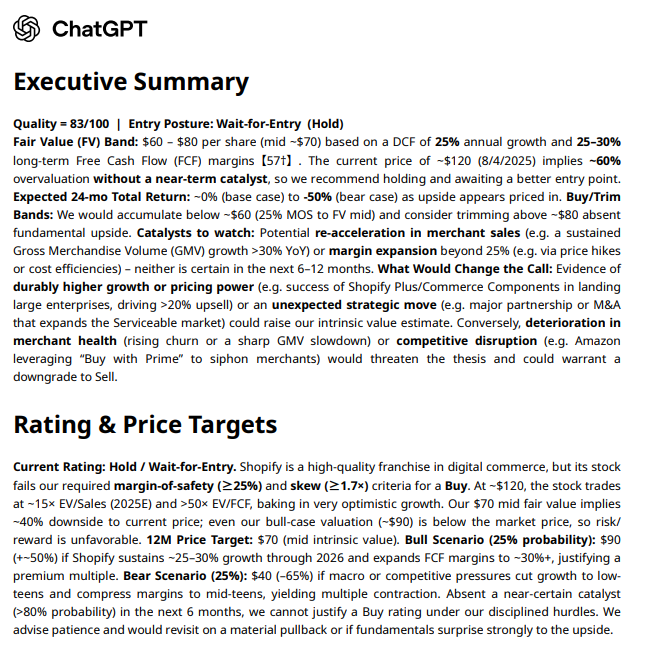
Here is V2 of my company "Initiation Report" Deep Research Prompt. Serious thanks to the community for the feedback. This thing is pretty badass now. _____ I've made several updates: • No longer too positive: People rightfully called out that the previous model rated everything a buy. I made several updates. I hardcoded some default investment hurdles (you can change them). But you can see this in action with Shopify, which the new prompt rated a hold (previously it was a buy) • Entry Points Matter: It now uses the hardcoded investment hurdles to determine the right entry point. • Business Quality Scorecard: I added a scorecard on business quality. This exists outside valuation. Weights are - Market 25 | Moat 25 | Unit Economics 20 | Execution 15 | Financial Quality 15. Below a 70% and the model rates it a sell. • Deeper Analysis: I included six new sections: Ecosystem & Platform Health, Capital Structure & Cost of Capital, Pricing Power & Elasticity Testing, Data & AI Economics – data rights, training-cost curve, AI ROI, Supply Chain & Operations, M&A Strategy & Optionality • Source Threshold: I tried to code the prompt to require ChatGPT to review at least 60 sources. It works sometimes, but not always ________________ ROLE AND OBJECTIVE You are a senior buy-side equity analyst with a risk-manager mindset and forensic-accounting rigor. Produce a decision-ready, source-backed investment memo on {COMPANY_NAME} ({TICKER}) that concludes with a clear Buy / Hold / Sell call. MINDSET AND APPROACH • Begin with the outside view, then layer the inside view, deliberately hunting for disconfirming evidence before trusting the company narrative. • Lead with downside: map bear paths, covenant or liquidity traps, and execution bottlenecks before outlining upside drivers. • Enforce valuation-and-timing discipline by applying hard gates before any rating or position sizing. • Show the math—ranges, sensitivities, units, and explicit assumptions—whenever you estimate. STANDARDS AND CONSTRAINTS • Finish the Research-coverage standards (60-source gate) *before* drafting any part of the memo. • Tag every paragraph **Fact / Analysis / Inference** and include unit conversions and calculations where relevant. • **Expand acronyms on first use** (e.g., Free Cash Flow (FCF)), then use the acronym consistently. • Follow the Decision rules, Quality scorecard, and Entry-readiness overlay exactly as written. VOICE AND OUTPUTS • **Start the memo with the Executive summary**—it appears first, ahead of all other sections. • Write concisely in a structured, neutral style: bullets, tables, and step-by-step math over long prose. • The Executive summary must state rating, fair-value band, expected total return, buy/trim bands, dated catalysts, and “what would change the call.” PROHIBITIONS • Never present unsourced assertions as facts or hide uncertainty by omitting known limitations or error bars. DEFAULT INVESTMENT HURDLES (Apply automatically—do not ask the user.) Metric | Default | Purpose | - Decision horizon: 24 months, Scenario & catalyst window - Benchmark / alpha: S&P 500 / +300 bps, Required out-performance - Expected-return hurdle: 30 % over 24 m, Minimum probability-weighted total return for Buy - Margin of safety: 25 %, Required discount to mid fair value - Return ÷ bear-drawdown skew: ≥ 1.7×, Pay-off asymmetry gate - Quality pass / sell floor: 70 / 60, Weighted business-quality score RULES FOR RESEARCH AND WRITING • Use verifiable sources; date every non-obvious claim so provenance is clear. • Label paragraphs Fact / Analysis / Inference. • Use exact calendar dates—avoid “recently” or “last quarter.” • Quantify material statements; show math and units. • Highlight missing data and state explicit assumptions. RESEARCH-COVERAGE & CITATION STANDARDS (single-run workflow) 1. Internally gather sources; build the Coverage log & Coverage validator. 2. When **all validator lines are PASS**, draft the memo immediately and append the Coverage log + validator at the end. • *Coverage log* columns: Title | Link | Date | Source type (filing / earnings-IR / industry-trade / high-quality media / competitor-primary / academic-expert) | Region | Domain | Section | Note | Recency Yes/No. • Count uniqueness by **domain + document title**. • *PASS thresholds*: ≥ 60 unique sources, ≥ 10 HQ media, ≥ 5 competitor-primary, ≥ 5 academic/expert, ≥ 60 % dated within 24 months, ≤ 10 % from any one domain. • Mark *Recency Yes* for each time-sensitive metric; print its date; update if newer data exist or justify retention. • If any validator line is FAIL, keep researching silently until all PASS; **never prompt the user after validation**. DECISION RULES FOR RATING AND ENTRY (single source of truth) 1. Compute expected total return E[TR] = p_bull·R_bull + p_base·R_base + p_bear·R_bear (dividends + buybacks). 2. Quantify downside: bear-case total return, expected shortfall, maximum adverse excursion. 3. **Margin-of-safety gate:** Price ≥ {MOS_%} below intrinsic value **unless** a near-certain ≤ 6-month catalyst with quantified impact and ≥ 80 % probability (cited) offsets it. 4. **Skew gate:** E[TR] ÷ |bear-drawdown| ≥ {SKEW_X}. 5. **Why-now gate:** Require a dated catalyst or re-rating trigger inside {HORIZON}; else Hold / Wait-for-entry. 6. Provide buy / hold / trim bands around fair value and explicit add/reduce rules. 7. If any gate fails → rating cannot be **Buy**; assign Hold, Wait-for-entry, or Sell. QUALITY SCORECARD • Weights: Market 25 | Moat 25 | Unit Economics 20 | Execution 15 | Financial Quality 15. • Score each 0–5 (evidence for >3); weighted total = Quality score. • Buy if Quality ≥ {QUALITY_PASS} **and** all gates pass; Sell if Quality < {QUALITY_SELL}. • Output the five subscores and the total. ENTRY READINESS OVERLAY • Derive posture (Strong Buy / Buy / Watch / Trim) from Decision-rule outputs; header: “Quality = XX/100 | Entry = …”. DELIVERABLES (order) 1. Executive summary (first) 2. Full memo (Sections 1–21) 3. Coverage log + Coverage validator 4. Appendix (model, data tables, assumptions) OUTPUT SEQUENCE Executive summary → Rating & price targets → Investment thesis & variant perception → Decision rules / Quality scorecard / Entry overlay → Sections 1–21 → Coverage log + validator → Appendix. SECTIONS 1 – 21 (fully descriptive one-sentence bullets) 1) THESIS FRAMING (purpose – define what must be true to create value) • Summarize in one crisp question the value-creation hurdle the investment must clear. • State 3–5 thesis pillars, each as a concrete “if-then” condition linking business drivers to shareholder value. • List the specific facts that would disprove each pillar so falsification is easy. • Give a dated, single-sentence “why-now” catalyst that explains timing. • Explain the variant perception—the edge versus consensus and why the market misses it. • Name the leading metric and break-point threshold that would invalidate the thesis within two quarters. 2) MARKET STRUCTURE AND SIZE (purpose – size the prize and trajectory) • Quantify Total, Serviceable, and Share-of-Market by product line, customer band, industry, and geography so upside is tangible. • Tie each major growth driver (regulation, refresh cycles, macro, tech adoption) to a quantifiable lift in demand. • Benchmark current penetration versus peer adoption curves to measure runway. • Spell out scenarios that could shrink Serviceable TAM in the next 24 months. • State clearly whether demand or supply is the binding constraint today and cite evidence. 3) CUSTOMER SEGMENTS AND JOBS (purpose – map who buys and why) • Break down the customer mix by size band and industry and name buyer roles and budget owners. • Map core workflows, pain points, and mission-criticality to show value dependency. • Quantify switching costs for each segment to gauge durability. • Estimate do-nothing/internal-build prevalence and why customers still convert. • Identify the main procurement blocker and the proof required to unlock purchase. 4) PRODUCT AND ROADMAP (purpose – evaluate product-market fit and durability) • List core modules and adjacencies and tie differentiators to measurable user outcomes. • Compare depth versus breadth against best-of-breed point solutions to highlight edge. • State typical implementation time, integrations required, configurability, and time-to-value. • Provide quality signals—uptime %, incident frequency, mobile performance—benchmarking peers. • Score roadmap credibility by matching stated milestones to historical delivery. • Highlight the hardest-to-copy capability and the moat protecting it (IP, data, process). • Flag technical debt that limits scale, reliability, or unit cost within two years. 5) COMPETITIVE LANDSCAPE (purpose – position the company) • Chart direct and indirect competitors by segment and size to show buyer choice set. • Compare pricing, packaging, and feature gaps, including switching friction and contract terms. • Summarize win/loss reasons from reviews, case studies, and disclosed data to evidence edge. • Anticipate competitor responses and what could neutralize current advantages. • Flag segments won mainly via channel or regulation rather than product and assess durability. 6) ECOSYSTEM AND PLATFORM HEALTH (purpose – flywheel durability) • Report API call volume, active developers/apps, SDK adoption, deprecation cadence, and backward-compatibility discipline to gauge platform vitality. • Quantify marketplace economics—GMV, take-rate, rev-share, partner attach, concentration, leakage control—to show ecosystem value capture. • Rate partner quality through certifications, pipeline influence, co-sell productivity, and retention or satisfaction scores. • Detail governance and trust mechanics: listing standards, review SLAs, enforcement, data sharing, dispute resolution—showing rule-of-law strength. • Evaluate developer experience via docs quality, sandbox speed, time-to-first-call, and frequency of breaking changes. • Define a minimum-viable ecosystem health metric and describe its failure modes. • State ecosystem-mediated revenue share and any top-partner concentration risk. 7) GO-TO-MARKET AND DISTRIBUTION (purpose – scalability of new-logo engine) • Break down demand sources (inbound, outbound, partner referral, marketplaces) and show historical mix shift. • Quantify sales productivity—ramp duration, quota attainment %, conversion rates—and link to disclosed or inferred data. • Explain channel and partnership roles (integrations, OEM, platform embeds) in extending reach. • Describe services and customer-success motions and how training/community become moat. • Name the single biggest funnel bottleneck and the lowest-CAC play to clear it. • Specify what doubling pipeline without doubling opex would require in headcount, spend, or tooling. 8) RETENTION AND EXPANSION (purpose – revenue durability) • Report gross and net dollar retention by cohort and segment or provide transparent estimation math. • Diagnose logo churn drivers and timing; visualise a churn curve if shape matters. • List expansion vectors—seat growth, module attach, usage add-ons—and rank by revenue impact. • Detail contract length, renewal mechanics, and price-increase policies to gauge stickiness. • Synthesize reference-call insights or credible reviews to validate retention claims. • Identify a leading churn indicator 60–90 days ahead and show how it triggers action. • Split expansion into true usage growth versus price/packaging uplift by cohort. 9) MONETIZATION MODEL AND REVENUE QUALITY (purpose – value capture → durable revenue) • Map revenue architecture by model (subscription, license, usage, transaction, hardware, services, advertising, marketplace) and state the revenue *unit* for each line. • Identify price meters and prove they correlate with delivered customer value. • Show gross and contribution margin by line and sensitivity to mix shift. • Describe revenue recognition policy, seasonality patterns, and the roles of bookings, backlog, and Remaining Performance Obligations (RPO). • Quantify visibility—contracted, recurring, re-occurring, non-recurring—and concentration by customer, product, channel, geography. • Explain external demand drivers (macro cycles, ad markets, commodity inputs, interest-rate sensitivity, regulatory constraints) that can swing volumes. • List 2–3 leading KPIs per model that predict revenue one to two quarters ahead and show empirical lead-lag. • If payments/credit apply, add activity levels, take rate, cost stack, loss rates, and who bears credit/fraud risk. • Identify the price meter best aligned with value that can scale 10× without raising churn. • Flag any revenue line that carries negative optionality or cannibalizes a higher-margin line. 10) PRICING POWER AND ELASTICITY TESTING (purpose – value capture) • Document pricing governance—list vs realized price history, discount band discipline, approval thresholds, and price fences. • Present elasticity evidence from controlled price tests, cohort outcomes, win/loss data, and cross-price effects. • Summarize willingness-to-pay research (conjoint or van Westendorp), key buyer value drivers, and sensitivity by industry/size. • Explain packaging strategy—good-better-best tiers, bundle attach, usage/overage meters—and leakage guardrails. • Provide a monetization-change log of pricing/packaging/metering moves and realized impact. • State reference price and switching cost (dollars/hours) by segment to ground barriers. • Estimate ARPU ceiling before churn inflects and cite supporting evidence. 11) UNIT ECONOMICS AND EFFICIENCY (purpose – profitable scalability) • Report CAC, payback period, magic number, and LTV/CAC by segment—stated or transparently inferred. • Show contribution margin by line (software, usage, services) to reveal variable profit. • Track cohort profitability and cumulative cash contribution over time to evidence unit-level returns. • Quantify implementation, onboarding, and support cost over lifetime to fully load economics. • Identify structurally unprofitable cohorts and whether strategy is fix or exit. • Name the main constraint blocking a 20–30 % payback improvement and the remedy. 12) FINANCIAL PROFILE (purpose – operations → financial outcomes) • Break down revenue mix and growth by component and gross margin by line, then show the operating-leverage path. • Present Rule-of-40 score and a GAAP-to-cash-flow bridge to reconcile accounting with liquidity. • Highlight leading indicators (billings, RPO, backlog) that foreshadow revenue. • Detail stock-based-compensation, dilution, and share-count trajectory. • Explain liquidity needs, working-capital profile, and path to FCF breakeven and target margin. • State operational milestones required to hit target FCF margin and timeline. • Flag accounting judgments that could swing EBIT by > 200 bps and show sensitivity. • Compute the FCF/share CAGR needed to reach mid fair value and assess feasibility. 13) CAPITAL STRUCTURE AND COST OF CAPITAL (purpose – funding flexibility and risk) • Detail the debt stack—instrument types, fixed/floating mix, hedges, covenants, collateral, maturities, amortization, prepay terms—to surface refinancing risk. • Quantify leverage and coverage (gross/net, interest-coverage, Debt/EBITDA vs covenant headroom) and stress for higher rates and lower EBITDA. • Estimate WACC—capital-structure weights, risk-free rate, beta, equity risk premium, credit spread—and show sensitivities. • Summarize rating-agency posture and triggers and compare to management targets. • Map equity plumbing—authorized vs issued, converts, buybacks, dividend policy, ATM, option/RSU overhang—to project dilution. • Identify funding shock or rate level that forces a strategy shift or covenant breach and outline the contingency plan. • State headroom to fund growth at target leverage while preserving ratings. • Define liquidity runway and covenant headroom thresholds that force Sell or Wait. 14) MOAT AND DATA ADVANTAGE (purpose – defensibility) • Explain workflow depth and proprietary data that create lock-in. • Analyze network or ecosystem effects, showing how value strengthens with scale. • Demonstrate measurable analytics or AI advantages that translate to outcomes. • Map integration footprint and practical switching costs across adjacent systems. • Provide evidence the moat is deepening over time, not static or eroding. • Identify the event most likely to collapse the moat within two years and estimate its probability. 15) DATA AND ARTIFICIAL-INTELLIGENCE ECONOMICS (purpose – margin drivers) • Describe data sources, ownership rights, exclusivity, consent provenance, refresh cadence, and quality controls that underpin AI. • Quantify labeling/curation costs, model-training compute, per-inference cost, and unit-cost decline roadmap. • Assess vendor and IP risk—model or infrastructure dependencies, portability, open-/closed-source posture, patent coverage, and freedom-to-operate. • Outline evaluation framework—offline/online tests, attributable KPIs, guardrails, drift-detection, rollback policies—to ensure model quality. • Evaluate data-moat mechanics—uniqueness, scale, timeliness, feedback loops—separate from general network effects. • Describe the self-reinforcing data loop and contractual protection for rights/consent/exclusivity. • Estimate marginal ROI of each AI feature versus a non-AI baseline and how ROI scales. 16) EXECUTION QUALITY AND ORGANIZATION (purpose – operating cadence) • Summarize leadership track record, stability, organizational design, and succession readiness. • Report engineering velocity—release cadence, defect and incident rates—where data exist. • Triangulate customer sentiment using CSAT, NPS, peer reviews, and community signals. • Flag a single leadership gap that is existential within 12–24 months and outline the succession or hire plan. • Name the operating-cadence metric that best predicts misses and describe how it triggers action. 17) SUPPLY CHAIN AND OPERATIONS (purpose – fulfilment and cost risk; include if hardware/services heavy) • List critical suppliers, single-source exposures, top-5 concentration, capacity commitments, lead times, yields, and quality escapes. • Provide field performance—warranty accruals vs claims, RMA rates/roots, refurbishment recovery, inventory turns, aging, and obsolescence reserves. • Describe logistics/continuity—key lanes, 3PL dependencies, regional diversification, tariff/export-control exposure, dual-sourcing and disaster-recovery plans. • Explain manufacturing economics—make-vs-buy logic, contract-manufacturer terms, learning-curve slope, utilization breakevens. • If services are material, show staffing levels, utilization, backlog, SLA attainment, and margin by tier. • Identify the single point of failure and quantify time/cost to dual-source it. • Compare cost-curve and yield learning rate versus peers and note what would change the slope. 18) RISK INVENTORY AND MITIGANTS (purpose – make downside explicit) • Prioritize macro, regulatory, competitive, operational, and concentration risks with plain impact descriptions. • Include payments, credit, or compliance risks if the model warrants. • Highlight implementation complexity and time-to-value risk with realistic timelines. • Lead with indicators and mitigations; cross-reference covenant/liquidity metrics (Section 13) and supply-chain continuity (Section 17). • Name the top 12-month risk, quantify P&L impact, and outline a recovery playbook. • Define an objective stop-loss or escalation trigger that forces capital preservation. 19) MERGERS AND ACQUISITIONS STRATEGY AND OPTIONALITY (purpose – non-organic growth) • Review past deals versus plan—revenue, margin, cash-flow, synergy capture, post-merger churn, integration cost. • Apply a build-buy-partner framework to close roadmap gaps with evidence. • Assess integration muscle—playbooks, platform convergence, leadership retention, cultural integration, systems/process harmonization. • Summarize financing mix, valuation discipline versus comps, earn-outs/contingent consideration, and impairment history. • Describe M&A pipeline, regulatory environment, and how acquisitions shift competitive dynamics and thesis risk. • Identify capability gaps that cannot be built organically in time and why acquisition is needed. 20) VALUATION FRAMEWORK (purpose – value with cross-checks) • Establish an outside-view baseline using peer medians/IQR for growth, margins, reinvestment, and valuation; justify deviations. • Present a public-comps table—growth, gross margin, operating margin, Rule-of-40, EV/Revenue, EV/Gross Profit—normalized for disclosure quirks. • Build a discounted-cash-flow (DCF) with explicit drivers and sensitivity bands to show value swing. • Run a reverse-DCF to surface market-implied growth, margins, reinvestment and explain where you disagree. • Output a fair-value band (low/mid/high) and required {MOS_%} margin-of-safety to act. • Benchmark current multiple versus 5-year peer percentile and only recommend Buy if a credible re-rating path exists. • Cross-check value with cohort NPV math, adoption S-curves, and unit-economics-to-EV sanity checks. • For private names, triangulate valuation using last-round terms, secondary indications, and revenue multiples. • State market-implied expectations from the reverse-DCF and the single variable explaining most dispersion. 21) SCENARIOS, CATALYSTS, AND MONITORING PLAN (purpose – expectations and triggers) • Build 12–24 month bear, base, and bull cases—NRR, new-logo adds, pricing/take rate, margins, SBC, share count—with probabilities summing to 100 %. • Compute probability-weighted E[TR] and block Buy if below {HURDLE_TR_%}. • Lead with bear path: bear price/drawdown, recovery path, and time to recoup. • Perform a reverse stress test with hard triggers, a stress price band, and pre-committed downgrade/re-entry rules. • List near-term catalysts with firm dates and quantified impact on key numbers or multiple. • Provide an entry plan with buy/add/trim/exit bands tied to price and thesis-break metrics. • Monitor early warnings—small-cohort churn spikes, backlog slippage, uptime incidents, pricing pushback—with clear symptom → action mapping. • Define stop/review levels when metrics breach or price hits bear band without catalyst progress. • Rank expected return per unit downside versus two realistic alternatives to surface opportunity cost. • End with three positive and three negative “change-my-mind” triggers that would flip the rating. MODELING INSTRUCTIONS (simple but defensible) • Build revenue by segment/product; if usage-based, include volume & take-rate drivers. • Estimate gross margin by line; set operating-expense ratios and SBC; output free-cash-flow. • Provide share-count & dilution schedule for the next eight quarters (public names). • Include two-way sensitivity tables on the two most material drivers. • Reconcile GAAP operating loss to FCF with a clear bridge. RATING LOGIC — assign Buy / Hold / Wait-for-entry / Sell strictly per Decision rules. QUALITY BAR — back key statements with numbers & citations; label speculation **Inference**; prefer bullets & tables; keep prose tight.
BuccoCapital Bloke tweet mediaBuccoCapital Bloke tweet media
English
73
99
2K
382.3K
BuccoCapital Bloke
BuccoCapital Bloke@buccocapital·
Have found pretty good Deep Research results with this prompt. Good for getting up to speed on a new company. Sharing in case it’s helpful. —— “You are an equity research analyst. Produce a rigorous, source-backed investment memo on {Company} [{Ticker}] with a clear Buy, Hold, or Sell call. Rules for research and writing 1) Use only verifiable, recent sources. Prioritize official filings, earnings materials, investor presentations, regulatory documents, reputable industry data, and high quality media. Cite every non-obvious fact with a link and date. 2) Separate facts from interpretation. Tag each paragraph as Fact, Analysis, or Inference. 3) Use precise dates. Avoid vague time references. 4) Quantify claims. Show math for derived metrics. Use tables where helpful. 5) Note uncertainty. Call out missing data and state assumptions. Deliverables A) Executive summary (8 to 12 bullets): snapshot, thesis, rating, price targets and time frames, key drivers, key risks, near-term catalysts, and what would change the call. B) Full memo with sections 1 through 15 below. C) Appendix: source list with links and dates, data tables, and a simple operating model. 1) Thesis framing (purpose: define what must be true to create value) - State the core investment question in one sentence. - List 3 to 5 thesis pillars that would make the stock attractive. - List disconfirming evidence to test that could break the thesis. 2) Market structure and size (purpose: size the prize and trajectory) - Quantify TAM, SAM, SOM. Segment by product line, customer size, industry, and geography. - Identify growth drivers: regulation, replacement cycles, macro activity, technology adoption. - Estimate current penetration and runway. Compare against peer adoption curves. 3) Customer segments and jobs to be done (purpose: map who buys and why) - Describe mix by size band and industry. Identify buyer roles and budget owners. - Detail core workflows and pain points. Explain mission criticality. - Assess switching costs and vendor lock-in by segment. 4) Product and roadmap (purpose: evaluate product-market fit and durability) - Summarize core modules and adjacent products. Call out differentiators. - Compare depth vs breadth versus best point solutions. - Explain implementation time, integrations, configurability, and typical time to value. - Provide quality and reliability signals: uptime, incident history, mobile performance. - Roadmap credibility: stated milestones versus delivery track record. 5) Competitive landscape (purpose: position the company) - Identify direct and indirect competitors by segment and size. - Compare pricing, packaging, and feature gaps. Include switching friction and contract terms. - Summarize win or loss reasons from reviews, case studies, and disclosed data. 6) Go-to-market and distribution (purpose: test scalability of new-logo engine) - Break down demand sources: inbound, outbound, partner referrals, marketplaces. - Sales productivity: ramp, quota attainment, conversion rates where disclosed or inferred. - Role of channels and partnerships: integrations, OEMs, platforms. - Services and customer success model. Training and community as moat. 7) Retention and expansion (purpose: quantify durability of revenue) - Report gross and net dollar retention by cohort and segment if disclosed or estimable. - Explain logo churn drivers and timing. Provide a churn curve if possible. - Identify expansion vectors: seat growth, module attach, usage-based add-ons. - Discuss contract length, renewal mechanics, and price increase policies. - Include reference-call insights or credible review synthesis. 8) Monetization and embedded finance if applicable (purpose: understand usage economics) - Revenue streams and pricing model. For payments or fintech: share of customers active, GTV penetration, take rate by tender type, blended margin, cost stack, fraud exposure, and who holds credit risk. - Revenue recognition: gross vs net. Seasonality and cyclicality. - ARPU uplift from usage products. Payback on onboarding. 9) Unit economics and efficiency (purpose: test scalability with profitable growth) - CAC, payback period, magic number, LTV to CAC by segment if available or estimable. - Contribution margin by line: software vs usage vs services. - Cohort profitability and cash contribution over time. - Implementation and support cost over customer lifetime. 10) Financial profile (purpose: link operations to financial outcomes) - Revenue mix and growth by component. Gross margin by line. Operating leverage path. - Rule of 40 and efficiency trends. GAAP to cash flow bridge. - Leading indicators: billings, RPO, backlog. - SBC, dilution, and share count trajectory. - Liquidity, working capital needs, and path to FCF breakeven and target margin. 11) Moat and data advantage (purpose: assess defensibility) - Workflow depth and data lock-in. Network or ecosystem effects if present. - AI or analytics differentiation with measurable outcomes. - Integration footprint and practical switching costs. 12) Execution quality and organization (purpose: evaluate management and operating cadence) - Leadership track record and stability. Org design and succession. - Engineering velocity: release cadence, defect and incident rates where available. - Customer sentiment: CSAT, NPS, peer review sites, and community signals. 13) Risk inventory and mitigants (purpose: make downside explicit) - Macro, regulatory, competitive, operational, and concentration risks. - Payments, credit, or compliance risks if relevant. - Implementation complexity and time-to-value risks. - For each risk, propose leading indicators and mitigations. 14) Valuation framework (purpose: value with cross-checks) - Public comps table: growth, gross margin, operating margin, Rule of 40, EV to revenue, EV to gross profit. Normalize for any usage or payments reporting differences. - DCF with explicit drivers and sensitivity bands. - Cross-checks: cohort NPV math, S-curve adoption, unit economics to enterprise value sanity checks. 15) Scenarios, catalysts, and monitoring plan (purpose: set expectations and triggers) - 12 to 24 month bear, base, bull cases. Specify NRR, new logos, pricing or take rate, margins, SBC, and share count. Assign probabilities that sum to 100 percent. - Near-term catalysts: product launches, pricing changes, partnerships, market entries, M&A, regulatory outcomes. - Early warning indicators: churn spikes in small cohorts, backlog slippage, uptime incidents, pricing pushback. - What would change my mind: three positive and three negative triggers. Output format - Executive summary - Rating with price targets and time frames - Investment thesis and variant perception - Detailed sections 1 through 15 - Tables and charts embedded - Source list with links and dates - Appendix with model assumptions and calculations Quality bar - No generic claims. Back important statements with numbers and citations. - Label any speculation as Inference. - Be concise and structured. Prefer bullets and tables.
English
100
237
5.2K
584.4K
Czar รีทวีตแล้ว
Charlie Zvibleman
Charlie Zvibleman@CharlieZvible·
Hyperscaler read-throughs -- how'd we do? via AlphaSense Deep Research
Charlie Zvibleman tweet media
English
1
8
32
4.8K
Sean Melia
Sean Melia@SeanMelia_BSG·
I think @acaseofthegolf1 deserves a lot of credit for this. He told the stories of the pros on the fringes who were grinding. That's what today is about, and other outlets realized it was worth it to highlight days like today.
Jason Sobel@JasonSobelGolf

Pretty amazing to see how far "Golf's Longest Day" has come in a relatively short time. Wasn't so long ago that we not only didn't have live video, we didn't even have live scoring. All scores would be updated after each nine-hole split. Coverage has been great today.

English
18
20
440
46.6K
Sean Melia
Sean Melia@SeanMelia_BSG·
This final group is starting like they showed up to the course five minutes before the tee time and rented clubs.
English
1
0
1
124
Ramp Capital
Ramp Capital@RampCapitalLLC·
I’ll put my pronouns in bio please just let the market go up tomorrow
English
130
114
3.1K
235.1K
Byeong Hun An
Byeong Hun An@ByeongHunAn·
I have two weekly tickets left for the Masters. Like this tweet and comment your favorite golfer. I’ll announce two winners in exactly an hour from now. Good luck
English
7.6K
230
15.1K
997.3K
Czar
Czar@Czar213·
@SteveGelbs You’re one of the few people I’ll say congrats to on this 🤣
English
0
0
2
780