Robert Goulden

181 posts

Robert Goulden

Robert Goulden

@EMrobg

Emergency physician | Epidemiology PhD student | Medical Flashnotes app creator

เข้าร่วม Haziran 2019
165 กำลังติดตาม161 ผู้ติดตาม
Robert Goulden
Robert Goulden@EMrobg·
Fully agree with this. Sadly the @Royal_College residency program requirements require each resident to make their 'own' research project - mostly low quality single centre observational studies or surveys - rather than encouraging multi centre collaborative RCTs.
Samer Al Hadidi, MD,MS,FACP@HadidiSamer

Check our viewpoint published @JAMA_current #MedEd Abstract Factory—Research Culture Harming Medical Education The "abstract factory" is destroying medical education. Trainees and junior faculty compete with abstract counts instead of meaningful research. Result: inflated CVs, diluted conferences. We shouldn't celebrate this—you don't need publications to be a great doctor. ➡️jamanetwork.com/journals/jama/… @utswcancer @rajshekharucms @HiraSMian @ManniMD1 @HemOncFellows @ASCOTECAG

English
0
1
5
477
Robert Goulden
Robert Goulden@EMrobg·
@nickmmark @pjedmonds The fact that ketamine maintains a 1% mortality benefit (albeit non-significant) despite increased transient post-intubation hypotension suggests etomidate may still be doing something harmful in the days-weeks after.
English
1
0
2
586
Nick Mark MD
Nick Mark MD@nickmmark·
@pjedmonds Neural on mortality - though 1% differences are too small to detect. The secondary outcome is worrisome imo.
English
2
0
8
1.8K
Nick Mark MD
Nick Mark MD@nickmmark·
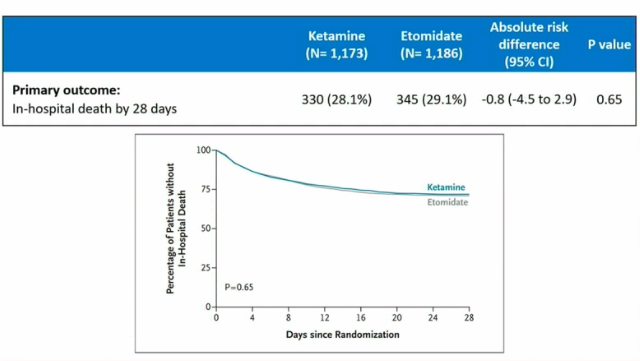
Big news: Results of the HIGHLY anticipated RSI trial: Ketamine vs Etomidate 🥁 Drumroll... n=2,365 pts 1° No difference in mortality (28.1 vs 29.1%) 2° Ketamine associated with WORSE hemodynamic outcomes (SBP <65, new/increased vasopressor requirement, or cardiac arrest): 17 vs 22% #CCRDownUnder
Nick Mark MD tweet mediaNick Mark MD tweet media
English
9
43
215
40.3K
Robert Goulden
Robert Goulden@EMrobg·
RSI trial in shows transient post RSI ⬇️BP does *not* lead to increased mortality; the point estimate is in fact in the opposite direction. Using previous RCTs as priors, Bayesian interpretation still favours ketamine as the preferred induction agent. 2/2
English
0
0
2
82
Robert Goulden
Robert Goulden@EMrobg·
Interesting to see people jumping to 'we should use etomidate' based on the RSI trial surrogate 2ry outcome of less post intubation⬇️BP. But we only care about that surrogate outcome based on years of confounded retrospective studies, which RSI study itself has disproven. 1/2
English
1
1
2
150
Robert Goulden
Robert Goulden@EMrobg·
All this suggests that routine Mg supplementation of everyone falling below the reference range may be another example of low value care. Very low levels and high-arrythmia risk patients likely still need treatment, but not everyone who's number is red on the EMR. RCTs needed.
English
1
0
0
35
Robert Goulden
Robert Goulden@EMrobg·
We have a new study in JAMA IM asking: do all 'hypomagnesemic' patients need supplementation? Many reflexively prescribe Mg when the number is below the reference range, but is this indicated? We used a quasi-experimental design to find out. jamanetwork.com/journals/jamai…
English
1
0
0
67
Robert Goulden
Robert Goulden@EMrobg·
In arrest patients brought to ED, already having received multiple doses, focus should be on reversible causes and/or timely ECMO. Ongoing EpiDOSE RCT of max 2 mg vs max 6 mg epi should provide more definitive evidence on this question.
English
0
0
0
34
Robert Goulden
Robert Goulden@EMrobg·
PARAMEDIC-2 showed epi has a *very* small survival benefit, but half of extra survivors have poor neuro outcome. This study suggests benefit mostly comes from first dose. In older adults especially, extra doses are futile/harmful.
English
1
0
0
31
Robert Goulden
Robert Goulden@EMrobg·
Another win for less is more. Pre-post study of multi-dose epi in cardiac arrest (Q3-5min i.e. current routine practice) vs. single-dose protocol (1mg x1). Multi dose ⬆️ROSC but not neuro-intact survival. onlinelibrary.wiley.com/doi/10.1111/ac… . If age >65, ⬆️ROSC but ⬇️neuro-intact survival.
English
1
0
0
39
Robert Goulden
Robert Goulden@EMrobg·
@DrToddLee @giovannilandoni Absolutely. If the optimal target is in fact 60, 55, or even 50, that would lead to a huge decrease in vasopressor, ICU, and hence resource use.
English
1
0
1
127
Todd C. Lee
Todd C. Lee@DrToddLee·
@EMrobg @giovannilandoni Once again. Very low map is bad. Raising map with drugs is better than a map of 30. Raising map with drugs may not actually be better than a map of 55 or 60 without drugs. These drugs both help and harm
English
2
2
4
383
Robert Goulden
Robert Goulden@EMrobg·
Less is more wins again. RCT of high MAP target in older adults w/sepsis, stopped early for harm, 39% mortality MAP 80-85 vs. 29% mortality MAP 65-70 link.springer.com/article/10.100…. Recall also that the 65 Trial hinted that MAP60 may be better than 65. How low can we go?
English
2
6
18
1.2K
Robert Goulden
Robert Goulden@EMrobg·
Epidemiologic methods are increasingly difficult for clinicians and policy makers (and epidemiologists?) to understand. Are they at least getting us closer to uncovering causal relationships? My argument in this new commentary: we don't know, because we haven't checked. 1/2
English
1
0
0
82
Robert Goulden
Robert Goulden@EMrobg·
It was all totally wasted. The findings were wrong and the net contribution to scientific understanding was negative. Publish or perish, ultimately pushed by funders and institutions, is driving a toxic culture of scientific waste. We have to stop. 5/5
English
0
0
0
57
Robert Goulden
Robert Goulden@EMrobg·
Collectively the individual observational studies (plus the SRs, and the SR of the SRs) represents at least 10s of thousands of labour hours from researchers, ethics panels, funding reviews, journal reviewers etc., and a large amount of $$$. 4/
English
1
0
0
65
Robert Goulden
Robert Goulden@EMrobg·
2 big new RCTs on IO vs IV access in cardiac arrest -> another chance to check on the utility of conventional observational studies. Relative risk/odds of IO vs IV for survival in the RCTs: 1.16 (0.87-1.56), 0.93 (0.72-1.21). What about the most recent observational studies? 1/
English
1
0
0
109