Harry Costello

5.3K posts

Harry Costello banner
Harry Costello

Harry Costello

@Harry_Costello

@drharrycostello.bsky.social Academic neuropsychiatrist | MD PhD | Clinical Lecturer @UCLPsychiatry | Mood, Motivation & Neurodegeneration | Aspiring apiarist

London เข้าร่วม Aralık 2009
2K กำลังติดตาม1.3K ผู้ติดตาม
Allen Frances
Allen Frances@AllenFrancesMD·
I definitely have cognitive decline as I age- just as I have muscle/cardiac/gi/& especially knee decline. I strongly objected to silly inclusion of Mild Cognitive Impairment in DSM5. Testing for MCI makes no sense because massive # of false positives/no treatment that works.
Sean X. Luo MD PhD@seanluomdphd

@AllenFrancesMD I actually don’t think you believe what you say. If you are diagnosed MCI today you’d probably go on an antibody.

English
8
7
51
5.6K
Harry Costello
Harry Costello@Harry_Costello·
@seanluomdphd @AllenFrancesMD Sean, we’re both psychiatrists. I’m sure we treat similar things in similar ways. Our discussion is the current risk–benefit of anti-amyloid therapies. They’re not funded across much of Europe, including the UK, for a reason. This isn’t therapeutic nihilism.
English
1
0
1
32
Sean X. Luo MD PhD
Sean X. Luo MD PhD@seanluomdphd·
@Harry_Costello @AllenFrancesMD Yes you never write meds off label. I understand your style of practice. There’s zero data on many things I treat. But I don’t just tell people I don’t recommend that we treat them off label. There’s a difference between following evidence and therapeutic nihilism.
English
1
0
0
28
Harry Costello
Harry Costello@Harry_Costello·
@seanluomdphd @AllenFrancesMD No, I advise my patients with dementia based on current evidence, not my ‘feelings’ about the future. I don’t recommend intensive therapies with marginal benefits, risks and costs. Focus on what truly improves quality of life and future care. I support trial participation.
English
1
0
1
28
Sean X. Luo MD PhD
Sean X. Luo MD PhD@seanluomdphd·
Yes. So your answer is to advise the dementing patients to wait until they are fully demented. Because there’s not enough data because their dementia is too mild. Or if you had pancreatic ca don’t get into a trial for Dara cause hey it only gives you 6 months ARIA can be tracked and monitored and you can stop the treatment. I’m just not that kind of clinician. I also tell people who have ldl of 100 to try to drop it below 50. But you’d probably haggle and say the effect size is too small on all cause mortality. 🤷‍♂️🤷‍♂️🤷‍♂️ To each his own
English
1
0
0
31
Harry Costello
Harry Costello@Harry_Costello·
@seanluomdphd @AllenFrancesMD I wish my feelings were so optimistic… Sadly there’s little evidence for this potent prevention signal currently, and the drugs have serious side effects. I also have an issue with using external historical cohorts (ADNI) as comparators. Hopefully I’m proved wrong in future.
English
1
0
1
35
Sean X. Luo MD PhD
Sean X. Luo MD PhD@seanluomdphd·
@Harry_Costello @AllenFrancesMD I have a feeling in long term data coming out, if you are cognitively early impairment with low tau and your amyloid clearance is 100%, the odds of you not decline at all is 60%+. Let’s see if this forecast turns out to be true. There are ongoing primary prevention trials.
English
1
0
0
35
Sean X. Luo MD PhD
Sean X. Luo MD PhD@seanluomdphd·
@Harry_Costello @AllenFrancesMD By the way, that Cochrane review has ALL kinds of problems. Not the least of which is that they included non-approved AND approved meds. How is this even a valid analysis?
English
1
0
0
58
Harry Costello
Harry Costello@Harry_Costello·
@seanluomdphd @AllenFrancesMD Antibodies are no justification for validity of MCI diagnosis. Amyloid monoclonals have marginal effects on cognition and significant risks of brain swelling and micro haemorrhage. I wouldn’t advise any patient or family member with MCI to go on them. cochrane.org/about-us/news/…
English
1
0
0
60
Sean X. Luo MD PhD
Sean X. Luo MD PhD@seanluomdphd·
@AllenFrancesMD Really. You are telling me that if you ever were explicitly diagnosed with MCI you’d never try an antibody. Or is your option on this matter purely theoretical and when push comes to shove in a real clinical case you’d do otherwise? Have you evaluated someone on an antibody?
English
2
0
0
235
Harry Costello รีทวีตแล้ว
George Kirov
George Kirov@GeorgeKirov1·
Our paper is out: By analysing health records from millions of real-world patients from the literature, we can now finally answer the questions about the long-term outcomes of ECT. What we found, consistently, across well-designed studies from the UK, Canada, US, Sweden, Denmark, and Taiwan, is that ECT does not increase the risk for dementia, heart attacks or stroke, and is associated with a significant reduction in overall mortality. cambridge.org/core/journals/…
English
13
85
191
25.9K
Harry Costello รีทวีตแล้ว
Prof Linda Gay Griffith
Prof Linda Gay Griffith@LindaGGriffith1·
This gorgeous story of "severe morning sickness" continues to have surprising new chapters, and is a testament to the maternal instinct as a force of Nature - the senior author (Marlena Fejzo) suffered from hyperemesis gravidarum and left no stone unturned in a search for what caused it. Beautiful!
Veera Rajagopal @doctorveera

New multiancestry GWAS of hyperemesis gravidarum (pregnancy-associated severe vomiting) based on ~11k cases and ~460k controls out in Nature Genetics The study identified 10 signals, 4 known and 6 novel implicating - GDF15-GFRAL brainstem axis - metabolic/insulin pathways - neuronal genes suggesting roles in nausea perception and food/smell sensitivity. GDF15 continues to be the strongest signal! Fejzo et al. Nat Gen 2026 nature.com/articles/s4158…

English
0
6
31
8K
Harry Costello รีทวีตแล้ว
Veera Rajagopal 
Veera Rajagopal @doctorveera·
A new paper in @Nature from David Reich, @aliakbari23 and colleagues breaks the conventional understanding of recent human evolution. The field believed that strong selection in the recent past (~10,000 years) was rare, with few exceptions like the lactase persistence locus. In this paper, the authors challenge that belief, showing that we weren't looking at the problem right. Previous studies that looked for evidence of selection using ancient DNA addressed the problem cross-sectionally, asking if allele frequencies differed across populations more than what one would expect based on genetic drift and migration. Most arrived at the conclusion that population structure primarily explained the observed differences. Here, the authors addressed the problem longitudinally, accounting for when ancient individuals lived by explicitly modeling time as a variable in the analysis. It turns out doing it this way dramatically increases power, increasing the number of genome-wide significant selection signals by 20-fold! Looking at why accounting for the time variable led to such dramatic changes in results, the authors find that previous studies missed so much because selection often happened not on new variants leading to dramatic sweeps (the conventional model: new variant -> selection -> increase in frequency) but on already existing variants driven by transient environmental pressures. Many of these variants underwent reversals, selected up when a pressure existed, then purged when it disappeared or the trade-off cost became dominant. A great example is the TYK2 variant, where an allele boosting immunity was selected for thousands of years because it protected against TB, then got purged as TB endemicity declined and the autoimmune cost took over. The scale of what they found is striking: hundreds of loci showing strong selection in the past 10,000 years with a median selection coefficient of ~0.86%. This number is pretty big in evolutionary terms, meaning allele frequencies have been shifting by ~1% per generation in a consistent direction. Previous selection scans found a maximum of 20 loci, and this one finds hundreds. That isn't an incremental change. It fundamentally reframes our understanding of how common strong selection has been in recent human history. Some of the most striking findings come from polygenic selection, where hundreds of small-effect alleles were pushed in the same direction simultaneously. Polygenic scores based on large-scale GWAS of today predict recent negative selection for traits like body fat, waist circumference and schizophrenia, and positive selection for others like cognitive traits. One important caveat is that GWAS phenotypes are measured in industrialized societies today, and how well they capture what was actually being selected in ancient environments is debatable. For me personally, these findings have direct implications for drug discovery. When using human genetics to find drug targets, we often fixate on the benefit and risk profiles of variants visible today. But we need to be aware that a variant's benefit:harm ratio might be environmentally contingent, and could reverse when the wrong environment manifests. An evolutionary understanding of a variant's association with traits is therefore essential. The same logic applies, perhaps even more urgently, to embryo selection. Selecting embryos based on polygenic traits is humans making permanent, heritable decisions for their offspring with a narrow view of today's environment. The ancient DNA record now shows that cost-benefit landscapes flip over time. So, an embryo carrying man-made selections is carrying those changes into an unpredictable future environment. The broader takeaway is that human evolution didn't freeze in the last 10,000 years. We just lacked the tools and datasets to see its movement. The current findings are based on European populations. I am curious to see these analyses extended to other populations too, like South Asian, East Asian and African populations, which might be holding more surprises to blow our minds. Akbari et al. Nature 2026 nature.com/articles/s4158…
Veera Rajagopal  tweet media
English
21
214
1.1K
259.9K
Harry Costello รีทวีตแล้ว
David Taylor
David Taylor@DavidTa23968240·
74% of people who stopped clozapine because of neutropenia were successfully rechallenged. Only 7% had another episode of neutropenia. thelancet.com/journals/lanps…
English
3
43
133
8.5K
Harry Costello รีทวีตแล้ว
John Bistline
John Bistline@JEBistline·
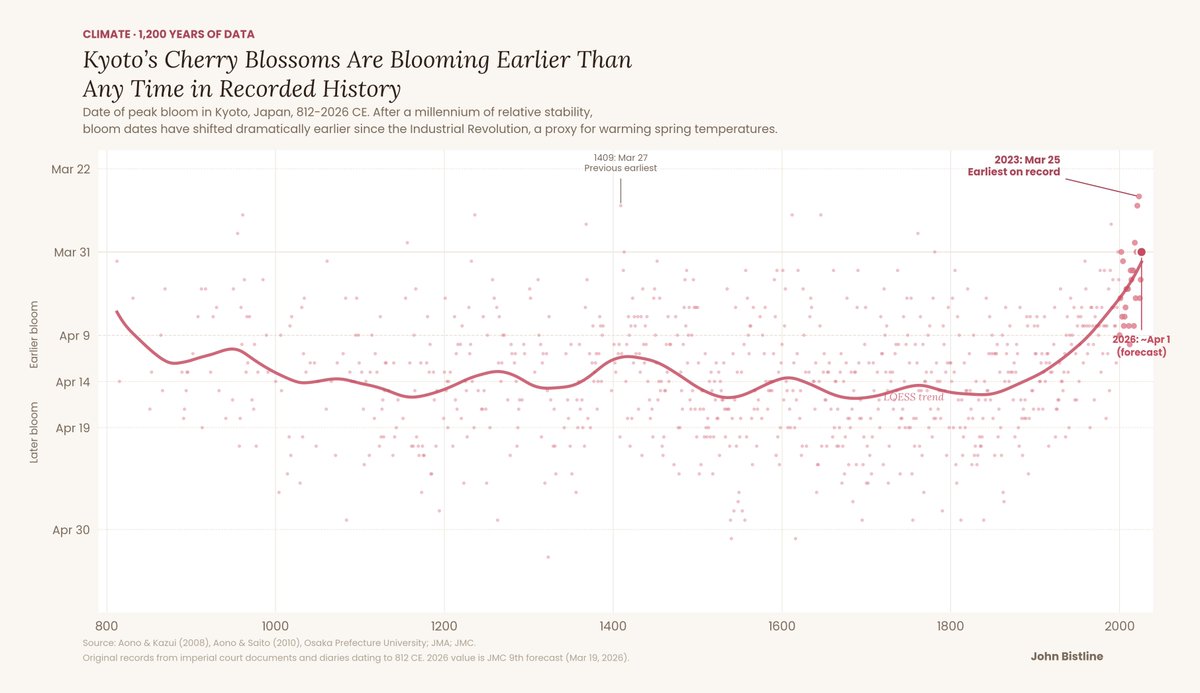
This is my favorite climate change chart. Japanese monks, aristocrats, and emperors kept meticulous records of cherry blossom festivals for 1,200 years and accidentally built the world's longest climate dataset.
John Bistline tweet media
English
238
9.4K
50.1K
1.6M
Harry Costello รีทวีตแล้ว
Michael Albert, MD
Michael Albert, MD@MichaelAlbertMD·
The cholesterol wars are over. LDL won. New guidelines. Four landmark trials. An oral PCSK9 inhibitor that matches injectables. And data proving we should be treating patients we currently aren't. Here's everything clinicians need to know. 🧵
English
177
439
3K
1.3M
Harry Costello รีทวีตแล้ว
JAMA Psychiatry
JAMA Psychiatry@JAMAPsych·
Among individuals with severe, treatment-resistant #Schizophrenia, #dementia was common and showed a distinct clinical and genetic profile not explained by #Alzheimer disease, cardiovascular risk, or medication effects. ja.ma/4uWAsGG
JAMA Psychiatry tweet media
English
7
86
221
18.8K
Harry Costello รีทวีตแล้ว
Luke Jelen
Luke Jelen@LukeJelen·
✨New Paper✨"Regional Blood Flow Signatures of Opioidergic Modulation of Ketamine in Major Depressive Disorder: A Randomized Crossover Study" | American Journal of Psychiatry psychiatryonline.org/doi/10.1176/ap…
English
2
8
23
1.6K
Harry Costello รีทวีตแล้ว
Jim Sciutto
Jim Sciutto@jimsciutto·
“Even the apartheid regime in South Africa did not dare to say that if a black man kills a white man, he will be executed. But if a white man kills a black man, he will not be. What Israel did…it is exactly that saying that a Palestinian could be sentenced to death penalty, but an Israeli no for the same crime.” -@MustafaBarghou1 on Israel’s new death penalty law.
English
432
8.4K
23K
898.3K
Harry Costello รีทวีตแล้ว
Gagan Wig
Gagan Wig@GaganWig·
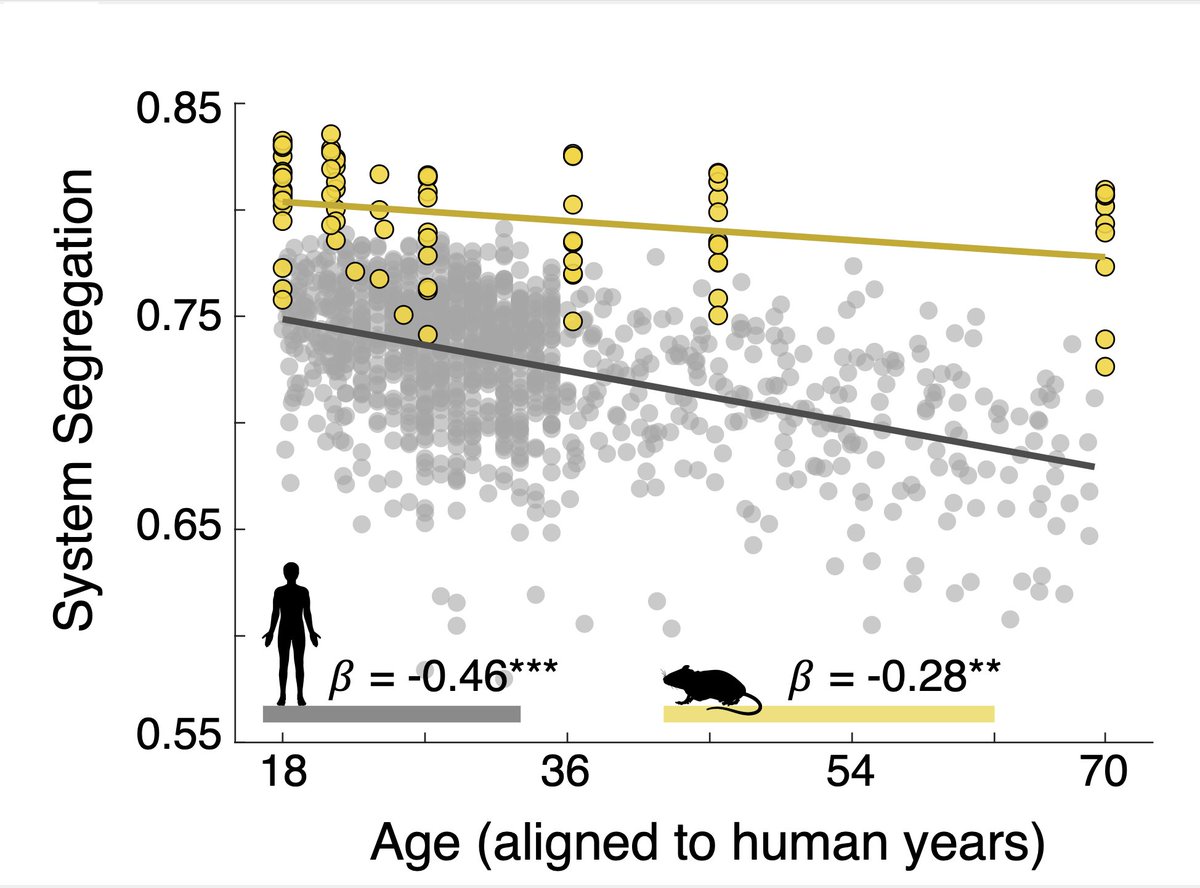
We know aging reorganizes large-scale brain networks in humans, with real consequences for cognition and dementia risk. What we haven't had is an animal model of this phenomenon — one that could help us figure out why it happens and how to intervene. We’ve now mapped brain network changes over a wide range of the mouse adult lifespan. The changes mirror key features of human brain aging, but not entirely, and the differences are just as interesting as the similarities. New paper in @PNASNews 🧵 pnas.org/doi/10.1073/pn…
Gagan Wig tweet media
English
3
14
37
10.9K
Harry Costello รีทวีตแล้ว
Egan Peltan
Egan Peltan@EganPeltan·
This is totally out of control: There’s 0 - I repeat 0 - evidence any of the LLM work did anything meaningful for Rosie’s cancer I’m sorry to rain on the parade here. I know we want to believe. But, it’s possible to do a lot of things and have nothing happen @paul_conyngham co-administered α-PD-1 (conventional immunotherapy) with a TKI and the mRNA. It’s probably the most effective cancer immunotherapy of all time. This isn’t a small detail! There’s no evidence his process (beyond FDA approved doggie α-PD-1) had any impact on disease progression. The most parsimonious explanation is a partial response to α-PD-1 I get it. The chat bots make for a great story (although checking multiple LLMs isn’t validation), but it’s really just a neat story. It’s fundraising copy. Before he starts selling the “custom neoantigen mRNA vax” story to consumers, he should provide some evidence it did anything! That’s responsible citizen science This is just storytelling for the AGI true believers. Specifically, a story in search of venture money
Sam Altman@sama

The coolest meeting I had this week with was Paul, who used ChatGPT and other LLMs to create an mRNA vaccine protocol to save his dog Rosie. It is amazing story. "The chat bots empowered me as an individual to act with the power of a research institute - planning, education, troubleshooting, compliance, and yes, real scientific design work in converting genomic data to a vaccine prescription and designing the treatment protocol around it. But they worked alongside humans at every step. The combination is what made it possible." It immediately got me thinking "this should be a company". Also, Paul is an extraordinary guy. This should be easy to do, but it is not yet.

English
56
211
1.6K
214.2K
Harry Costello รีทวีตแล้ว
Robert Howard
Robert Howard@ProfRobHoward·
Voting has opened in the RCPsych President Election. If eligible to vote, you should have received an email with a link to the voting site and details of the candidates. If you haven’t received the email, check your Trash/Clutter (mine often go there). Please use your vote!
English
13
14
35
5.2K
Harry Costello รีทวีตแล้ว
Prof Kamlesh Khunti
Prof Kamlesh Khunti@kamleshkhunti·
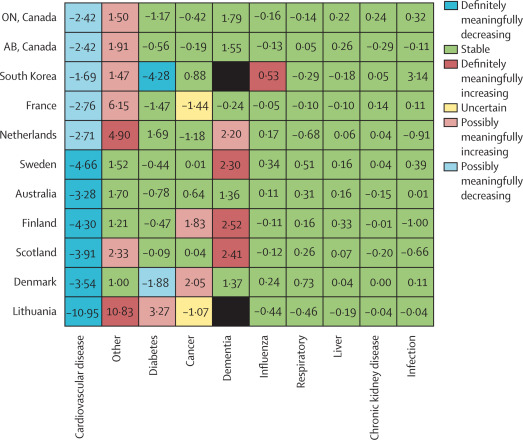
📉 Big shift in diabetes mortality trends Across 11 countries & 1.7B person-years: ❤️ CVD deaths ↓ sharply (–8% to –25% every 5 yrs) 🧠 Dementia deaths ↑ markedly 🎗️ Cancer now the leading cause of death in people with diabetes in several countries 🚨 Cardiovascular disease is no longer universally the main cause of death in diabetes. #Diabetes #CVD #PublicHealth sciencedirect.com/science/articl… @DiannaMagliano et al
Prof Kamlesh Khunti tweet media
English
2
15
27
3.1K