Henry

17.9K posts

Henry banner
Henry

Henry

@HenryInvests

Equity Research @Rebellionaire. Primarily covering Upstart, but own other companies too. Posts are not financial advice.

Wisconsin, USA เข้าร่วม Haziran 2021
657 กำลังติดตาม6.1K ผู้ติดตาม
ทวีตที่ปักหมุด
Henry
Henry@HenryInvests·
My conversation with @Upstart co-founder & incoming CEO Paul Gu @paulxgu, February 23, 2026 $UPST 🏆 (0:00) Introduction (0:26) Co-Founder Experience & CEO Transition (2:14) Upstart's Evolution (5:01) Long-Term Vision & Growth (7:31) Gu's $3.9M Insider Buy (11:16) Model 25 (13:15) 100M Repayment Events (14:31) Upstart Macro Index (UMI) (17:04) Auto & HELOC Margin Potential (20:08) Marketing & Borrower Relationships (23:10) Upstart Capital Partners (25:51) Bank Partner Growth (27:28) Closing Remarks
English

13
14
198
51.6K
Henry รีทวีตแล้ว
Evan
Evan@StockMKTNewz·
SUPER MICRO CO-FOUNDER, EMPLOYEE AND CONTRACTOR SMUGGLED NVIDIA CHIPS TO CHINA, U.S. PROSECUTORS CHARGE - CNBC
Evan tweet media
English
48
86
859
354.4K
Henry
Henry@HenryInvests·
My conversation with @Upstart co-founder & incoming CEO Paul Gu @paulxgu, February 23, 2026 $UPST 🏆 (0:00) Introduction (0:26) Co-Founder Experience & CEO Transition (2:14) Upstart's Evolution (5:01) Long-Term Vision & Growth (7:31) Gu's $3.9M Insider Buy (11:16) Model 25 (13:15) 100M Repayment Events (14:31) Upstart Macro Index (UMI) (17:04) Auto & HELOC Margin Potential (20:08) Marketing & Borrower Relationships (23:10) Upstart Capital Partners (25:51) Bank Partner Growth (27:28) Closing Remarks
English
13
14
198
51.6K
Magnus Sigurdsson
Magnus Sigurdsson@MagnusSigurdss·
@HenryInvests @HenryInvests do you know if these forward flow agreements are at will (if they like, and no requirements), or agreement where they are committed and required to deploy capital?
English
1
0
1
64
Henry รีทวีตแล้ว
Henry
Henry@HenryInvests·
Upstart $UPST Announces a $1B Forward-Flow Agreement with Eltura Ventures and Aperture Investors
English
10
8
85
13.7K
Henry รีทวีตแล้ว
Henry
Henry@HenryInvests·
A few thoughts on the $UPST bank charter: Upstart is pitching Upstart Bank as a sister company, meaning the structure would be something like Upstart Network (fintech platform) & Upstart Bank (a bank) put together equals Upstart. The pitch involves that one federal regulatory body eliminates a lot of state-by-state regulatory friction. With a charter, Upstart could abide by the rules of one regulator versus 50, allowing them to serve much more of the American population at lower costs. At first glance that makes sense to me. Also makes me believe that if regulatory friction is that high (UPST says regulatory costs accounted for $200M last year, 40,000 consumers unable to apply to Upstart in 2024, small dollar loans (SDL) not available in 1/5th of the USA) as these 'headwinds' rescind, CAC has the potential to drop enormously. My thinking there is that if it is so complex and complicated to operate on a state-by-state basis, with certain states having different regulations, blanket advertising at the federal level would lead to more efficient marketing. It's not guaranteed CAC drops but it's something I think is possible. So the bank charter in that regard makes logical sense to me. Gu clarified the change here occurred now as a result of a pro-growth administration and would allow them to serve a full economic spectrum of consumers across all states. Part of the press release involves Sanjay saying, "We are not seeking to compete with our depository partners for local customer deposits and checking accounts." So it appears that Upstart does not plan to operate as a consumer facing bank, or a bank in the traditional sense. Although Gu did confirm that Upstart will still accept some customer deposits. That makes it so incentives between Upstart and its capital partners are still aligned. Gu expects "the overwhelming majority of loans will still be funded by our partners. This is about efficiency, not a change in strategy." He also added that Upstart Bank will be the one originating the loans. It sounds like Upstart will originate with some cost advantages as a bank, before selling those loans immediately to capital partners / 3P funding. The savings Upstart generates from reduced regulatory friction & capital cost advantages can be passed to borrowers in the form of lower APRs, to the capital partners in the form of greater returns, or to Upstart in the form of greater margins. Options 1 and 2 seem most likely as they want to become "the most radically pro consumer finance company" Upstart's business as it stands today likely remains the same, but it is supplemented by a sister company, Upstart Bank, that eliminates regulatory overhead and provides greater access to cheaper capital. From that perspective, it seems as if Upstart is almost like a fintech with a bank wrapper. It makes the funding structure stronger. Now, of course there are puts and takes. In my interview with Gu, I asked about big bank partnerships because I was surprised more adoption had not taken place. Has that had an influence on their decision to seek a bank charter? I'm not sure - but it is something to consider. In Upstart's piece 'Building the Road: Why We’re Launching Upstart Bank' Annie Delgado talks about the Car and the Cobblestone path. In other words, Upstart no longer believes having the best technology is enough, they must also innovate on the regulatory path to implement it. I think that's fine and it makes sense, but it is without contention that Upstart has said several times they do not want to be a bank. This was said most recently at AI Day (May 2025), which means the decision to push forward with this appears to have been made within the last year. With Gu now CEO, Upstart appears to be moving / changing at tremendous velocity with no sunk costs. Once again, I believe Upstart has the 'goods' figured out (their models), but the go to market / distribution strategy continues to evolve as they scale. I have long said I believe if the product is truly superior, the rest of the pieces will fall into place. Right now management is demonstrating enormous confidence. They are guiding for a 35% revenue CAGR through FY28, rapidly scaling new products Auto & HELOC, launched Cash Line, are applying for a bank charter, and they recently bought back $100M in stock when the entire market thinks they are capital constrained. The broad market also has rather extreme fear / jitters about macro/credit in general. Private credit is of particular worry, which could impact Upstart's credit deal renewals, although Sanjay has said commitments here remain strong. While the regulatory provisions make sense, I do believe management is understating the value of cheap capital access as a driver in the decision as well. Their funding model has always been a bit wonky and this provides some stability, even if it's not the main focus. Okay on multiples, banks trade at lower multiples than technology companies - that is undeniably true. Partially because being a bank comes with some pretty enormous capital and regulatory requirements. Being up close and tight with the regulators has been a strength of Upstart's for a long time. They have been working with the CFPB since the beginning, so I am not worried about scrutiny over their models. But as we think about the stock, I think the multiple upside is probably compressed? Maybe? It depends on how they utilize the bank charter (if granted). If they truly don't hold a lot of loans and only use it to really facilitate greater credit access & reduced regulatory overhead (which is what they are saying), then the multiple compression would be much less extreme. The problem here is that's a strategy that we won't have clarity on at least a year. 2027 would be when Upstart Bank starts running. That uncertainty might weigh on the stock in the short-term. But I do think this enables Upstart to scale faster. TLDR: Upstart's bank charter was a surprise to me, but in retrospect perhaps foreseeable. IMO it represents a pivot in their go-to-market strategy. The regulatory impacts are logical and appear favorable. Management has been displaying enormous confidence and Upstart is undergoing rapid change at extreme velocity.
Henry@HenryInvests

Building the Road: Why We’re Launching Upstart Bank $UPST upstart.com/news/upstart-b…

English
8
7
67
10.8K
Henry
Henry@HenryInvests·
@jbulltard1 You put me onto this and now I see it all the time
English
0
0
1
46
Henry รีทวีตแล้ว
Bradford Ferguson
Bradford Ferguson@bradsferguson·
What if I told you there was a company trading at 5.5x next quarter's annualized profits, 0.06 price-to-earnings growth and forecast to more than double earnings... just had a better quarter than Tesla ever had... and profits will likely more than double from here?
GIF
English
11
2
26
6.1K
Henry
Henry@HenryInvests·
Tbh, I gave Pro a super lazy prompt and had it run while I was working on something else. So it could probably be even better. Here it is if you want to try it with Gemini. "Please give me a full detailed understanding of Micron's latest earnings report that was released yesterday - discuss the major developments and explain the surge in memory prices. Please include the conference call and guidance as well as everything else you feel is important. I am leaving this purposefully ambiguous, so feel free to go in whichever direction you'd like but please be comprehensive"
English
0
0
2
76
Troy Gomm
Troy Gomm@tgomm·
@HenryInvests This is a useful summary. I’d love to see the exact same prompt used with Gemini to see if there’s any differences in the summary or take-aways
English
1
0
1
64
Henry
Henry@HenryInvests·
ChatGPT Pro notes on the unbelievable $MU quarter: Micron’s March 18, 2026 earnings report was not just “strong.” It was a statement that memory has become one of the main bottlenecks of the AI buildout. Revenue was $23.86 billion, non-GAAP operating income was $16.46 billion, non-GAAP EPS was $12.20, and Micron guided fiscal Q3 to $33.5 billion of revenue with about 81% non-GAAP gross margin and $19.15 EPS. Micron also highlighted that its Q3 single-quarter revenue guide is higher than its full-year revenue in any year through fiscal 2024. Management reinforced the message on both its March 18 financial call and its separate analyst call later that evening. If I reduce the whole report to one sentence, it is this: Micron did not suddenly ship vastly more bits; it sold somewhat more bits at much higher prices into a market where AI is increasing memory content faster than supply can expand. DRAM bit shipments were only up mid-single digits sequentially, but DRAM ASPs jumped in the mid-60% range. NAND bit shipments were up only low-single digits, but NAND ASPs jumped in the high-70s. That is the cleanest explanation for why revenue, margins, and EPS exploded. By technology, DRAM remained the core story: $18.8 billion of revenue, 79% of the total, up 74% q/q and 207% y/y. NAND was $5.0 billion, 21% of revenue, up 82% q/q and 169% y/y. By business unit, Cloud Memory and Mobile & Client each did about $7.7 billion, Core Data Center did $5.7 billion, and Automotive & Embedded did $2.7 billion. Gross margins were 74%, 74%, 79%, and 68% respectively, with operating margins from 62% to 76%, which tells you this was broad strength, not a one-product anomaly. The demand side is broader than just “HBM for GPUs.” Micron said AI will push data-center DRAM and NAND bit TAM above 50% of total industry TAM for the first time in calendar 2026. Traditional servers are also strong because of agentic-AI-driven workloads and a broad server refresh, and server DRAM content is still rising with new platforms. In data-center NAND, Micron said vector databases, KV-cache offload, and rising SSD penetration are accelerating demand; data-center NAND revenue more than doubled sequentially to a record, and Micron said NAND demand significantly exceeds its available supply for the foreseeable future. Micron also argued that AI is lifting memory content at the edge. It said DRAM/NAND supply constraints could make PC and smartphone unit shipments fall low double digits in calendar 2026, but on-device AI should still drive strong memory-content growth. It highlighted 32GB as a recommended memory level for on-device agentic-AI PCs—about double the average PC—and said the share of flagship smartphones shipping with 12GB+ of DRAM rose to nearly 80% in calendar Q4 from under 20% a year earlier. Automotive and industrial revenue together exceeded $2 billion in the quarter, and Micron noted that moving from today’s typical sub-L2 vehicles to L4 autonomy drives memory per vehicle dramatically higher. Why can’t supply catch up faster? Micron’s explanation was unusually explicit. It expects both DRAM and NAND bit demand in calendar 2026 to be constrained by supply and says tight conditions should persist beyond 2026. For DRAM, it cited cleanroom constraints, long construction lead times, a higher HBM trade ratio, faster HBM growth, and declining bits-per-wafer gains from node migrations. In plain English, more industry capacity is being absorbed by HBM and advanced memory, while each new node is not unlocking supply as easily as in older cycles. For NAND, Micron said some suppliers are redirecting cleanroom space toward DRAM and overall cleanroom space remains limited. Its market view is that industry DRAM bit shipments grow only in the low-20% range and NAND about 20% in calendar 2026. The Q&A made the shortage even clearer. Management said some key customers are still only getting about 50% to two-thirds of the memory they want in the medium term. Just as important, Sanjay Mehrotra said non-HBM margins are actually higher than HBM margins today. That is a huge nuance: investors often assume HBM is the whole profit story, but Micron is basically telling you that conventional DRAM and NAND pricing is also extremely strong because the shortage is broad. On the product roadmap, Micron tried to show this is not just near-term price inflation. It said 1γ DRAM is ramping faster than any prior node in its history and should become a majority of DRAM bit mix by mid-calendar 2026; G9 NAND should likewise become a majority of bits by mid-calendar 2026. On HBM, Micron said it began volume shipments of 36GB 12-high HBM4 in calendar Q1 2026 for NVIDIA Vera Rubin, expects HBM4 to reach mature yields faster than HBM3E, has sampled a 48GB 16-high HBM4 part, and expects HBM4E to ramp in calendar 2027. It also highlighted high-volume production of G9-based PCIe Gen6 data-center SSDs and strong adoption of its 122TB SSD. Micron also emphasized that AI-memory demand is broadening beyond HBM into LP DRAM and server memory form factors. It said LP DRAM for data centers uses about one-third the power of DDR server modules and that it sampled the industry’s first 256GB LP SOCAMM2 built on 1γ, enabling 2TB per CPU. That matters because it means new AI architectures can create massive memory pools even outside the classic HBM-on-GPU stack. One of the most important conference-call disclosures was strategic rather than numerical: Micron signed its first five-year strategic customer agreement. Management said these SCAs are different from the old one-year LTAs because they are multi-year and include specific commitments meant to give both Micron and customers more visibility and stability; it also said it is discussing similar agreements with multiple other customers. That is a big tell that major buyers now see memory as capacity they need to secure years ahead, not just a spot-market purchase. Guidance was the other headline. Micron forecast fiscal Q3 revenue of $33.5 billion ± $750 million, non-GAAP gross margin of about 81%, non-GAAP opex of about $1.40 billion, and non-GAAP EPS of $19.15 ± $0.40. Management said higher price, lower cost, and favorable mix should all drive the next leg of gross-margin expansion. It also said fiscal Q4 2026 opex will be lifted by an extra work week in this 53-week year, fiscal 2027 opex will rise as R&D spending increases, and trade/geopolitical impacts are not included in guidance. CFO Mark Murphy would not give Q4 gross-margin guidance, but said the 81% Q3 guide already contemplates more HBM4 and that Micron still expects tight market conditions beyond 2026. Below the income statement, the balance sheet is moving fast too. Micron generated $11.9 billion of operating cash flow in Q2 and $6.9 billion of free cash flow after $5.0 billion of capex. Ending inventory was $8.3 billion with 123 days of inventory, but DRAM inventory days remained below 120, which management described as especially tight. Cash and investments reached $16.7 billion, liquidity topped $20 billion including an untapped credit line, debt fell by $1.6 billion to $10.1 billion, and the company ended with $6.5 billion of net cash. It repurchased $350 million of stock and raised the quarterly dividend 30% to $0.15. The uncomfortable part of the report—and the main reason the stock did not just rip higher—is capex. Micron now expects fiscal 2026 capex above $25 billion, about $7 billion in Q3, and a meaningful step-up again in fiscal 2027. It said the majority of the increase versus its prior plan is cleanroom-facility capex, led by Tongluo and U.S. fab projects, and that construction-related capex will rise by more than $10 billion y/y in FY2027. Reuters reported Micron boosted its FY2026 capital-spending plan by $5 billion; despite the huge beat, shares fell because investors focused on the heavier spending and the risk that enough new capacity could eventually normalize the cycle. Reuters/LSEG also reported that Micron’s Q2 revenue beat the $20.07 billion consensus and that the Q3 guide was far above the $24.29 billion consensus. The added spending is going into projects that take years, not quarters, which is why Micron believes tightness can last even as it spends aggressively. The acquired Tongluo site is expected to support meaningful product shipments from the existing fab beginning in fiscal 2028, with a second cleanroom planned by the end of FY2026. Micron still expects initial wafer output from its first Idaho fab in mid-calendar 2027, has started prep for a second Idaho fab, broke ground on the first New York fab, is expanding Hiroshima in Japan, has started commercial shipments from its India assembly-and-test facility, and expects a new Singapore NAND fab to begin initial wafer output in 2H 2028. Its Singapore HBM advanced-packaging facility is expected to contribute meaningfully in calendar 2027
English
2
0
19
1.1K
Henry
Henry@HenryInvests·
$MU - shares are down b/c investors appear to be worried about higher capex and increased capacity which will lead to increased supply and therefore lower memory prices. Management believes this is not the case. Is demand for memory truly insatiable? If so, we have a memory #supercycle
English
0
0
6
538
Henry
Henry@HenryInvests·
Sticking to my guns 🦾
English
1
0
28
1K
Henry รีทวีตแล้ว
Wall St Engine
Wall St Engine@wallstengine·
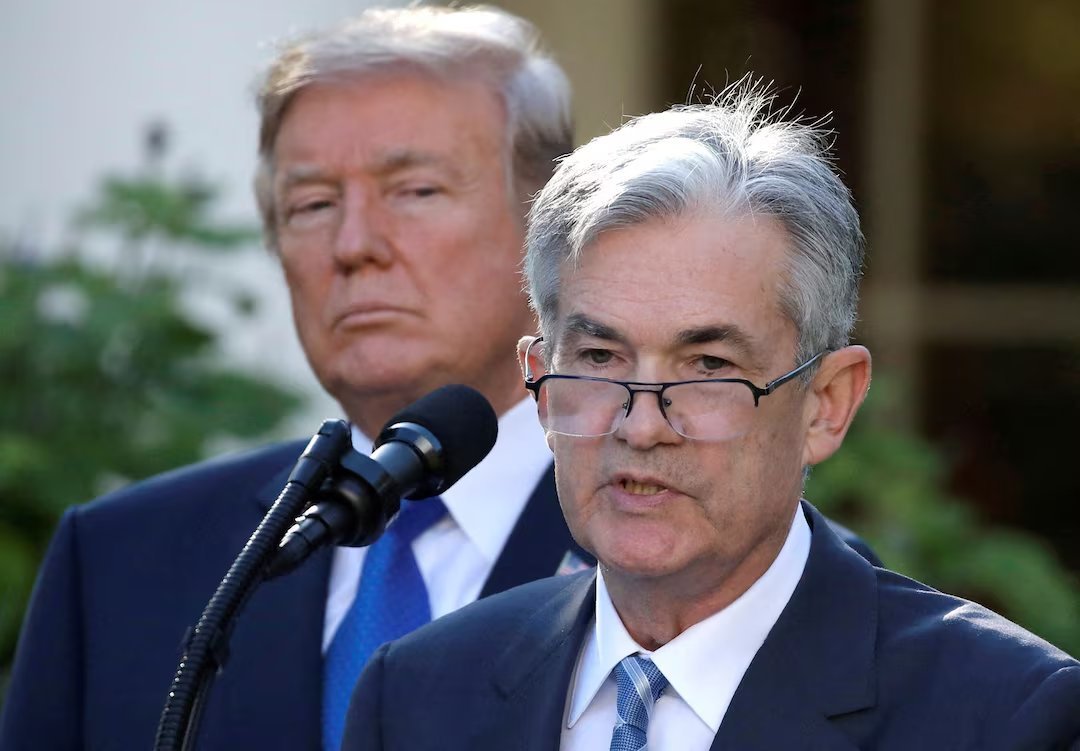
FED CHAIR POWELL HOLDS RATES UNCHANGED, AS EXPECTED
Wall St Engine tweet media
English
3
21
104
26.5K
Capt. Tweetz 🇮🇷
Capt. Tweetz 🇮🇷@CaptTweetz·
@HenryInvests Any bad news from peers or in the space and $UPST stock dives more than them as if they are the same company 😂
English
2
0
5
532
Henry
Henry@HenryInvests·
@MagnusSigurdss They are definitely standing out from peers. @davegirouard I'd assume Upstart's contrast is stemming from strong credit performance, but maybe there are other factors at play too?
English
0
0
1
259
Magnus Sigurdsson
Magnus Sigurdsson@MagnusSigurdss·
@HenryInvests The bad news keeps trickling in. Those goes against their success in signing up more investors.
English
1
0
2
254
Henry รีทวีตแล้ว
Negligible Capital
Negligible Capital@negligible_cap·
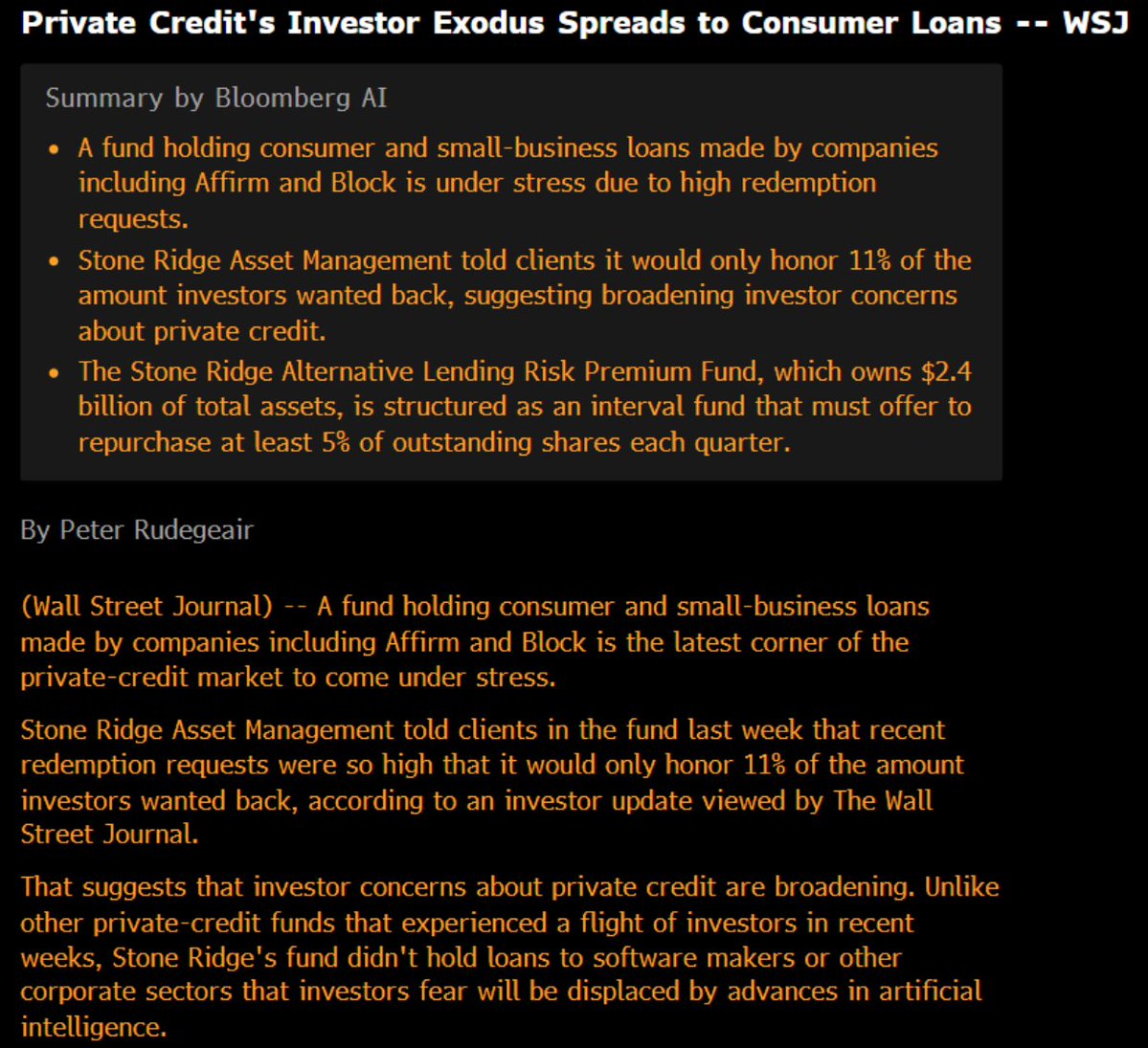
Private credit’s investor exodus is spreading to consumer loans, according to WSJ Interval fund Stone Ridge Asset Management, which holds consumer loans made by $XYZ and $AFRM are apparently under stress due to redemption requests Stone Ridge honoring 11% redemption requests $XYZ, $AFRM selling off on the article
Negligible Capital tweet media
English
16
70
280
96.2K