Still an Imaginer

10.6K posts

Still an Imaginer

Still an Imaginer

@JeffreyFDunn

Imaging with MRI and NIRS. Talk science anytime. Researching brain-multiple sclerosis, concussion, stroke, cancer, arthritis. Supportive of trainees, Sciomm

Earth, Treaty 7, Calgary เข้าร่วม Temmuz 2011
1.8K กำลังติดตาม2.2K ผู้ติดตาม
Still an Imaginer
Still an Imaginer@JeffreyFDunn·
@object_in_space @ianhanomansing I was wondering about the same thing but at a different part of the flight. They were going really fast in one direction, zipped around the moon and then were going fast in the opposite direction..any microgravity effect
English

0
0
1
6
EP
EP@object_in_space·
@ianhanomansing On the way back to earth, Orion's speed was increasing due to the pull of earth's gravity. They went from 900 mph to 7,000 mph halfway between the moon and the earth. Did they feel the acceleration at all, or did they remain at 0 g the whole time?
English
1
0
3
169
Ian Hanomansing
Ian Hanomansing@ianhanomansing·
Well, here's a fun assignment: I'm interviewing the Artemis II astronauts Thursday. What would you like me to ask them?
English
343
82
1.7K
52.1K
Still an Imaginer
Still an Imaginer@JeffreyFDunn·
@JstAnthrCrysis @finance_compare It's a quantum computer. Not sure if your comment was in fun but some might not know. That whole rig gets submerged in liquid helium as the system runs very cold
English
0
0
0
11
Still an Imaginer
Still an Imaginer@JeffreyFDunn·
@friesen_f @LukaszukAB Yes separatists need to look at what we get from federation. Can you add, and repost again periodically. Alberta would currency, passports, foreign embassies, and a military arm. Does your grant section include canada research chairs and equipment (CFI's)?
English
0
0
0
90
Still an Imaginer
Still an Imaginer@JeffreyFDunn·
Leaving Canada would gut the ability to attract top researchers, students and funding. Yes, easier for Albertans to get in- but to what? The UCP cut funding in the last few years. That and leaving would lead to second rate higher education, and cripple the tech startups.
English
0
0
1
41
Still an Imaginer
Still an Imaginer@JeffreyFDunn·
Another reason I support Alberta staying in Canada. We have spent decades building Alberta Universities. UofA and UCalgary are in the top 5 of Canadian Uni's. Calgary alone brought almost a billion in research $. Top Uni for startups. @JasonGregor
English
1
0
0
56
Still an Imaginer รีทวีตแล้ว
Jason Gregor
Jason Gregor@JasonGregor·
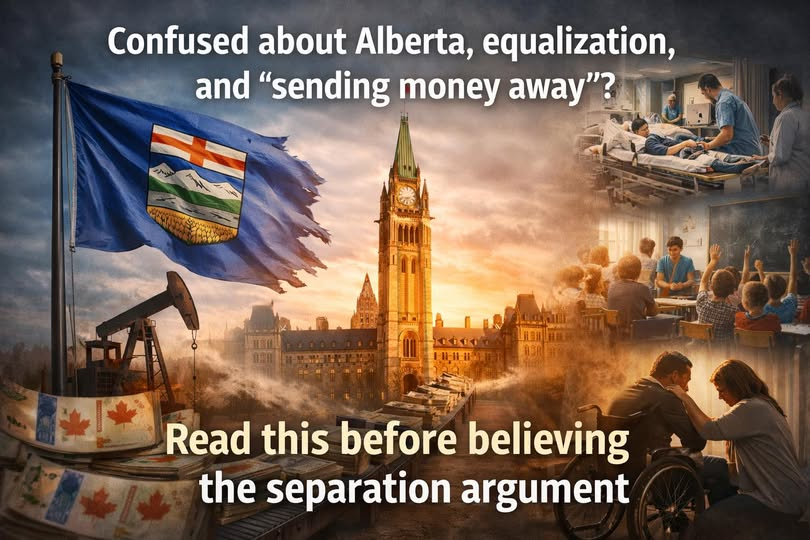
Very good post from Sharon Hayes...Worth your time. Most Alberta separation arguments fail before they even get to equalization. They start with the assumption that Alberta “sends money away” and would magically fix its problems if that stopped. That assumption misunderstands how federal taxes, equalization, and risk-sharing actually work. From there, the entire argument collapses. The pitch is simple and emotionally effective: “Alberta pays billions in equalization and gets nothing back. We’d be better off on our own.” That story only works if you isolate one program, blur how it actually functions, and quietly imply things that are not true. Yes, Alberta pays more to the federal government than it gets back in equalization. That part is true. What’s misleading is treating that fact as evidence of extraction. Here’s what equalization actually is. Equalization is a federal program, paid out of general federal revenues. It is not a direct transfer from Alberta to Quebec. Alberta does not write an equalization cheque. There is no line item where “Alberta’s money” is sent east. The federal government collects revenues nationally through: - Personal income taxes - Corporate taxes - GST and excise taxes - Other federal revenues Those revenues go into a single federal pool. Equalization payments are then calculated based on fiscal capacity, meaning a province’s ability to raise revenue at average tax rates. If a province has lower capacity, the federal government tops it up so it can provide reasonably comparable public services. If a province has higher capacity, it does not qualify. That’s it. Equalization is not: - A refund program - A reward or punishment - A moral judgment - A transfer from Alberta taxpayers to Quebec taxpayers Alberta doesn’t qualify because its fiscal capacity is higher. British Columbia and Saskatchewan also receive zero. That distinction matters, and it is almost always missing from separation rhetoric. Another implication that often sneaks into this conversation is that individual Albertans are personally paying higher federal taxes than people elsewhere. That is also false. Federal income taxes are set nationally. An Albertan and an Ontarian earning the same income pay the same federal income tax. Same brackets. Same rates. Same rules. There is no “Alberta surcharge” in the federal tax code. When Alberta sends more to Ottawa, it is not because Albertans are taxed more harshly. It is because: - Average incomes are higher - Corporate profits are larger in boom years - Employment rates are higher - More people are working and earning taxable income That’s arithmetic, not discrimination. Demographics matter here too. Alberta has a younger population than many provinces. Younger populations mean: - More people in prime working years - Fewer retirees drawing federal benefits - Higher employment-to-population ratios - More income tax collected relative to benefits paid That demographic advantage boosts federal revenues flowing out of Alberta in good years. It also means Alberta draws less from age-related federal programs compared to older provinces. That is not a policy choice made in Ottawa. It is a population-structure reality. More importantly, equalization is one program, not the totality of Alberta’s relationship with Canada. Here’s the part the propaganda skips: Alberta receives billions every year in federal transfers that have nothing to do with equalization. Core transfers alone matter: - The Canada Health Transfer - The Canada Social Transfer Together, these now total roughly $8–9 billion per year flowing to Alberta, rising over time. These funds support healthcare, post-secondary education, childcare, and social services. They do not disappear just because Alberta does not receive equalization. Then there is stabilization: Alberta is a high-income, high-volatility province tied to global oil prices. In boom years, Alberta sends more to Ottawa. In bust years, the federal government acts as a shock absorber. That is not redistribution. That is insurance. We have seen this repeatedly. In 2014–2016, oil prices collapsed from over $100 USD to under $30. Alberta lost more than 100,000 jobs. Provincial revenues cratered. Federal EI payments surged. Household incomes were stabilized by federal programs while Alberta absorbed the shock. In 2020, oil prices briefly crashed at the same time COVID shut down large parts of the economy. Alberta still received $6.6B in core federal transfers that year, rising to $8.2B by 2024–25, with $9.2B projected. That is before counting pandemic programs. Canada also has a Fiscal Stabilization Program specifically designed for sharp provincial revenue collapses. Alberta received hundreds of millions through this mechanism when oil revenues imploded. Alberta’s volatility is not ignored by the federation. It is explicitly planned for. Now let’s talk COVID support, because this is where the “we get nothing back” claim really breaks. Alberta received less CERB per capita than many provinces, although not dramatically so. Not because Ottawa singled it out, but because Alberta has higher wages and more EI-eligible workers. CERB flowed mainly to low-wage, service, tourism, gig, and seasonal work. Alberta has less of that. Meanwhile, the real money was flowing elsewhere. Through the Canada Emergency Wage Subsidy, Alberta businesses received roughly $14–15B, scaled to payroll size and wage levels. Add CEBA loans, liquidity programs, and sector supports, and Finance Canada estimates Alberta saw a net increase of roughly $10.9B in federal inflows in 2020 compared to 2019. That matters when people cite figures like “$244B sent to Ottawa.” Those numbers measure net contribution in good years, not what Alberta avoided losing in bad ones. Net contributor status is not proof of extraction. It is the arithmetic result of higher incomes during booms, paired with federal insurance during busts. Now add the piece that separation rhetoric almost never confronts: If Alberta were truly being starved of its own money, its provincial systems would reflect that. They don’t. They reflect provincial policy choices, even while federal money continues to flow. Alberta’s health system has experienced repeated emergency department disruptions and closures, even as it receives billions annually through the Canada Health Transfer. The province is currently restructuring its entire healthcare system because the existing model is not functioning as intended. Alberta’s education system has faced rapid enrollment growth, larger class sizes, and rising classroom complexity, culminating in a historic province-wide teachers’ strike. This is happening while federal social transfers continue to flow and while Alberta remains one of the wealthiest provinces in the country. And Alberta is actively restructuring disability supports, reducing benefit levels under a new program while instructing recipients to apply for the federal Canada Disability Benefit, then clawing that federal money back. That is not Ottawa starving Alberta. That is Alberta choosing how to allocate support. The claim that Alberta would thrive if it simply “stopped sending money away” collapses when you look at outcomes. Equalization is not draining Alberta’s budget. Federal money is already flowing in. The state of healthcare, education, and disability services reflects provincial governance decisions, not federal confiscation. Now add the piece that is almost always left out entirely: oil industry support and cleanup costs. In 2020, the federal government committed $1.7 billion to clean up orphan and inactive oil and gas wells in Western Canada, with Alberta receiving the largest share, including: - Over $1 billion to the Alberta government - A $200 million loan to the Orphan Well Association This is direct federal spending inside Alberta to deal with oil industry liabilities. On top of that, the federal government provides ongoing oil and gas subsidies, tax preferences, public financing, carbon capture incentives, and transition funding. A disproportionate share of this support flows to oil-producing provinces, primarily Alberta. These are not symbolic amounts. They are material assumptions of environmental and financial risk by the federal government. Now we have to talk honestly about Alberta’s dependence on oil prices, because this is where the independence fantasy quietly breaks. “Oil is profitable” is not the same thing as “Alberta is fiscally stable.” Alberta produces several types of oil, each with different economics. For conventional light and medium oil, operating break-even costs are roughly $35–$50 USD per barrel. These wells can remain viable at relatively low prices, but they represent a shrinking share of production and no longer drive provincial revenues the way oil sands do. For oil sands mining projects, operating costs once built can fall into the $30–$40 USD range. But when you include capital costs, financing, and long-term investment recovery, full-cycle break-even prices rise to roughly $60–$80 USD per barrel. For in-situ oil sands (SAGD), operating break-even typically sits around $35–$45 USD, while full-cycle economics usually require $50–$65 USD oil. Oil sands projects can keep pumping at lower prices once built, but new investment, expansion, royalties, and public revenues depend on much higher sustained prices. For Alberta as a province, fiscal stability historically requires oil prices in the range of $75–$85 USD per barrel. Below that, royalty revenues fall sharply even if companies remain profitable. At $50–$60 USD, Alberta’s public finances deteriorate quickly. At $40–$50 USD, deficits become structural. In other words: - Oil companies can survive at $40 - Alberta’s public finances cannot And volatility is the real problem. Oil prices are shaped by OPEC decisions, wars, global demand cycles, financial speculation, and technological shifts. Alberta does not control these forces. This leads to one unavoidable conclusion that rarely gets stated plainly: Alberta is a price taker, not a price maker. Alberta does not set global oil prices. It reacts to them. Prices are influenced by: - OPEC and OPEC+ production decisions - U.S. shale output and U.S. domestic political priorities - Global demand from China, India, and Europe - Wars, sanctions, and shipping disruptions Even the United States, the world’s largest producer, cannot fully control prices. Alberta, as a single producer within a global market, has even less influence. That means Alberta’s fiscal health is structurally tied to decisions made outside the province, often for reasons that have nothing to do with Alberta’s needs. Independence does not change that reality. It intensifies it. Without federal risk-sharing: - Volatility becomes fiscal crisis - Downturns become deeper and longer - Public services become harder to sustain Oil doesn’t just fund Alberta. Oil destabilizes Alberta. Being part of a federation cushions that instability. Independence would magnify it. Much of the anger wrapped around equalization isn’t really about equalization at all. It’s about control over resources, regulatory friction, pipelines, and a feeling that decisions affecting Alberta are made elsewhere. Those are legitimate political debates. But laundering those grievances through a misleading story about equalization distorts the problem and leads to bad conclusions. Now ask the question separation advocates avoid. What does an independent Alberta look like in the next oil crash? No federal EI backstop. No wage subsidies. No national borrowing power. No stabilization program. No shared cleanup funding. No national balance sheet absorbing risk. An independent Alberta wouldn’t just “keep more money.” It would have to build its own EI system, its own stabilization fund large enough to absorb oil crashes, its own borrowing credibility, and fully assume oil cleanup liabilities alone. Comparisons to Norway ignore the fact that Norway built its sovereign wealth fund before separating risk, runs massive trade surpluses, and taxes oil aggressively at the national level. Alberta has not done that at scale. That doesn’t mean Alberta couldn’t survive. It means the recessions would be deeper, the swings harsher, and the fiscal promises harder to keep. You can argue for reform. You can argue for more autonomy. But if the case for separation collapses once you explain equalization, federal transfers, stabilization, demographics, oil-sector risk sharing, oil-price dependence, price-taking reality, and the actual state of Alberta’s public systems, then equalization was never the real issue. Sharon Hayes Footnote: None of this even touches the legal and political reality that separation would require renegotiating Indigenous treaties, navigating constitutional law, and securing broad democratic legitimacy.
Jason Gregor tweet media
English
393
736
1.7K
94.4K
Still an Imaginer
Still an Imaginer@JeffreyFDunn·
This has nothing to do with why Canadians are boycotting aspects of the USA but it has everything to do with it. The path it is on should end. There are many good politicians that could lead the USA. This regime is dangerous. theglobeandmail.com/gift/1d29a575c…
English
0
0
0
49
Still an Imaginer รีทวีตแล้ว
Wab Kinew
Wab Kinew@WabKinew·
What’s happening in Minnesota right now is an outrage. Now is a time for moral clarity. As Canadians and Manitobans, with a history as peacekeepers and and a desire to be a beacon for human rights, we stand with Minnesotans for the value of a human life. No matter where you stand politically, we want to see our American friends and family get through this. Check in on them. Let them know we’re standing with the average person there for freedom and democracy. 🇨🇦
English
1.3K
1K
4.7K
114.6K
Still an Imaginer รีทวีตแล้ว
Bill Clinton
Bill Clinton@BillClinton·
Over the course of a lifetime, we face only a few moments where the decisions we make and the actions we take will shape our history for years to come.  This is one of them.
Bill Clinton tweet media
English
0
27.4K
125.7K
10.3M
Still an Imaginer
Still an Imaginer@JeffreyFDunn·
And added value on a peaceful sunday, a moose walked through our yard
English
0
0
0
43
Still an Imaginer
Still an Imaginer@JeffreyFDunn·
Storm is over in yyc. Calgary. Beautuful snow capped mountains
Still an Imaginer tweet media
English
1
0
0
119
Still an Imaginer รีทวีตแล้ว
Spencer Hakimian
Spencer Hakimian@SpencerHakimian·
BREAKING: NEW ANGLE OF MINNESOTA SHOOTING MOST DIRECT ANGLE YET
English
584
2.2K
6.9K
632K
Still an Imaginer
Still an Imaginer@JeffreyFDunn·
@Bannons_WarRoom As a proud Canadian, I am not against the USA. I like the US and most Americans. What I'm pissed about is a long-term ally turning on us. Americans that threaten a 51st state, srew up our shared trade and manufacturing, and support Alberta separatists are NOT welcome
English
0
0
0
36
Bannon’s WarRoom
Bannon’s WarRoom@Bannons_WarRoom·
STEVE BANNON:  Canada is in the vital national security interest of the United States.  This is inextricably linked to Hemispheric Defense. Hemispheric Defense for the United States starts in Canada.  Canada's rapidly changing,  these people are hostile to the United States of America. Not neutral. They're hostile to the United States of America.
English
1.9K
792
2.2K
870.6K
Still an Imaginer
Still an Imaginer@JeffreyFDunn·
The UCP is meddling with legal independence, like it meddles in medicine and education, without a focus on what is good for Albertans. The law foundation staff just quit in protest. Alberta Law Foundation sees 2 ... cbc.ca/news/canada/ca…
English
7
16
22
8.1K
Still an Imaginer รีทวีตแล้ว
Al-Karim Walli 🇨🇦
Canada deploys N.I.C.E. agents.
English
1
4
5
853
Still an Imaginer รีทวีตแล้ว
Brian Krassenstein
Brian Krassenstein@krassenstein·
A message from a Danish friend that really hit home: “Dear Americans, Look Inward I write this as a Dane, from Denmark. From here — and with Greenland very much in mind — it may appear that we fear the direction the United States is heading. And we do. But the truth is that you — as an American — are far more frightened. You live in a country where power turns against its own people. Where the military is used at home. Where democratic institutions are weakened while fear becomes a governing tool. In that reality, silence is not neutral. It is a survival strategy. So, you do things to convince yourself that everything is fine. You scroll. You binge-watch. You drink a little more. You choose sitcoms over news. You post a smiling selfie, add a stronger filter, and write: “Doing great.” You stay quiet because speaking up can cost you your job. Because your employer fears losing contracts. Because schools, boards, and communities prefer calm over courage. So denial becomes routine. Distraction becomes normal. Comfort replaces truth. But fear does not stop there. You begin to police yourselves. You watch each other. You suspect each other. You question motives. You report. You label. You call fellow citizens extremists. You call them terrorists. In the name of security, you learn to mistrust one another. And then think about this: when you dream of a bigger gun, a stronger caliber, more firepower. Ask yourself whether that weapon is protection, or a mirror. Whether the need for a larger gun is not a sign of strength, but a measure of how afraid you have become. Fear has many faces. Fear of those who call themselves patriots but threaten instead of arguing. Fear of your neighbor. Fear of the police. Fear of being open, kind, or publicly disagreeing. From the outside, this does not look like freedom. It looks like a frightening society pretending to function. And then there is the thought you try hardest to suppress: that people willingly choose not to be part of the United States. Not out of hatred. Not out of jealousy. But out of clarity. That must be brutal and deeply disorienting to face — especially because, deep down, you already know why. So, look inward. Not as a nation. As a person. Because democracies do not collapse in one dramatic moment. They fade while people convince themselves that everything is fine. Kind Regards, Jacob @JacobHokland
English
644
3K
10.2K
470.3K
Still an Imaginer รีทวีตแล้ว
Crazy Vibes
Crazy Vibes@CrazyVibes_1·
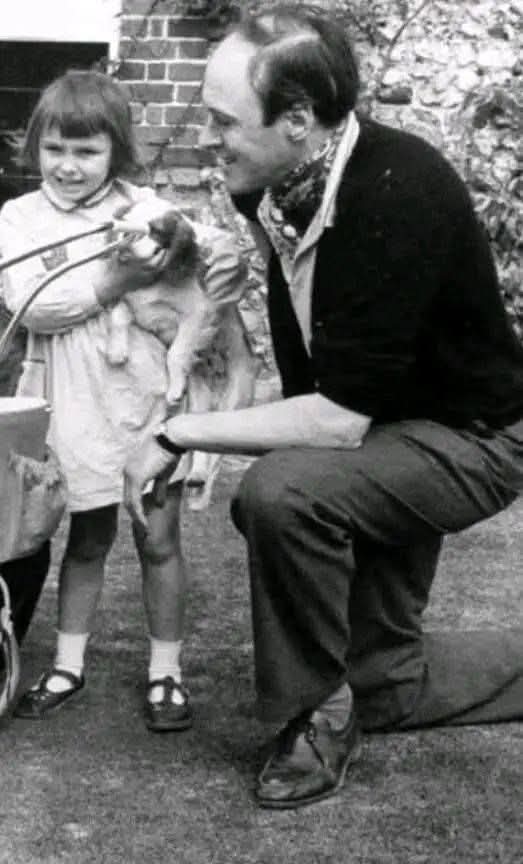
Roald Dahl on Measles: Olivia, my eldest daughter, caught measles when she was seven years old. As the illness took its usual course I can remember reading to her often in bed and not feeling particularly alarmed about it. Then one morning, when she was well on the road to recovery, I was sitting on her bed showing her how to fashion little animals out of coloured pipe-cleaners, and when it came to her turn to make one herself, I noticed that her fingers and her mind were not working together and she couldn’t do anything. 'Are you feeling all right?' I asked her. 'I feel all sleepy,' she said. In an hour, she was unconscious. In twelve hours she was dead. The measles had turned into a terrible thing called measles encephalitis and there was nothing the doctors could do to save her. That was...in 1962, but even now, if a child with measles happens to develop the same deadly reaction from measles as Olivia did, there would still be nothing the doctors could do to help her. On the other hand, there is today something that parents can do to make sure that this sort of tragedy does not happen to a child of theirs. They can insist that their child is immunised against measles. ...I dedicated two of my books to Olivia, the first was ‘James and the Giant Peach’. That was when she was still alive. The second was ‘The BFG’, dedicated to her memory after she had died from measles. You will see her name at the beginning of each of these books. And I know how happy she would be if only she could know that her death had helped to save a good deal of illness and death among other children. Roald Dahl, 1986
Crazy Vibes tweet media
English
542
12.7K
44.9K
1.6M