@LeviIsraelson@JohnCleese My initial point to Mr Cleese was that Jesus IS talked about in the Old Testament.
It predicts the exact time period he would come in.
It predicts his birth place.
It describes his death by crucifixion in detail before that execution method existed.
This should interest sceptics.
Someone needs to explain to the Pope about MAGA Christians...
The reason they prefer the Old Testament to the New Testament is simply that...Christ isn't in it
@PhilBlagden@JohnCleese Your opinion regarding this has nothing to do with the subject that I have been discussing.
You may want to ask why many missionaries insist on making the claim even though it has nothing to do with what Isaiah 53 means.
What do you think their goal is?
@LeviIsraelson@JohnCleese Regardless, you blindly trust the Rabbinical interpretation which does not fit the descriptions in the passage which clearly describe the suffering of an individual who is gravely wounded, dies, is buried in a rich man's grave yet his life is then prolonged.
Read it carefully.
@PhilBlagden@JohnCleese I know you didn't make the claim personally. And yet you accept the claim without any skeptism and you do that even after you were told its not true.
You may want to ask yourself why you put so much faith in missionaries.
@LeviIsraelson@JohnCleese I'm not the one that made this claim personally.
I watch various YouTube channels where Messianic Jews share their beliefs with either secular or Orthodox Jews.
Most Jews don't seem to be aware of Isaiah 53, and what it teaches.
Many do see Yeshua in this passage.
@PhilBlagden@JohnCleese No, not good enough.
It's not forbidden in any sense of the word.
It is not avoided, it is not omitted.
Yes, that is the problem. You are relying on people who not experts. And yet when people who actually know what they are talking about say otherwise, you give it the same...
@PhilBlagden@JohnCleese ... is immaterial. What matters is that the claim is unproven.
So, either concede that the non reading of Isaiah 53 in Judaism has nothing to do with how Christians see it or provide evidence that it was deliberately omitted.
@PhilBlagden@JohnCleese Yes, you are telling me your Christian beliefs.
I am here to point out that those beliefs have nothing to do with the Haftarah readings in Judaism.
THEREFORE, the assumption that Isaiah 53 is somehow deliberately avoided is incorrect.
Whether or not you accept what I say...
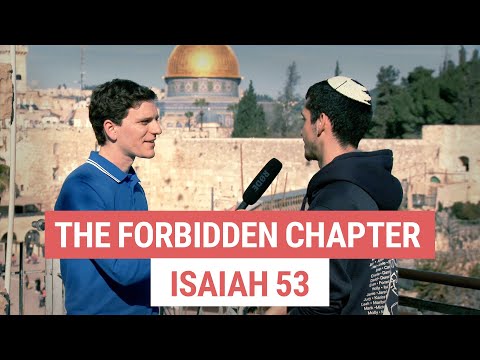
@kayessdub@Ghostbanned7@Askwhyisit Several times in fact. If Isaiah 53 was "about Israel" it wouldn't need to be referred to as "the Forbidden Chapter". And if Psalm 22 wasn't about Jesus, 1st Century Jews wouldn't have changed the text from "Pierced my hands and my feet" to "like a lion."
sixnotesclothing.com/blog/isaiah-53…
BREAKING NEWS
A team of apologists has, after careful study, concluded that God is going to come down on earth sacrifice himself and come back to life for all of us to see and it will happen within the next month.
What they still have to tell us is where it is going to happen so we can bring our cameras.
@PhilBlagden@JohnCleese ... your disagreement doesn't change the fact that is how it is seen in Judaism. THEREFORE, your "argument" that Isaiah 53 should be read because you believe the subject is the Messiah doesn't apply. It doesn't apply because, as I said at the beginning, your view is irrelevant.
@PhilBlagden@JohnCleese ... they are Messianic themed or not is *not* a determining factor as to their selection. THEREFORE, making an "argument" that "x should be read because it is Messianic" doesn't apply.
2) The subject of Isaiah 53 is about Israel. And yes, I know you don't agree. But...
@PhilBlagden@JohnCleese ... see no reason why it should be read.
After all, over 80% of Isaiah is not read as part of the weekly services. I don't question that either. What makes Isaiah 53 so special over the other 80% that isn't read? Nothing.
@PhilBlagden@JohnCleese ...from Judaism's point of view.
Who makes the determination that it *should* be read? You?
Christianity?
Well, that is the basic problem as I see it. You have to understand that the Christian view is irrelevant to Judaism.
I don't question why it isn't read because I honestly
@PhilBlagden@JohnCleese Your characterization of the objection of Orthodox Jews, who are the one group who should know whether something has been forbidden to them or not, as a "claim" is what I was addressing.
Orthodox Jews are not *required* to provide evidence that it is not true.
@PhilBlagden@JohnCleese What the meaning of Isaiah 53 is has no bearing on the claim that it is somehow deliberately withheld (or "forbidden").
That is what I mean by "burden of proof".
The people who claim it have to provide evidence or concede that they were wrong.
Its a prophecy. Few things affected me more than seeing how Jews respond to Isaiah 53 or Zechariah 12:10.
Hannah, you need to study Zechariah and Isaiah.
>.They will look to me whom they have pierced; and they shall mourn for him as one mourns for his only son, and will grieve bitterly
youtu.be/cGz9BVJ_k6s?si…
@PhilBlagden@JohnCleese Tellingly, the missionaries who produced this video spent no time proving it. I should also note that even if the claim were true, that doesn't make it a "forbidden chapter".
I should also note that Orthodox Jews are not the ones with the burden of proof here.
@PhilBlagden@JohnCleese And this is a different claim.
Saying "it was removed from the Haftarah" is different from "I was told by someone not to read it personally".
As for that claim, while it is correct that it isn't read, there is no evidence that it used to be.
@PhilBlagden@JohnCleese Did they identify who gave them that advice?
I have seen many claims in the past that it is outright forbidden by rabbis or that rabbis tell people not to read it and *not once* has any rabbi gone on or off record to confirm it.
Its a serious claim, there should be evidence.
@LeviIsraelson@JohnCleese I have seen some interviews with Jews who said they were advised not to read it.
In any case the interpretation that the suffering servant is the nation of Israel or a faithful remnant is not consistent with the text.