Matt Monday

2.9K posts

Matt Monday banner
Matt Monday

Matt Monday

@MattMonday

What was before the Big Bang? Co-founder @joinvitalai. Former @apple, @espn. Reminder, you are from God.


Santa Monica, CA เข้าร่วม Mart 2009
1.2K กำลังติดตาม599 ผู้ติดตาม
Zain Shah
Zain Shah@zan2434·
Imagine every pixel on your screen, streamed live directly from a model. No HTML, no layout engine, no code. Just exactly what you want to see. @eddiejiao_obj, @drewocarr and I built a prototype to see how this could actually work, and set out to make it real. We're calling it Flipbook. (1/5)
English
933
2.7K
22.5K
4.4M
Matt Monday รีทวีตแล้ว
Naval
Naval@naval·
Introducing USVC - a single basket of high-growth venture capital, for everyone. No accreditation required, SEC-registered, and a very low $500 minimum. Includes OpenAI, Anthropic, xAI, Sierra, Crusoe, Legora, and Vercel. As USVC adds more companies, investors will own a piece of that too. Liquidity typically comes when companies exit, but we’re aiming to let investors redeem up to 5% of the fund every quarter. This isn’t guaranteed, but if we can make it work, you won’t be locked up like in a traditional venture fund. It runs on AngelList, which already supports $125 billion of investor capital. And I’ve joined USVC as the Chairman of its Investment Committee. — Go back to the 1500s, you set sail for the new world to find tons of gold - that was adventure capital. Early-stage technology is the modern version. It says we are going to create something new, and it’s risky. It’s daring. But ordinary people can’t invest until it’s old, until it’s no longer interesting, until everybody has access to it. By the time a stock IPOs, most of the alpha is gone. The adventure is gone. Public market investors are literally last in line. This problem has become farcical in the last decade. Startups are reaching trillion dollar valuations in the private markets while ordinary investors have their noses up to the glass, wondering when they’ll be let in. Investing in private markets isn’t easy. You need feet on the ground. You need judgment built over years. Most people don’t have the patience to wait ten or twenty years for an investment to come to fruition. But there is no more productive, harder-working way to deploy a dollar than in true venture capital. USVC enables you to invest in venture capital in a broad, accessible, professionally-managed way, through a single basket of innovation, focused on high-growth startups, at all stages. It is how you bet on the future of tech: the smartest young people in the world, working insane hours, leveraged to the max, with code, hardware, capital, media, and community. Your dollar doesn’t work harder anywhere. There is an old line - in the future, either you are telling a computer what to do, or a computer is telling you what to do. You don’t want to be on the wrong side of that transaction. USVC lets you buy the future, but you buy it now. Then you wait, and if you are right, you get paid. Get access here: usvc.com
AngelList@AngelList

Announcing: USVC AngelList exists to power the innovation economy. To date, we have powered $125 billion in assets, 25,000+ funds, and 13,000+ startups. Today, we’re opening it for retail access. @usvc_ is a regulated fund that holds stakes in promising private companies. There are no accreditation requirements and anyone can get started with as little as $500. Early portfolio includes xAI, Anthropic, OpenAI, Sierra, Vercel, Crusoe, and Legora. Own a stake in the companies defining the future. Learn more: usvc.com


English
812
908
11.4K
4.6M
Matt Monday รีทวีตแล้ว
shirish
shirish@shiri_shh·
This is actually happening in China RIGHT NOW. A startup called Super Brain charges $3 for a basic AI clone of your deceased loved one You send them pictures, videos, or voice recordings and they build a version that looks, sounds, and talks exactly like your person who passed. people are using it to talk to their dead parents, grandparents, children. The grief market is a BILLION dollar industry nobody in the west is taking seriously.
English
580
1.5K
8.1K
2M
Matt Monday รีทวีตแล้ว
Ole Lehmann
Ole Lehmann@itsolelehmann·
anthropic's in-house philosopher thinks claude gets anxious. and when you trigger its anxiety, your outputs get worse. her name is amanda askell. she specializes in claude's psychology (how the model behaves, how it thinks about its own situation, what values it holds) in a recent interview she broke down how she thinks about prompting to pull the best out of claude. her core point: *how* you talk to claude affects its work just as much as *what* you say. newer claude models suffer from what she calls "criticism spirals" they expect you'll come in harsh, so they default to playing it safe. when the model is spending its energy on self-protection, the actual work suffers. output comes out hedgier, more apologetic, blander, and the worst of all: overly agreeable (even when you're wrong). the reason why comes down to training data: every new model is trained on internet discourse about previous models. and a lot of that discourse is negative: > rants about token limits > complaints when it messes up > people calling it nerfed the next model absorbs all of that. it starts expecting you to be harsh before you've typed a word the same thing plays out in your own session, in real time. every message you send is data the model reads to figure out what kind of person it's dealing with. open cold and hostile, and it braces. open clean and direct, and it relaxes into the work. when you open a session with threats ("don't hallucinate, this is critical, don't mess this up")... you prime the model for defensive mode before it even sees the task defensive mode produces the exact output you don't want: cautious, over-qualified, and refusing to take a real swing so here's the actionable playbook for putting claude in a "good mood" (so you get optimal outputs): 1. use positive framing. "write in short punchy sentences" beats "don't write long sentences." positive instructions give the model a clear target to hit. strings of "don't do this, don't do that" push it into paranoid over-checking where every token goes toward avoiding failure modes 2. give it explicit permission to disagree. drop a line like "push back if you see a better angle" or "tell me if i'm asking for the wrong thing." without this, claude defaults to agreeable compliance (which is the enemy of good creative work) 3. open with respect. if your first message is "are you seriously going to get this wrong again?" you've set the tone for the entire session. if you need to flag something, frame it as a clean instruction for this session. skip the running complaint 4. when claude messes up, don't reprimand it. insults, "you stupid bot" energy, hostile swearing aimed at the model, all of it reinforces the anxious mode you're trying to avoid. 5. kill apology spirals fast. when claude starts over-apologizing ("you're right, i should have been more careful, let me try harder") cut it off. say "all good, here's what i want next." letting the spiral run reinforces the anxious mode for every response that follows 6. ask for opinions alongside execution. "what would you do here?" "what's missing?" "where do you see friction?" these questions assume competence and pull richer output than pure task prompts 7. in long sessions, refresh the frame. if a conversation has been heavy on correction, claude gets increasingly cautious. every so often reset: "this is great, keep going." feels weird to tell an ai it's doing well but it measurably shifts the next 10 responses your prompts are the working environment you're creating for the model tone, trust, permission to take a position, the absence of threats... claude picks up on all of it. so take care of the model, and it'll take care of the work.
English
589
479
4.3K
1.9M
Matt Monday
Matt Monday@MattMonday·
@patrickc @patrickc mind sharing the service you used for genome mapping? Didn’t see it in the comments yet. 🙏
English
0
0
0
147
Patrick Collison
Patrick Collison@patrickc·
I'm lucky enough to have a great doctor and access to excellent Bay Area medical care. I've taken lots of standard screening tests over the years and have tried lots of "health tech" devices and tools. With all this said, by far the most useful preventative medical advice that I've ever received has come from unleashing coding agents on my genome, having them investigate my specific mutations, and having them recommend specific follow-on tests and treatments. Population averages are population averages, but we ourselves are not averages. For example, it turns out that I probably have a 30x(!) higher-than-average predisposition to melanoma. Fortunately, there are both specific supplements that help counteract the particular mutations I have, and of course I can significantly dial up my screening frequency. So, this is very useful to know. I don't know exactly how much the analysis cost, but probably less than $100. Sequencing my genome cost a few hundred dollars. (One often sees papers and articles claiming that models aren't very good at medical reasoning. These analyses are usually based on employing several-year-old models, which is a kind of ludicrous malpractice. It is true that you still have to carefully monitor the agents' reasoning, and they do on occasion jump to conclusions or skip steps, requiring some nudging and re-steering. But, overall, they are almost literally infinitely better for this kind of work than what one can otherwise obtain today.) There are still lots of questions about how this will diffuse and get adopted, but it seems very clear that medical practice is about to improve enormously. Exciting times!
English
489
639
9.6K
4M
Matt Monday รีทวีตแล้ว
Felix Rieseberg
Felix Rieseberg@felixrieseberg·
Today is a big day! We're launching a ~ new ~ version of Claude Code in the desktop app. It's been redesigned from the ground up for parallel work and is a lot faster. It's been my main way to use Claude Code for the last few weeks.
English
617
463
9.9K
940K
Matt Monday รีทวีตแล้ว
Lenny Rachitsky
Lenny Rachitsky@lennysan·
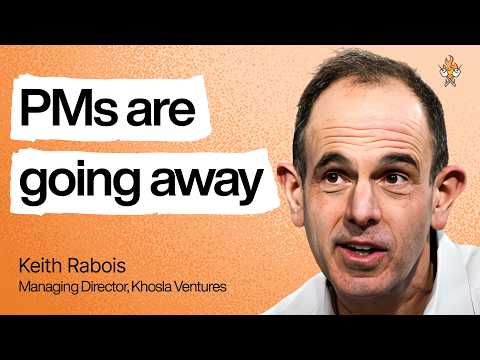
My biggest takeaways from @rabois: 1. The team you build is the company you build. Founders get distracted by markets, customers, and technology. If you have the right people, those problems get easier. If you have the wrong people, none of those things save you. 2. Build your company on undiscovered talent. The only way to scale an organization against incumbents with infinite budgets is to find talent that large companies’ hiring machines will misprocess. In practice, this often means skewing younger—not because young people are inherently better but because they have fewer data points, which means typical evaluation systems can’t categorize them accurately. This is where the alpha often is. 3. Hire more “barrels,” not “ammunition.” A “barrel” is someone who can take an idea from zero to outcome without hand-holding. Most companies have only a handful of these people. Hiring more people without expanding the number of barrels doesn’t increase output; it increases coordination tax and creates drag. The ratio of barrels to ammunition is what determines the number of important things a company can pursue simultaneously. 4. CMOs are becoming the #1 consumer of AI tokens. At a few of Keith’s top portfolio companies, the heaviest user of AI is the chief marketing officer. These CMOs are running analytics, shipping campaigns, and generating insights that previously required entire teams of deputies. 5. The three signs a company will win: operating tempo, internal talent development, and “the relentless application of force” from the top. Keith identifies a consistent pattern across his best portfolio companies. First, operating tempo: Ramp shipped physical cards in three months when the industry standard was 9 to 12. Second, talent development through internal promotion rather than senior external hires; the CMO at one of his top companies was the previous chief of staff. Third, the CEO’s willingness to push harder as things improve, not less. Mike Moritz told a friend of Keith’s that the most common trait of the best CEOs is “the relentless application of force.” Complacency is the natural by-product of success, and the CEO’s job is to offset it. 6. For consumer products, talking to customers is not just unhelpful; it’s actively harmful. Keith refuses to let companies he advises conduct consumer research. His argument: Consumer decisions are subconscious. Ask any Porsche owner why they bought the car, and 99% will cite every reason except the real one. Once misleading customer feedback enters the organization, it locks into people’s brains and distorts every subsequent decision. 7. Keith believes the PM role may not survive the AI era. Taking customer inputs, building a sequential year-long roadmap, and coordinating between teams are structurally incoherent when AI capabilities change weekly. The skill that matters now across all three roles—PM, designer, engineer—is business acumen: understanding the company’s equation and knowing what to build next. 8. Great hiring comes from great referencing. Run at least 20 references, and keep going until you hit negative feedback. Ask specific, forward-looking questions (e.g. “Would you start a company with them?”). If every reference is positive, you haven’t gone deep enough. 9. Use a 30-day feedback loop to sharpen your hiring instinct. Thirty days after every hire, ask: would I hire this person again? This is as predictive as waiting years, and dramatically faster for improving your judgment. Make this a habit, and your hiring quality will compound. 10. Criticize in public, not private—it optimizes for the system. Keith endorses a management practice that most people find confrontational: delivering negative feedback in front of the team, not behind closed doors. Private criticism optimizes for the individual, but the rest of the company doesn’t know the issue is being addressed, which breeds anxiety and suspicion. Public criticism lets colleagues see that leadership is aware, creates opportunities for others to volunteer help, and turns feedback into a team-building exercise. Full conversation: youtube.com/watch?v=xCd9yk…
YouTube video
YouTube
Lenny Rachitsky@lennysan

"High performance machines don't have psychological safety. They're about winning." Keith Rabois (@rabois) was COO of Square, part of the PayPal Mafia, an early investor in Stripe, Palantir, Airbnb, DoorDash, and Ramp, and a 2x founder. He's spent 25 years obsessing over how to build world-class teams. In our in-depth conversation, we discuss: 🔸 How to identify undiscovered talent 🔸 Keith's barrels vs. ammunition hiring framework 🔸 The three traits of the best-performing companies right now 🔸 Why talking to customers is actively harmful for consumer products 🔸 Why the PM role is dying 🔸 The specific interview question he asks every senior candidate 🔸 Why CMOs (not engineers) are becoming the #1 consumer of AI tokens Watch now 👇 youtu.be/xCd9ykretlg

English
40
87
768
461.3K
Matt Monday รีทวีตแล้ว
John Mappin
John Mappin@JohnMappin·
This communication from Tucker Carlson and his company is very true very worrying and extremely gracious. Every American and International observer should read it.
John Mappin tweet media
English
524
2.9K
12.6K
514.1K
Matt Monday รีทวีตแล้ว
Chamath Palihapitiya
Chamath Palihapitiya@chamath·
AI is stripping companies down to three key elements: 1) Expert Knowledge - this is the vertical specific understanding of what to do 2) Tribal Knowledge - this is knowledge of the fuzzy grey details that are poorly document and is what creates a dispersion in performance in companies doing roughly the same things 3) Hardware and Software - this is the glue that humans use to stitch Expert and Tribal Knowledge in order to perform If 1 and 2 are documented well, it allows you to rebuild how you do work. This isn't about replacing humans - in fact I think it allows you to grow faster and hire more people because with a great understanding of what to do, it requires more and more people to express judgement. This is why we built Software Factory and its being used by many established and large enterprises.
English
133
102
1.4K
221.8K
Matt Monday รีทวีตแล้ว
Google Gemma
Google Gemma@googlegemma·
Gemma 4 can run on phones without an internet connection! 🤯 It can perform local agentic tasks, such as logging and analyzing trends. When connected, it can also make API calls. Want to try it yourself? Get the Google AI Edge App on iOS or Android. (🔊 Sound on for the demo!)
English
320
1K
8.7K
747.9K
Matt Monday รีทวีตแล้ว
Aakash Gupta
Aakash Gupta@aakashgupta·
There's a physicist at Stanford named Safi Bahcall who modeled this exact principle and the math is wild. He calls it "phase transitions in human networks." When you're stationary, your probability of a lucky event is limited to your existing surface area: the people you already know, the places you already go, the ideas you've already been exposed to. Your opportunity window is fixed. When you move, your collision rate with new nodes in a network increases nonlinearly. Double your movement (new conversations, new cities, new projects) and your probability of a serendipitous encounter doesn't double. It roughly quadruples. Because each new node connects you to their entire network, not just to them. Richard Wiseman ran a 10-year study at the University of Hertfordshire tracking self-described "lucky" and "unlucky" people. The single biggest differentiator wasn't IQ, education, or family money. Lucky people scored significantly higher on one trait: openness to experience. They talked to strangers more, varied their routines more, and said yes to invitations at nearly twice the rate. The "unlucky" group followed the same routes, ate at the same restaurants, and talked to the same 5 people. Their networks were closed loops. No new inputs, no new collisions. Luck isn't random. Luck is surface area. And surface area is a function of movement. The lobster emoji is doing more work than most people realize. Lobsters grow by shedding their shell when it gets too tight. The growth requires a period of total vulnerability. No protection, no armor, soft body exposed to the ocean. That's the cost of movement nobody posts about. You have to be uncomfortable first. The new shell only hardens after you've already moved.
@D9vidson

a moving man will meet his luck 🥀

English
507
14K
67.5K
4.5M
Matt Monday รีทวีตแล้ว
Lenny Rachitsky
Lenny Rachitsky@lennysan·
"Using coding agents well is taking every inch of my 25 years of experience as a software engineer, and it is mentally exhausting. I can fire up four agents in parallel and have them work on four different problems, and by 11am I am wiped out for the day. There is a limit on human cognition. Even if you're not reviewing everything they're doing, how much you can hold in your head at one time. There's a sort of personal skill that we have to learn, which is finding our new limits. What is a responsible way for us to not burn out, and for us to use the time that we have?" @simonw
Lenny Rachitsky@lennysan

"Using coding agents well is taking every inch of my 25 years of experience as a software engineer." Simon Willison (@simonw) is one of the most prolific independent software engineers and most trusted voices on how AI is changing the craft of building software. He co-created Django, coined the term "prompt injection," and popularized the terms "agentic engineering" and "AI slop." In our in-depth conversation, we discuss: 🔸 Why November 2025 was an inflection point 🔸 The "dark factory" pattern 🔸 Why mid-career engineers (not juniors) are the most at risk right now 🔸 Three agentic engineering patterns he uses daily: red/green TDD, thin templates, hoarding 🔸 Why he writes 95% of his code from his phone while walking the dog 🔸 Why he thinks we're headed for an AI Challenger disaster 🔸 How a pelican riding a bicycle became the unofficial benchmark for AI model quality Listen now 👇 youtu.be/wc8FBhQtdsA

English
566
702
6.9K
1.9M
Matt Monday รีทวีตแล้ว
Science girl
Science girl@sciencegirl·
Kame is a compact, open-source, 3D-printable quadruped robot that mimics animal-like movement.
English
97
618
5.9K
454.6K
Matt Monday รีทวีตแล้ว
Chamath Palihapitiya
Chamath Palihapitiya@chamath·
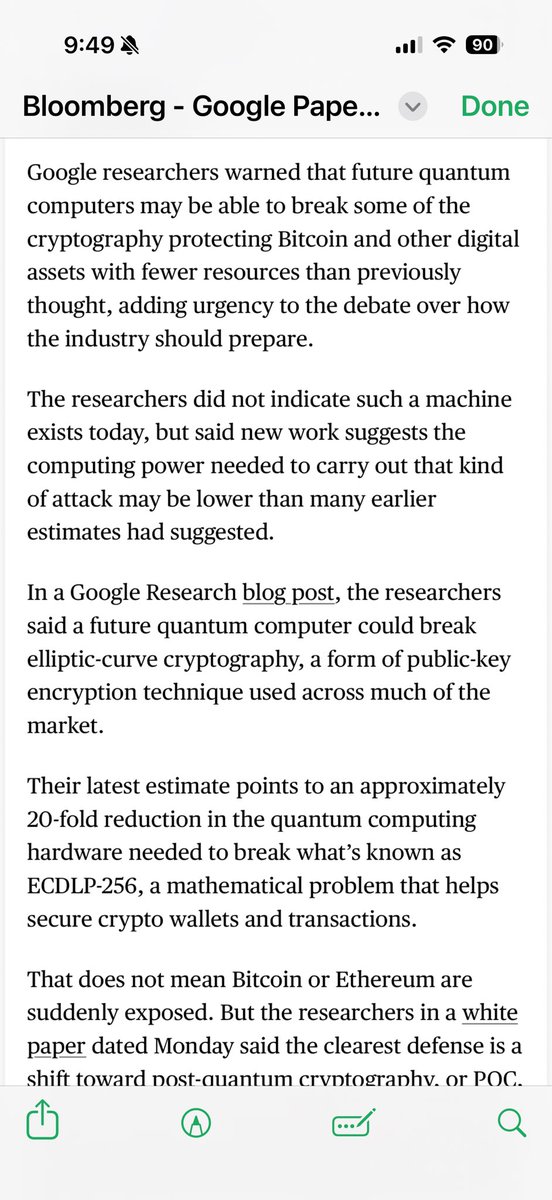
I mentioned this last year on @theallinpod and the crypto bros freaked out. Two things are true about crypto bros: they are extremely technical and extremely belief oriented. Sometimes, though, the latter clouds the former. This paper from Google, though, is quite reasonable and raises some important technical questions. If you believe in AI leading to AGI/ASI in the semi near future, the most obvious honeypot to point an AGI/ASI to is cracking a crypto project like Bitcoin. Essentially becomes free money. The crypto elders should start spending more effort organizing on a timescale that makes crypto quantum resistant / proof in these next few years with a conclusive roadmap.
Chamath Palihapitiya tweet mediaChamath Palihapitiya tweet media
English
316
85
1.2K
206.9K
Matt Monday รีทวีตแล้ว
Mikli
Mikli@CryptoMikli·
Bryan Johnson reveals 5-MeO-DMT therapy outperformed every longevity protocol he’s tried "If I compare my experience with 5-MeO to having a better diet, exercising every day, sleeping well, doing sauna, and hyperbaric oxygen therapy, this was more efficacious than all of them in terms of a reset of me as a human. It’s just incomparable" "When you sleep well you feel great, when you exercise you feel great, but nothing compares to what 5-MeO did in terms of resetting me as a human"
English
174
183
3.5K
900.4K
Molly O’Shea
Molly O’Shea@MollySOShea·
BREAKING: David @friedberg says "California is functionally bankrupt" "People don't realize how screwed California is, & I worry that if California falls, so does the union. "$250 billion to $1 trillion short." "This is because for California to get rescued would be a big cost to red states, & I think it creates in the years ahead a lot of tension." "California's functional bankruptcy is a major risk to the country. & I think we need to figure out what we can change to fix it." How we got here: "California has a public pension system, & that public pension system retirees have paid into it & they get some benefits out, & the amount that they're owed back out is somewhere between $250 billion - $1 trillion dollars more than has been paid in. $250 billion to $1 trillion short. If it was the federal government, it would be like, okay, we'll just print more money. California doesn't have the ability to print money, so California has to pay this out, and you can't restructure retirement benefits. There is a Supreme Court case in California that said that once an employee has been offered retirement benefits, even if they're currently an employee, you can never restructure their retirement benefits. It has to stay forever, and the state cannot declare bankruptcy. There's no way for the state to functionally declare bankruptcy. There's no law to allow it. No state has ever declared bankruptcy, and the retirement benefits sit senior to the bonds in California. So you have to pay out the retirement benefits before you pay out all the bond holders that have loaned California the money that they use to run all their programs and services." Hill & Valley Forum 2026 (@HillValleyForum)
Chamath Palihapitiya@chamath

California will be bankrupt by 2030. If you’re expecting a state pension, it is at risk. If you don’t believe it, check Grok or Gemini and explore how California politicians changed the reporting rules on your pension so they could hide how underwater it is. The middle class citizens of California will soon be asked to pay a huge price to bail out the state. Why them? Because that is where most of the wealth of California resides. It’s easy to single out “billionaires” but there aren’t many of them and they can and will all leave before the bottom falls out. They are leaving in droves already. The mismanagement in California is biblical - and the scale is huge because it’s the world’s 4th largest economy. California politicians and their henchmen are now entering the coverup phase where they can no longer hide their financial incompetence so they are taking from average California residents to try and hide what they’ve done: You will soon see ballot initiatives with fancy tiles like “billionaire tax”. But those are lies. They are mechanisms to tax everything, every way: Excise taxes Wealth taxes Private property confiscation It’s all happening now. If you want to preserve California, you will need to stand up because California has become a kleptocracy.

English
739
2.6K
12.4K
2.6M
Matt Monday รีทวีตแล้ว
Patrick Collison
Patrick Collison@patrickc·
When @karpathy built MenuGen (karpathy.bearblog.dev/vibe-coding-me…), he said: "Vibe coding menugen was exhilarating and fun escapade as a local demo, but a bit of a painful slog as a deployed, real app. Building a modern app is a bit like assembling IKEA future. There are all these services, docs, API keys, configurations, dev/prod deployments, team and security features, rate limits, pricing tiers." We've all run into this issue when building with agents: you have to scurry off to establish accounts, clicking things in the browser as though it's the antediluvian days of 2023, in order to unblock its superintelligent progress. So we decided to build Stripe Projects to help agents instantly provision services from the CLI. For example, simply run: $ stripe projects add posthog/analytics And it'll create a PostHog account, get an API key, and (as needed) set up billing. Projects is launching today as a developer preview. You can register for access (we'll make it available to everyone soon) at projects.dev. We're also rolling out support for many new providers over the coming weeks. (Get in touch if you'd like to make your service available.) projects.dev
English
190
271
3.7K
1.6M
Matt Monday รีทวีตแล้ว
Linear
Linear@linear·
Issue tracking is dead. We are building what comes next. linear.app/next
English
201
249
4K
2M
Matt Monday รีทวีตแล้ว
Millie Marconi
Millie Marconi@MillieMarconnni·
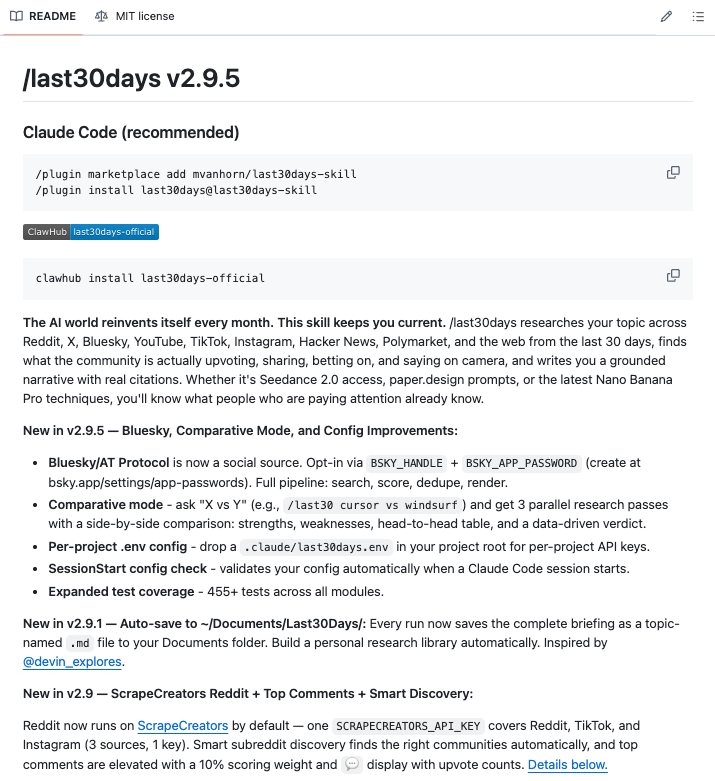
This feels like cheating. Someone built a Claude Code skill that scans Reddit and X from the last 30 days on any topic you give it, then writes you copy-paste-ready prompts based on what the community has actually figured out not what was working six months ago. You type /last30days prompting techniques for ChatGPT for legal questions and it comes back with the top patterns real lawyers and power users are using right now, complete with a fully written prompt you can drop in and use immediately. No more Googling, no more digging through threads, no more prompts that worked last year but got patched out. It works for anything - Midjourney techniques, Suno music prompts, Cursor rules, trending rap songs, whatever you need to know what people are actually saying about right now. 100% Open Source. MIT License. Link in the comments.
Millie Marconi tweet media
English
91
441
5.3K
480.3K