Julian Naderi

25 posts

Julian Naderi

Julian Naderi

@Naderij_

Transcriptional Regulation & Protein engineering | PhD student @HniszLab @MPI_Molgen

Berlin, Deutschland เข้าร่วม Ekim 2022
160 กำลังติดตาม109 ผู้ติดตาม
ทวีตที่ปักหมุด
Julian Naderi
Julian Naderi@Naderij_·
Human TFs face a molecular trade-off between activity and specificity encoded as submaximal dispersion of aromatic residues in their disordered regions. A collaborative effort of @dhnisz, @VingronLab and Graf Lab published today in @NatureCellBio nature.com/articles/s4155…
English
6
56
219
27.3K
Julian Naderi
Julian Naderi@Naderij_·
@YZhongping88129 We have not sequenced the WT(N)-IS15 mutant, but I agree that it would be quite interesting to test whether its expression profile is more similar to that of the wild type.
English
1
0
1
219
Yuan Zhongping
Yuan Zhongping@YZhongping88129·
@Naderij_ I'm curious whether the RNA-seq expression profile of WT(N)-IS15 has also changed significantly due to the increased activity?
English
2
0
1
83
Julian Naderi
Julian Naderi@Naderij_·
@YZhongping88129 Agree! I believe that there is indeed synergy between canonical activation domains and non-linear sequence features encoded within the same sequence.
English
0
0
1
177
Julian Naderi รีทวีตแล้ว
Simon Barnett
Simon Barnett@SimonDBarnett·
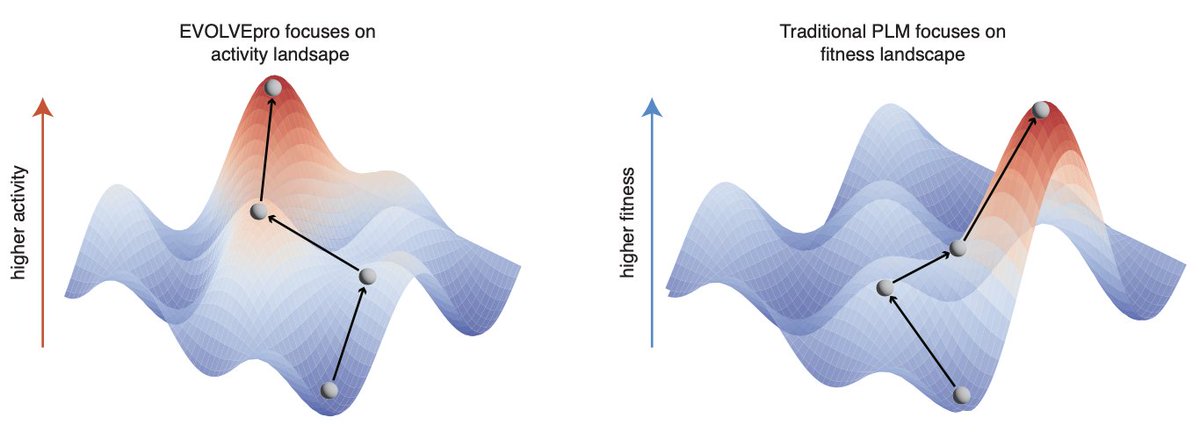
I thought this was one of the most provocative images from the EVOLVEpro paper by @omarabudayyeh and @jgooten. Supported by experimental data, they assert that a protein's fitness and its activity are lowly, or even negatively, correlated. How could this be? Shouldn't nature have selected for proteins with maximum activity? Shouldn't these two landscapes be one-in-the same? As it turns out, the answer is no. - - - - - First, protein language models (PLMs) are trained on large databases of naturally occurring proteins. The 'fitness' they estimate is how likely a sequence occurs in nature or how well it fits the pattern of existing proteins. This fitness score is a proxy for evolutionary fitness. Second, protein activity, which is often experimentally determined, refers to a how potent a specific function or property is that a designer is hoping to optimize. This could be catalytic efficiency, binding affinity, stability or something else. Intuitively, one might expect that proteins that are more 'fit' according to a PLM would also be more active. There are several reasons why this isn't necessarily the case." - - - - - 1. Natural Selection v. Engineered Function - natural selection optimizes proteins for overall organismal fitness; not for maximum activity for a specific function - Eg. an enzyme in nature might be moderately active but stable because of evolution whereas an engineered version may be highly active and not have to worry as much about stability 2. Real Trade-Offs - proteins face evolutionary trade-offs between different properties because they often have multiple roles - high activity might come at the cost of reduced stability or energy consumption; a PLM trained on natural sequences might favor balanced proteins - Eg. a natural protease might have moderate activity to avoid damaging other proteins in a cell whereas an engineered version may not have to worry about this 3. Contextual Differences - proteins evolve their functions in specific environments; these can be different than in an experimental set up - pH, temperature, pressure, and other factors can cause a divergence in data - Eg. a thermophilic enzyme might appear highly fit to a PLM, but be lowly active in room temperature 4. Novel Functions - some mutations might appear unfavorable based on natural sequences (and thus unfit to PLMs); but actually they unlock novel functionality - Eg. a rare mutation could create a new binding pocket in an enzyme, drasstically increasing its activity despite appearing unfit to a PLM All of these contribute to the observed discrepancy between PLM-predicted fitness and experimental activity. To achieve breakout performance, EVOLVEpro combines the strengths of evolutionary embeddings from a PLM with a few-shot domain expert layer that harness small tranches of experimental data. This means it combines the best of both worlds to help us engineer proteins.
Simon Barnett tweet media
Omar Abudayyeh@omarabudayyeh

Directed evolution is key for unlocking new protein function But is difficult and time consuming So how can we accelerate protein design by 10-100x? With AI! Now introducing EVOLVEpro, an LLM-based model for evolving proteins rapidly and efficiently biorxiv.org/content/10.110…

English
3
30
143
27.8K
Julian Naderi รีทวีตแล้ว
Philine
Philine@PGuckelberger·
I am so excited to share this part of my PhD where we tackle the question: What impact do 3D contacts have on how enhancers regulate their target genes? biorxiv.org/content/10.110… 1/
Philine tweet mediaPhiline tweet media
English
12
63
225
51K
Julian Naderi
Julian Naderi@Naderij_·
Together with recent work on enhancer elements, these results suggest an important evolutionary role of suboptimal features in transcriptional control.
English
1
0
5
377