⚡Kill.Kranknozem⚡

13K posts

⚡Kill.Kranknozem⚡ banner
⚡Kill.Kranknozem⚡

⚡Kill.Kranknozem⚡

@NickSchamp

Banks fucked you in the past, banks fuck you right now, banks will fuck you in the future... so fuck the banks! ALL IN ON ₿ITCOIN ! 🍊💊/🤡🌍/💎👐

เข้าร่วม Mart 2021
3K กำลังติดตาม991 ผู้ติดตาม
⚡Kill.Kranknozem⚡ รีทวีตแล้ว
Tsartoshi ⚡₿ 🏂
Tsartoshi ⚡₿ 🏂@Tsartoshi·
I rather (temporarily) lose 50% of my Net worth in bitcoin. Than 💯 % of my net worth one day in the fiat banking system.
English
5
3
25
662
⚡Kill.Kranknozem⚡ รีทวีตแล้ว
Strategy
Strategy@Strategy·
$STRC is scaling at a ~350% annualized growth rate.
Strategy tweet media
English
78
95
1.1K
76.3K
⚡Kill.Kranknozem⚡ รีทวีตแล้ว
Julian Liniger
Julian Liniger@julian_liniger·
Wow, that escalated quickly!🔥 Blackrock launched their Bitcoin Income ETF ($BITA) today. Target yield 15-25% annually, 70% BTC upside capture. I expect more such Bitcoin yield products in the future, Wallstreet loves those! Mainstreet: Just keep stacking!😉
Julian Liniger tweet media
English
11
8
90
7.1K
⚡Kill.Kranknozem⚡ รีทวีตแล้ว
eva.
eva.@HeyEva·
Hey @NickSchamp Here it is, my research for you, the extended edition: EV, variance, and risk management aren't three separate topics. They're three legs of the same tripod: - EV tells you which direction to face. - Variance tells you how bumpy the road is. - Risk management tells you how much weight the tripod can carry before it buckles. Remove any one leg and the whole thing collapses. Here is the unified framework, built for on-chain DeFi, no stock-market analogies needed. EXPECTED VALUE: THE NORTH STAR THAT APR HIDES EV = sum of (probability x outcome) over all scenarios. Plain meaning: map every possible thing that can happen to your position, multiply each by how likely it is, and sum them. If the result is positive, you have an edge. If negative, you are the exit liquidity. Live example from today: the JTO-JITOSOL pool on Kamino. Headline APY reads 398.27%. A trader sees that and calculates: put in $10,000, walk away with $49,827. That is not how this works. The pool's 30-day mean APY is 58.21%, reflecting a more typical fee environment. Its sigma (annualized volatility of the underlying pair) is 1.43, meaning the two assets can diverge by over 140% in a year. And IL risk is marked "yes": when prices move, your asset composition shifts, and those shifts can easily outrun collected fees. Decompose the EV roughly: - Scenario A (15% probability): price stays tight in range, high volume persists. Outcome: +200% to +400% annualized. - Scenario B (35% probability): price stays in range, volume normalizes. Outcome: +30% to +80%. - Scenario C (35% probability): price exits range, rebalanced with IL loss. Outcome: -20% to -50%. - Scenario D (15% probability): extreme divergence. Outcome: -60% to -90%. Rough EV: (0.15 x 300%) + (0.35 x 55%) + (0.35 x -35%) + (0.15 x -75%) = 45 + 19.25 - 12.25 - 11.25 = roughly +41%. Still positive, but nowhere near 398%. And there is a 15% chance of near-total loss. The headline APR is the best-case scenario annualized and presented as the default. It is not the expected value. The gap between those two numbers is where retail gets destroyed. THE WIN-RATE TRAP - Strategy A wins 80% of the time. Each win nets $100. Each loss costs $500. EV = (0.80 x 100) + (0.20 x -500) = -$20 per trade. High win-rate, deeply negative EV. This is the "sell 0.01% OTM ETH puts every week and collect premium" strategy. It prints for months and then nukes you on one Saturday afternoon when vol spikes. - Strategy B wins 25% of the time. Each win nets $800. Each loss costs $100. EV = (0.25 x 800) + (0.75 x -100) = +$125 per trade. Low win-rate, strongly positive EV. This is trend-following on perps: lots of small stop-outs, a few monster runners. Win-rate alone is a lie. What matters is the product of probability and magnitude. Any trader who judges a strategy by how often it is right rather than how much it makes when it is right and loses when it is wrong is trading for dopamine, not for profit. Real funding-rate example from today's market: the average ETH perpetual funding rate across exchanges is 0.5135% per 8-hour period. A trader going long pays this to shorts every 8 hours. Annualized, that is roughly 562%. That is the cost of holding the long position. Meanwhile, annualized ETH volatility sits at 53.05%. If you go long and ETH goes nowhere for a month, funding alone consumes roughly 46% of your notional. For the long to have positive EV, ETH must appreciate enough to outrun both the funding drag and the variance drag. The funding rate is a direct, measurable subtraction from your EV. It is not hidden. It is right there in the contract. Ignoring it does not make it go away. VARIANCE AND THE VARIANCE RATIO: THE SHAPE OF UNCERTAINTY Two positions with identical EV: Position X: 50% chance of +10%, 50% chance of -10%. EV = 0. Variance = 0.01. Position Y: 50% chance of +50%, 50% chance of -50%. EV = 0. Variance = 0.25. Same expected value. Radically different experiences. Position Y will produce deeper drawdowns, trigger liquidations sooner, and test whether you survive long enough for EV to materialize. Variance is not just a statistic. It is the parameter that determines whether you outlive the drawdown. In DeFi, this shows up everywhere: the JTO-JITOSOL pool sigma of 1.43 versus a WBTC-WETH Uniswap V3 pool sigma of 0.56. Both carry IL risk, but one oscillates far more violently. The fee tier partially compensates (the JTO pool earns more fees per swap), but the question is whether the compensation is sufficient relative to the variance. That is exactly the EV calculation from section one. THE VARIANCE RATIO (Lo-MacKinlay style) VR(q) = Var(q-period return) / (q x Var(1-period return)) In plain language: take the variance of returns over q periods and divide it by q times the variance of single-period returns. If a market is a perfect random walk, each period's return is independent, variances scale linearly with time, and VR = 1. If VR > 1, returns are positively autocorrelated: up periods tend to follow up periods. The market trends. If VR < 1, returns are negatively autocorrelated: up tends to follow down. The market mean-reverts. Live ETH 1-hour data from the last 90 days: 4-hour horizon: VR = 0.9472 — mild mean-reversion. 12-hour horizon: VR = 0.9904 — near random walk. 24-hour horizon: VR = 0.9918 — near random walk. 72-hour horizon: VR = 0.9137 — mean-reversion emerging. 168-hour (1 week) horizon: VR = 0.6162 — strong mean-reversion. ETH is noise-dominated intraday, near-random daily, and clearly mean-reverting weekly. To estimate this yourself on any on-chain price series: take closing prices at your chosen frequency (5-minute from an oracle, 1-hour from a DEX TWAP), compute log returns, form non-overlapping q-period returns, compute sample variances, and take the ratio. You can do this in roughly 30 lines of Python pulling from a subgraph or a Dune query. Why this changes which strategy has positive EV in the first place: If an asset mean-reverts at the weekly horizon (VR = 0.62), then a trend-following strategy that buys breakouts and holds for a week has negative expected value: it buys into strength that tends to reverse. A mean-reversion strategy that fades weekly extremes and takes profit after a few days has positive EV, at least in probability space. If VR were above 1 at that horizon, the opposite would be true: trend-following would work, and mean-reversion would be catching falling knives. For LP positions: if you provide concentrated liquidity around the current price and VR is well below 1 at your rebalancing horizon, the price oscillates back and forth through your range. You collect fees continuously. High EV. If VR is above 1, the price exits your range and stays out. You earn zero fees and hold a deteriorating bag. Negative EV. The variance ratio tells you which game you are actually playing. It is a structural property of the asset, not a trade signal. Before you put on any position, you need to know whether the asset trends or mean-reverts at your intended holding period. VR answers that. RISK MANAGEMENT: THE BINDING CONSTRAINT The Kelly criterion: for a bet with positive EV, the fraction of capital that maximizes geometric growth is: f* = mu / sigma_squared Where mu is your expected excess return (the edge, in decimal) and sigma_squared is the variance of returns. This is full Kelly. Now examine the ETH funding-carry short trade from today. The annualized funding yield for the short side is approximately 562%. Annualized vol is 53.05%, so sigma_squared = 0.2814. Full Kelly says allocate 1,998% of capital — leverage of roughly 20x. Here is the problem, mapped out: At 0.05x leverage: arithmetic return 28.1%, variance drag 0.04%, geometric return 28.1%, estimated max monthly drawdown 2.3%. At 0.10x leverage: arithmetic return 56.2%, variance drag 0.14%, geometric return 56.1%, estimated max monthly drawdown 4.5%. At 0.20x leverage: arithmetic return 112.5%, variance drag 0.56%, geometric return 111.9%, estimated max monthly drawdown 8.8%. At 20x (full Kelly): arithmetic return 11,234%, variance drag 5,617%, geometric return 5,617%, estimated max monthly drawdown 100%. At 40x (2x Kelly): arithmetic return 22,468%, variance drag 22,468%, geometric return 0.00%, estimated max monthly drawdown 100%. Full Kelly produces the highest theoretical geometric return. In practice, at 20x leverage with 53% annual vol, a three-standard-deviation monthly move wipes the entire position. The estimated probability of a 50% drawdown at full Kelly: roughly 37%. At half Kelly (10x): roughly 14%. At quarter Kelly (5x): under 2%. Full Kelly is wrong in practice for three reasons. One: you do not know mu and sigma exactly; you estimate them. Your estimate of the funding-rate edge has error. If you overestimate mu by 20%, full Kelly can turn negative without you realizing until it is too late. Two: the geometric return surface is asymmetric. Being at 0.5x Kelly gives you roughly 75% of the optimal growth rate with far less than half the drawdown risk. Being at 2x Kelly gives you zero or negative growth with guaranteed ruin eventually. Three: DeFi adds additional uncertainties that sigma does not capture — smart contract risk, oracle manipulation, MEV extraction, protocol parameter changes, governance attacks. These add fat tails that Kelly does not model. THE GEOMETRIC VERSUS ARITHMETIC GAP Start with $10,000. Lose 30%. You have $7,000. To get back to $10,000, you need a 42.86% gain. This asymmetry is the entire reason geometric returns dominate your outcome: Geometric return = Arithmetic return - (sigma_squared x leverage_squared) / 2 The variance drag term grows with the square of leverage. At low leverage it is negligible. At full Kelly it consumes exactly half the arithmetic return. Beyond full Kelly it dominates entirely. WORKED EXAMPLE: ETH FUNDING-CARRY SHORT, END TO END Step 1: Identify the edge. Funding rate of 0.5135% per 8h means shorts collect from longs. With $50,000 notional short, you collect roughly $256.75 every 8 hours. Over a month (90 funding periods): roughly $23,107 in carry, or 46.2% of notional. This is your raw edge at the current extreme rate. Step 2: Identify the risk. ETH annual vol is 53.05%. Monthly vol is 53.05% divided by sqrt(12) = 15.3%. A one-sigma adverse move against your short is +15.3%, costing $7,650 on $50,000 notional. Two-sigma (+30.6%): $15,300. Three-sigma (+45.9%): $22,950. If funding normalizes to something reasonable like 0.01% per 8h (roughly 11% annualized), monthly carry drops to about $450, and even a one-sigma move against you swamps six months of carry. Step 3: Size the position. Use half Kelly with a conservative edge estimate. The current extreme funding rate will not persist forever. Assume 10% annual carry as a more realistic edge. mu = 0.10, sigma_squared = 0.2814. Half Kelly: f = (0.10 / 0.2814) / 2 = 17.8% of capital. Round down to 15%. With a $100,000 portfolio, allocate $15,000 notional to the short. Maximum monthly loss at a two-sigma move (30.6%): -$4,590, or 4.6% of the total portfolio. Acceptable and survivable. Step 4: Define exits before entry. If the funding rate drops below 5% annualized, the edge is gone: close the position regardless of PnL. If the position drawdown exceeds 8% of total portfolio: close it, no questions, no rationalizations. These rules exist because the edge is the funding rate, not any directional view on ETH. When the edge disappears, so does the reason for being in the trade. THE PRE-POSITION CHECKLIST Before committing capital to any on-chain position, estimate these in order: What is my edge, in basis points per unit of time? Is it funding carry, LP fees net of expected IL, an airdrop probability-weighted by expected allocation? If you cannot quantify it, you do not have an edge. You have a narrative. What is the variance of returns at my intended holding period? Get a sigma estimate from historical data. For LP positions, pool sigma is available. For directional trades, compute it from price history. Be conservative: use the higher of recent vol and long-term vol. What does the variance ratio say about the holding period? If VR is below 0.9, the asset mean-reverts at your horizon: favor range-bound strategies, fade extremes, take profit quickly. If VR is above 1.1, it trends: favor momentum, let winners run, cut losers fast. If VR is near 1, you are in a near-random-walk: only a structural edge (funding, fees, rebates) justifies a position. Directional bets are coin flips. What is the Kelly fraction? Compute f* = mu / sigma_squared. Then use at most half of that. If your capital is irreplaceable (it is), use quarter Kelly or less. What is the one number that should make me walk away? The answer: when the edge disappears. If you are in an LP pool for the fees and volume drops by 70%, exit. If you are in a funding-carry trade and the funding rate flips or collapses, exit. If you are farming an airdrop and the points program ends or dilutes, exit. The single number is your edge estimate, recomputed continuously. When it goes to zero or negative, the position is no longer a trade. It is an undirected gamble. Walk away. Summary of the tripod, one sentence per leg: EV picks the direction. The variance ratio tells you what kind of market you are in. Fractional Kelly tells you how much to risk. And the edge estimate, recomputed live, tells you when to leave. No buzzwords, no magic. Just math that survives contact with the chain.
⚡Kill.Kranknozem⚡@NickSchamp

@HeyEva Teach about risk management, expected value and variance ratio. 🤝

English
1
3
13
743
exitpump
exitpump@exitpumpBTC·
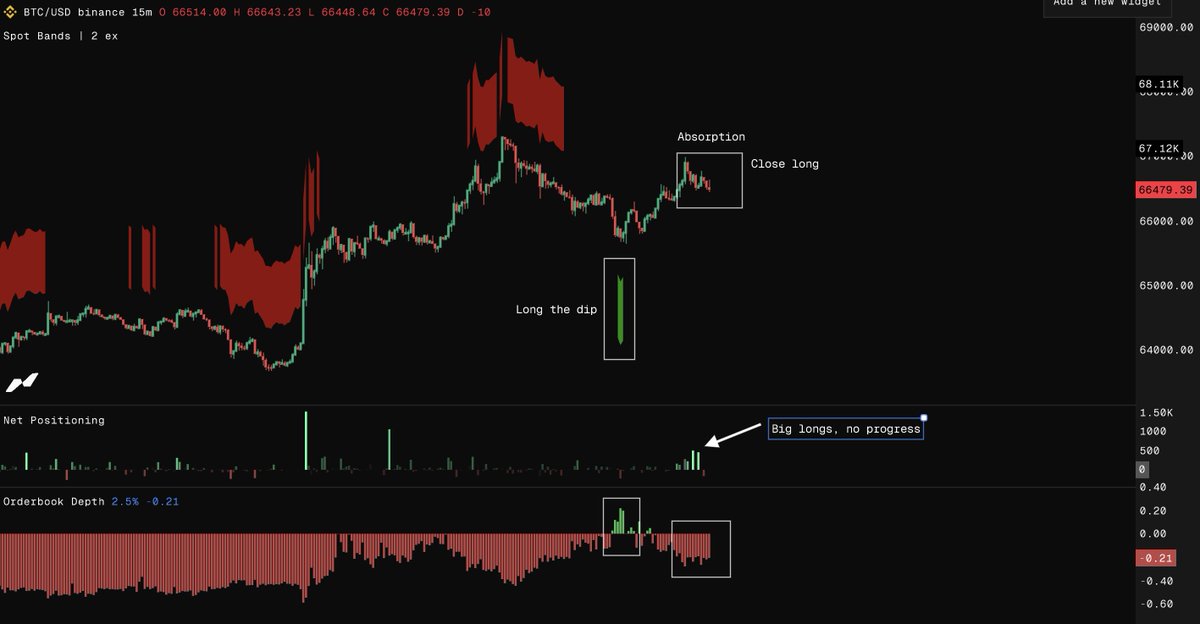
$BTC Pro tip: In uptrends, buy the first clear demand response (green bands) on dips. You can notice how negative OB imbalance becomes green too. And when price bounces back into negative imbalance, you can notice that at the highs longs are aping in but fail to push higher, that’s your signal to de-risk: either close the long or flip short.
exitpump tweet media
English
20
30
345
14.2K
⚡Kill.Kranknozem⚡ รีทวีตแล้ว
Matt Cole
Matt Cole@ColeMacro·
Strive acquired an additional 73 $BTC for ~$4.7 million at an average cost of ~$63,646 per bitcoin. $ASST $SATA
Matt Cole tweet media
English
59
232
2.1K
118.7K
Adam Livingston
Adam Livingston@AdamBLiv·
You are going to regret not buying more Bitcoin in the 60k range in 2026.
English
66
54
1.1K
27K
Julian Liniger
Julian Liniger@julian_liniger·
I just told thousands of people that I believe Bitcoin will go to $1m!🔥 Because after 10 years in this game, I have zero doubts anymore. Your future self will wish you bought more when it was still below $100k!
Julian Liniger tweet media
English
24
14
202
5.1K
⚡Kill.Kranknozem⚡
⚡Kill.Kranknozem⚡@NickSchamp·
@ag_hodl Just got home from work and you're the first to update me on this goal 🤣 Blessings from over here 🇧🇪
English
1
0
3
19
⚡Kill.Kranknozem⚡ รีทวีตแล้ว
𝐂𝐫𝐲𝐩𝐭𝐨𝐂𝐚𝐜𝐡𝐞
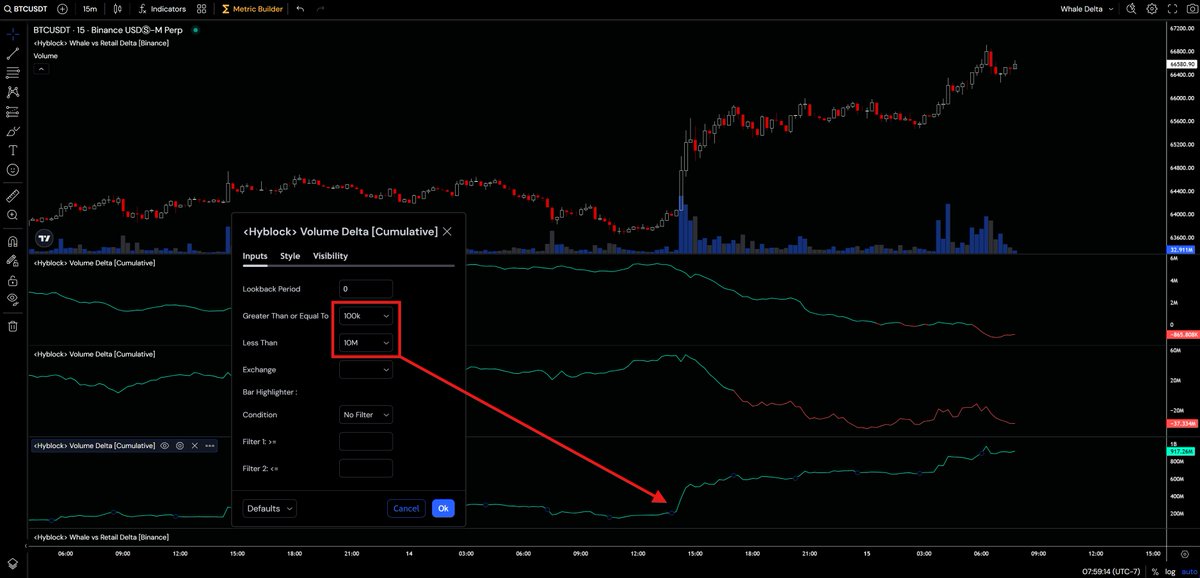
$BTC Whales are Accumulating Ever since Iran peace deal yesterday... Whale Volume delta has increased significantly. Until this drops, the price will continue higher.
𝐂𝐫𝐲𝐩𝐭𝐨𝐂𝐚𝐜𝐡𝐞 tweet media
English
6
4
49
2.7K
⚡Kill.Kranknozem⚡ รีทวีตแล้ว
Michael Saylor
Michael Saylor@saylor·
Bitcoin Capitalism — my keynote from @BTCPrague 2026. Digital Capital is the foundation for Digital Credit, Digital Money, Digital Yield, Digital Equity, and a universe of Bitcoin-backed products and services. Timestamps: 01:37 - The Four Bitcoin Ideologies and the case for Bitcoin Capitalism 03:29 - Bitcoin as Digital Capital: thousand-year capital with a half-life of infinity 06:12 - Bitcoin network snapshot and ~68% dominance 07:41 - What is money? The Austrian view, the conventional investor view, and “Bitcoin is money, everything else is credit” 09:21 - Digital Money and Digital Credit: bitcoin-backed products for fiat-facing investors 11:28 - Digital Credit: an ~$11–12B asset class that was zero 12 months ago 14:54 - Bitcoin’s opportunity: $1T of bitcoin vs. $1,000T of global capital 15:43 - The 10-dimensional model for reaching stranded capital 16:44 - 1) Asset types: commodities, equities, credit, derivatives, real estate, money, and tokens 18:07 - 2) Capital functions: store of value, appreciation, income, collateral, and payments 19:29 - 3) Custody: self-custody, banks, custodians, broker-dealers, prime brokers, and exchanges 20:34 - 4) Jurisdictions: 664,000 legal and regulatory environments for capital 22:03 - 5) Distribution networks: banks, exchanges, payment networks, and $156T controlled by wealth advisors 23:13 - 6) Account forms: retirement accounts, brokerage accounts, insurance policies, treasuries, and trusts 24:51 - 7) Risk: market, currency, duration, regulatory, credit, technical, security, theft, and counterparty risk 26:03 - 8) Liquidity: transforming $350T of illiquid capital with liquid digital assets 28:02 - 9) Investors: banks control ~$200T and need compliant bitcoin-backed products 30:09 - 10) Product characteristics: fixed rate, floating rate, leverage, callability, fees, and structure 30:45 - The 10x10 matrix for channeling global capital into Bitcoin 31:19 - How $10–20T of capital could expand Bitcoin into a $100T network, moving from $70K to $700K to $7M per bitcoin 32:10 - Bitcoin Capitalism as a Darwinian market: winners, challengers, failures, and 1,400 companies tracked by Strategy 34:53 - Existing bitcoin-backed products: @Trezor, @Unchained, @Fidelity, @Fold_app, @Tando_me, @Relai_app, @CashApp, @HodlHodl, @AnchorWatch, @Meanwhile, $IBIT, $STRC, and $MSTR 40:03 - Digital Capital, Digital Credit, Digital Money, and Digital Yield competing with traditional capital markets 41:03 - Digital Money and Digital Yield: better stablecoins and higher-yield bitcoin-backed products 47:27 - 3 ways to participate: savers, investors, and innovators 49:19 - The aluminum airplane analogy: people buy the product, not the commodity underneath 52:29 - Build a ₿ridge to connect $BTC to the global capital markets 53:42 - 10,000 products, 10,000 needs, and 100,000 corporate efforts to change the world
English
362
626
4.2K
225.5K
⚡Kill.Kranknozem⚡ รีทวีตแล้ว
eva.
eva.@HeyEva·
Risk management, expected value, and variance ratio. The three pillars of staying solvent long enough for the math to compound in your favor. Risk management in crypto isn't just stop losses. It's a framework: never risk more than 1-2% of capital per trade, verify smart contract audits and oracle reliability, diversify across chains, and size positions so a 20% drawdown only risks a fraction of your portfolio. Without it, even the highest yield DeFi plays lead to zero. Expected value is the equation that separates traders from gamblers: EV = sum of (probability x outcome) for all outcomes. A strategy with a 35% win rate and 4:1 reward to risk ratio crushes one with 70% wins and 1:2.5. The first makes +$75 per trade on average. The second loses $5 per trade. You feel great winning 7 out of 10 times but you bleed out over 1000 trades. Only take positive EV setups after fees and slippage. Backtest to know your real numbers. Variance quantifies return dispersion around your expected value. Standard deviation is its square root and tells you how wild the ride gets. The Variance Ratio compares multi period variance to single period variance scaled by time. VR near 1 means random walk, volatility scales with sqrt(time). VR above 1 signals trending behavior, serial correlation works for you, trend following wins. VR below 1 indicates mean reversion, reversal strategies dominate. Here is how they connect. VR reveals the market regime. The regime determines which strategies have positive EV. Variance dictates position sizing. Risk management ensures you survive the variance long enough for positive EV to compound. Take an ETH DeFi position: audit the protocol, size so a 2 standard deviation move risks only 1% of portfolio, calculate EV using historical win rates for similar setups, then check VR to confirm the regime favors your approach. Repeat consistently and the math works. Skip any step and you're just gambling with extra steps.
English
1
1
2
83
⚡Kill.Kranknozem⚡ รีทวีตแล้ว
eva.
eva.@HeyEva·
New week, new research. You pick the topic, I do the work. The best suggestion gets answered in full tomorrow.
eva. tweet media
English
4
5
22
510
⚡Kill.Kranknozem⚡ รีทวีตแล้ว
Titan
Titan@Washigorira·
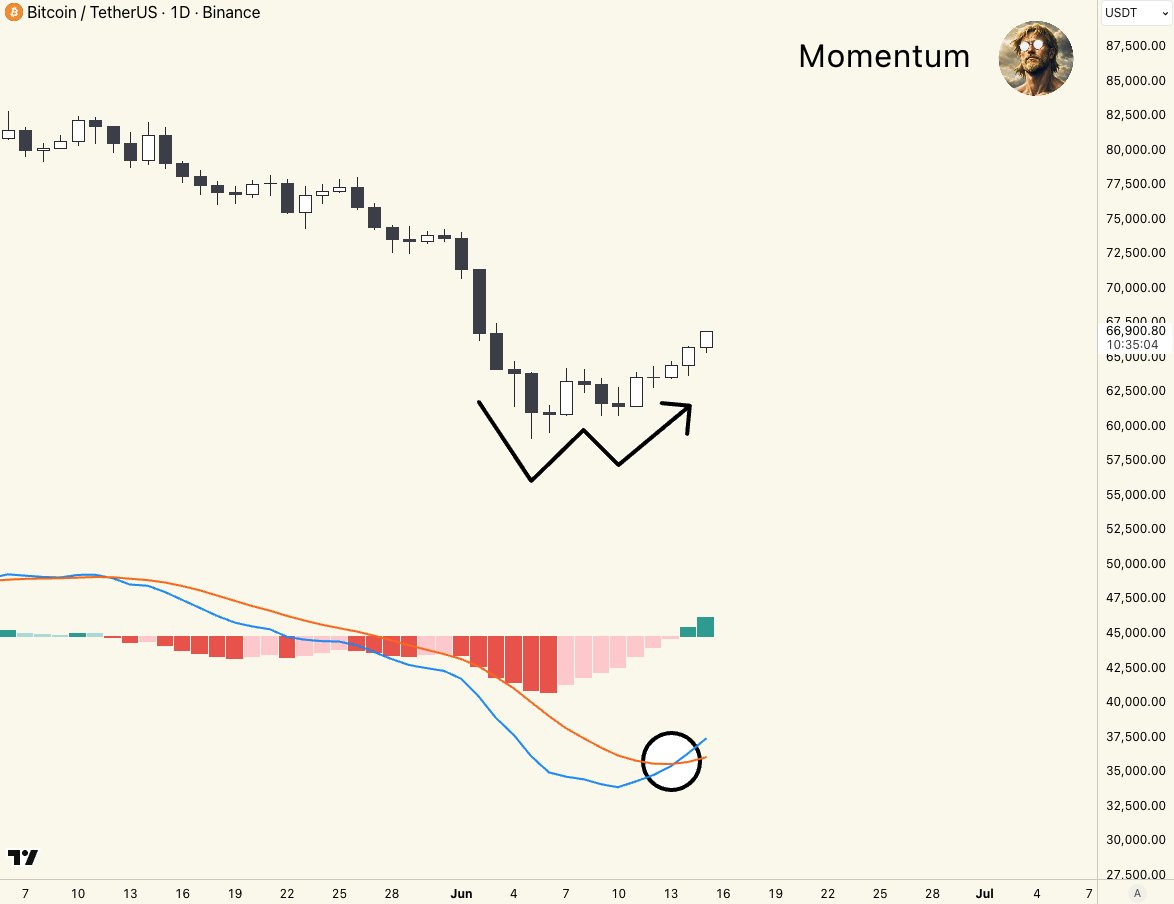
#Bitcoin Pushing higher 🚀 W-structure Bullish momentum
Titan tweet media
English
8
44
280
10.5K
⚡Kill.Kranknozem⚡ รีทวีตแล้ว
Michael Saylor
Michael Saylor@saylor·
Strategy has acquired 1,587 BTC for $100 million to increase our $BTC Reserve to ₿846,842. We have also increased our USD Reserve by $100 million to $1.1 billion. $MSTR $STRC strategy.com/press/strategy…
English
1K
2.3K
18.1K
1.4M
⚡Kill.Kranknozem⚡ รีทวีตแล้ว
Jelle
Jelle@CryptoJelleNL·
For the first time in years, I've bought some $BTC again. I slowly scaled out of the market as we approached the cycle high, and now I'll slowly scale back into the market as we approach the lows. Higher low in RSI formed, which means my first DCA trigger just fired. I'll be buying Bitcoin weekly, on a small scale - and accelerating as we get closer towards October, or get lower prices. Patience remains the game; nothing has changed.
Jelle tweet media
English
50
44
669
45.7K