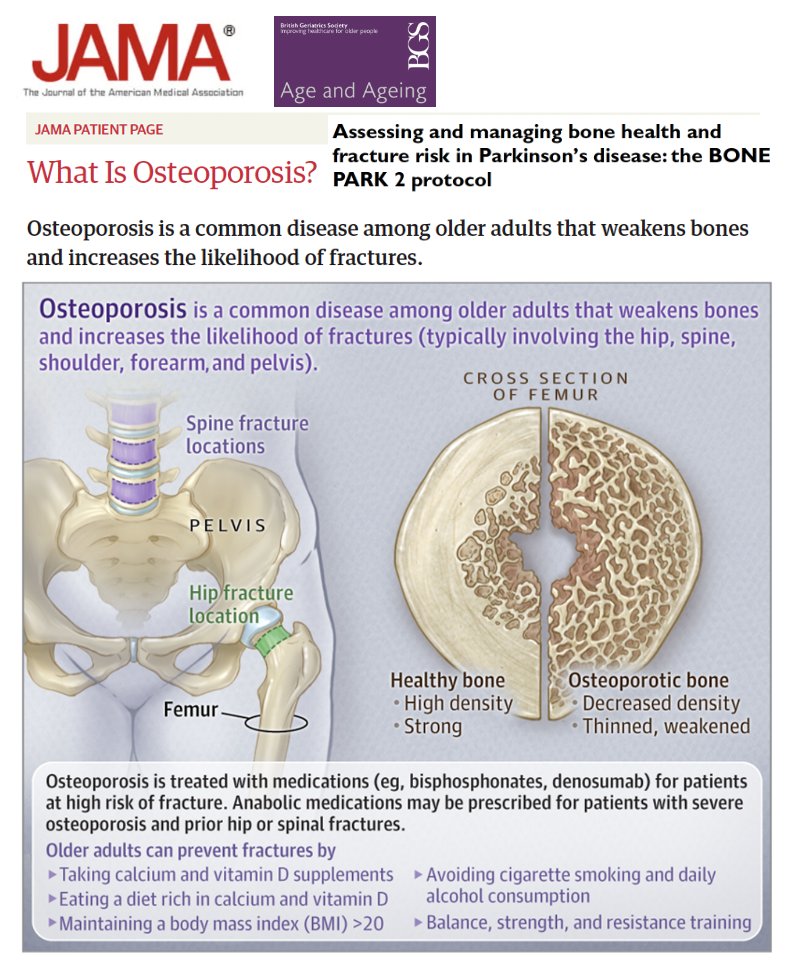

A fresh and shocking update on osteoporosis risk in Parkinson’s? Spoiler alert: Osteoporosis is twice as common in folks w/ Parkinson’s including men, and it is completely treatable when we find it early and we act on it. Osteoporosis means that bones lose mineral density and become fragile, increasing the chance of fractures. Naylor and colleagues describe in a new paper in Age and Ageing that osteoporosis in PD is underestimated and undertreated and they provided a new BONE PARK 2 algorithm to close the treatment gap. To pile on, a new JAMA Patient Page by Voelker highlights practical steps for bone screening and treatment across all older adults. Key Points: - High fracture risk in Parkinson’s is driven by a mix of falls and higher rates of osteoporosis across all stages of disease. - DXA scanning is feasible in most folks w/ Parkinson’s and helps refine FRAX risk predictions, however the overall treatment message rarely changes. - A major treatment gap persists because only a minority of those who qualify for therapy are receiving bone protective medications. My take: I tell all of the folks in my clinic w/ Parkinson's to get regular bone scans and act early if any signs of bone softening. Parkinson's disease is a condition you definitely don't want to be walking around w/ soft bones. Here are 5 points that resonated w/ me: 1- Recognize fracture risk early since folks w/ Parkinson’s have more than 2X risk of hip and spine fractures and this includes men. 2- Understand that osteoporosis is treatable and therapies are available that safely strengthen bone and lower fracture risk. 3- Request a bone density scan because DXA results can guide decisions and help health care providers to match the right therapy to your situation. 4- Ask about vitamin D and calcium since optimizing these nutrients is central for maintaining healthy bones. 5- Reduce falls whenever possible since balance training resistance work and safe home environments are critical pieces of a prevention plan. jamanetwork.com/journals/jama/… academic.oup.com/ageing/article… #parkinson @ParkinsonDotOrg @FixelInstitute @ACPIMPhysicians @GeriSoc @JAMA_current @RayDorseyMD