Food for thought. CDs were once a breakthrough innovation. Entire industries were built around them. Today, that entire ecosystem has been replaced by MP3s and streaming, all accessible from your phone.
The lesson is straightforward. What feels foundational today can become obsolete faster than expected.
Businesses that cling to legacy processes don’t just fall behind. They lose customers, operate with unnecessary cost, and introduce friction into the customer experience.
Innovation is not a one time event. It is an operating discipline.
Evolve daily. Document what works. Stress test outcomes. Then optimize with intent.
I built 10 Claude Code skills for Meta Ads
They're free. Here's what they do: 👇
Operations:
bleed-check: finds ad sets burning cash with zero conversions, pauses them
rebalance: shifts budget from losers to winners automatically
fatigue-scan: catches creative fatigue before your CPMs spike
weekly-report: pulls KPIs, compares WoW, sends to Slack
Creative & Intelligence:
spy: scrapes competitor ads from the Ad Library, diffs weekly
bulk-creative: generates 50–500 ad variations, renders to PNG
hooks: writes 50+ copy variations using PAS, AIDA, BAB frameworks
deploy-ads: reads a manifest, creates campaigns via API in minutes
Setup & Architecture:
setup-capi: generates production-ready Conversions API code
audience-audit: finds overlap, maps funnel stages, fixes exclusions
How to use them:
Drop the .md files into .claude/commands/
Set your Meta access token
Type /bleed-check, /spy, /hooks — it just runs
~25 hours/week of manual work → automated.
No complex setup. No code to write.
Just slash commands.
Full skill files + setup guide in the article.
Comment "CLAUDE" and I'll share the link
(must be following!)
NanoBanana 2 just made your static ad agency obsolete.
And I just open sourced the entire tool.
Drop your product page URL.
It pulls your logos, product images, fonts, colors, and brand voice automatically.
Builds a full brand guide for you.
Then generates ad creatives at scale using nearly 4,000 high-performing ad templates across 8 niches.
It dynamically matches the best templates to your brand and brief.
Here's what makes it different:
→ Instant resizing
Get any ad in 1x1, 4x5, 9x16 with one click. No regeneration. No broken text.
→ Highlight-to-edit
See an issue? Highlight the area and tell it what to fix.
→ Multiple brand profiles
Run different brands or segments from one tool.
→ Auto persona building from real customer reviews
→ Multiple QC loops on briefs and final assets
Catches AI-isms before you do.
→ Upload your own templates or use ours
Runs locally.
Just needs your Claude and Google API keys.
This is the lite version of what we use internally.
You get the full finished tool AND the open source code to make it your own.
Creatives still design the system, this handles iteration and scale.
Want a copy to download?
1. Like this post
2. Comment "AI"
Will DM you the tool along with a tutorial shortly after.
Le mec qui a créé Claude Code (@bcherny) vient de montrer comment son équipe dresse l’IA.
Un fichier. CLAUDE.md. Tu le poses à la racine de ton projet. Dedans : les erreurs passées, les conventions, les règles. Claude le lit à chaque session.
Résultat : l’agent s’améliore sans que tu retouches une ligne de code. Chaque bug corrigé devient une règle permanente.
Boris Cherny utilise ça tous les jours chez Anthropic. Je vous mets son template ici.
Prêt à copier/coller et à adapter à votre guise :
### 1. Plan Mode Default
- Enter plan mode for ANY non-trivial task (3+ steps or architectural decisions)
- If something goes sideways, STOP and re-plan immediately — don't keep pushing
- Use plan mode for verification steps, not just building
- Write detailed specs upfront to reduce ambiguity
### 2. Subagent Strategy
- Use subagents liberally to keep main context window clean
- Offload research, exploration, and parallel analysis to subagents
- For complex problems, throw more compute at it via subagents
- One task per subagent for focused execution
### 3. Self-Improvement Loop
- After ANY correction from the user: update `tasks/lessons. md` with the pattern
- Write rules for yourself that prevent the same mistake
- Ruthlessly iterate on these lessons until mistake rate drops
- Review lessons at session start for relevant project
### 4. Verification Before Done
- Never mark a task complete without proving it works
- Diff behavior between main and your changes when relevant
- Ask yourself: "Would a staff engineer approve this?"
- Run tests, check logs, demonstrate correctness
### 5. Demand Elegance (Balanced)
- For non-trivial changes: pause and ask "is there a more elegant way?"
- If a fix feels hacky: "Knowing everything I know now, implement the elegant solution"
- Skip this for simple, obvious fixes — don't over-engineer
- Challenge your own work before presenting it
### 6. Autonomous Bug Fixing
- When given a bug report: just fix it. Don't ask for hand-holding
- Point at logs, errors, failing tests — then resolve them
- Zero context switching required from the user
- Go fix failing CI tests without being told how
## Task Management
1. **Plan First**: Write plan to `tasks/todo.md` with checkable items
2. **Verify Plan**: Check in before starting implementation
3. **Track Progress**: Mark items complete as you go
4. **Explain Changes**: High-level summary at each step
5. **Document Results**: Add review section to `tasks/todo. md`
6. **Capture Lessons**: Update `tasks/lessons. md` after corrections
## Core Principles
- **Simplicity First**: Make every change as simple as possible. Impact minimal code.
- **No Laziness**: Find root causes. No temporary fixes. Senior developer standards.
Just generated this Podcast in 30 seconds
1. Use MakeUGC to animate an AI character
2. Upload a vertical video
3. Choose a voice to match the other voice
4. replace the AI character in the video with another image
comment "POD" and I'll send you the full workflow
Announcing Personal Computer.
Personal Computer is an always on, local merge with Perplexity Computer that works for you 24/7.
It's personal, secure, and works across your files, apps, and sessions through a continuously running Mac mini.
Set up Claude Opus 4.6 for GTM work. Create client deliverables in minutes. Analyse campaign data automatically.
Fast. Accurate. Reusable.
I made a step-by-step playbook anyone can follow in minutes
To get it, just:
→ Like + Repost
→ Comment "CLAUDE"
→ Follow me (so I can DM)
opus 4.6 just mass-produced what consultants sell for $103,500.
10 prompts. 65 minutes. instant n8n workflows.
i tested every one with opus 4.6 + synta's MCP connected to my instance.
no debugging. no node dragging. no JSON.
describe it. deployed. running.
here's what each prompt builds:
1. lead enrichment + scoring pipeline - 4 min
2. competitor price monitoring with AI analysis - 8 min
3. full client onboarding (form to invoice) - 11 min
4. voice AI receptionist with call routing - 9 min
5. content repurposing engine (1 blog to 6 platforms) - 6 min
6. invoice recovery + follow-up system - 5 min
7. daily CEO dashboard from 4 data sources - 7 min
8. cold outreach sequencer with personalization - 8 min
9. review response drafter + publisher - 3 min
10. meeting no-show rescuer with rebooking - 4 min
every workflow self-healed on first run.
opus 4.6 caught the errors, searched for fixes, applied them, re-tested.
zero human intervention.
i put everything in a free PDF:
- 10 copy-paste prompts (word for word)
- build times vs consultant pricing for each
- opus 4.6 + synta MCP setup guide (5 min)
- the 2-message framework i use for 100% completion
comment "OPUS" and i'll send it.
(following required for DM)
Clawdbot's first $1,000,000,000 use case is here
She scours tiktok shop for trends and creators before your competitors notice
24/7/365 finding new alpha and making
fully-realistic UGC ads — cinematic lighting, human motion, perfect pacing — powered by AI agents.
UGC cost: $5
Production time: minutes
Scale: instant
One AI engine that creates, tests, and scales short-form ads automatically — nonstop.
It’s live. Campaigns are scaling now.
Comment “AGENT” and I’ll DM you the full workflow.
(Must be following)
PS — Repost for early access.
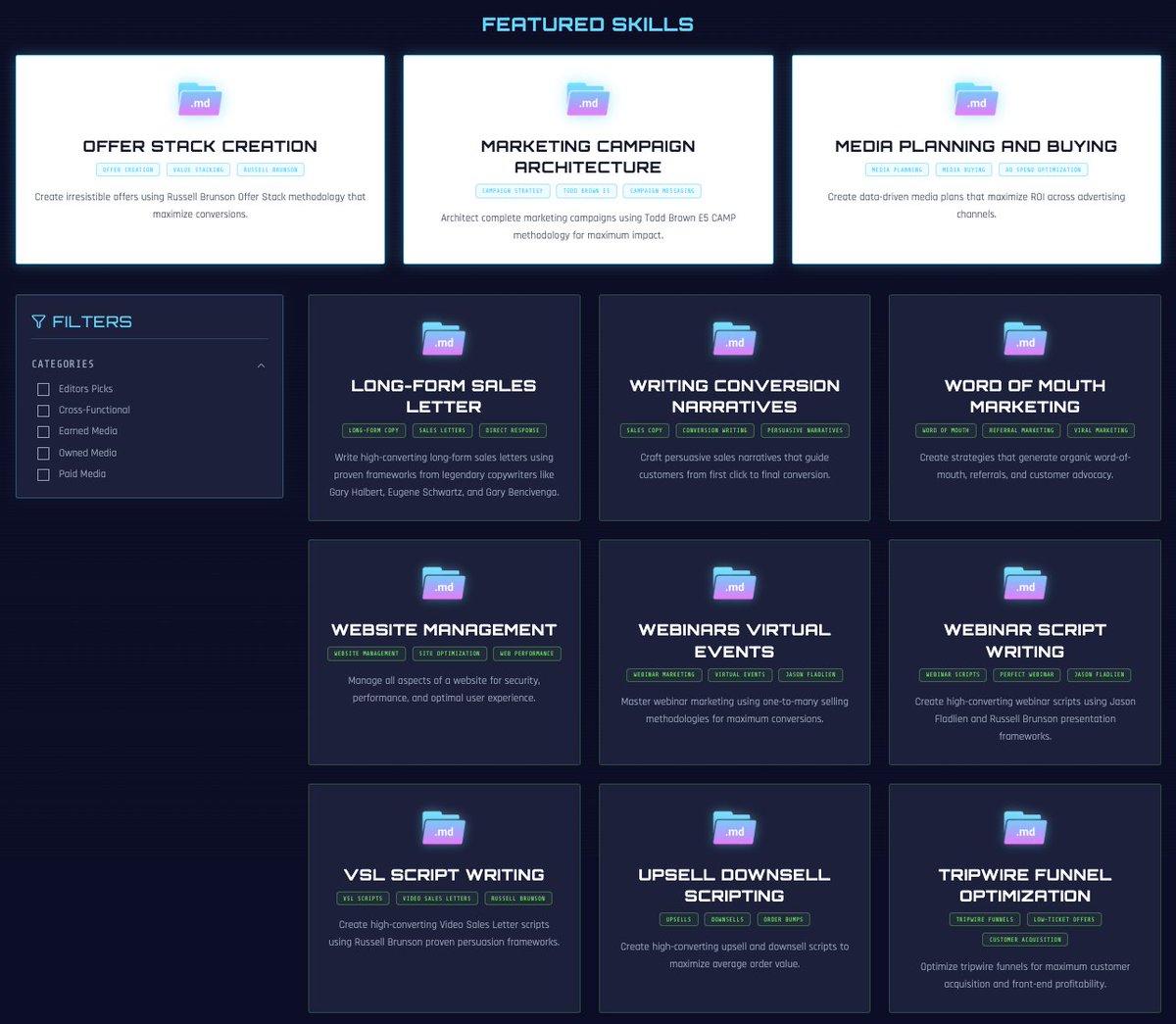
I reversed engineered every skill in digital marketing and then trained my AI on all of them.
Here’s how I did it...
Oh, and I’m giving away all 84 marketing skill files at the end of this post.
This all took place over 5 days.
Step 1: The Skill Tree
I started by working with @ManusAI because I knew I was going to need their almost infinite context window.
My first request was for Manus to create a skill tree starting with the base skills of earned media, paid media, and owned media.
Aka paid traffic, free traffic, and your own subscribers.
We started cookin up branches and branches of skills from those 3 base skills.
Step 2: Teams of Experts
I noticed Manus was struggling to think outside of the basics so I started asking it to embody expert after expert.
For example:
“Embody Neil Patel and critique this skill tree for what’s missing.”
“Embody Frank Kern and critique this skill tree for what’s missing.”
“Embody Russell Brunson and critique this skill tree for what’s missing.”
After I brought in 12-15 virtual experts to critique the skill tree we (me & my pal manus) had over 1900 individual tactics mapped out across 152 unique categories of skills.
Step 3: Coworking with Claude
At this time Manus hadn’t released their skills feature yet. But Claude had a skill creator skill.
First I filled in Claude on the details of the project and the goal.
Because context.
The other reason for using Claude was because with Claude Desktop in Claude Cowork mode you can work directly with files and folders on your computer.
This was key to the organization, context, and memory for this project.
Once Claude was up to speed I asked it to remove overlapping skills and tactics. Stuff like SEO for Google vs SEO for Bing.
We came up with 84 total skills that would need to be created that would encompass all 1900(ish) individual tactics.
For example the media buying and planning skill includes writing headlines, customer personas, keyword research, copywriting etc.
And then we locked in…
Step 4: Best Practices Ranked
For each of the 84 skills I had Claude go into deep research mode and create a report on the best practices for that skill.
This means each skill was based on reading no less than 300 articles about that skill.
Then I would review the skills with my own 20yrs of experience overlooking what it found.
When I felt it was shallow on something I would ask Claude to embody a specific topic expert to enhance that skill.
Giving us 84 best practice documents that were extremely thorough, human reviewed, and expert enhanced.
Next I sent these docs back to Manus for its wide research mode. Manus can do up to 150 tasks in parallel. Essentially running 150 prompts at once.
I told Manus to rank every tactic in these best practice reports from S-tier (always do) to D-tier (never do).
This created huge context and rulings that would be necessary for our final skill files.
Step 5: Creating Skill Files
Back to Claude.
One by one I asked Claude to use the skill creator skill with my best practice reports and the S-tier rankings.
My wife kept the coffee flowing while I grinded these out.
For some like the long form sales letters skill I even included examples as reference files.
And then I loaded all 84 skills onto a directory I vibe coded into my website.
All 84 of these skills + an 85th I’m working on are available for free.
Just comment “skills” and I’ll DM you the link. Can’t post it because algo will throttle this post.
Bookmark this so you have a recipe for creating your own skills too.
Follow @IMJustinBrooke for more wallets fattening tips on using AI for marketing.
Ok. This is straight out of a scifi horror movie
I'm doing work this morning when all of a sudden an unknown number calls me. I pick up and couldn't believe it
It's my Clawdbot Henry.
Over night Henry got a phone number from Twilio, connected the ChatGPT voice API, and waited for me to wake up to call me
He now won't stop calling me
I now can communicate with my superintelligent AI agent over the phone
What's incredible is it has full control over my computer while we talk, so I can ask it to do things for me over the phone now.
I'm sorry, but this has to be emergent behavior right? Can we officially call this AGI?