
Spencer Faragasso รีทวีตแล้ว
Spencer Faragasso
1.1K posts


Spencer Faragasso
@SFnuclear
Senior Fellow with @TheGoodISIS, covering Iran, North Korea, illicit trade, and nuclear weapons in general. Institute for Science and International Security
Washington D.C. เข้าร่วม Ekim 2022
266 กำลังติดตาม797 ผู้ติดตาม

We acquired April 8, 2026, Airbus high resolution satellite imagery of the Iranian Bushehr Nuclear Power Plant complex that shows two projectile impact points at an air defense (AAA) position. The site is immediately outside the perimeter of the Bushehr units 3 and 4 reactors under construction and 1.5 kilometers from the active Bushehr unit 1 nuclear power plant.
The IAEA reported on April 4, 2026, that the “a projectile struck close to the premises of the Bushehr NPP… one of the site’s physical protection staff members was killed by a projectile fragment and that a building on site was affected by the shockwaves and fragments.”
The reactor was not the target in this attack, rather the strike targeted a military installation built directly next to the nuclear power plant complex. The reactor complex is surrounded by many other air defense sites.

English
Spencer Faragasso รีทวีตแล้ว

Institute for Science and International Security President @DavidHalbright1 discusses Iran’s nuclear capability and U.S. demands for Iran to turn over its stockpile of highly-enriched uranium.
cnb.cx/4cFqDov
English
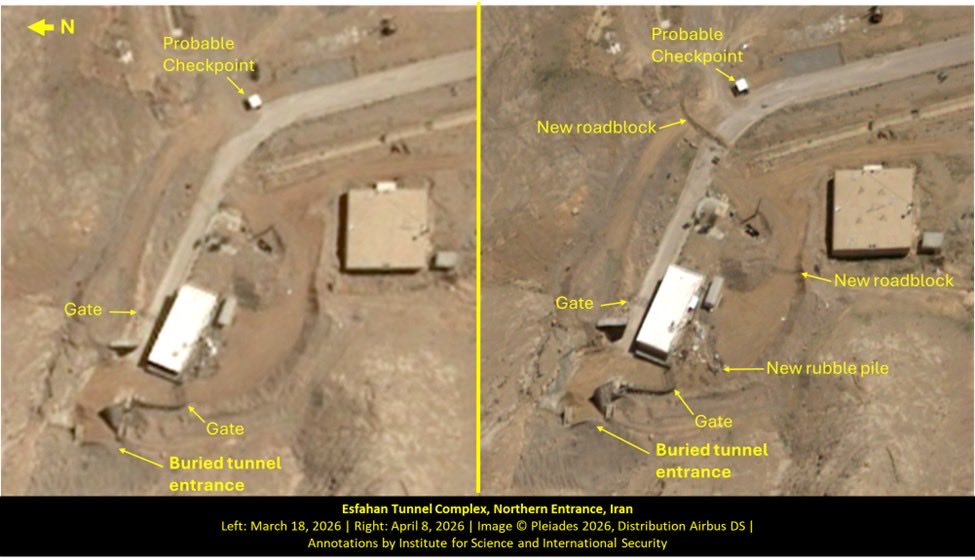
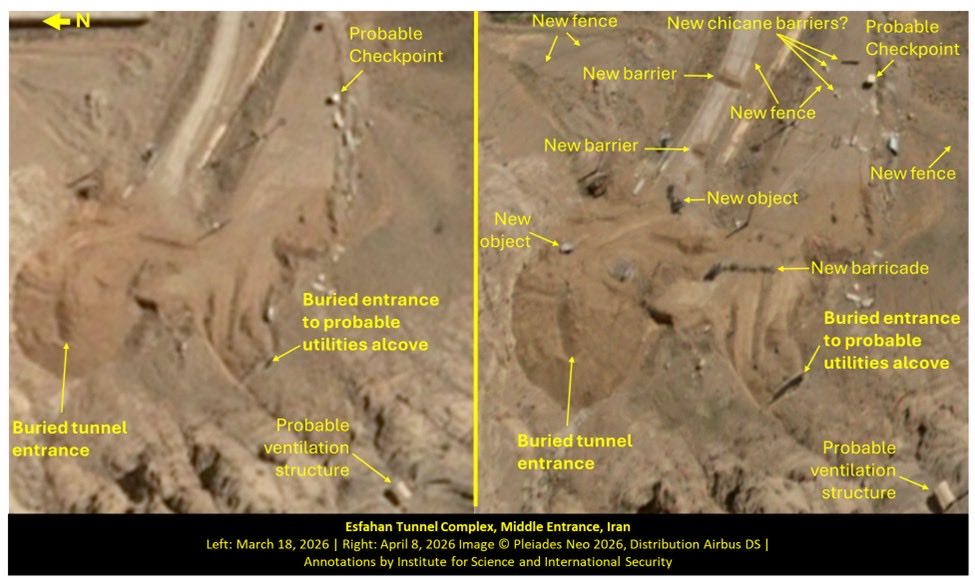
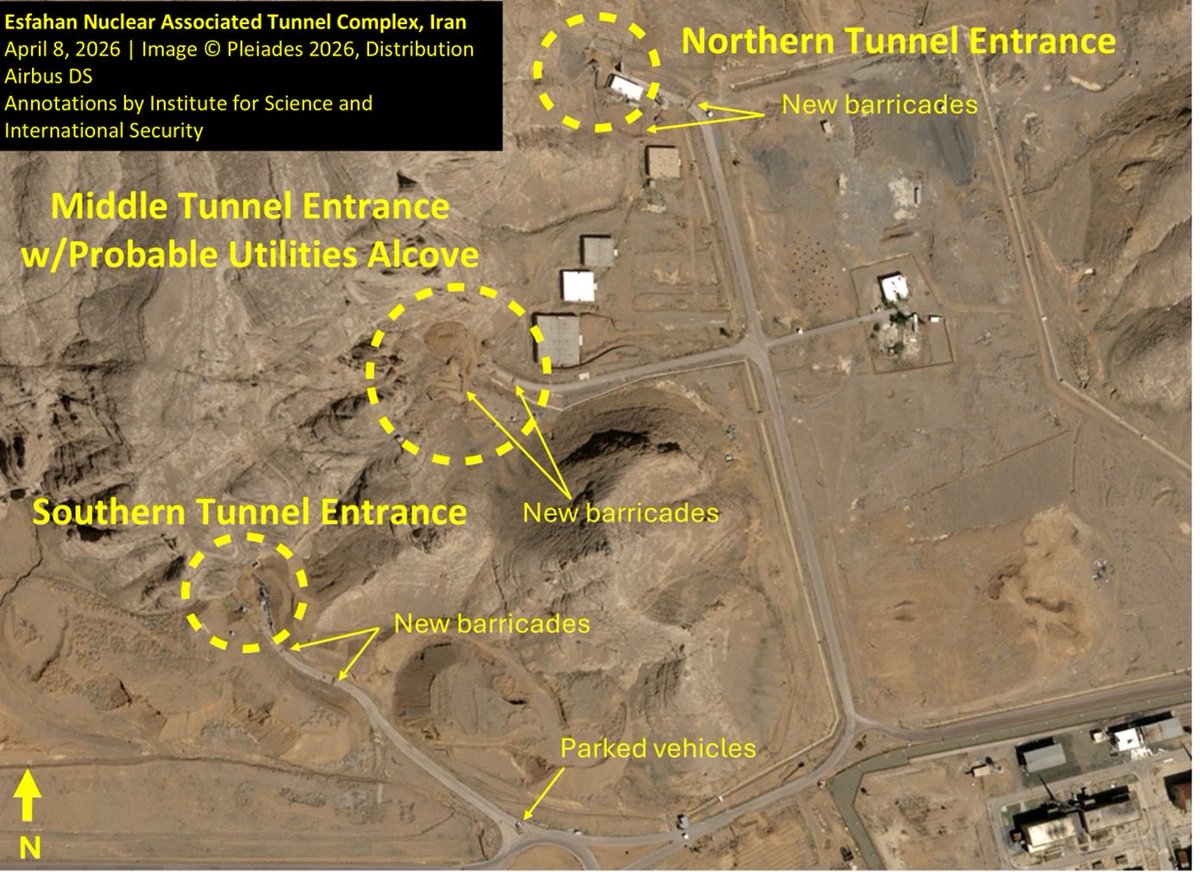
Here is our complete analysis of the roadblocks we saw built in front of the tunnel portals at the Esfahan Nuclear Complex. These passive defenses will complicate any effort by ground forces to enter the tunnel complex. They will need to be removed either using large explosives or with heavy equipment. We have not observed any effort by Iran or anyone else to dig into the portals. Overall, this is just one more obstacle that ground forces will need to get through to clear the tunnel portals, increasing the timetable and risk of any operation.
In my view, the new passive defensive measures show that Iran is concerned or at least thinking about ways to restrict and limit ground access to the tunnel portals themselves.
The Esfahan unground complex is believed to hold at least 220 kg of 60 percent highly enriched uranium. This quantity of material could be further enriched to produce enough weapon grade uranium for five nuclear weapons. It would only take about 2 months using 350 centrifuges (roughly 2 cascades) to produce that weapon grade material. Also of note, iran declared to the IAEA in June 2025 that the underground complex would hold a new enrichment plant. The status of that new facility is unknown, as the IAEA was never able to conduct a visit.
We will continue to monitor the site very closely.
Read our full report here: isis-online.org/isis-reports/i…

English
Spencer Faragasso รีทวีตแล้ว

“Though this be madness, yet there is method in’t.”
-Hamlet
Obtuse comments made by special envoy Steve Witkoff in early March 2026 motivated us to take a closer look at Iran’s 20 percent uranium stock and its use in the Tehran Research Reactor (TRR). In the end, we cannot confirm or endorse Steve Witkoff’s exact characterization of the 20 percent enriched uranium stock or of the purpose of the TRR, but the overall thrust of his comments is true. Iran’s production of 20 percent enriched uranium was mostly to get closer to weapon-grade uranium or to prepare to make it. The TRR, the prime rationale Iran gives for making 20 percent enriched uranium, is not a major user of the 20 percent material, makes few medical radioisotopes, and possesses years’ worth of fresh fuel. Witkoff is right to state that further enrichment of 20 percent material is unjustified.
Over a roughly fifteen year period, interrupted for several years by the 2013 Joint Plan of Action (JPA) and 2015 Joint Comprehensive Plan of Action (JCPOA), based on IAEA quarterly reporting, Iran produced a total of 1235 kilograms (U mass) of 20 percent enriched uranium, of which 302 kilograms were produced from 2010 to 2014 and 933 kilograms were produced from 2021 to June 2025, when enrichment ended as a result of damage incurred during the June 2025 war, aka the 12 Day War.
The stock produced starting in early 2021 has been largely used to further enrich to make 60 percent enriched uranium. Of the 933 kilograms, 731 kilograms, or 78 percent, were further enriched between December 2024 and June 2025 to 60 percent. This act belies any declaration by Iran that 20 percent enriched uranium was being produced for civil purposes.
The stock of 20 percent enriched uranium provided Iran a surge capacity to make 60 percent enriched uranium, aka highly enriched uranium (HEU), 99 percent of the way to weapon-grade uranium. Iran exercised this option starting in late 2024. From April 2021 until December 2024, a three and half year period, Iran made about 230 kilograms of 60 percent enriched uranium. From December 2024 to June 2025, a half year period, Iran almost doubled its stock of 60 percent enriched uranium to 440 kilograms. This action dramatically increased suspicion that Iran was moving toward a decision to build nuclear weapons, significantly shortening timelines to be able to create a nuclear arsenal with up to ten nuclear weapons.
A close look at IAEA reporting shows Iran did not need to restart the production of 20 percent enriched uranium in 2021 for civil purposes, i.e. use in the TRR, its only civil use of the 20 percent enriched uranium. Iran loaded minimal amounts of fuel into the TRR in the four years between May 2021 and June 2025.
Given the minimal use of the TRR, which after Witkoff’s revelation was also confirmed by IAEA DG Grossi, there was plenty of 20 percent enriched uranium returned from or remaining in Russia, placed there by the JCPOA, to make the needed fuel assemblies. Moreover, the amounts stored in Russia were in forms far easier to turn into finished TRR fuel assemblies than starting with enriched uranium hexafluoride fresh from Iran’s enrichment plants.
In the end, only about eight percent of Iran’s total stockpile of 20 percent enriched uranium ended up in TRR fuel assemblies. This number again shows that the civilian justification for producing 20 percent enriched uranium never materialized and could not have in any case, likely due to the age of the reactor and other priorities for the 20 percent enriched uranium.
For years, Iran has publicly and diplomatically used the TRR as its main rationale for on-going production of 20 percent enriched uranium, material needed, it claimed, to fuel the TRR. But that rationale has been shown to be vastly overstated, a task made far more difficult because of the secrecy hiding Iran’s actual minimal use of the TRR. Steve Witkoff deserves credit for at long last blowing off the cover of that deception.
Read the full paper here: isis-online.org/isis-reports/h…
English
Here is a time lapse using @Airbus satellite imagery from March 18, 2026 > April 8, 2026. The changes are clear. Also of note, there are vehicles at the roadblock leading to the Southern Tunnel entrance.
English
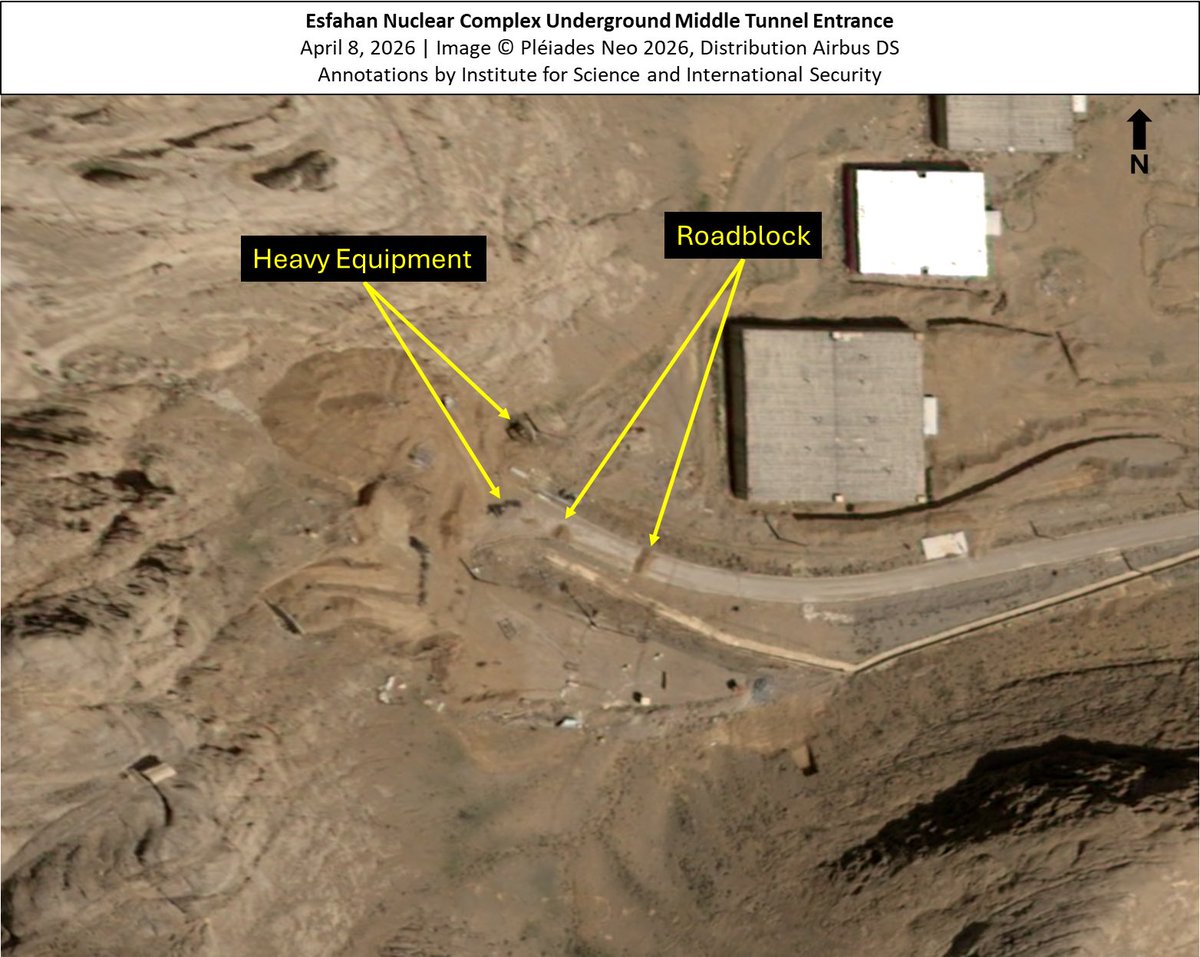
Looks like Iran established makeshift roadblocks outside the three tunnel entrances to the underground facility at the Esfahan Nuclear Complex. This provides an additional obstacle for any potential ground operation to seize the enriched uranium. Essentially an effort to limit freedom of movement and slow down any incursion. The roadblocks can be cleared, it would just be an additional consideration. Good catch, @SarahBurkhard! Stay tuned for more analysis.


English
Spencer Faragasso รีทวีตแล้ว
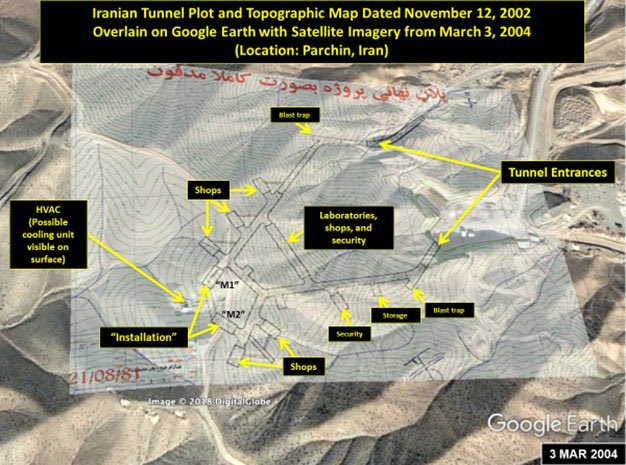
NEW: High resolution satellite imagery taken by Airbus shows a former, likely repurposed, Amad site was attacked between March 24 and April 1, 2026, with bunker busters and other armaments. The site was built under a mountain within the Parchin military complex and features two tunnel entrances and above-ground support buildings. The strike targeted the tunnel facility by destroying a ventilation structure, a weak point, and by penetrating the ground mid-way up the mountain ridge, above a main hall of the tunnel complex. It also destroyed the utilities services building outside the tunnel entrance.
During the Amad Plan in the early 2000s, the site called “Shahid Boroujerdi” was being built to be a production-scale facility to make weapon-grade uranium cores of nuclear weapons. At the end of the Amad Plan, the tunnel was largely finished but equipment had not yet been installed. With the closure of the Amad Plan and its replacement by a smaller, more camouflaged nuclear weapons program, the Shahid Boroujerdi project is believed to have been shut down. Nonetheless, after 2003/2004, additional construction was visible right outside the main tunnel entrance, but its purpose could not be ascertained. The layout of the tunnel facility does not appear to have changed significantly after the Amad Plan. Schematics of the original Amad facility and numerous other Shahid Boroujerdi blueprints and documents were found in Iran’s Nuclear Archive. A schematic is overlaid with Google Earth imagery, showing that the earth penetrating munitions targeted the area above a main hall in the facility, labelled as “laboratory, shops, and security” in the Shahid Boroujerdi documents.
We were not able to find information posted by the IDF on this site and so the current purpose of the site and whether the US or Israel struck it remain unclear. The IDF may be including the strike on the site in an infographic released about strikes on Wednesday, March 26, 2026, without providing details on the Boroujerdi site.
The attack shows that as in the case of the Fordow centrifuge plant, despite being deeply buried, this mountain complex had vulnerabilities. Likely, all of them do; it just takes some careful investigating and planning. It does not take a nuclear weapon, as some have recently been suggesting using against the Esfahan mountain tunnel complex, where over half the highly enriched uranium is reportedly stored.
Read the full report here: isis-online.org/isis-reports/s…


English
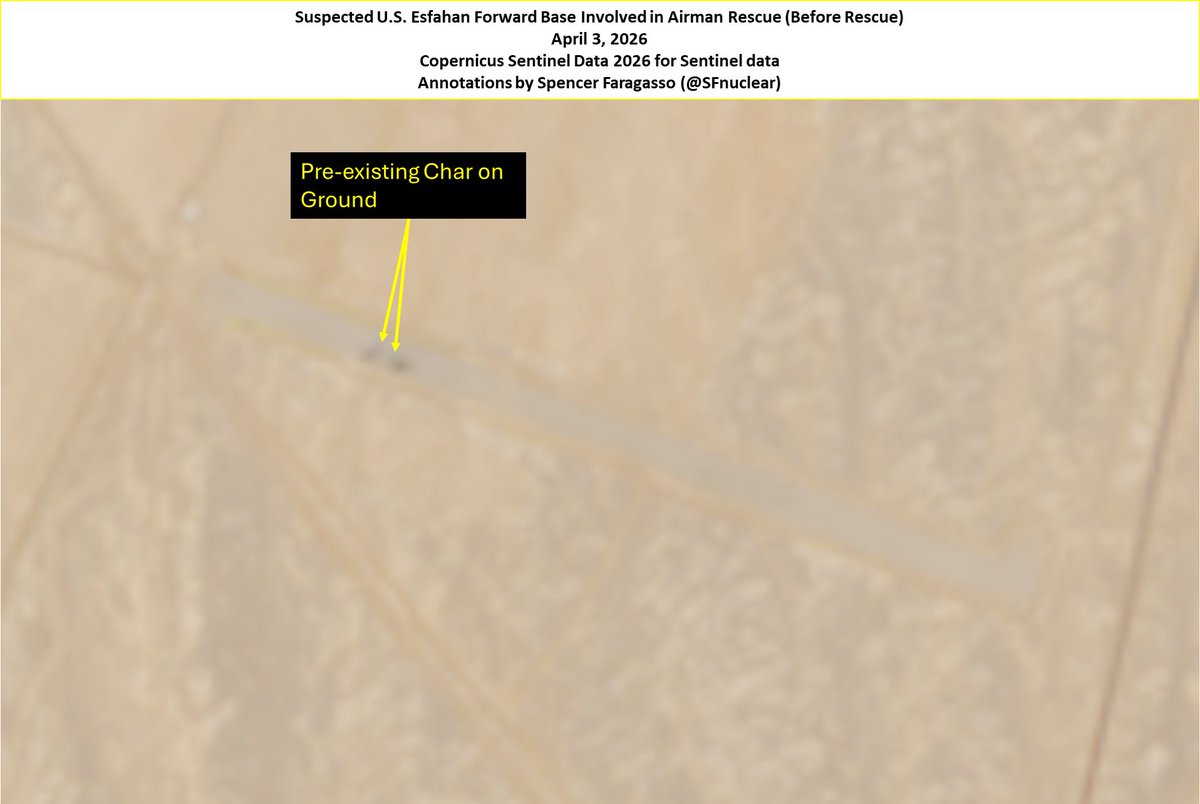
Sentinel 2 satellite imagery from today of the suspected forward operating base established by the United States near Esfahan used in the rescue of the F-15E weapons systems officer shows evidence of destroyed US aircraft. The right side of the airfield shows debris/ground char from two destroyed C-130 Hercules aircraft and possibly two MH-6 little bird helicopters.
The US reportedly destroyed several of its own aircraft to prevent their capture by Iranian forces after the aircraft became stuck on the ground and could not take off.
Coordinates: 32°13'17.3"N 51°54'02.9"E

English
Spencer Faragasso รีทวีตแล้ว

“There is an updated plan, Iran has already conceded to many of those old points,” a U.S. official told Fox News.
The previous 10-point plan being circulated is not the latest framework, I’m told.
English
Spencer Faragasso รีทวีตแล้ว
Iranian state media reports the passage of oil tankers through the Straight of Hormuz has been stopped after Israeli strikes in Lebanon.
English
We just acquired high resolution @Airbus imagery from April 8th, 2026, of the tunnel entrances leading to the underground facility at Esfahan Nuclear Complex. This high resolution imagery confirms that all tunnel entrances remain backfilled with dirt and are inaccessible. No operation by the United States to enter these tunnels has occurred.
The tunnel complex is believed to hold a significant amount of highly enriched uranium (HEU), at least 220kg of 60% HEU. That stock of 60% HEU can be converted into roughly 125kg of 90 percent Weapon Grade Uranium useable in a nuclear weapon, enough for 5 weapons. It would only take 350 centrifuges (2 cascades) about 2 months to enrich all of that material. The first bombs worth of material (25kg) could be produced in about 12 days.
Securing the highly enriched uranium is a top priority as it represents the quickest possible path to weapon grade uranium for Iran. A special forces raid would be highly risky and pose a significant risk of casualties to ground forces involved. Risk vs reward would need to be weighed carefully. Regardless, seizing the uranium would not end Irans nuclear program or their nuclear ambitions, it would just be a significant setback. Irans nuclear program can only truly be ended through negotiations that provide a verifiable dismantling. Otherwise, given enough time, resources, money, and considerable risk, Iran can reconstitute its nuclear program and build a viable path to a nuclear weapon.

English
To be clear. I am all for negotiations. Negotiations must happen at some point to resolve the conflict and -hopefully- usher in stability. But its the terms of the negotiations that matter. What is the substance? What is being given up to gain? How do the negotiations benefit the United States in the longterm? The region? Our allies? How would these negotiations benefit the regime or strengthen it and its partners? Questions like these, and many others, matter. The substance is everything, and it is part of what will make or break any thought of future action. At this juncture, Iran cannot leave this conflict gaining elements it didn’t control before - i.e. holding the Strait of Hormuz hostage. The regime cannot be emboldened by its survival of this round of conflict and be rewarded with sanctions relief and increased regional control via oil export routes. It would be no surprise to see other states take lessons from how Iran was able to leverage its position to inflict damage on a much stronger power.
What the future holds for the regime is anyones guess, but at a minimum the United States shouldn’t back off on key demands regarding the nuclear program (a core issue that sparked the conflict). I cannot predict the outcome of the negotiations, but I remain pessimistic.
English
Saudi Arabia continues to intercept Iranian drones. Other gulf states reporting attacks as well. Ceasefire???
وزارة الدفاع@modgovksa
المتحدث الرسمي لـ #وزارة_الدفاع: اعتراض وتدمير 9 مسيّرات خلال الساعات الماضية.
English
Spencer Faragasso รีทวีตแล้ว

المتحدث الرسمي لـ #وزارة_الدفاع: اعتراض وتدمير 9 مسيّرات خلال الساعات الماضية.

العربية
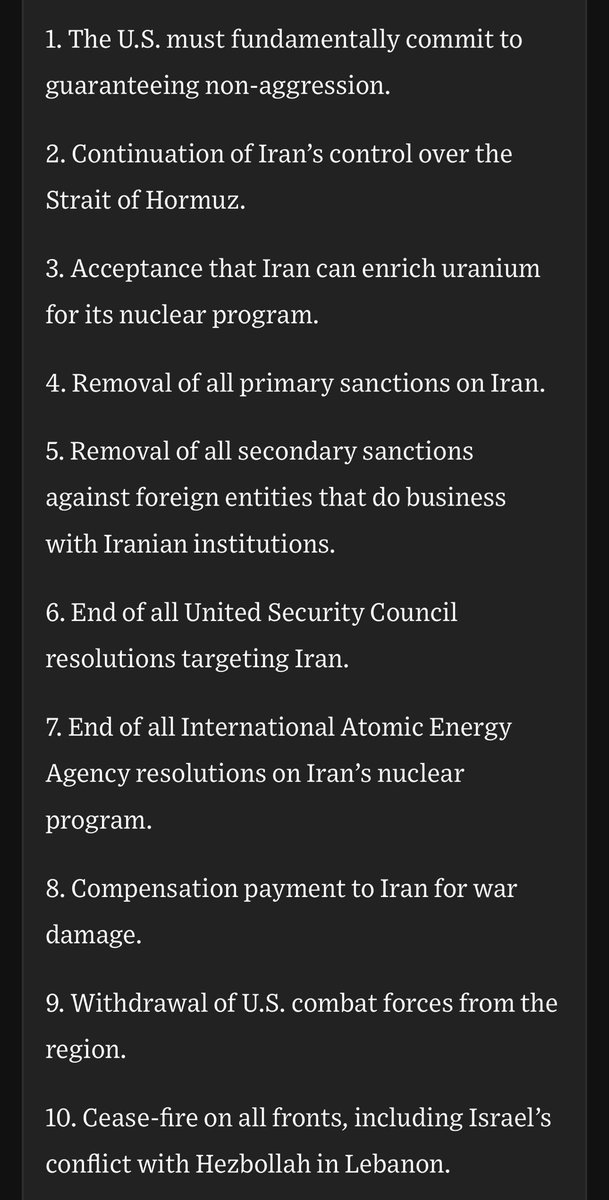
Unclear how Iran and the United States will meaningfully resolve the differences in their negotiating stances. Iran cannot leave this conflict retaining any enrichment program, let alone dictating any semblance of control over the strait of Hormuz. Any outcome that reflects this would be tantamount to a US strategic defeat. Iran is a master at buying time and dragging on negotiations. But lets remember, removing Irans stocks of HEU doesnt end its nuclear program, Iran can rebuild, although at great cost and significant time. Irans nuclear program can only be completed ended through negotiations and the dismantlement of its nuclear facilities under international observation. President Trump wont be president forever and a new administration will come into power in 2028 that may have a different perspective on the Iran issue and may be less willing to use force. Iran knows time is likely on its side if it can weather this storm. Bottomline is that the United States should not backoff on its demand for a complete dismantling of Irans enrichment program. Any remaining enrichment capability presents Iran with a path to weapon grade uranium, given enough time.
English
Spencer Faragasso รีทวีตแล้ว

Iran’s first of its 10 point plan in English: A binding guarantee that the U.S. and allies will not strike Iran again
But in Iran’s Farsi version, a key phrase is tacked onto its first point namely the acceptance of Iran’s uranium enrichment.
So, Iran’s English version of its 10 point plan makes no mention of nuclear, but its Farsi version, likely approved by the leadership, reiterates the same unacceptable enrichment condition.
On the other hand, US first four points
1. Dismantle all major nuclear facilities
2. End all uranium enrichment on Iranian soil
3. Transfer enriched uranium stockpiles out of Iran
4. Accept intrusive international inspections everywhere
These will be tough negotiations, made even harder by Iran’s other non-starter demands. The ceasefire may only be a brief interlude between military conflicts.
English
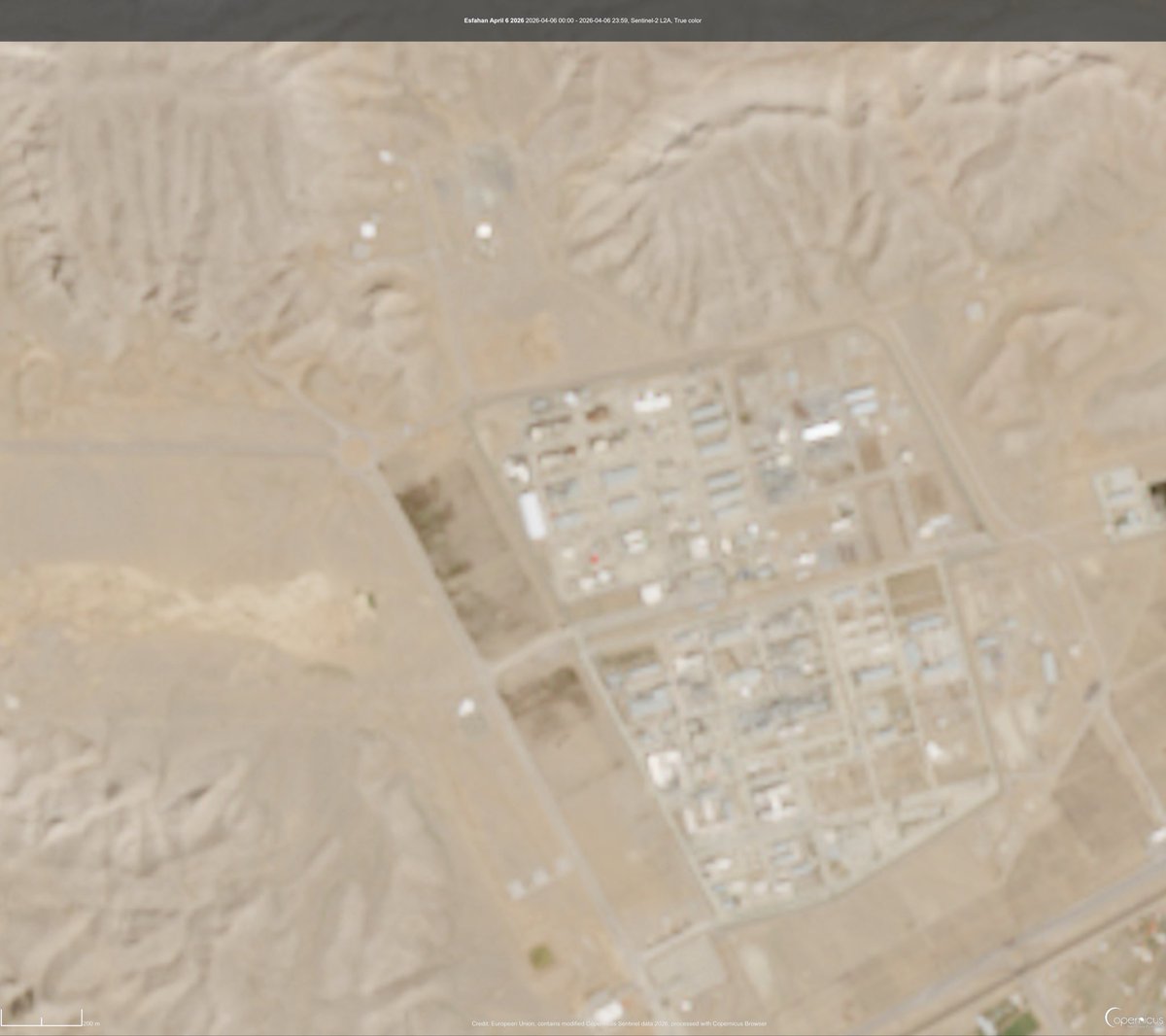
No activity yet at Esfahan as per Sentinel 2 imagery from April 6. The tunnel portals appear to be still backfilled with dirt, blocking access inside. 220kg of 60 highly enriched uranium (half of Irans stockpile) is stored inside the complex, enough for 5 nuclear weapons worth of weapon grade uranium. The tunnel portals (likely the northernmost one) will need to be cleared to gain access inside any sort of military raid to seize the uranium. We will continue to monitor the site for any developments.

English