Sandeep Chinchali

127 posts

Sandeep Chinchali

Sandeep Chinchali

@SPChinchali

UT Austin Prof. Chief Scientist at Poseidon AI. Work on GenAI and Networked Intelligence. Stanford CS PhD. All views my own.

Austin, TX เข้าร่วม Ekim 2021
87 กำลังติดตาม1.2K ผู้ติดตาม
ทวีตที่ปักหมุด
Sandeep Chinchali
Sandeep Chinchali@SPChinchali·
From Stanford to UT Austin, I’ve spent my career chasing one question: how do we gather and value the right data to make AI work in the real world? There are three battlegrounds in AI: Compute – Solved by Nvidia. Models – Rapidly commoditizing. Data – The last, unpriced frontier. Earlier this year, @sarick invited me to give a talk at @storyprotocol. I met @WhatTheLJW, @storysylee, and the team. The energy, clarity, and ambition were electric. What started as advising has now grown into much more. Today, we’re announcing @psdnai, incubated with @a16zcrypto: a decentralized data coordination layer for physical AI built on Story’s IP graph. Poseidon unlocks IP-cleared, human-labeled, long-tail data for robotics, vision, and healthcare with automatic attribution and royalties powered by @StoryProtocol. Data is the most promising subset of IP, and we’re building the infra to value it. More soon!
Poseidon@psdnai

AI is moving beyond the browser and into the real world. The bottleneck? Data. Today we’re announcing a $15M seed round led by @a16zcrypto to build infra that collects, curates, and licenses high-quality data for physical AI. Incubated by and built on @StoryProtocol.

English
44
16
158
19.5K
Sandeep Chinchali
Sandeep Chinchali@SPChinchali·
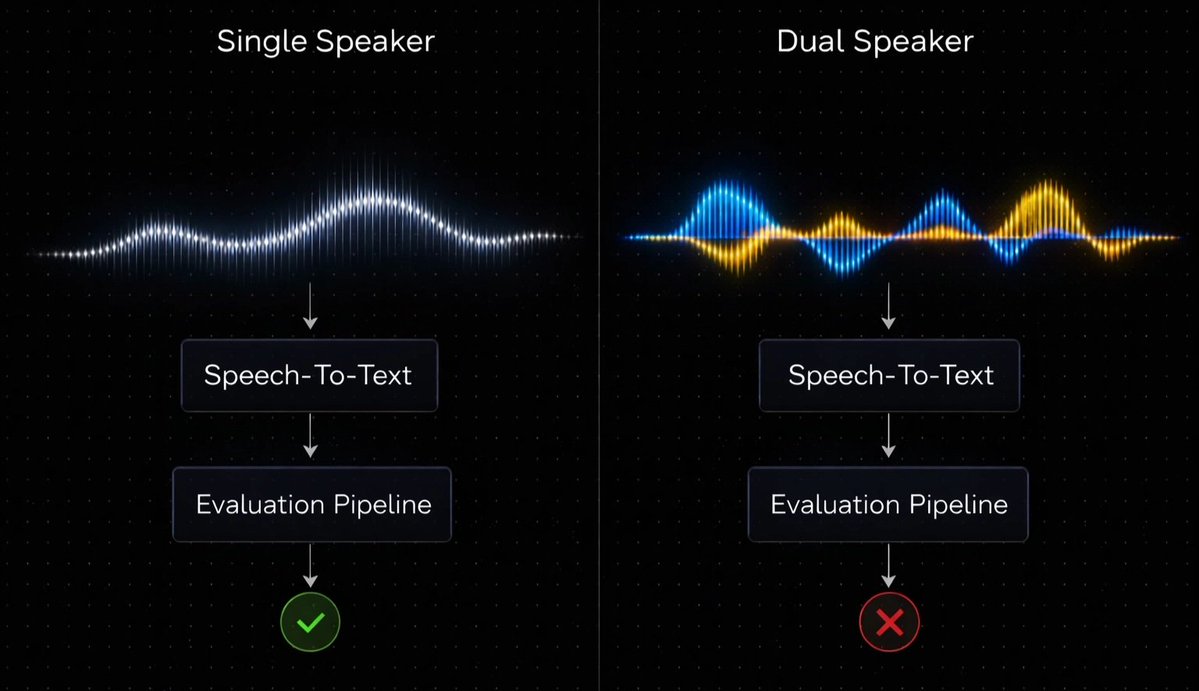
Our takeaway is that evaluation pipelines need to be built for the shape of the data they're measuring, not just the content itself. A metric calibrated on single-speaker audio will systematically misrepresent conversational data. On low-resource languages like Bengali where labeled data is scarce, that misrepresentation carries real cost. psdn.ai/blog/the-compl…
English
0
1
8
109
Sandeep Chinchali
Sandeep Chinchali@SPChinchali·
We tested six preprocessing strategies to remove the artifact – amplitude thresholds, timestamp trimming, neural voice activity detection, diarization, and others. Performance varied clip by clip, so we solved this with a Best-of-N approach where we ran all six, scored each output, and kept the highest. Dual-speaker scores recovered to 0.856.
Sandeep Chinchali tweet media
English
1
2
8
447
Sandeep Chinchali
Sandeep Chinchali@SPChinchali·
Most voice AI products run on conversational data, and that training data is sourced from multi-speaker audio. But how confident can we be that our evaluation pipelines are actually measuring what we think they are? We built the Poseidon Score to evaluate. Findings in our latest blog ↓
Sandeep Chinchali tweet media
English
3
4
16
408
Sandeep Chinchali
Sandeep Chinchali@SPChinchali·
Speech models degrade sharply as you move off high-resource English benchmarks. @theinformation's AI Agenda surfaces the structural issue and references Poseidon’s work collecting multilingual, rights-cleared audio across dialects and domains. Without rigorous data curation and ground-truth validation, scaling voice systems globally remains an unsolved problem.
Stephanie Palazzolo@steph_palazzolo

In this morning's AI Agenda, I break down why researchers say that audio AI models need to improve on languages other than English—and why this is especially important as OpenAI and others increasingly expend into countries outside the Western hemisphere. theinformation.com/newsletters/ai…

English
6
3
26
2.2K
Sandeep Chinchali
Sandeep Chinchali@SPChinchali·
As AI moves into robotics and autonomy, the weak point isn’t just code or prompts. If you can manipulate the camera or audio input, you can manipulate the model’s behavior, which is very worrisome. Multimodal systems ingest pixels, audio, and sensor data. Adversarial inputs can be injected through a sign, a sound, or poisoned training data. High-quality data isn’t enough - more than ever, we need provenance and validation. If you can’t trace and verify the data pipeline, you cannot reason about model behavior. axios.com/2026/02/10/sen…
English
1
1
12
289
Sandeep Chinchali
Sandeep Chinchali@SPChinchali·
If this works, cities will take an entirely new form. Imagine a pipe bursts and traffic is instantly rerouted. A grid under strain sheds load before blackouts. Trains adjust frequency based on real passenger flow, not last year’s averages. The system responds in real time. To get there, you need dense, real-world sensor data, models that understand physical constraints, and data that can actually be used in safety-critical settings. weforum.org/stories/2026/0…
English
0
1
12
293
Sandeep Chinchali
Sandeep Chinchali@SPChinchali·
As AI systems integrate into infrastructure, telecom, healthcare, and robotics, data provenance becomes a systems-level constraint. If you cannot trace where training data originated, under what license, and whether consent is revocable, you introduce uncertainty into evaluation and deployment. While @Cloudflare’s AI Crawl Control gives websites a machine-readable way to signal training permissions, what is the equivalent primitive for individuals? Voice recordings captured by satellites or smartphone devices, behavioral data from wearables, and so on. Personal data is continuous and multimodal, making it far more challenging since it does not live on a single server behind a robots.txt file. As models move into physical systems, weak data lineage becomes a reliability and governance risk. We need provenance that is programmatic, auditable, and enforceable at the data layer itself. reuters.com/legal/litigati…
English
0
1
15
400
Sandeep Chinchali
Sandeep Chinchali@SPChinchali·
Negative agreement across 3 frontier models on the same Bengali transcripts suggests something deeper than random variance. In low-resource, dialect-rich settings, "correct" is not singular. Models absorb different norms from fragmented corpora, making evaluation itself unstable. We unpack the implications in our latest blog, including the role of human benchmarking.
Poseidon@psdnai

Poseidon needs voice data and reliable ground truth in low-resource languages to benchmark against. To ensure LLM transcript accuracy, we worked with linguists to audit Bengali outputs. For a language spoken by 280M people, the gaps we found point to a deeper issue: data ↓

English
3
4
36
2K
Sandeep Chinchali
Sandeep Chinchali@SPChinchali·
I had a great time on the Think Data podcast discussing why data and evaluation are becoming the limiting factors for multimodal systems. In low-resource settings and edge deployments, progress depends on curated long-tail examples, rigorous quality control, and benchmarks that surface failure modes early. At Poseidon, we are building infra to source rights-cleared datasets and make them usable for training and continuous testing.
Poseidon@psdnai

Poseidon Co-Founder and Chief Scientist, @SPChinchali, joins the latest ThinkData Podcast. Sandeep breaks down why, as multimodal and physical AI scales: • Rights-cleared, high-quality data is the core constraint • Rigorous validation is required to trust AI in production And more ↓

English
9
1
49
1.9K
Sandeep Chinchali
Sandeep Chinchali@SPChinchali·
We’re seeing a clear shift from volume to provenance in AI data. After a year dominated by large-scale scraping and legal uncertainty, model developers are beginning to demand transparency around data origin, rights, and consent. Licensed, verifiable datasets will increasingly define competitive advantage.
English
15
20
94
6.3K
Sandeep Chinchali
Sandeep Chinchali@SPChinchali·
Congrats to the World Labs team. A $1B round signals that world models are moving from R&D to a key strategic priority. If models are to act coherently in physical space, they need structured representations of dynamics, geometry, and causality, not just next-token prediction. That raises a harder systems question: how do we collect and align egocentric video, multimodal sensor streams, and rare edge cases at scale, with clear provenance and licensing? World models will only be as robust as the real-world data pipelines that train them.
World Labs@theworldlabs

World Labs has raised $1 billion in new funding. We are grateful and excited to partner with our investors, including AMD, Autodesk, Emerson Collective, Fidelity Management & Research Company, NVIDIA, and Sea, among others. worldlabs.ai/blog/funding-2…

English
1
0
18
683
Sandeep Chinchali
Sandeep Chinchali@SPChinchali·
Precision data overtakes the era of digital-sweatshops. The marginal returns of generic scraped data are declining. Model performance improvements now depend more on precision datasets: curated, expert-generated, legally licensed, and context-rich. Data quality and relevance increasingly matter more than scale alone.
English
9
11
88
5.9K
Sandeep Chinchali
Sandeep Chinchali@SPChinchali·
AI power will collapse into a handful of winners, but physical data is still up for grabs. Power across the AI stack continues to concentrate – a small number of players dominate compute and foundation models. Data providers will consolidate into two or three major players per modality, like text, audio, and video. Real-world data remains an exception, the largest untapped asset class in AI.
English
3
1
15
300
Sandeep Chinchali
Sandeep Chinchali@SPChinchali·
This article makes good points. Audio models do spend more compute on emotional cues, latency constraints are real, and the deeper issue is data. We saw this in 2020 when everyone shifted to remote. Suddenly Slack messages replaced watercooler context, short messages felt harsh, and neutral emails read as hostile. Voice is even less forgiving – prosody, hesitation, sarcasm, calm vs frustration. These signals must be learned from diverse, rights-cleared data. Until we fix data fidelity and coverage, voice AI will lag.
Stephanie Palazzolo@steph_palazzolo

VCs and founders have told me voice AI is on the verge of a breakthrough for months. Here's why it's so hard to get right, compared to text-based AI: theinformation.com/newsletters/ai…

English
0
3
18
514
Sandeep Chinchali
Sandeep Chinchali@SPChinchali·
Physical AI is inevitable. Every major lab is building world models because this is the next great frontier. But robotics exposes the constraints fast: perception noise, long-tail edge cases, embodiment, latency. You can’t prompt your way around bad real-world data. The bottleneck to this reality will be high-fidelity, task-specific datasets.
English
3
5
45
2.1K
Sandeep Chinchali
Sandeep Chinchali@SPChinchali·
An AI winter is coming, driven by leverage and data-center debt. Frontier models are already "good enough" for most use cases, while training and inference costs keep climbing. Much of today’s buildout is funded by borrowed capital and circular deals between the same few players. If real revenue doesn’t catch up, compute spending becomes unsustainable. The likely result is consolidation.
English
0
1
15
302
Sandeep Chinchali
Sandeep Chinchali@SPChinchali·
Hume AI’s work highlights an under appreciated constraint in voice systems: access to labeled audio that captures affect, prosody, and emotional context. These signals are sparse, culturally specific, and difficult to synthesize. Progress here depends less on model architecture and more on the availability of the right data.
TechCrunch@TechCrunch

Google reportedly snags up team behind AI voice startup Hume AI techcrunch.com/2026/01/22/goo…

English
0
2
12
425
Sandeep Chinchali
Sandeep Chinchali@SPChinchali·
Sovereign and regulated AI systems force a hard question: Can you prove your training data came from real humans, with the right skills, demographics, and consent, without violating privacy? This post breaks down why expert marketplaces alone don’t scale, and what replaces them.
Poseidon@psdnai

Sovereign AI needs verifiable trust. As AI moves into healthcare, government, and regulated domains, the bottleneck is no longer models or compute. It’s whether training data can be trusted. Details on the blog ↓

English
3
2
20
380