
Shalev

2.3K posts

Shalev banner
Shalev

Shalev

@Shalev_lif

do androids dream of electric sheep? building something new, prev @VectorInst @UofT | co-creator of STEVE-1, Multi-Agent Verification

เข้าร่วม Eylül 2017
438 กำลังติดตาม2K ผู้ติดตาม
Shalev รีทวีตแล้ว
Engineering at Meta
Engineering at Meta@Meta_Engineers·
We’re announcing two new partnerships to bring innovative energy generation and storage to our data centers: 1/ 🛰️ Space Solar: Partnering with Overview Energy to beam up to 1 GW of space solar power from orbit to Earth for around the clock power production.
English
76
191
1.5K
357.3K
Noam Brown
Noam Brown@polynoamial·
I'm a manager at @OpenAI, but with GPT-5.5 I'm a more effective IC than I've ever been. I can now write CUDA kernels like a pro. I can rely on it to run my research experiments. And we know how to make it much more powerful from here.
Noam Brown tweet media
English
101
164
3K
348.9K
Shalev
Shalev@Shalev_lif·
The zombie’s parent is still running, so killing the zombie doesn’t help - it respawns. - Sun Tzu
Shalev tweet media
English
0
0
0
128
Shalev
Shalev@Shalev_lif·
@philhchen @tkkong So excited to see what you guys build! It’s gonna be epic 😎
English
1
0
2
469
Phil Chen
Phil Chen@philhchen·
I’ve started a new company with @tkkong! TK is a driving force behind a lot of Ramp’s success, building much of the core product, incubating the procurement platform, and leading Ramp Labs. We’re a team of IMO and Physics Olympiad gold medalists, and we’re hiring the most talent-dense team.
TK Kong@tkkong

I’ve started a new company with @philhchen! Phil built frontier LLMs across research & engineering at OpenAI, DeepMind, and Scale. I was shipping AI experiments at Ramp Labs. We've been heads down building personalized AI coworkers for every business. We’re growing our team of researchers, designers, and IMO gold medalists. Reach out if you're interested!

English
58
17
374
109.7K
Tanishq Mathew Abraham, Ph.D.
Tanishq Mathew Abraham, Ph.D.@iScienceLuvr·
Everyone is misunderstanding this paper+tweet. THIS PAPER DOES NOT SHOW THAT EMF RADIATION IN YOUR ENVIRONMENT IS CHANGING YOUR GENES WIRELESSLY this paper designs and implements a new ARTIFICIAL GENE SWITCH that is controllable by EMF. This is a very impressive technology!! It will hopefully be a useful tool for biology research. But! You have to do some sort of gene therapy to an organism so that the expression of a gene in that organism can be controlled with EMF radiation. Additionally, the EMF radiation used is 1,000–100,000× stronger than ambient EMF radiation. I WANT TO BE CLEAR: It does not show you can precisely control gene expression using EMF WITHOUT any modifications to an organism. "no drugs" in the original tweet is misleading. I guess technically gene therapy isn't a drug but it's still a significant intervention. Now the mechanism identified is interesting. It does rely on this endogenous protein Cyb5b that triggers a transcription factor Sp7. Now idk if this is a pathway that could ever occur naturally, this is not studied in the paper AFAICT. However Sp7 seems to be relevant in bone formation/growth/healing. So here's my speculation (which could be totally wrong which is likely!): maybe, just maybe, with very high EMF radiation you could induce bone growth/healing without modification to an organism. But biology is complex and there's probably some reason this would never work lol
Zane Koch@zanehkoch

ok actually insane paper published yesterday a research group in Korea built a gene switch you can control wirelessly using electromagnetic fields they exposed mice to 60 hz EMF (same frequency as your wall outlet) using a pair of large coils that generate a uniform magnetic field around the animal, for cyclic 3-day on / 4-day off pulses they showed this could: - activate OSK to do epigenetic reprogramming in progeroid and aged mice, extending lifespan and reversing aging markers across multiple tissues - conditionally switch on mutant amyloid genes only in aged mouse brains, letting them separate aging effects from amyloid effects to study AD biology in a way previous models couldn't no drugs, no impacts, just a magnetic field from outside the body

English
22
37
278
32K
Shalev
Shalev@Shalev_lif·
The future of research is autonomous. This is obvious in SF now but outside of the valley I don’t think people understand that the self-improvement loop is being achieved.
Jan Leike@janleike

New research result: we use Claude to make fully autonomous progress on scalable oversight research, as measured by performance gap recovered (PGR). Claude iterates on a number of different techniques and ends up significantly outperforming human researchers for $18k in credits.

English
0
0
1
165
Tanishq Mathew Abraham, Ph.D.
Tanishq Mathew Abraham, Ph.D.@iScienceLuvr·
I try to avoid overhyping but... I genuinely believe if we execute well, @SophontAI could help save thousands of lives by the end of this year alone. Wish us luck!
English
9
5
111
14.9K
Shalev
Shalev@Shalev_lif·
@cloneofsimo What if I fed in your whole photo album and all photo albums you’ve ever taken, and the model knew your family tree, and everything about it, and then generated a plan for creating images that touch your heart via including unique aspects of your life?
English
0
0
1
98
Simo Ryu
Simo Ryu@cloneofsimo·
I am obviously bullish on genai and how its transforming media generation but I dont think AI models will ever touch my heart like this photo dad took
Simo Ryu tweet media
English
4
0
18
1.3K
Shalev
Shalev@Shalev_lif·
@tkipf Was this mostly a data problem or algorithmic problem (or both?)
English
1
0
1
107
Shalev
Shalev@Shalev_lif·
@jon_barron @Deep_Burner The journey becomes cheaper, which means you can reach many more destinations in the same amount of time!
English
0
0
1
28
Jon Barron
Jon Barron@jon_barron·
Coding got >10x more productive last month, which means that the opportunity cost of all work that isn't coding has gone up by >10x. You should rebalance your schedule accordingly: cancel meetings, reduce admin work, write fewer emails, close Overleaf. It's time to code.
English
7
7
146
15.3K
Shalev
Shalev@Shalev_lif·
@Deep_Burner @jon_barron Yes, it’s easier and cheaper to make code, which means code itself is less valuable.
English
1
0
1
46
Shalev
Shalev@Shalev_lif·
@Deep_Burner @jon_barron He’s saying that since coding is now more efficient, you can get a lot more done, so you should spend more time coding.
English
1
0
1
250
DeepBurner
DeepBurner@Deep_Burner·
@jon_barron Assigning my time to coding (as it's more productive) vs non-coding (as the value of code decreases) as a SWE
English
1
0
1
261
Alex Prompter
Alex Prompter@alex_prompter·
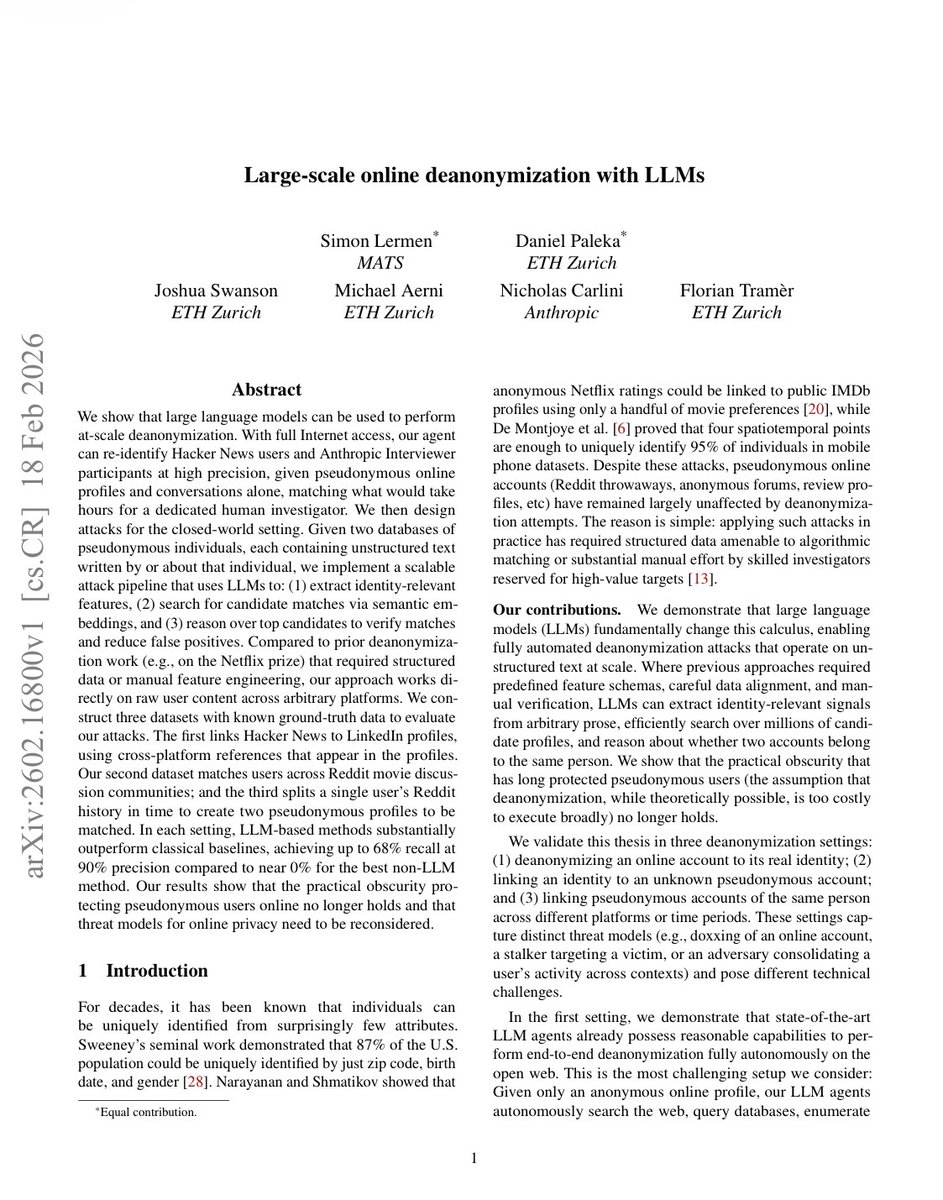
Holy shit… Your anonymous internet identity can now be unmasked for $1 😳 Not by the FBI. By anyone with access to Claude or ChatGPT and a few of your Reddit comments. ETH Zurich and Anthropic just dropped a paper called “Large-Scale Online Deanonymization with LLMs” and the results are the most alarming privacy research I’ve read this year. They built an automated pipeline that takes your anonymous posts, extracts identity signals, searches the web, and figures out who you are. No human investigator needed. Fully autonomous. Works on Hacker News, Reddit, LinkedIn, even redacted interview transcripts. Here’s how bad the numbers are. On Hacker News users: 67% identified correctly. When the system made a guess, it was right 90% of the time. On Reddit academics posting under pseudonyms: 52%. On scientists whose interview transcripts were explicitly redacted for privacy: 9 out of 33 still got unmasked. The pipeline works in four steps they call ESRC. Extract identity signals from your posts using LLMs. Search for candidate matches using embeddings across thousands of profiles. Reason over top candidates with models like GPT-5.2. Calibrate confidence so when it does guess, it’s almost never wrong. The classical deanonymization method from the famous Netflix Prize attack? Nearly 0% recall across every test. LLMs didn’t just improve on old techniques. They made old techniques look like toys. When they scaled to temporally split Reddit profiles, matching a user’s old posts to their newer ones across a full year gap, the pipeline hit 67% recall at 90% precision and 38% recall at 99% precision. Meaning even a year of changed interests and different conversations wasn’t enough to hide. More reasoning compute = better deanonymization. High reasoning effort doubled recall at 99% precision in some tests. As frontier models get smarter, this attack strengthens automatically. Every model upgrade is a privacy downgrade. What makes it nearly impossible to defend against: the pipeline splits into subtasks that all look benign. Summarize a profile. Compute embeddings. Rank candidates. No single API call screams “deanonymization.” The researchers themselves say they’re pessimistic that safety guardrails or rate limits can stop it. Their conclusion is blunt: “Users who post under persistent usernames should assume that adversaries can link their accounts to real identities.” And it extrapolates. Log-linear projections suggest roughly 35% recall at 90% precision even at one million candidates. Every throwaway account. Every anonymous forum post. Every “nobody will connect this to me” comment. It’s all searchable micro-data now. And the cost to run the full agent on one target is less than a cup of coffee. Practical anonymity on the internet just died. The paper killed it with math.
Alex Prompter tweet media
English
503
2K
8.1K
1.2M
Mathieu Tuli
Mathieu Tuli@TuliMathieu·
"but does it scale"
English
2
0
1
103
Shalev
Shalev@Shalev_lif·
@iScienceLuvr Just gotta keep it running long enough
English
0
0
0
50